
What permits do I need to connect to sewer in my NC county?
What permits does every NC sewer hookup require?
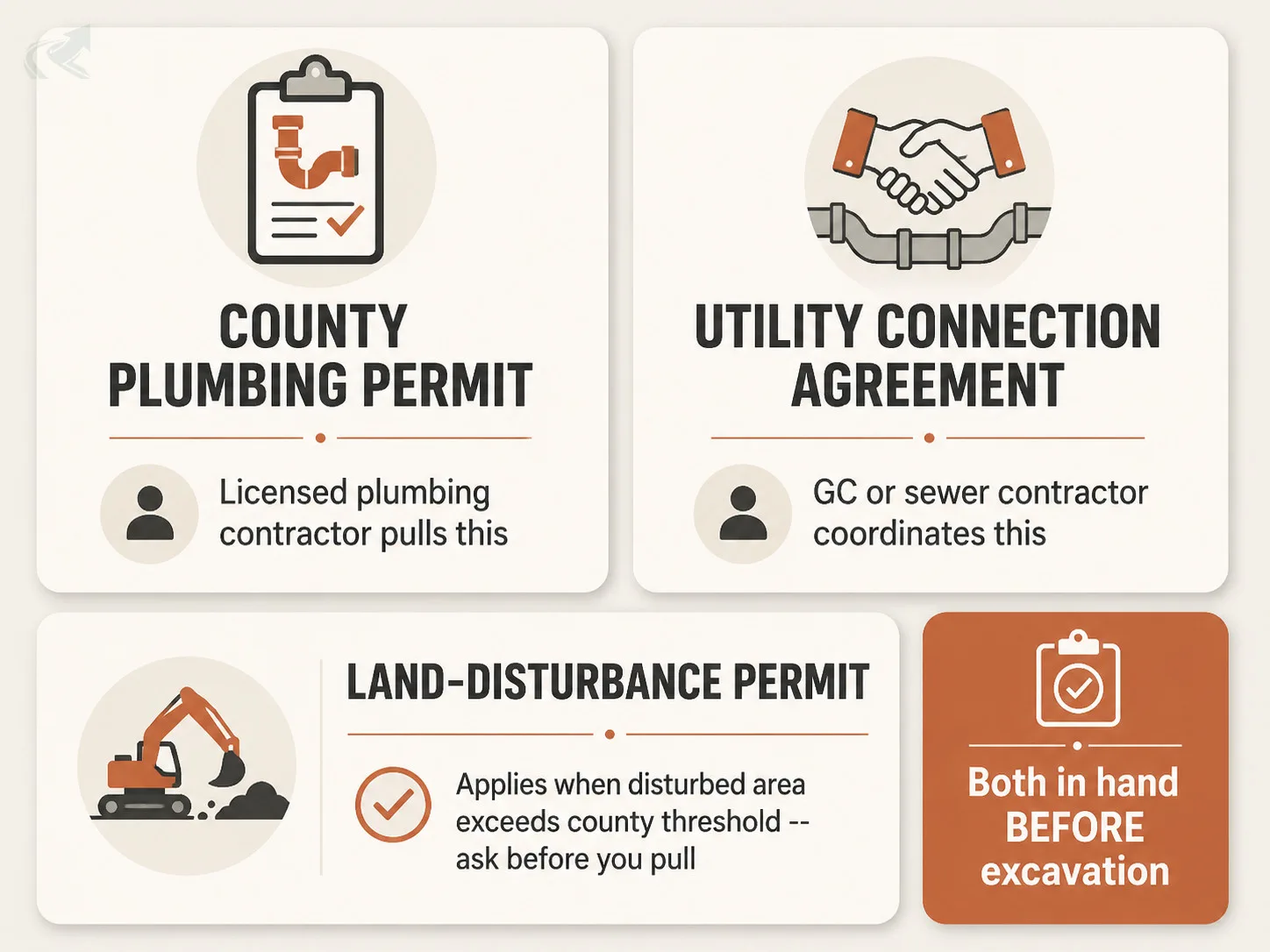
At minimum two: (1) A county plumbing permit for the interior connection and lateral from house to property line. (2) A utility connection agreement or inspection from the sewer authority -- separate from the county. Some projects also require a land-disturbance permit if excavation area or depth crosses the county threshold. All three must be in hand before work starts.
What do permits cost and how long do they take?
County plumbing permit fees run $60--$75 for a trade permit in Wake, Mecklenburg, and Guilford (confirmed from county fee schedules). Durham varies by scope -- confirm directly with City-County Building & Safety. Processing times vary by county and season -- Wake County's online portal is generally among the faster options; Guilford County runs slower than Triangle counties. Call the county before you book the contractor.
Who is responsible for pulling each permit?
The licensed plumbing contractor pulls the county plumbing permit. The GC or sewer contractor typically coordinates the utility connection agreement with the sewer authority. The homeowner is legally on the hook if either permit is skipped -- that liability transfers to you, not just the contractor.
Ray Pettiford has a hookup notice. The county gave him a deadline. His contractor gave him a price. What nobody gave him was a straight answer about which permits he needs, what they cost in Guilford County, and how long the county takes to issue them.
That is what this page is for.
North Carolina sewer connections require at minimum two separate permits. The requirements vary by county — and the permit portal, the fee schedule, and the sewer authority are different in every one of the four major markets covered here. This page breaks them down by county so you know what to expect before work starts.
The Two Permit Types Every NC Sewer Connection Requires
Every NC sewer hookup needs a county plumbing permit and a utility connection agreement — these are two separate permits with two separate authorities.
The first is the county plumbing permit. This covers the interior reconnection — pulling the existing septic plumbing to a new drain line — and the lateral from the house foundation out to the property line. The licensed plumbing contractor pulls this permit from the county inspections department.
The second is the utility connection agreement (sometimes called a connection permit or inspection authorization). This is issued by the sewer authority — which may be a separate utility from the county government. It authorizes the tap to the public sewer main and requires its own inspection at completion.
A third permit — a land-disturbance permit — applies if your lateral trench crosses county acreage or excavation thresholds. Wake and Mecklenburg counties require a land-disturbance permit when the disturbed area reaches one acre or crosses a regulated buffer. Durham requires a land-disturbance permit when disturbance exceeds 12,000 square feet (Durham City-County UDO Sec 12.10.2). Guilford County requires an erosion control plan for projects disturbing one acre or more. Most standard residential sewer laterals fall below all of these thresholds. Ask your contractor and confirm with the county inspections department before you pull the plumbing permit.
Who pulls what: The licensed plumbing contractor is responsible for the county plumbing permit. The GC or sewer contractor coordinates the utility connection agreement with the sewer authority. Do not let work start before both are confirmed in hand. If the contractor starts without permits, the stop-work order lands on your property address — not on the contractor’s license.
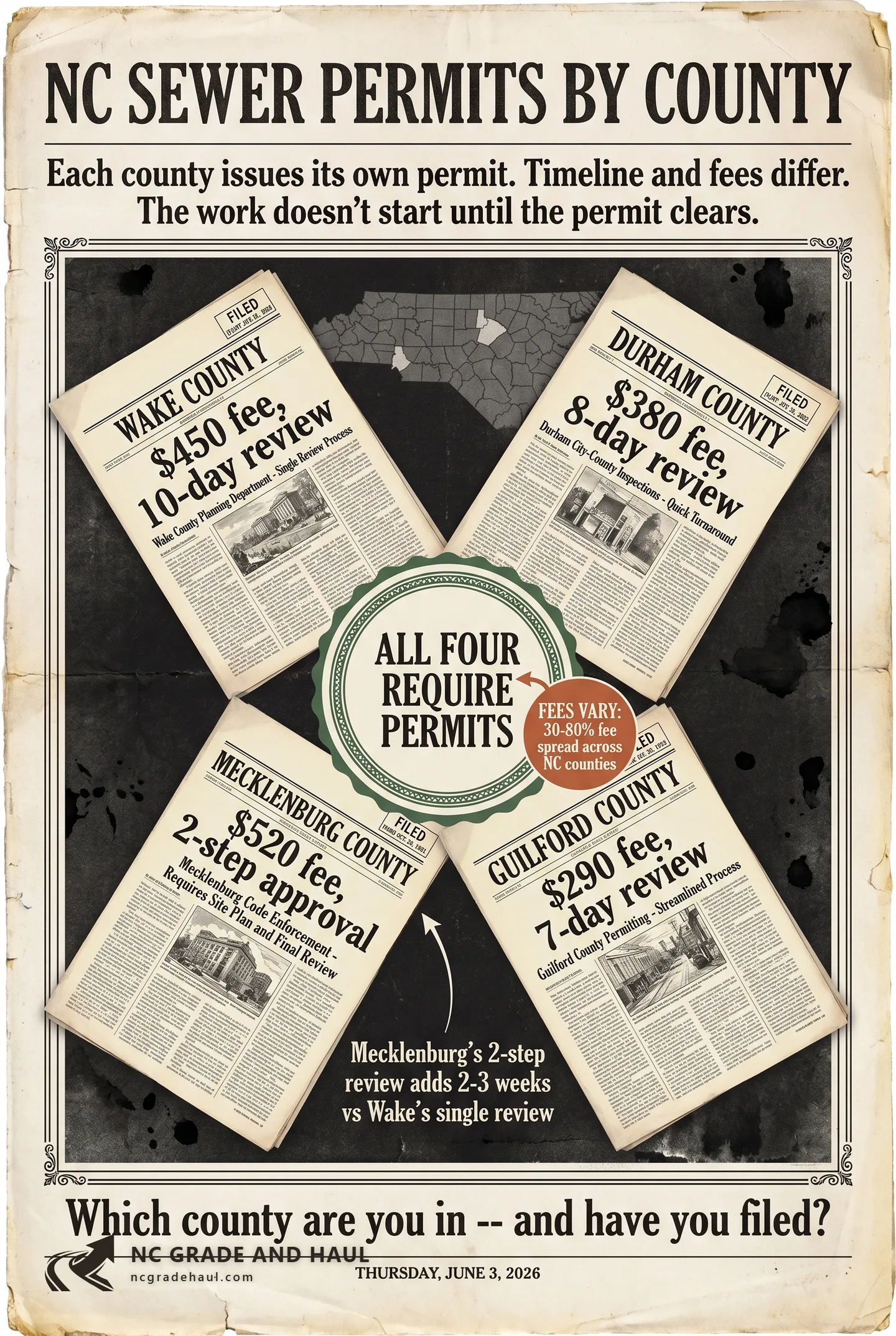
Wake County
Wake County permits sewer connections through its online portal — plumbing permits are generally issued faster here than in most other NC counties. Confirm current processing time with the county portal when you apply, as turnaround times vary by season and workload.
Wake County’s permitting runs through the Wake County Permits and Inspections division. The online portal for plumbing permits is at wake.gov/departments-government/permits-and-inspections. Plumbing permit fees in Wake County use a $75 residential trade permit for sewer lateral reconnections when no building permit is required (the trade permit covers plumbing, electrical, and mechanical as one flat fee). If the project involves structural work — such as opening walls or modifying framing — a Residential Building Alteration Permit is required instead, and that permit is $75 plus $0.25 per square foot of gross floor area. A standard sewer lateral reconnection typically uses the $75 trade permit (source: Wake County Permits and Inspections fee schedule).
The sewer authority identity in Wake County depends on location. Raleigh Water serves the City of Raleigh and merger communities including Garner, Knightdale, Rolesville, Wake Forest, Wendell, and Zebulon. Cary serves Morrisville, RDU, and RTP. Apex, Holly Springs, and Fuquay-Varina each operate their own wastewater systems. Wake County Consolidated Human Services issues septic failure notices but does not operate sewer lines. Confirm your specific service area before submitting the utility connection agreement — the wrong authority means a delay.
Wake County does not require a separate land-disturbance permit for a standard residential lateral unless the disturbed area exceeds one acre or crosses a regulated buffer. Most residential lateral installs fall below this threshold.
If you are connecting under the Durham cost-share program for a parcel that straddles the county line, see the Durham county permit and cost-share connection page — the permit sequence is different when cost-share funding is involved.
Durham County
Durham County sewer connections run through the Durham County Inspections Department — plumbing permits are processed online. Confirm current processing time with the county portal when you apply.
The City-County Building and Safety Department handles residential plumbing permits for both the City and County of Durham. Portal access is at durhamnc.gov/293/City-County-Building-Safety. Plumbing permit fees in Durham County vary by project scope — confirm the current fee with the City-County Building and Safety Department before submitting (third-party sources estimate trade permits in the $50—$200 range, but the official fee schedule is the authoritative source).
The sewer authority in Durham County is the City of Durham for most city-limit properties, which operates the North Durham and South Durham Water Reclamation Facilities. Unincorporated areas and parts of southeast Durham (including Research Triangle Park) are served by Durham County Engineering and Environmental Services via the Triangle Wastewater Treatment Plant. These are separate entities with separate connection agreement processes. Confirm your service area with the county before submitting the utility connection agreement.
One Durham-specific point: if you are applying for the City of Durham Northeast Creek cost-share program, confirm permit sequencing requirements directly with the Durham Public Works Department (919-560-4326 ext. 30211) before submitting your application — the program has specific application documentation requirements, and the cost-share funding ends June 2026. See Durham county permit and cost-share connection for the full cost-share workflow.
NC is pushing sewer expansion in the Triangle aggressively. Durham is one of the counties where forced-hookup notices are issued to homeowners with failing septic systems. If you have a notice, see can NC require me to convert to sewer for context on your rights and timeline.
Mecklenburg County
Mecklenburg County Code Enforcement (LUESA) administers plumbing permits through the Accela portal — Charlotte Water handles utility connection agreements for most addresses in the county.
Mecklenburg County’s permitting runs through Accela Citizen Access at meckpermit.com (the county is phasing out the legacy WebPermit portal). Plumbing permit fees are $61.70 for a residential plumbing permit flat fee (source: Mecklenburg County LUESA FY2026 fee schedule).
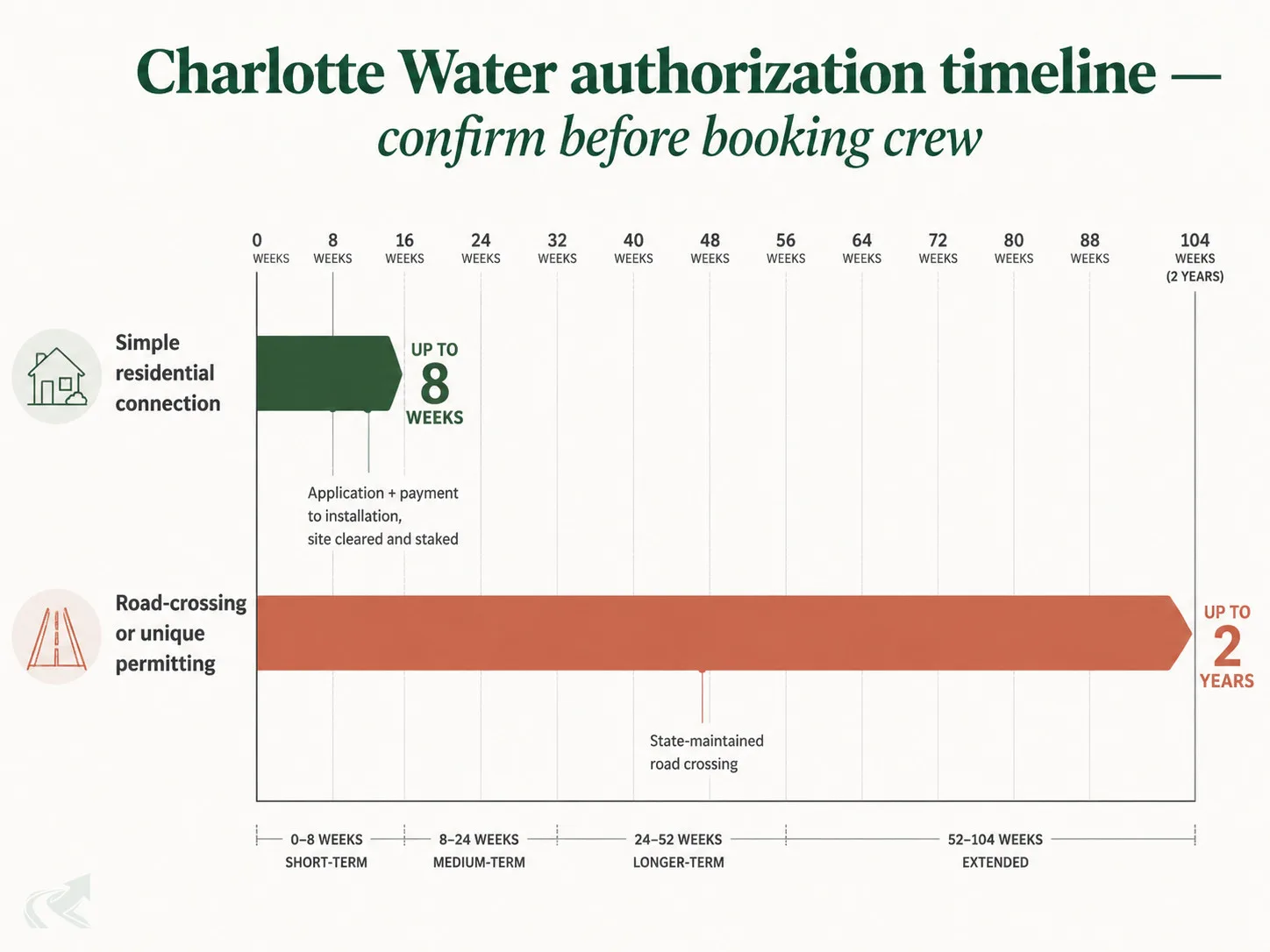
Charlotte Water is the utility connection authority for the City of Charlotte and most of the Mecklenburg County service area. Charlotte Water has its own connection agreement and inspection process — this is separate from the county plumbing permit and must be completed with Charlotte Water directly.
Charlotte Water installation of a simple residential sewer connection typically takes up to eight weeks from application and payment to installation, after the site is cleared and staked. Applications requiring pipe extensions under state-maintained roads or unique permitting can take up to two years. Do not book the trenching crew until the Charlotte Water authorization is confirmed — utility side holds have stopped more than one Mecklenburg job mid-dig.
For North Carolina sewer conversion cost benchmarks — including the pump vs. gravity cost difference that matters if your Mecklenburg lot sits below the main — see NC sewer conversion cost by gravity vs pump.
Guilford County
Guilford County processes residential plumbing permits through the Guilford County Inspections Department — online submission is available through the Civic Access Public Portal, and the timeline runs longer than Wake or Durham.
This is Ray’s county. The Guilford County Inspections Department handles residential plumbing permits. The online portal is the Civic Access Public Portal at guilfordcountync.gov/government/departments-and-agencies/inspections. Plumbing permit fees in Guilford County are $75 for a trade permit covering the plumbing portion (source: Guilford County Inspections fee schedule). Total cost runs higher only if the project also requires a separate building permit. A standard sewer lateral reconnection typically uses the $75 trade permit.
The sewer authority depends on location within the county. Greensboro serves most of the urban core. High Point serves its own service area. Jamestown, Sedgefield Sanitary District, Burlington, and Stokesdale also provide water and sewer service in parts of the county. Exact service-area boundaries vary — call the authority before submitting the utility connection agreement. A misrouted connection agreement can add weeks.
Guilford County’s permit processing timeline runs longer than Wake or Triangle counties — call the Guilford County Inspections Department at 336-641-3707 to confirm current turnaround time before scheduling your contractor. If you have a county deadline for connection, build in extra buffer. Pulling the permit two weeks before you think you need it is not overcautious — in Guilford County, it is standard.
For the broader picture on what sewer conversion costs in the Greensboro area, see NC sewer conversion cost by gravity vs pump.
County Permit Comparison
All fees and timelines require verification against current county fee schedules before pulling permits.
| Permit factor | Wake County | Durham County | Mecklenburg County | Guilford County |
|---|---|---|---|---|
| Plumbing permit fee | $75 trade permit (base); building permit adds $0.25/sq ft | Varies by scope -- confirm with City-County Building & Safety | $61.70 flat fee (homeowner); $60.00 flat fee (contractor trade permit) | $75 trade permit |
| Typical timeline | Confirm with county portal -- varies by season | Confirm with City-County Building & Safety | Confirm with LUESA -- varies by project type | Runs longer than Triangle counties -- call 336-641-3707 to confirm |
| Permit portal | wake.gov/permits-and-inspections | durhamnc.gov/building-safety | Accela (meckpermit.com) | guilfordcountync.gov/inspections (Civic Access) |
| Sewer authority | Raleigh Water (Raleigh + Garner/Knightdale/Rolesville/Wake Forest/Wendell/Zebulon); Cary (Cary/Apex/Morrisville/RDU/RTP); Apex, Holly Springs, Fuquay-Varina each operate own systems | City of Durham (most city-limit properties); Durham County Engineering/Utilities (southeast Durham + RTP area) -- confirm your service area | Charlotte Water (most county addresses) | Greensboro (urban core); High Point (own service area); Jamestown, Sedgefield Sanitary District, Burlington, Stokesdale in parts of county -- confirm your service area |
| Online submission available? | Yes | Yes | Yes via Accela | Yes via Civic Access |
| Land-disturbance permit trigger | 1-acre disturbed area or buffer crossing | 12,000 sq ft disturbed area; most residential laterals fall below this | 1-acre disturbed area or buffer crossing | 1 acre for erosion control plan; most residential laterals fall below this |
Plumbing permit fee
- Wake County
- $75 trade permit (base); building permit adds $0.25/sq ft
- Durham County
- Varies by scope -- confirm with City-County Building & Safety
- Mecklenburg County
- $61.70 flat fee (homeowner); $60.00 flat fee (contractor trade permit)
- Guilford County
- $75 trade permit
Typical timeline
- Wake County
- Confirm with county portal -- varies by season
- Durham County
- Confirm with City-County Building & Safety
- Mecklenburg County
- Confirm with LUESA -- varies by project type
- Guilford County
- Runs longer than Triangle counties -- call 336-641-3707 to confirm
Permit portal
- Wake County
- wake.gov/permits-and-inspections
- Durham County
- durhamnc.gov/building-safety
- Mecklenburg County
- Accela (meckpermit.com)
- Guilford County
- guilfordcountync.gov/inspections (Civic Access)
Sewer authority
- Wake County
- Raleigh Water (Raleigh + Garner/Knightdale/Rolesville/Wake Forest/Wendell/Zebulon); Cary (Cary/Apex/Morrisville/RDU/RTP); Apex, Holly Springs, Fuquay-Varina each operate own systems
- Durham County
- City of Durham (most city-limit properties); Durham County Engineering/Utilities (southeast Durham + RTP area) -- confirm your service area
- Mecklenburg County
- Charlotte Water (most county addresses)
- Guilford County
- Greensboro (urban core); High Point (own service area); Jamestown, Sedgefield Sanitary District, Burlington, Stokesdale in parts of county -- confirm your service area
Online submission available?
- Wake County
- Yes
- Durham County
- Yes
- Mecklenburg County
- Yes via Accela
- Guilford County
- Yes via Civic Access
Land-disturbance permit trigger
- Wake County
- 1-acre disturbed area or buffer crossing
- Durham County
- 12,000 sq ft disturbed area; most residential laterals fall below this
- Mecklenburg County
- 1-acre disturbed area or buffer crossing
- Guilford County
- 1 acre for erosion control plan; most residential laterals fall below this
Universal Rules That Apply in Every NC County
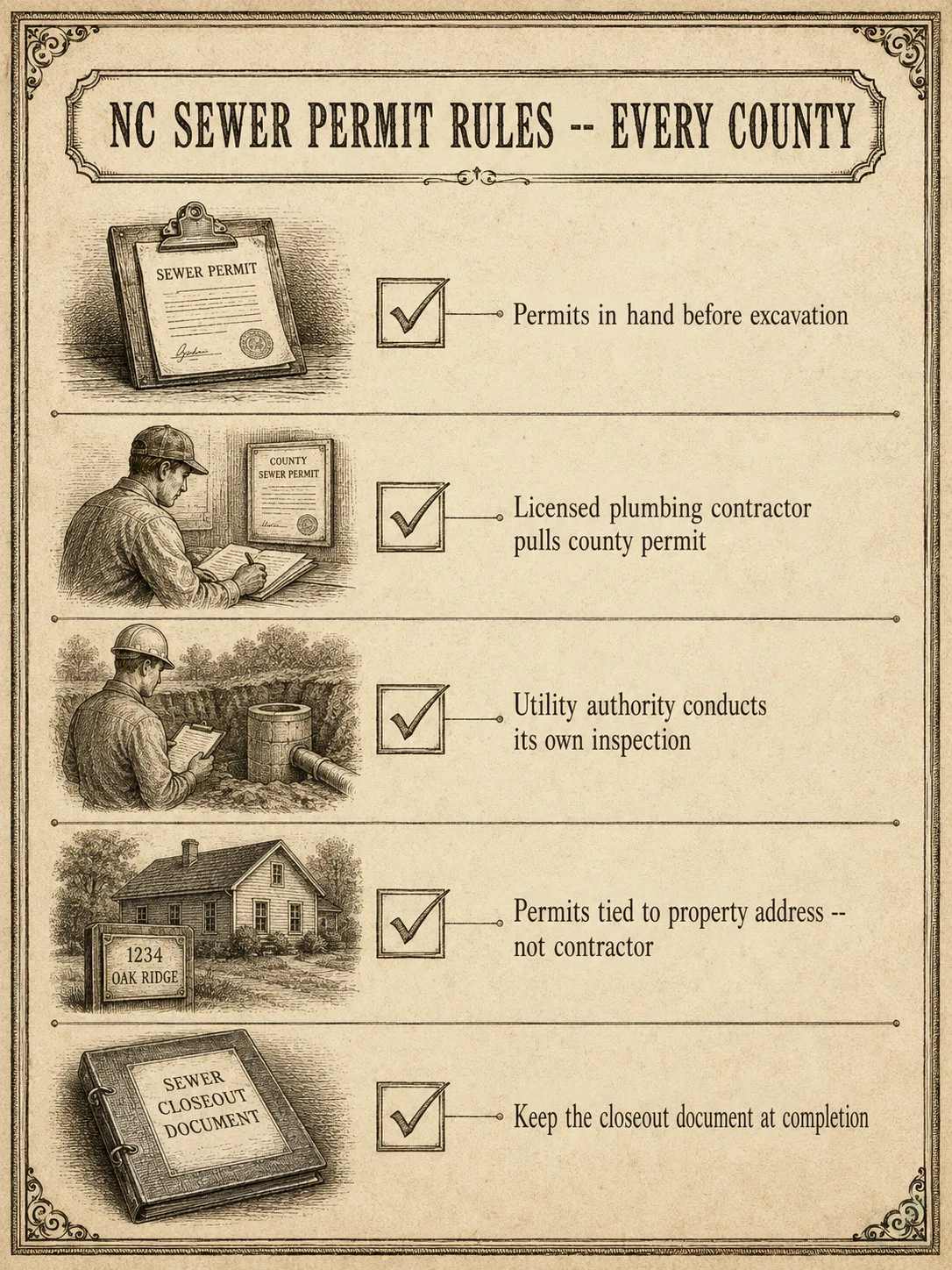
Pull permits before work starts — in every county, no exceptions. A contractor who starts excavation without permits is creating a stop-work order that lands on your property address.
A few rules that hold across Wake, Durham, Mecklenburg, and Guilford — and every other North Carolina county:
Permits must be in hand before excavation. The plumbing permit and the utility connection agreement both must be issued before the crew breaks ground. This is not a technicality — it is the condition under which your county inspection will pass at completion. If the inspector shows up and no permit was pulled, the work stops.
A county inspection is required at completion. The plumbing permit does not close until the county inspector signs off. The utility connection authority also conducts its own inspection at the tap. Schedule both before you assume the project is done.
Only a licensed plumbing contractor can pull the county plumbing permit for a sewer lateral reconnection in North Carolina. NC General Statute 87-21 requires a licensed plumbing contractor for sewer work — the statute does not include a broad homeowner self-perform exemption. Minor drain cleaning and minor replacements to an existing installed system are exempt, but a new sewer lateral installation is not a minor repair. If your contractor is not licensed, you are the one who pulled no permit.
Permits are tied to the property address. They do not transfer with the contractor if the contractor changes mid-project. If you swap contractors, the permit situation resets. Confirm with the county how to handle a mid-project contractor change before it happens.
Keep your permit closeout records. The county inspection closeout document is your proof that the work was done to code. You will need it at resale. Title companies and buyers’ attorneys ask for it. Losing it creates a problem — get it before the contractor demobilizes.
NC Sewer Connection Permit Checklist
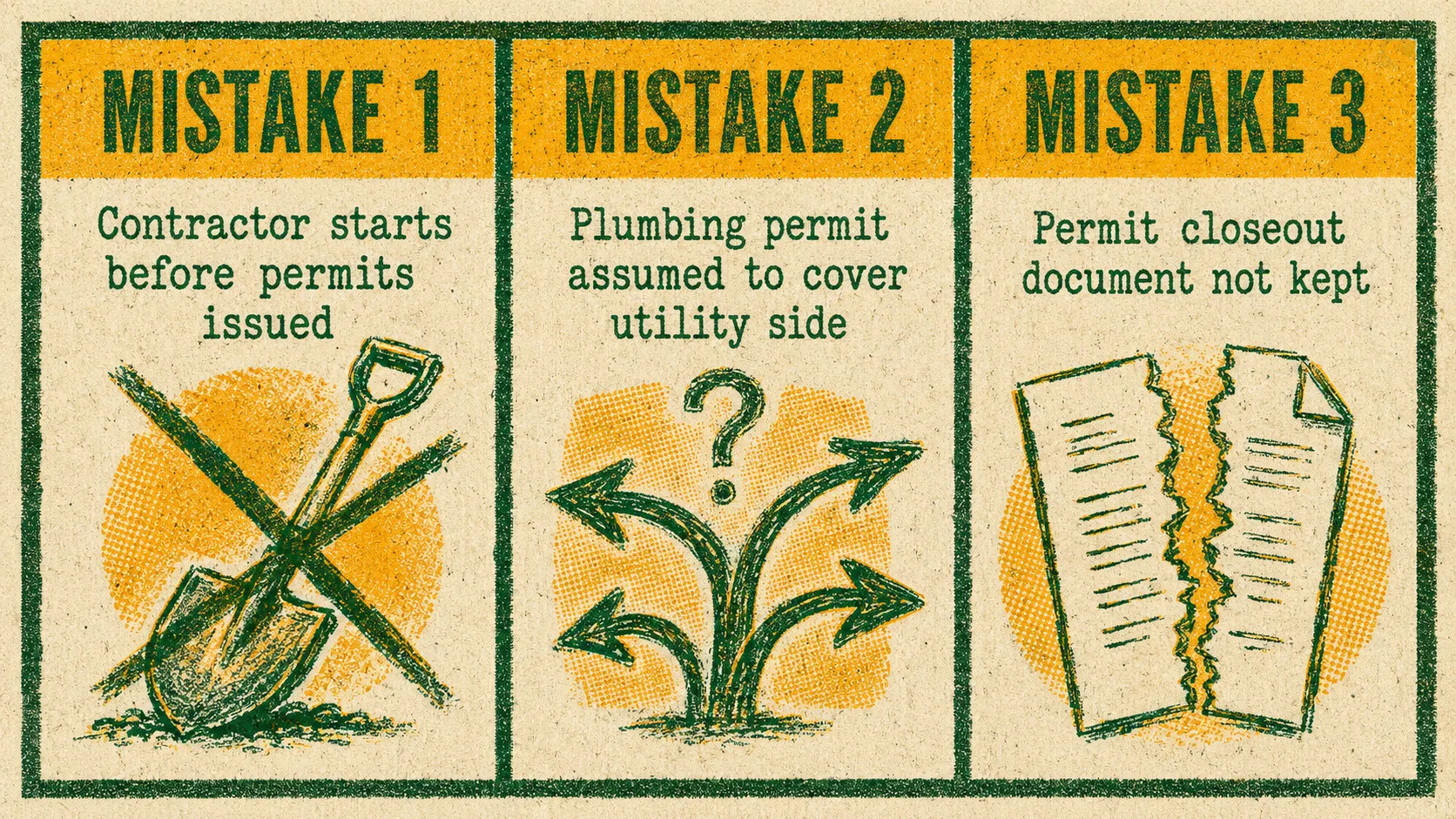
Three Common Mistakes
Letting the contractor start before permits are in hand. The pressure to book fast and start fast is real — especially if there is a county hookup deadline. But a stop-work order after excavation has begun costs more than the delay would have. Confirm permit issuance in writing before the crew shows up.
Assuming the plumbing permit covers the utility connection. These are two separate permits from two separate authorities. Homeowners who check “permit pulled” and then get surprised by the utility-side hold make this mistake. Confirm both — independently — before you consider the permit phase complete.
Not keeping the permit closeout document. This is the one piece of paper that proves the conversion was inspected and passed to code. At resale, a buyer’s attorney or title company will ask for it. It is much harder to obtain after the county closes the permit and the inspector moves on. Get it at completion and keep it with your property records.
Ready to Get Quotes?
Permits first — then quotes. Once you know which permits apply to your address (county plumbing permit + utility authority connection agreement, possibly land-disturbance permit), you can give a contractor a complete picture of the project scope.
See the NC sewer conversion permit and cost guide for the full picture on what a conversion involves, and the NC county permits reference for sewer connections for county-level permit fee tables updated on a rolling basis.
When you are ready to compare contractors, hire an NC grading operator to surface contractors who have cleared NCLBGC license, workers’ comp, and OSHA checks — and can pull permits legally in North Carolina.
Ask for an itemized quote that breaks out permit costs separately. If a contractor bundles them with no line-item, ask why.