Two questions people ask first
What permits does a new septic system need in North Carolina?
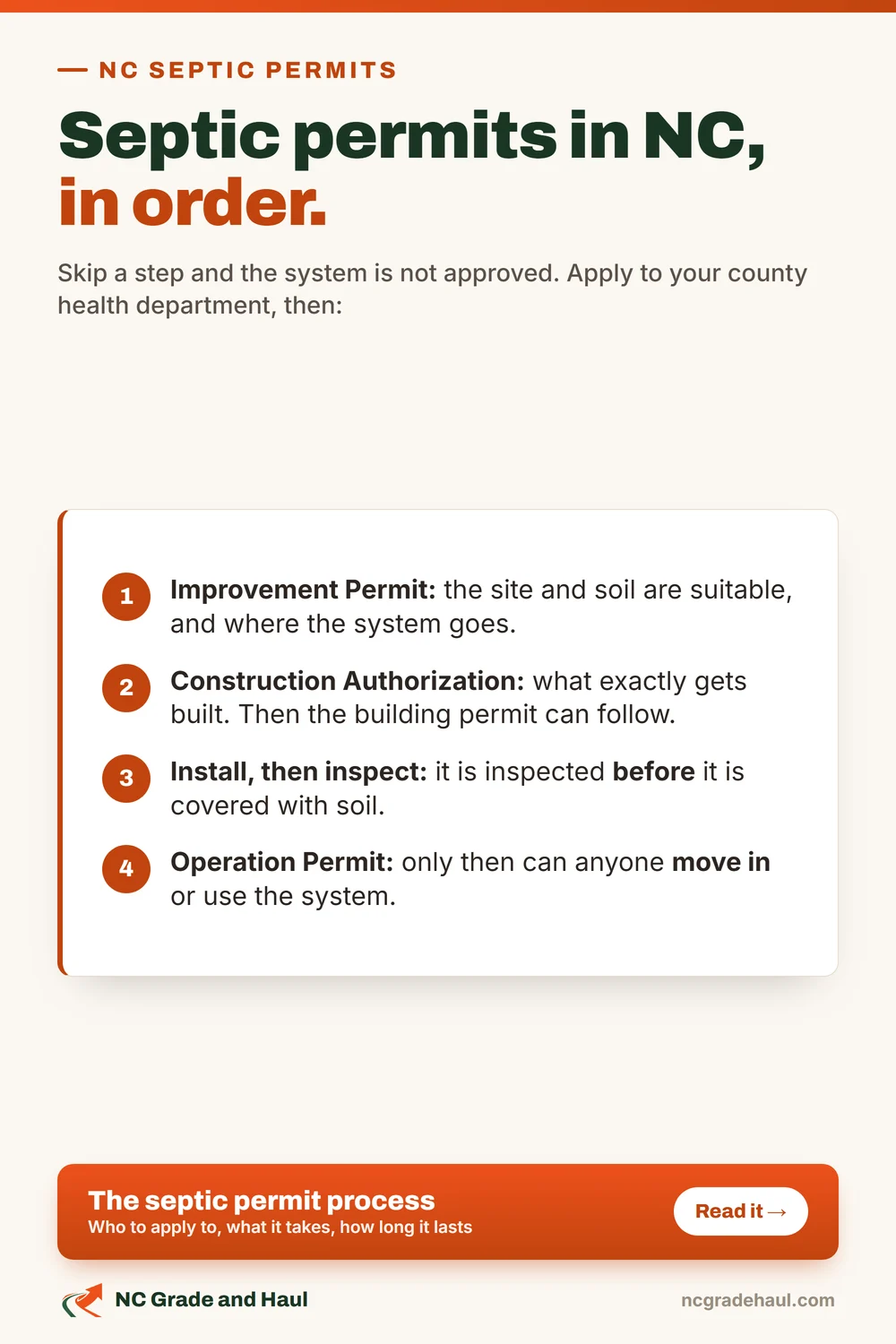
An application first, then three approvals in order: an Improvement Permit (the site is suitable), a Construction Authorization (here is the system to build), and an Operation Permit after the county inspects the finished system. The system can't be covered before it is inspected, and nobody moves in before the Operation Permit.
Who do I apply to?
The environmental health office of your county health department. You can also hire a licensed soil scientist or an engineer to do part of the work, but the county still gets the paperwork.
A question that comes up in North Carolina threads is a plain one: county, private company or state? Someone has bought land, or needs a system replaced, and nobody can tell them who actually hands out the permit. One asker in a Buncombe County thread said the county’s own web page was vague on the actual process. This page is the process, laid out.
We’re a directory of site-work contractors, checked against public records. We don’t write septic permits and we don’t install systems. What follows is read from the state’s rules and the counties’ own pages, and where a county decides something for itself, we say so.
The Short Version: Apply, Evaluate, Authorize, Inspect
North Carolina’s on-site wastewater rules (15A 18E) set one order for approving a septic system. First comes an application. The county then evaluates the soil and site and, if the site works, issues an Improvement Permit. A Construction Authorization says what to build. After the installer finishes and the county inspects, an Operation Permit lets the building be occupied and the system used.
The order of operations
1. Apply to the county -- Before anything is built, with a site plan or plat and the number of bedrooms. 2. Site and soil evaluation -- A county specialist or a licensed soil scientist checks whether the lot can take a system. 3. Improvement Permit, then Construction Authorization -- Where the system can go, then what exactly gets built. They are sometimes issued together. 4. Install, then inspect before covering -- The county, or a private inspector where one is allowed, has to see it before it is buried. 5. Operation Permit -- Only then can the building be occupied and the system put to use.
-
Apply to the county
Before anything is built, with a site plan or plat and the number of bedrooms.
-
Site and soil evaluation
A county specialist or a licensed soil scientist checks whether the lot can take a system.
-
Improvement Permit, then Construction Authorization
Where the system can go, then what exactly gets built. They are sometimes issued together.
-
Install, then inspect before covering
The county, or a private inspector where one is allowed, has to see it before it is buried.
-
Operation Permit
Only then can the building be occupied and the system put to use.
Skipping ahead is the expensive mistake. The system is not approved until the last step is done.
Would anyone get a full driver’s license before passing the road test? The Operation Permit works the same way: it comes after the inspection, never before.
Where You Apply: The County Health Department
You apply to the local health department, usually its environmental health office, in the county where the property sits. The rules say the county keeps the records for the system in the county where the permit is issued and the property taxes are paid, so that office is also where the file lives afterward. To find yours, the state keeps a lookup of local health departments at NCDHHS.
Counties run the front door differently. Three examples, all read from their own pages:
- Wake County says applications in its own jurisdiction usually start at its Planning, Development and Inspections office, and the applicant also applies for a wastewater permit through its online Permit Portal; applications from other jurisdictions start in the portal.
- Johnston County takes an application for service once you present a document from the planning and zoning office, plus a site plan, and assigns an environmental health specialist after the fees are paid.
- Guilford County lists site evaluations, improvement permits, construction authorizations, installation inspections and operation permits as one program, and requires an inspection before new construction on a property that already has a septic system or well.
Fees, forms and wait times belong to each county. Our septic cost page covers what the fees mean for your budget; for the number that applies to you, ask your county.
What the Application Needs
The rule lists what an Improvement Permit application has to contain. Counties turn it into their own forms, but expect to supply:
- Who is applying and who owns the property. Both sign. Electronic signatures are accepted, and an owner’s representative with power of attorney can sign for the owner.
- What you’re asking for: a new system, a change of use, a larger flow, or moving a system.
- A site plan or plat showing structures, the proposed system with its distances to property lines, driveways, wells and water lines, and streams or drainage.
- Where the property is: parcel number, address, acreage, directions.
- How much wastewater it will produce: the number of bedrooms and how many people live there, or the use of the building.
- Anything that limits the lot, such as wetlands, easements or approvals from other agencies.
Submitting a signed application also gives the county’s agent the right to enter the property. A Construction Authorization application adds the type of system you want and whether it will use a pump.
What would you do?
Read the situation, decide your first move, then tap to check.
1 You haven't bought the land yet, and you want a house on it.
Ask the county about the Improvement Permit before you buy.
Then: NC State Extension's advice is to get an Improvement Permit before you purchase a lot you mean to build on.
2 You applied, then the county waited on you for paperwork for a year.
The application has expired, and you'll file a new one.
Then: An application the county is waiting on you for expires 12 months after it was filed.
3 The soil evaluation is the slow part and your county is backed up.
Ask whether you can hire a licensed soil scientist to do the evaluation.
Then: State law lets the evaluation go in with the application. It's covered below.
4 You have a Construction Authorization in hand and the lot is still bare.
That's the point where you can apply for the building permit.
Then: State rules let the building permit follow once the Construction Authorization is issued.
The Three Permits
Each permit decides something different. The septic systems overview lists them in a sentence each; this is what each one means in practice.
The Improvement Permit says the site is suitable and where the system goes. The county evaluates the soil and site; if it’s suitable, the permit lists the design flow, number of bedrooms, the required treatment standard, the setbacks, and a site plan or plat that shows both the system area and the repair area. If the site isn’t suitable, the county has to give you a signed written report citing the rules, and any modifications or alternatives that might change the answer. The soil work itself is its own subject, covered on the perc test page.
The Construction Authorization says what exactly gets built: the system type and layout, the tanks, any pump, and what operator or maintenance contract it will need. It can’t be issued until the conditions on the Improvement Permit are met, though the county can issue the two together when none are pending. Easements and rights-of-way have to be settled first. Once it’s in hand, the building permit can follow. State law also bars electrical, plumbing and other permits for the building until the Construction Authorization exists.
The Operation Permit says the finished system passed. The installer notifies the county, and the county inspects before anything is covered with soil. If the installation doesn’t meet the rules and the permit conditions, the installer has to correct it; if it can’t be corrected, there’s no Operation Permit and the system can’t be used. Nobody is allowed to occupy the building or start using the system until the permit has been issued. For choosing and checking the person who installs it, see how a septic system is installed.
Holding tanks aren’t an alternative: the rules say no Improvement Permit is issued for one in new construction.
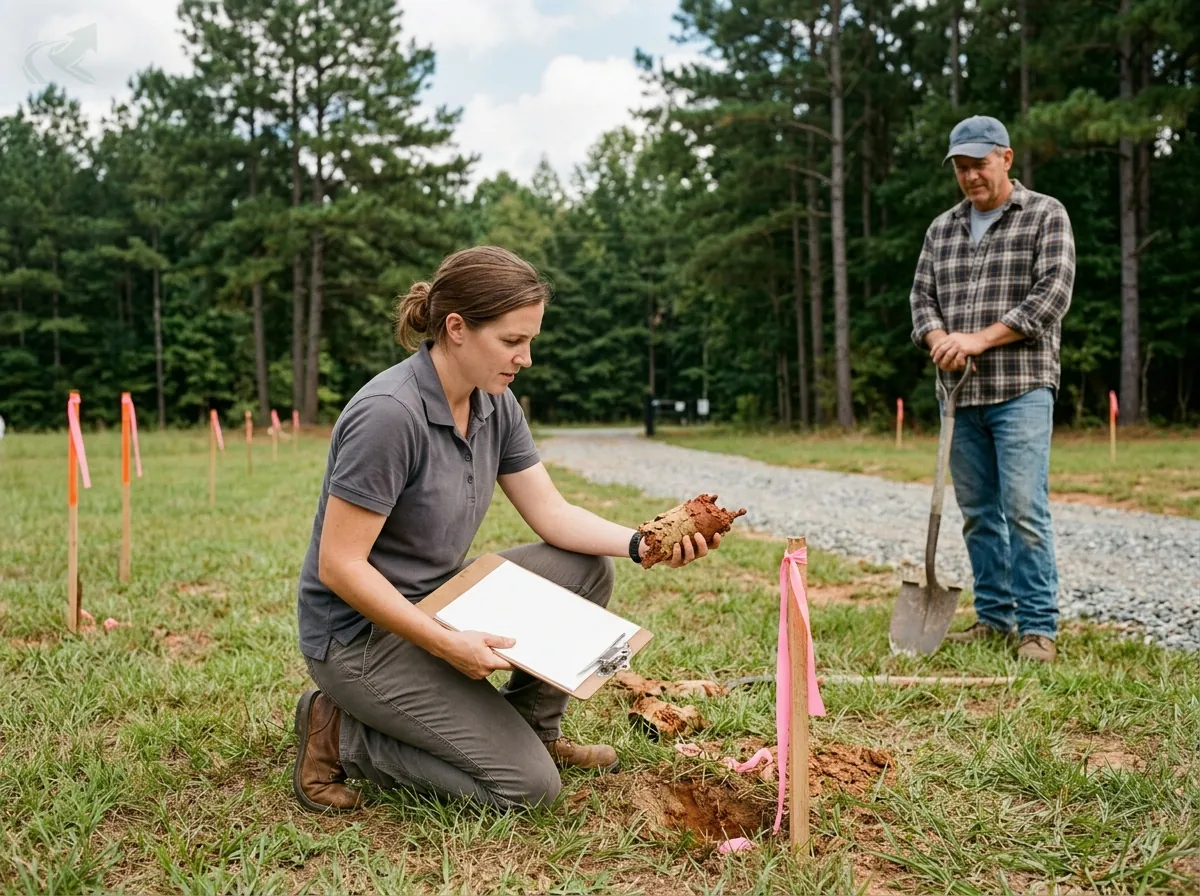
One Buncombe County thread has an owner describing the same visit in another county. They applied for a repair permit, two county employees came out, they talked through where a replacement system could go, and the owner was told to dig a hole in each spot, three to four feet deep, so the layers of soil showed. The owner says no perk test was done.
How Long a Permit Lasts, and What Voids It
Duration depends on the permit, and the permit itself states it.
- Improvement Permit. State law ties the length to the drawing: one issued with a plat is valid without expiration; one issued with a site plan is valid for five years. The period has to be printed on the permit. The law also makes it valid on a showing that the site and soil haven’t been altered and the building and its flow haven’t grown, and the permit is subject to revocation if the site plan or plat, or the intended use, changes. Ownership changes don’t affect it as long as the site and the building it serves haven’t changed.
- Construction Authorization. Valid for as long as the Improvement Permit. If one is more than five years old, state law requires a preconstruction conference, and the county then tells you about rule changes that could improve the system.
- Operation Permit. It stays in effect as long as the flow stays the same, the system is operated and maintained as the rules require, no malfunction is found, and the system hasn’t been abandoned. Systems classed Type V or VI, the classes that cover advanced pretreatment and large systems, get an Operation Permit that expires five years after issue, and the rules call for a new application at least 30 days before it expires.
- An application the county is waiting on you for expires 12 months after you filed it.
- An existing-system approval (see below) expires one year after it is issued.
What voids a permit is mostly changes. A permit can be suspended or revoked if the application turns out to be false or incomplete, if the site is altered so the system can’t be installed as permitted, if a permit condition can’t be met, or if a newer permit is issued for the same building on the same property. A larger building or more wastewater than the permit was written for puts the permit in question, and a new application follows.
If the County Says No
A “no” is not the end of the road. Before denying an Improvement Permit, the county has to tell you about possible site modifications or alternative systems and give a short description of them. If it does deny, the evaluation comes back in writing with reasons, and you’re told about your right to an informal review by the state and to appeal. Wake County’s FAQ also points to hiring a licensed professional to develop a proposal for a site the county turned down.
Private Options: Soil Scientists, Engineers and Evaluators
You don’t have to wait for the county for every step. North Carolina law opens three side doors, and the state keeps the forms on its private permitting page.
- A licensed soil scientist can do the soil and site evaluation, and the county has to use it in its permit review, as long as the scientist stays within the license and carries errors and omissions insurance. The county then has five business days to check the package for completeness, and if it doesn’t act in that time, you may treat it as complete. A Buncombe County commenter pointed to exactly this when the county is backed up.
- An Engineered Option Permit puts a licensed professional engineer in charge of the design. The owner files a Notice of Intent to Construct with the county rather than waiting for an Improvement Permit and Construction Authorization, and can apply for the building permit once the notice is complete. A soil scientist still does the soil evaluation, and the owner hires a certified operator to run the system.
- An Authorized On-Site Wastewater Evaluator (a soil scientist with extra certification) can do the same for systems that don’t need an engineer, also through a Notice of Intent.
Both private routes end with an Authorization to Operate in place of the county’s Operation Permit, and the county takes no liability for the result. Inspections can also be done privately: an Authorized Evaluator or a certified Private Compliance Inspector can verify the installation in some cases. Ask the county what it accepts before paying anyone.
Repairs, a New Bedroom and a Pool
Repairs. You need to apply to the county before repairing a system. Plain maintenance, like pumping, doesn’t need a permit. When the county issues a notice of violation for a failing system, the repair is due within 30 days unless the notice says otherwise. Johnston County’s page says repair permits there are free; Wake County takes repair requests online or by phone. Rules differ by county on the details.
A new bedroom. The minimum design flow for a house is 120 gallons a day per bedroom, or 60 gallons a day per person when more than two people live in each bedroom, whichever is greater, and the rules define a bedroom as any room the NC Building Code calls a sleeping room. Does a pot sized for four servings still work when eight people come to dinner? A system is the same. An increase in flow needs an application, not just a building permit.
Pools, sheds and decks. When no flow is added but the project needs a building permit, the county (or an Authorized On-Site Wastewater Evaluator or a certified inspector) can issue an existing system approval instead of starting over. It takes a finding of no uncorrected malfunction and no increase in flow, and that the addition meets the setbacks. It’s good for one year. Owners are responsible for showing where the property lines are and, if the existing system can’t be found, for locating it. The rules also let an owner use an Affidavit for Existing Wastewater System Approval instead: under state law, when the project won’t increase the design flow or wastewater strength and the owner affirms the work will meet the setbacks, a local government can’t withhold the building permit. Wake County reviews additions through its Accessory Structure Permitting process, which checks that the existing system, its repair area and any well won’t be harmed. If the flow or wastewater strength would go up, or the new building isn’t in the same footprint as the old one, the county issues a Construction Authorization (or an evaluator files a notice of intent) before work starts. Before digging near the system, the excavation guide covers the checks that come first.
Getting the Records for a System You Already Have
Your county may well hold a file, though records for older systems can be thin. Ask before you pay for any new evaluation.
- Wake County lets you view wastewater permits online in its Permit Portal or through its mapping tool. If the permit hasn’t been scanned, you can submit a research request with the property and owner information, and the county warns that records for older structures may be thin.
- Johnston County has an online search for septic and well permits by address, street or permit number, and takes email requests when you can’t find one.
If no permit can be found and nothing suggests the system was put in illegally, the rules treat it as having an Operation Permit or its equivalent. That’s not the same as having a drawing, and it’s the reason the septic overview tells you to ask the county for the permit and soil sheet. For a home sale, Wake County says a point-of-sale inspection has to come from a certified inspector, not the county.
Finding and Checking Who Does the Work
A permit approves a plan; somebody still has to build it right. The North Carolina On-Site Wastewater Contractors and Inspectors Certification Board certifies the people who install and inspect systems, and the certified contractor is the one who notifies the county when the system is ready for inspection. Our directory of septic contractors lists people checked against public records, and the guide to checking a contractor shows how to confirm a license and insurance yourself.