Two questions people ask first
Is there a perc test in North Carolina?
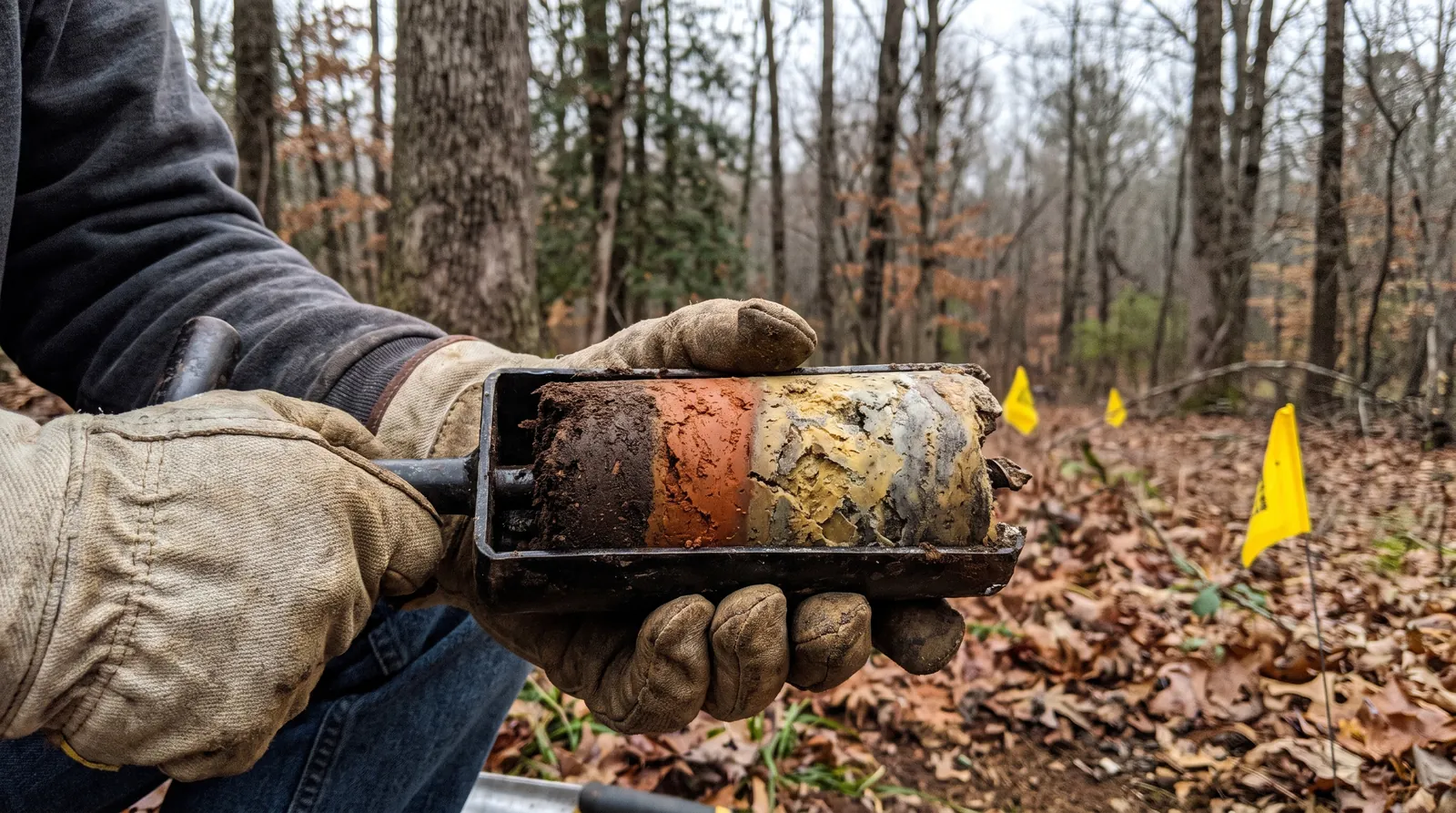
Not by that name in the state's rules. What people call a perc test is a soil and site evaluation by the local health department. The evaluator digs or bores into the ground and describes the soil itself: its layers, texture, structure, wetness and depth. The result is a classification, suitable or unsuitable, and a suitable one leads to an Improvement Permit.
When should I get it done?
Before you buy land you mean to build on. NC State Extension's advice is to get an Improvement Permit before you purchase a lot, because many North Carolina soils are unsuitable for a conventional system, and some even for the alternatives.
Somebody tells you the land has to “perc” before you can build. You search for a perc test, and you find a dozen pages written for other states. This one is for North Carolina, where the test has a different name, a different method, and a county employee who decides.
We’re a directory of site-work contractors, checked against public records. We don’t do soil evaluations or install septic systems. We read the rules so you know what to expect when the county shows up, and who to call when it asks for a hole to be dug.
What People Mean by “Perc Test”
Would you rather take a used car once around the block, or put it on a lift and look at the frame, the rust and the fluids?
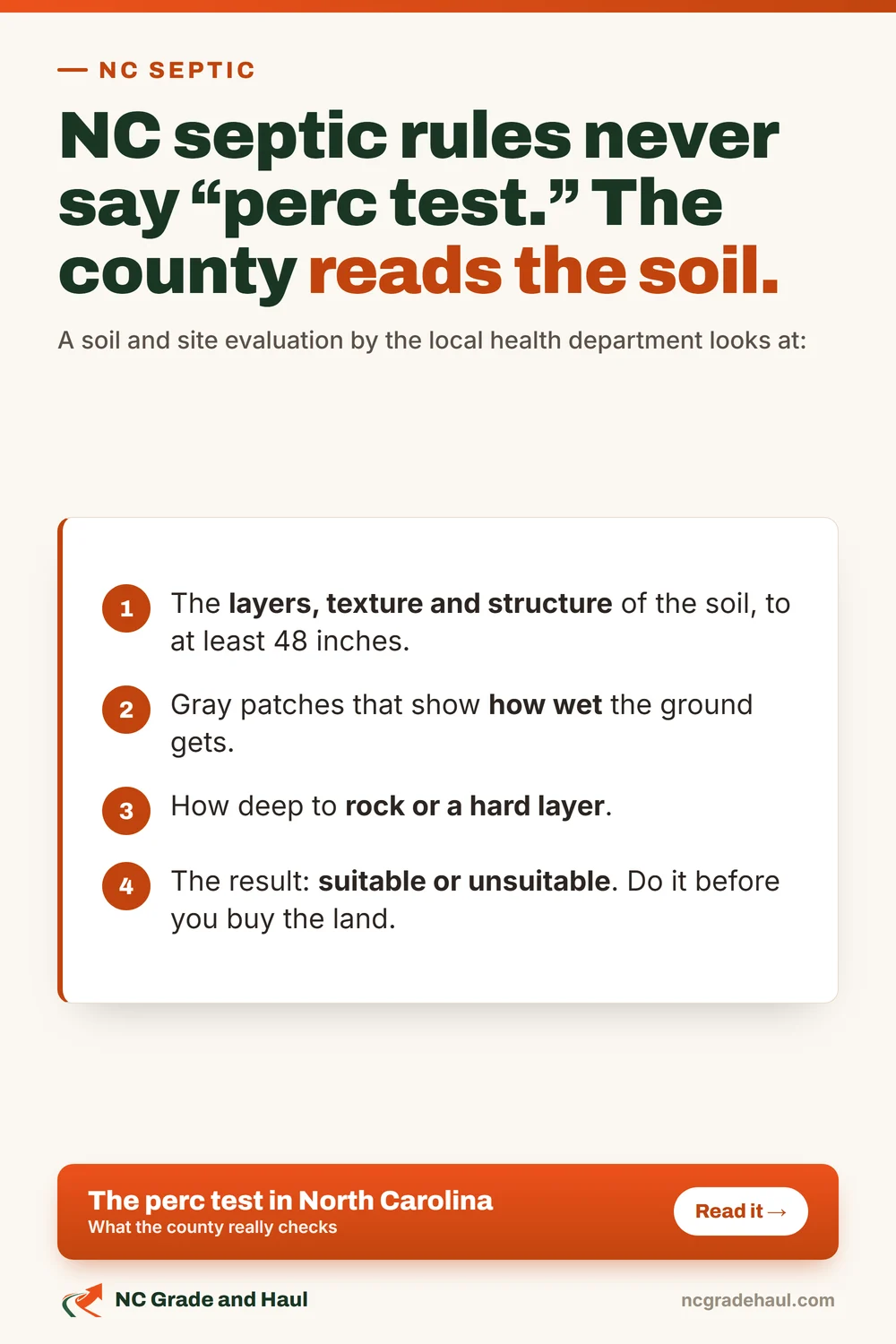
North Carolina’s septic rules take the lift. People still say “perc test” or “perk test,” and some county pages use the old name: Onslow County’s page, for one, says a soil evaluation “is formally known as a Perk Test.” But the state’s current wastewater rules (15A 18E) never use the word percolation. They tell the evaluator to look at the soil itself: what it is made of, how it is layered, how wet it gets, how deep it goes.
The person doing the looking is an authorized agent of the local health department, usually an environmental health specialist (some people call them sanitarians). The state law also lets a licensed soil scientist do the soil evaluation instead, which we get to below.
What the evaluation decides is simple to say and large in consequence: whether this spot on this lot can hold a septic system at all. It’s the step that comes before the Improvement Permit, and everything on the septic system page about drain fields and repair areas depends on it.
What the Evaluator Reads in the Soil
What does a ring in an old bathtub tell you, even when the tub is dry?
It tells you where the water used to stand. Soil keeps a ring like that too. Gray patches in soil that would otherwise be red, brown or yellow are how an evaluator spots ground that gets wet. The rules call it a soil wetness condition, and it has a hard limit: wet soil too close to the surface fails the spot.
The rules list what the field investigation has to describe in writing:
- The lay of the land: topography, slope and landscape position.
- Soil morphology: the depth of each layer, its texture, its structure, how firm it is, and its color. Texture is judged in the field by feel and sorted into twelve classes from sand to clay.
- Wetness: the gray colors and standing-water signs above.
- Soil depth: how far down to rock or parent material.
- Restrictive horizons: hard, compacted or cemented layers that stop water moving down.
- A long-term acceptance rate: the rate the soil can take wastewater after years of use, which later sets how big the drain field has to be.
- Available space for the system and a repair area, with the setbacks they need.
Soil is described by borings, pits or other digging, to a depth of at least 48 inches, or down to a limiting condition if one turns up sooner, across both the initial and the repair areas. That’s why it takes more than one hole.
How to Get Ready for the Evaluation
You apply to your local health department, usually the county’s, with a site plan or plat and the fee. The fee is set locally, so we won’t put a number on it here; the county can tell you the current one when you call. Signing the application also gives the county’s agent the right to enter the property.
Then the preparation is yours, and the rules put it on the owner, in writing:
What the owner does before the evaluator arrives
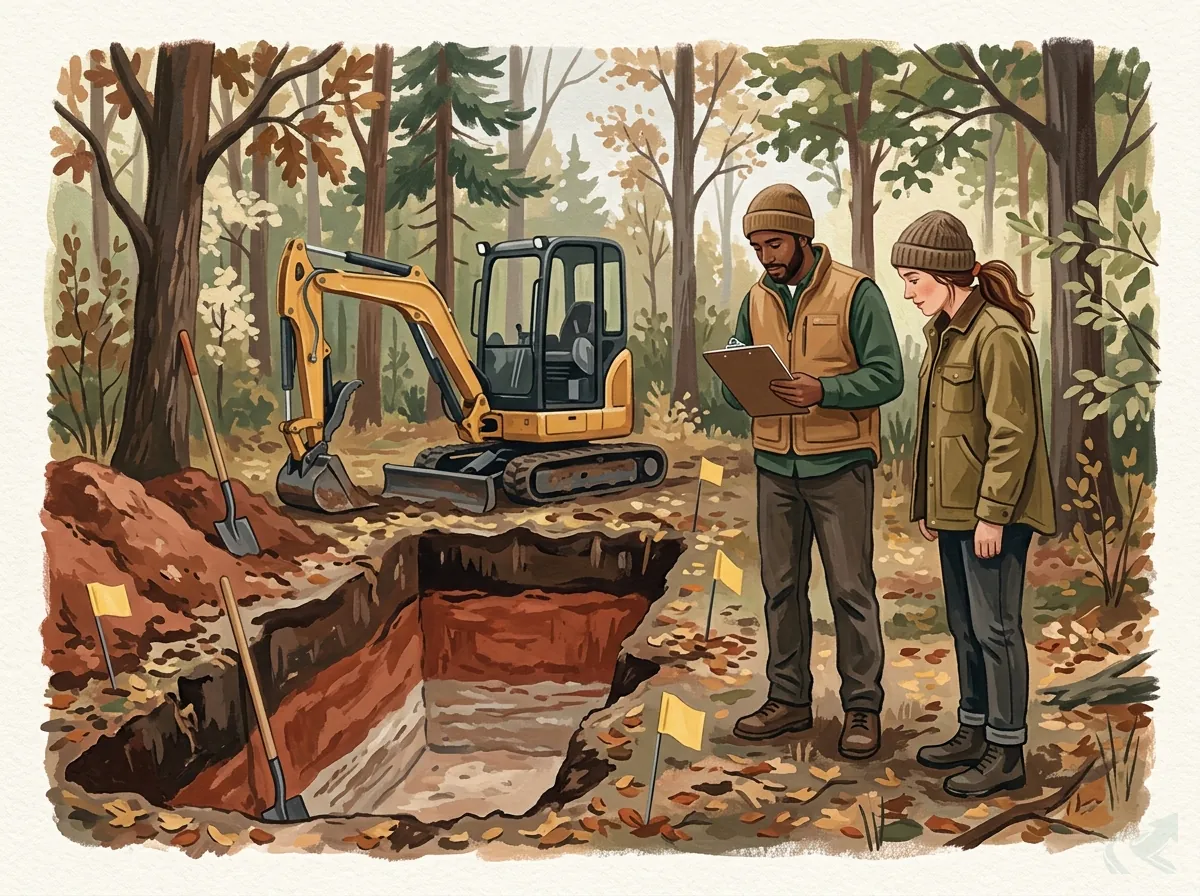
1. Find the property lines -- Identify the lines and fixed reference points in the field before the visit. Onslow County's page says that if the iron pins can't be found and marked, no work can be done. 2. Make the site reachable -- The evaluator has to be able to get to every spot being looked at. 3. Stake where things will go -- Mark the proposed house or facility and everything that goes with it: driveway and parking, garage, pool, shed, entryways, decks. 4. Be ready to dig pits -- If the health department asks for pits, the owner provides them, with steps or a ramp cut in so people can get in and out.
-
Find the property lines
Identify the lines and fixed reference points in the field before the visit. Onslow County's page says that if the iron pins can't be found and marked, no work can be done.
-
Make the site reachable
The evaluator has to be able to get to every spot being looked at.
-
Stake where things will go
Mark the proposed house or facility and everything that goes with it: driveway and parking, garage, pool, shed, entryways, decks.
-
Be ready to dig pits
If the health department asks for pits, the owner provides them, with steps or a ramp cut in so people can get in and out.
Each of these is an owner duty in the state's wastewater rules (15A NCAC 18E .0301).
Notice the third step. The evaluator can only judge the places you point at. If you stake the house in one spot and change your mind afterward, the permitted layout can stop matching the lot. In North Carolina’s rules, an Improvement Permit can be suspended or revoked if the site is altered and the permitted system can’t be installed as permitted.
Do owners always dig? No. The rules say the owner may be required to provide pits when the evaluator needs them, such as to look at weathered rock or soil structure. In public North Carolina threads, people describe it varying by county and by lot: one says the county bored holes, another that the county’s people usually make do with a hand auger, another was told to dig a hole in each possible area so the layers could be seen. Treat those as stories, not rules. Ask your health department what it wants on your lot.
What Comes Back: Suitable or Unsuitable
The rules sort each soil profile, and then the whole site, into one of two words: suitable or unsuitable. A site is suitable only if every item tested comes out suitable. One unsuitable item makes the site unsuitable.
If it’s suitable, the health department issues an Improvement Permit that names the proposed system and repair areas, the daily flow it was sized for, and conditions. That’s the first of the three permits, and the septic permit page takes it from there. What kind of system it allows is the next question: see septic system types.
If it’s unsuitable, no Improvement Permit can be issued for that site. You get a signed, written report that describes the unsuitable features and cites the rules, and it is supposed to say whether modifications or alternatives could make the site suitable. Onslow County’s page calls this a “turn down letter.”
One more result is worth knowing about. The Improvement Permit shows where the initial and repair areas are, not just that the lot passed. A commenter in a public North Carolina thread passed along a warning worth hearing: even if the county says a whole acreage perks, the system gets placed in the best spot, which may be far from where you imagined the house. Ask where the permitted area is, not just whether the lot passed.
If the Soil Fails
If a key doesn’t fit the lock, do you tear out the door or get a different key cut?
An unsuitable result is a statement about a spot, and the rules leave several ways to change the answer. They let an unsuitable site be reclassified suitable when:
- Site modifications supply the required vertical separation to the wet soil.
- An interceptor drain diverts the sideways flow of water that was saturating the area.
- Advanced pretreatment is used, with the modified siting and sizing the rules allow.
- A different approved system is used from the ones the rules list for such soils.
Each of these changes what gets built, and what it costs. NC State Extension notes that some wet or shallow soils get a drain field set very shallow, drainage around the system, or a treatment unit between the tank and the field. We cover the choices on the septic system types page and the price consequences on the septic cost page.
There’s also a route that starts with the owner. A site classified unsuitable can be put through a special site evaluation: written documentation, prepared by a licensed professional where the law requires one, showing that a specific system design can overcome the unsuitable conditions and still work.
And you aren’t stuck with the county’s calendar or opinion as the only way in. State law lets a licensed soil scientist evaluate a site for soil and site features, and the evaluation goes in with the Improvement Permit application. The scientist has to carry errors and omissions insurance, and the evaluation can’t reach outside the scope of the license. The county then has five business days to check the package for completeness. A commenter in a public Buncombe County thread put the appeal of this simply: depending on the county’s backlog, you can hire a soil scientist instead of waiting.
Last, appeals. When an Improvement Permit is denied, state law (G.S. 130A-335) says the written evaluation has to give the reasons and tell you about two rights: an informal review by the state, and an appeal under G.S. 130A-24, heard in the county where the land is. That appeal statute runs on a 30-day clock from notice. For an action under the state’s rules, the appeal is a contested-case petition filed with the Office of Administrative Hearings; for rules a local board of health adopted itself, it’s a written notice of appeal to the local health director. Your letter should tell you which applies. If it doesn’t, ask the health department right away, and keep the 30-day date on your calendar.
What would you do?
Read the situation, decide your first move, then tap to check.
1 A six-acre wooded lot is cheap, and the seller says it will pass.
Ask the county for a soil and site evaluation before you sign. The seller's word isn't the county's classification.
Then: NC State Extension's advice is to get an Improvement Permit before you purchase the lot.
2 The evaluator asks you to dig pits.
Hire an excavator and operator, and have steps or a ramp cut into each pit.
Then: Ask the health department where and how deep before the machine arrives.
3 Evaluation day, and nobody can find the iron pins at your property corners.
Find them or have a surveyor stake the corners first.
Then: Onslow County's page says no work happens until corners are found and marked.
4 The county's letter says the site is unsuitable.
Read what it cites. It must describe the unsuitable features, and name any modifications or alternatives that are available.
Then: Ask about a special site evaluation or a licensed soil scientist, and note the 30-day appeal window the letter describes.
5 After the permit, you want to shift the house a few feet to save a tree.
Call the health department before anything moves.
Then: A permit can be suspended or revoked if the site is altered and the system can't go in as permitted.
Why You Do This Before You Buy the Land
Would you pay a deposit on a house before it has been inspected?
Land is the same bet with less to look at. North Carolina has more than 400 kinds of soil, and a single acre can hold several. Many are unsuitable for a conventional system, and some for any on-site system. A lot that looks perfect from the road can be one that can’t take a septic system on any part of it.
So the order is: apply to the health department first, and sign second. NC State Extension says to get the Improvement Permit before you purchase a lot you intend to build on, and for land you plan to subdivide, to hire a licensed soil scientist for preliminary evaluations. The evaluation costs a fee and takes time. The wrong lot costs a lot more.
Who Digs the Pits, and How to Check Them
Three kinds of people touch a soil evaluation, and they’re checked in different ways:
- The health department’s evaluator does the evaluation. You don’t hire them; you apply, and the county sends them.
- A licensed soil scientist, if you choose that route. The license is issued under Chapter 89F of the General Statutes, so ask for the license number and the insurance.
- An excavator operator, if pits are needed. That’s ordinary site work, and the checks that apply to any dig apply here: insurance sent to you by the insurer, a written price, a record you can look up, and a call to 811 before anyone digs. Our excavation guide covers all of it.
When the evaluation passes and it’s time to install, the certified installers and inspectors come in, and the septic installation page covers that process. To compare contractors, our hire guide walks through the public-record checks, and the septic listings in our directory show contractors already checked against those records. For how the soils themselves differ across the state, see our NC soil guide.