Two questions people ask first
How much does a new septic system cost in North Carolina?
We don't print one price, because no public source we could read gives a current North Carolina figure. What is public is the county permit fee: $400 to $800 for a typical single-family system in the seven counties whose schedules we read (each county's smallest residential size, or a three-bedroom house where a county prices by bedroom). The installation price depends on what your soil allows, and the public sources we found disagree by far more than a factor of ten.
Why does one lot cost so much more than the next?
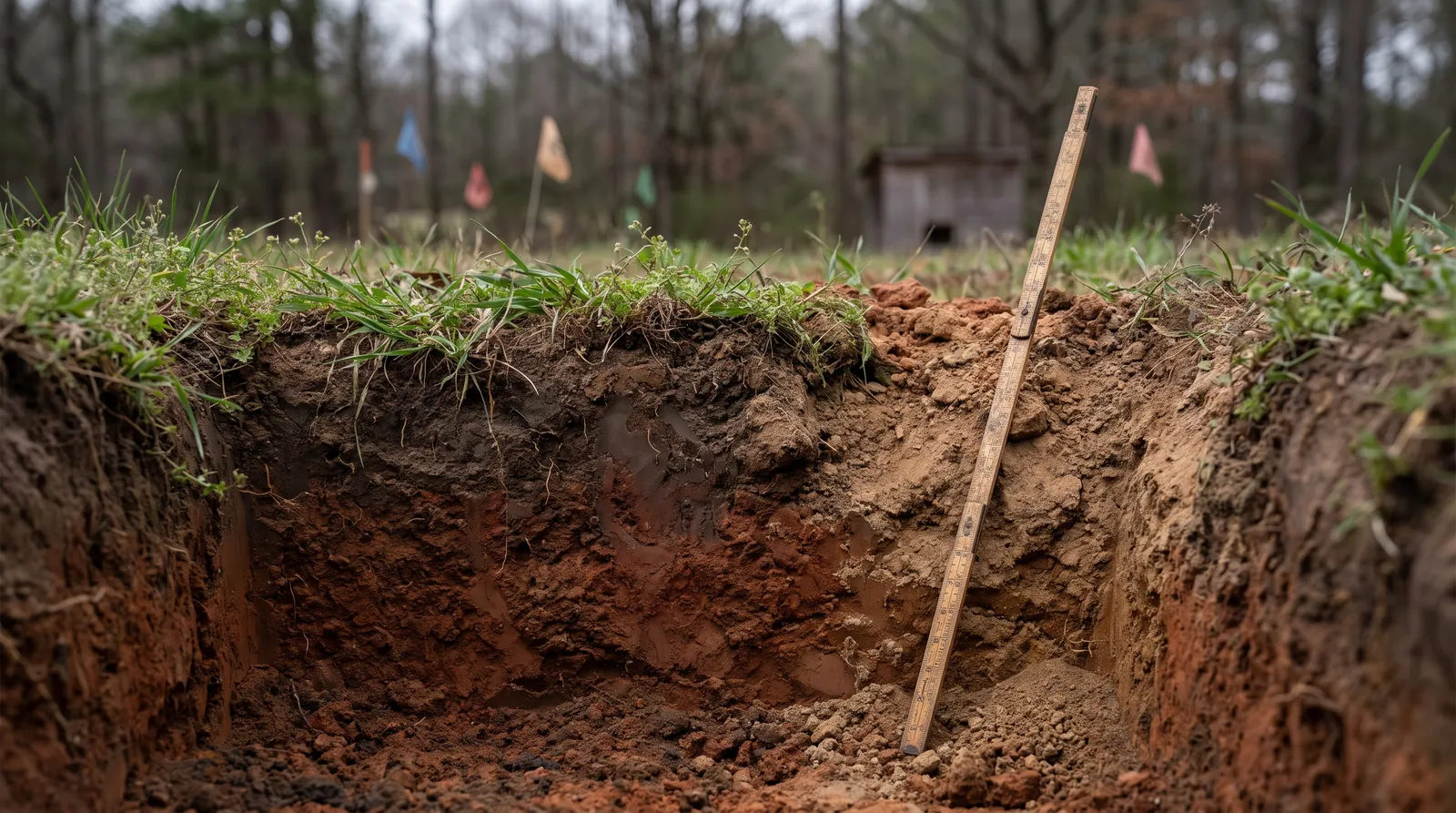
The soil and the water table decide which type of system the county will permit. A simple system and an advanced one with pumps, treatment and a raised bed are different jobs. Get the county's soil evaluation first, then get quotes that all name the same system.
Search for what a septic system costs and you’ll find a number on every page. Most of those pages are selling something. We’re a directory of site-work contractors, checked against public records, and we don’t install septic systems. So here is the honest version: we have no quote data of our own yet, and we won’t print a price range we can’t source.
What we can do is show you the part of the cost that is public and exact, explain what pushes the rest up or down, and show you how to get quotes you can actually compare.
Why Two Lots Cost Different Amounts
Two families book a moving truck. One lives in a fifth-floor walk-up, the other in a ground-floor house with a driveway. Would you expect the two bills to match?
Septic works the same way. Two identical houses can get very different bills, and the difference is the ground under them.
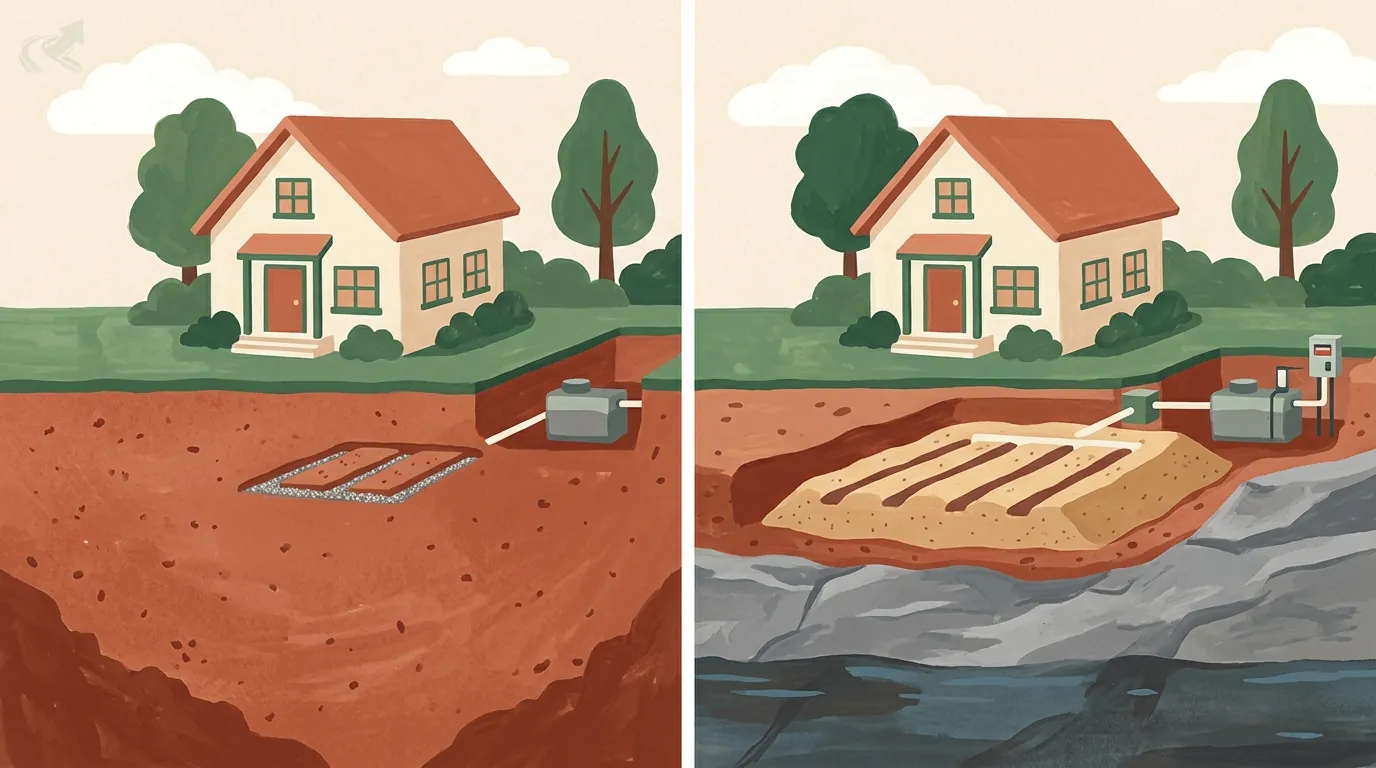
North Carolina has more than 400 kinds of soil, and a single acre can hold several. Where the soil drains slowly, is fractured, or sits over a high water table, NC State’s Crop and Soil Sciences department says the lot needs a more complicated engineered or pretreated system, and that those conditions are common in the mountains and on the coast. An NC State Extension specialist adds that the Charlotte area has several limiting soil types, and that in Wake County bigger houses are going onto smaller lots, some of which were previously denied conventional systems. A lot that can take a plain tank and trenches is a different job from one that can’t.
The Part You Can Read: What Counties Charge
County health departments issue the permits, and they publish what they charge. We read the fee schedules for seven counties on October 18, 2026. Every one of them is a county’s own page or document, and counties revise these, often each July, so treat the list as a snapshot.
Guess the county fee
A new house with a typical-size system. Some counties price by gallons a day, some by bedrooms, and some charge one residential fee. Guess what the county charges, then tap to check.
1 Mecklenburg County. All the permits for a new residential system.
$650, which the county says includes all required permits and inspections.
How it's built: It is paid in steps: $250 with the application for the soil evaluation and Improvement Permit, $200 more for the Construction Authorization, and $200 more before the Operation Permit.
2 Johnston County. A new septic permit for a system of 480 gallons or less.
$600, on the fee schedule effective July 1, 2026.
How it's built: A system over 480 gallons is $700. An installation re-inspection is $100.
3 Buncombe County. A new system, with no Improvement Permit on file.
$550 on the schedule we read: either a $400 Improvement Permit (first 500 gallons) plus a $150 Construction Authorization, or $550 for the Construction Authorization when no Improvement Permit is on file. It includes the Operation Permit.
How it's built: The county's current schedule, dated September 9, 2026 in the document's title, lists the same septic figures as its July 1, 2024 schedule. Each extra 500 gallons adds $250 to the Improvement Permit.
4 Rowan County. The two permits for a system of 480 gallons a day or less.
$500: $275 for the Improvement Permit and $225 for the Construction Authorization, on the schedule effective July 1, 2026.
How it's built: Rowan prices both permits by size, up to $650 and $375 for systems of 2,001 gallons a day or more.
5 Haywood County. A full permit for a home of up to three bedrooms.
$500 on the schedule effective July 1, 2023. A four-bedroom home is $600 and five bedrooms is $700.
How it's built: Haywood prices by bedroom count. That is the oldest schedule here, so check it.
6 Wake County. The permits for a new house on its own system.
$800: a $400 Improvement Permit and a $400 Construction Authorization, which includes the Operation Permit.
How it's built: Wake also lists a $110 design review fee for residential permits without saying when it applies, so ask. The fee page is undated.
7 Guilford County. A three-bedroom house, with a system in the county's type I or II class.
$400: $100 per bedroom for the soil evaluation, plus $100 for the Authorization to Construct.
How it's built: Other system types cost more to authorize: $140 for type IIIb, and $450 for the alternative types IV, V and VI. The fee page is undated.
Read the pattern, not just the numbers:
- The repair permit is free in five of them. Mecklenburg, Johnston, Buncombe, Rowan and Haywood all list a septic repair permit at no charge. Wake’s and Guilford’s schedules don’t list a repair fee, so ask there. Either way, if your system is failing, the permit is not what makes it expensive.
- Size can change the fee. Johnston, Buncombe and Rowan price by gallons a day, Haywood and Guilford by bedrooms, while Mecklenburg and Wake list one residential fee. Tank size is set by the number of bedrooms, so a bigger house means a bigger system and often a bigger permit fee.
- A county may charge in steps, as Mecklenburg does, so the fee at application is not the total.
- These are the small part. Every figure above is in the hundreds of dollars. The install is where the large numbers live.
State law adds one option worth knowing about. A property owner can go the private route with an Engineered Option Permit, where a licensed engineer designs the system, or with an Authorized On-Site Wastewater Evaluator, a licensed soil scientist with extra certification. The owner files a Notice of Intent with the county instead of waiting on the county’s permits, and for those two routes state law caps the county’s fee at $35 for filing costs. Johnston, Buncombe, Rowan and Guilford list it at $35. Other ways of using a private soil scientist, where the county still issues the permits, carry different county fees, so ask. You pay the engineer or evaluator separately, and we found no public price for that work, so we won’t guess one.
What Moves the Installation Price
Five things decide what a new system costs you: four set the installer’s bill, and one sets what it costs to own. They are all things you can find out before anyone digs.
Five things that move the price of a new septic system
1. The soil and the water table -- They decide what the county will permit. Slow drainage, fractures or a high water table push a lot toward an engineered or pretreated system. 2. The type of system -- A conventional system is a tank and trenches. Each step up adds parts: pumps, pretreatment units, raised beds or drip lines. NC State Extension says a low-pressure pipe system may cost twice as much to install as a conventional one. 3. The size -- The number of bedrooms sets the legal size of the tank, and the permit sets how much water the system is designed to handle. 4. The site -- Steep slopes, wet or rocky ground, nearby streams or wetlands, a well that needs 100 feet of distance, and enough room left for a repair area all limit where the system can go. 5. Who looks after it afterward -- Advanced systems carry an operator requirement. Extension says they cost more to run and maintain, and that research in North Carolina found 40 to 50 percent of advanced systems fail within six years without that maintenance.
-
The soil and the water table
They decide what the county will permit. Slow drainage, fractures or a high water table push a lot toward an engineered or pretreated system.
-
The type of system
A conventional system is a tank and trenches. Each step up adds parts: pumps, pretreatment units, raised beds or drip lines. NC State Extension says a low-pressure pipe system may cost twice as much to install as a conventional one.
-
The size
The number of bedrooms sets the legal size of the tank, and the permit sets how much water the system is designed to handle.
-
The site
Steep slopes, wet or rocky ground, nearby streams or wetlands, a well that needs 100 feet of distance, and enough room left for a repair area all limit where the system can go.
-
Who looks after it afterward
Advanced systems carry an operator requirement. Extension says they cost more to run and maintain, and that research in North Carolina found 40 to 50 percent of advanced systems fail within six years without that maintenance.
Only the first four change the install price. The fifth changes what it costs to own.
That repair area matters for cost. Extension warns that the system your lot needs in the repair area can be a completely different and more sophisticated type than the one first installed. If the first field ever fails, the replacement may cost more than the original.
What Public Sources Say About Installation Price
We looked for a public, citable price for a new North Carolina system. We found three sources that give one, and they do not agree. Guess before you tap.
Three public sources, three very different numbers
Guess what each one says, then tap to see it.
1 NC State Extension, Investigate Before You Invest (reviewed April 2025). The average installation cost of a conventional septic system.
It says $650 to $2,000, depending on the part of the state.
Why we don't use it: That is far below what the other two sources give, and the publication does not say what year the figure comes from. We do not treat it as today's price.
2 The US EPA's Financing Septic Systems guide (2018, national). A conventional system and an advanced one, including materials, labor and permits.
About $3,000 to $15,000 for conventional, and often $10,000 to $30,000 for alternative and advanced systems.
Why we don't use it: It is eight years old, it is a national range with no North Carolina figure, and it says design can be billed separately. It is not a quote either.
3 NC State's Crop and Soil Sciences news (2023). What pretreatment adds to a conventional system.
An NC State Extension specialist said pretreatment can add 30,000 to 70,000 or more, depending on the system and the site.
Why we don't use it: It is one quoted sentence in a news article, not a price list. It tells you the gap between simple and advanced can be large, not what your lot will cost.
Put them side by side and the honest conclusion is that nobody can tell you from here. Extension’s publication puts a conventional system at $650 to $2,000, while an Extension specialist says pretreatment can add $30,000 or more on top. Those are not the same system, and that gap is the point of this page: the price is not a property of the septic system. It is a property of your lot. A single average would mislead more people than it helped, so we haven’t printed one. When we hold real quotes gathered through the directory, we’ll say so and show them.
The Costs Before the Dig
Would you hand over the money for a used car before a mechanic had looked under it, or after?
A lot is the same. NC State Extension’s advice for anyone buying land is to do four things before the purchase: find out the types of soil on the lot, find out what septic system, if any, will work on them, get an Improvement Permit from the local health department, and get a cost estimate for the kind of system you would need. Ask too what it will cost to operate and maintain, and whether the approval limits the number of bedrooms, the house location, the driveway or a swimming pool.
Those steps cost real money, and they come before the system does:
- The soil evaluation and Improvement Permit from the county, which is the evaluation we cover on its own page. If you are comparing lots, Extension suggests applying for each one, and says an experienced soil consultant can help you screen lots first.
- The permits that follow, which the permit page walks through, with the Construction Authorization before the install and the Operation Permit after it.
- The design, which the EPA notes can be billed separately from construction in some areas.
If the county can’t issue the Improvement Permit, you’ve learned something that cost a few hundred dollars and saved you a lot more. That is a good trade. Buying a lot that turns out to be unbuildable, or buildable only with an advanced system you hadn’t budgeted for, is the expensive version.
The system types the county can choose between are on our types page, and how a system actually goes in is on the installation page. The overview is the septic system page.
How to Get Quotes You Can Compare
An owner in a 2023 r/bullcity thread needed septic repair or installation work. They had an estimate from one company, knew nothing about septic, and couldn’t tell whether the number was reasonable, so they went looking for more. Most replies just named companies. One commenter said the firm they used had given them a quote listing everything to be fixed with a price for each item, and it seemed reasonable. Another said the two firms they knew were booked at least a month and a half out.
You ask three mechanics what a repair will cost. Two quotes are close. The third is half the price, written on a napkin with no list of parts. Do you assume it’s the best deal?
You don’t, and the same goes here. A low number with no detail usually means the scope is different, not that the work is cheaper. To make three quotes comparable:
- Get the county’s drawing or Improvement Permit first, so every installer is pricing the system the county will actually permit. A quote for a conventional system is not comparable to a quote for a pretreatment system.
- Ask for the quote in writing, itemized: tank, drain field, pumps and controls, any pretreatment unit, permits and inspections, site restoration, and who applies for the permits. Our guide to evaluating quotes that don’t agree and the one on itemized versus lump-sum quotes cover how to read the lines.
- Ask about what comes after: the operator requirement, if there is one, and what that costs each year.
- Check who is quoting. The North Carolina On-Site Wastewater Contractors and Inspectors Certification Board certifies the people who install and inspect septic systems. Ask for the certification number and check it with the Board. Our hire guide covers vetting a contractor more broadly, and our directory lists contractors checked against public records.
If you’re deciding between a new system and connecting to a sewer line, that comparison has its own page.
One Honest Limit
Prices move, schedules change every July, and a quote is only good for the lot and the day it was written. Use the county fees on this page as a way to know what to expect, not as a budget. The number that matters is the one in a written, itemized quote for the system your county will permit on your lot.