Which tool should I use?
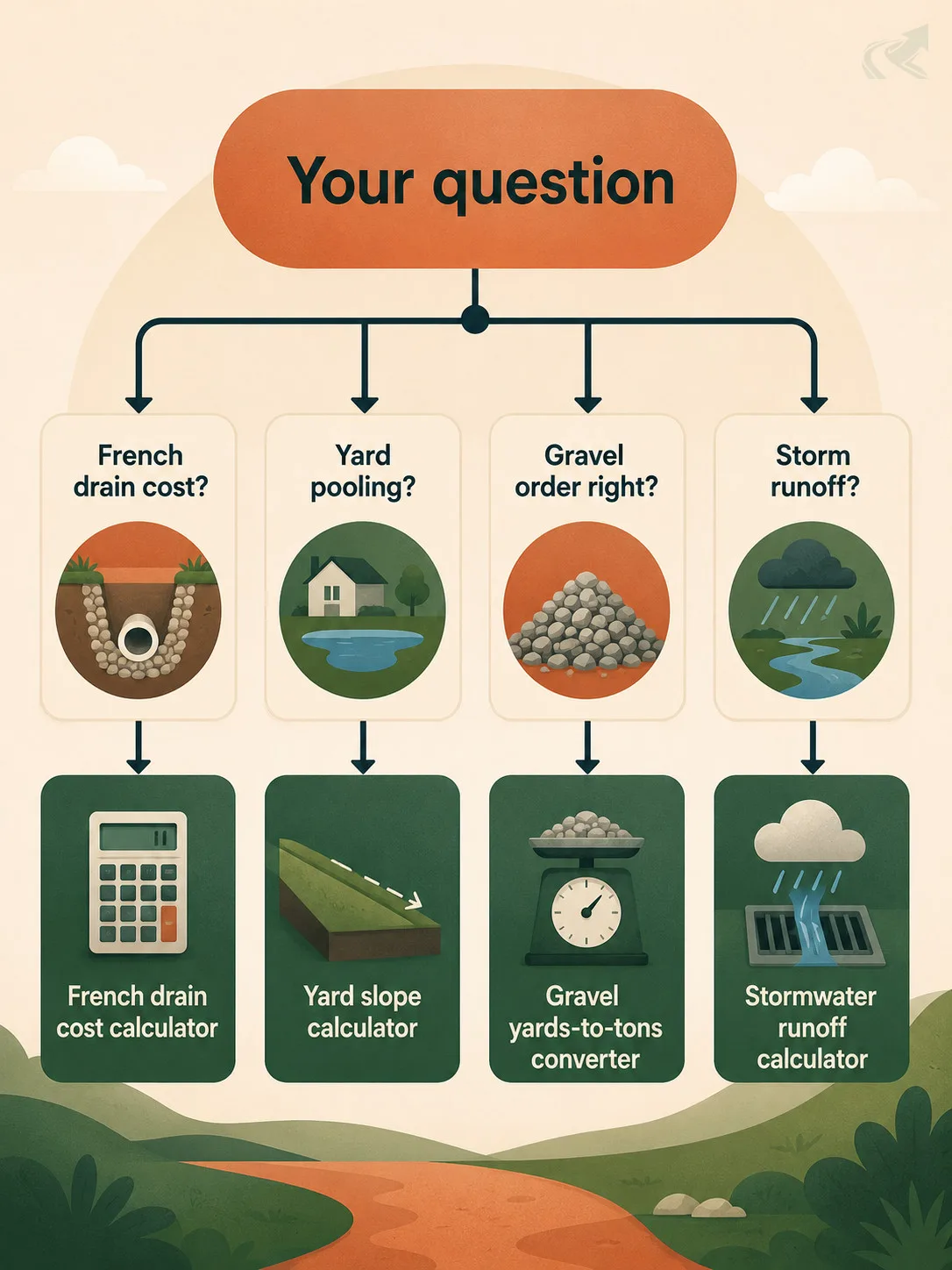
Which tool should I use if I'm pricing a French drain?
The French drain cost calculator. Enter your linear footage, depth, and soil type and get a cost range based on NC Piedmont defaults. Use it to sanity-check any quote before you sign.
What if I'm ordering gravel, checking my yard slope, or sizing a drainage system?
Yard pooling after rain -- use the slope calculator. Ordering gravel -- use the yards-to-tons converter. Sizing stormwater drainage -- use the runoff calculator. Each tool answers one specific question.
You got two quotes. One is $9,800 and the other is $14,200 for what sounds like the same 80 linear feet of French drain. Neither contractor explained the math. One way to sanity-check contractor numbers before you sign is to run your project specs through the same tool they should be using.
These calculators use North Carolina-specific defaults — Piedmont clay soil behavior, local material pricing — not generic national ranges. They won’t replace an itemized quote from a verified contractor. But they’ll tell you whether the number you’ve been given is in the same zip code as reality.

Which Tool Answers Your Question
Four tools. Four specific questions. Find yours and click through.
| Tool | Your question | What you put in | What you get | What you can verify |
|---|---|---|---|---|
| NC French drain cost calculator | How much should a French drain cost for my yard? | Linear feet, depth, stone spec, clay soil flag, daylight distance | Cost range (low/high) + per-LF breakdown | Whether a contractor quote is in the right range |
| Check your yard slope for the 2% minimum | Does my yard drain at the right angle? | Elevation at two points, distance between them | Fall percentage | Whether your yard meets the 2% minimum for positive drainage |
| Gravel yards-to-tons converter for NC projects | Did I get the gravel I paid for? | Volume in cubic yards, material type (ABC, #57, #67) | Weight in tons | Whether the delivery ticket matches your order |
| NC stormwater runoff calculator | How much water is hitting my yard in a storm? | Impervious surface area, rainfall intensity | Peak flow estimate | Whether your drainage system is sized for your site |
How to Use the Numbers You Get
These tools produce estimates, not bids. Use them as a sanity check, not a contract number.
Every tool on this page uses NC Piedmont defaults: standard red clay excavation rates, local material pricing, Triangle and Charlotte metro labor market. Those defaults hold for most residential projects in central North Carolina. If your project deviates significantly — heavily wooded lot, coastal sandy soil, unusual slope, or a long outlet run — the output will be less precise at the edges of the range. The tool will tell you where the assumptions sit.
The more useful application is in the contractor conversation. Once you have a tool output, you have a specific number to ask about. “I ran your quote through the French drain cost calculator and got a range of $X to $Y for 80 linear feet at 18 inches. Your number is at $14,200 — can you walk me through the itemized breakdown?” A contractor who can answer that question in line items is a contractor who knows what they’re doing. A contractor who can’t is lump-summing, and that’s a flag.

What These Tools Don’t Do
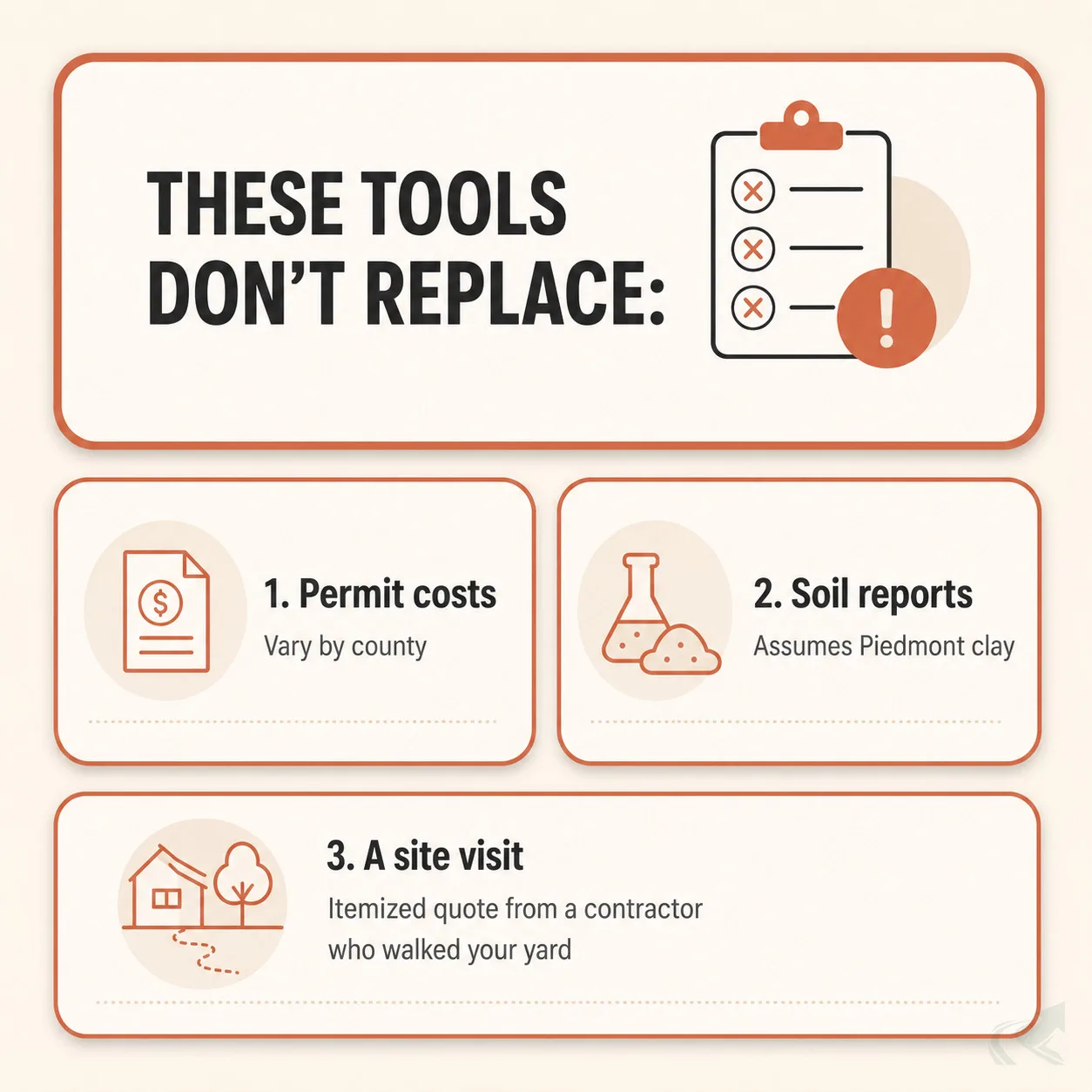
These tools don’t design your drainage system and they don’t replace a site visit.
A few things that are out of scope:
- Permit costs — land-disturbance thresholds, permit fees, and E&S bond requirements vary by county. See the NC county permit matrix for the breakdown.
- Soil reports — these tools assume standard Piedmont red clay. If you have a specific soil condition (rock shelf, high water table, or coastal sand), the inputs will be off.
- Contractor quotes — an itemized quote from someone who has walked your yard is not replaceable by a calculator.
If you’ve run the numbers and want a quote that shows the math, hire a verified NC grading contractor who provides itemized bids.