
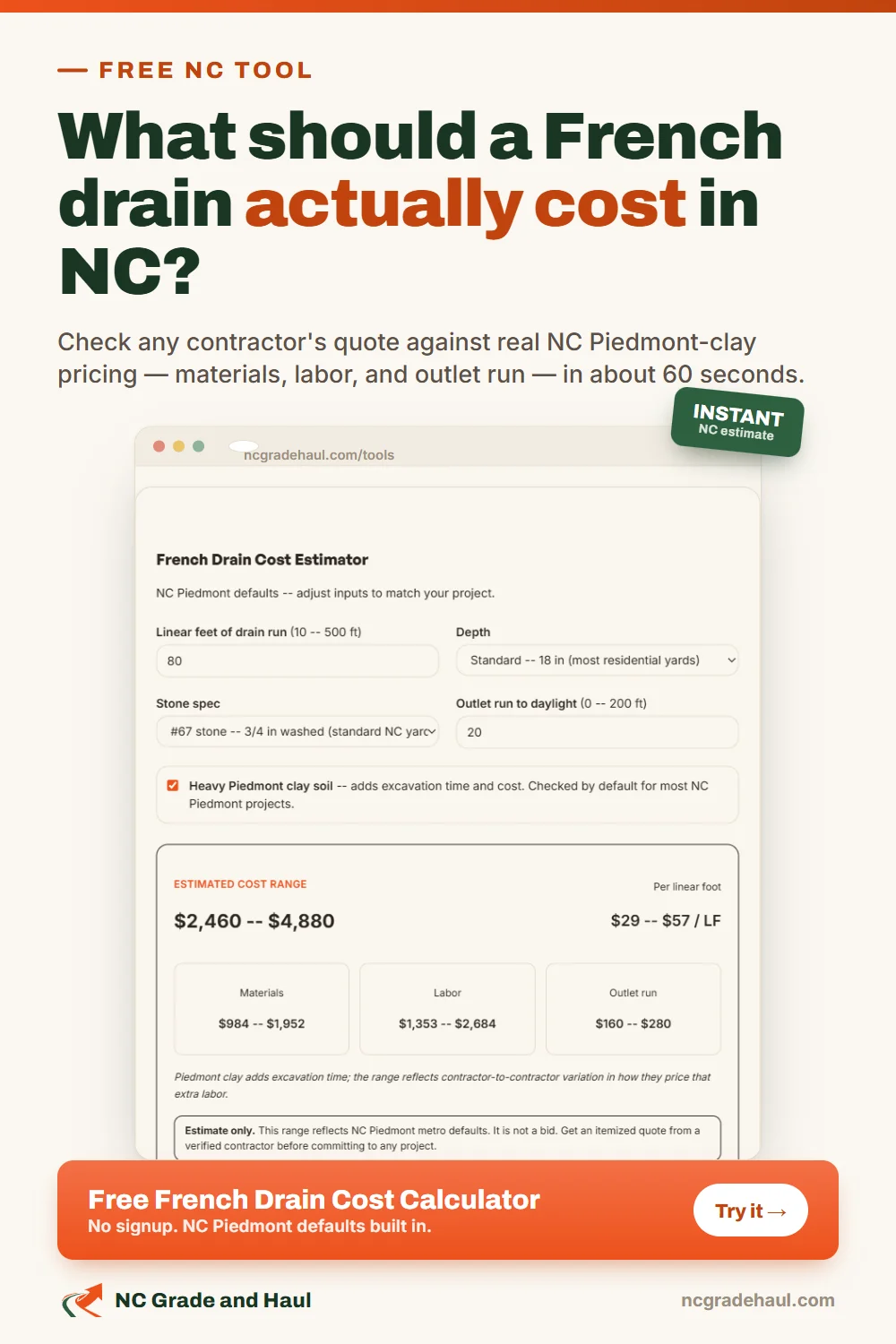
French Drain Cost Estimator
NC Piedmont defaults -- adjust inputs to match your project.
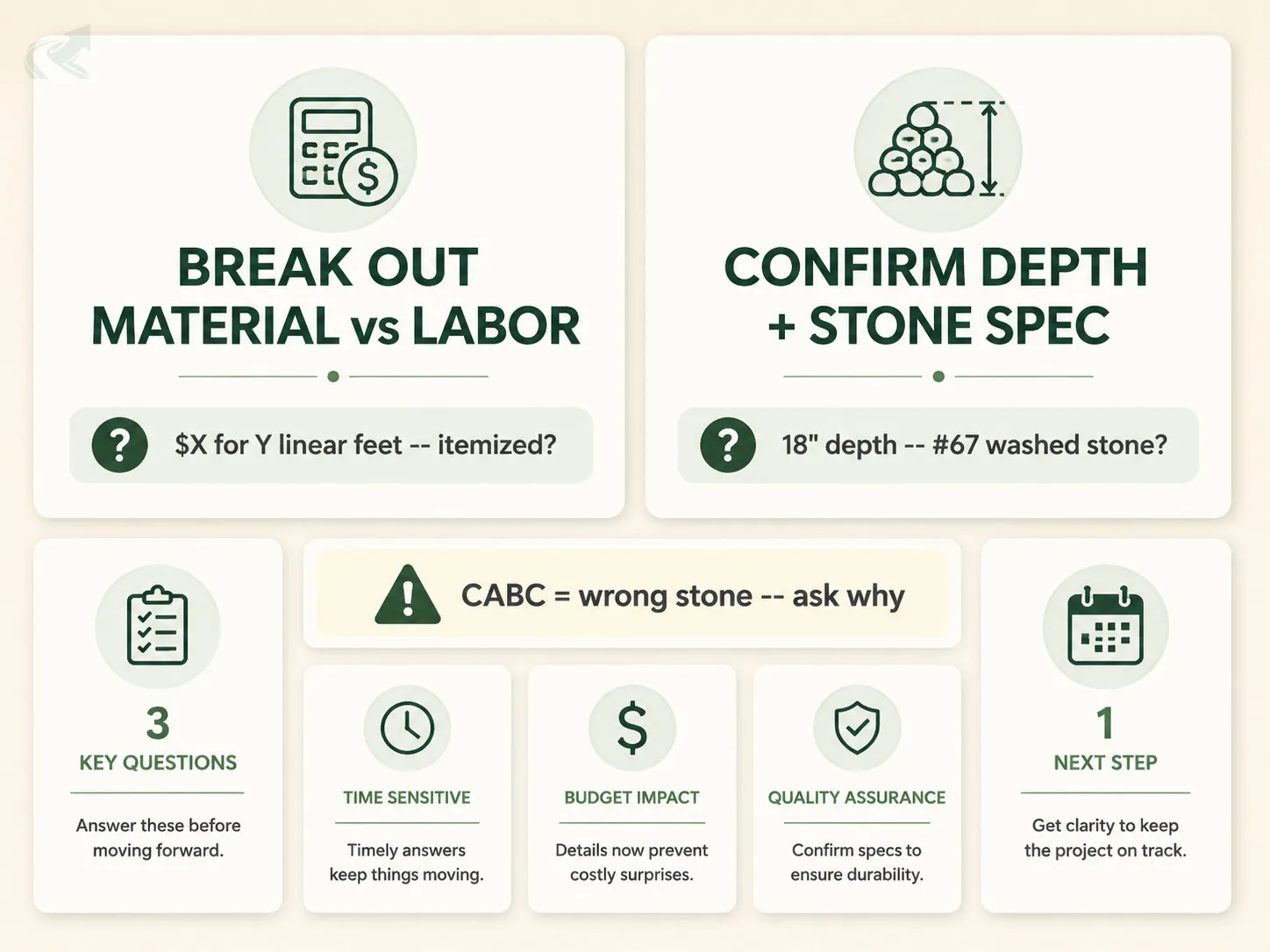
CABC has too many fines -- it clogs filter fabric and defeats the drain. Shown for reference only; verified NC contractors will not spec this for French drains.
A standard 18-inch residential French drain in NC Piedmont clay runs roughly $25 to $50 per linear foot installed across the Triangle, Triad, and Charlotte metros. The spread on any single quote is wide, and most of it traces back to three things: depth, how far the outlet has to run to reach daylight, and whether the soil is the dense red clay that slows every excavator down.
The calculator above turns those specifics into a cost range you can hold a contractor’s quote against — treat the output as a sanity check, not a contract figure.
What Each Input Means
The two inputs that move the number most are depth and whether the drain has a clean daylight point.
- : Measure from where the drain starts to where it ends. Don’t include the outlet run distance — that’s a separate input.
- Depth: Standard residential Piedmont clay drains run 18 inches. Foundation drains or drains installed next to a footing may need 24 inches or more. Shallow 12-inch installs work for minor yard drainage situations where water isn’t moving volume.
- Stone spec: #67 washed stone is the workhorse for NC yard drainage — 3/4 inch, voids let water move. #57 is coarser, used for larger drains and septic field stone. is a driveway base material, not a drain material. It has too many fines and defeats the purpose of filter fabric.
- Clay soil flag: NC Piedmont red clay adds about 15% to excavation cost versus sandy or loam soils. If your soil has significant rock or is denser-than-average clay, expect the high end of the range.
- Daylight distance: The further the outlet from the drain end, the more pipe and grading. Zero means the drain outlets close to where it ends. 100 feet or more means a long outlet run that adds material and labor cost separately from the drain itself.
How to Use This Number in a Contractor Conversation
A good contractor should be able to explain line by line why their quote lands where it does.
Two questions worth asking before you sign:
- “Your quote is $X for Y linear feet — can you break out material cost from labor cost?” A contractor who can’t answer this is giving you a lump-sum number. That’s a flag — not necessarily a bad contractor, but you can’t verify anything.
- “What depth are you speccing? What stone are you using?” These should match the inputs you’ve verified for your site. If a quote uses as the drainage stone, that’s a warning sign in a grading bid worth a direct follow-up.
For a full walkthrough on evaluating NC contractor quotes using French drain cost data, including what an itemized bid should show and red flags to watch for, see the quote evaluation guide.
What This Calculator Doesn’t Account For
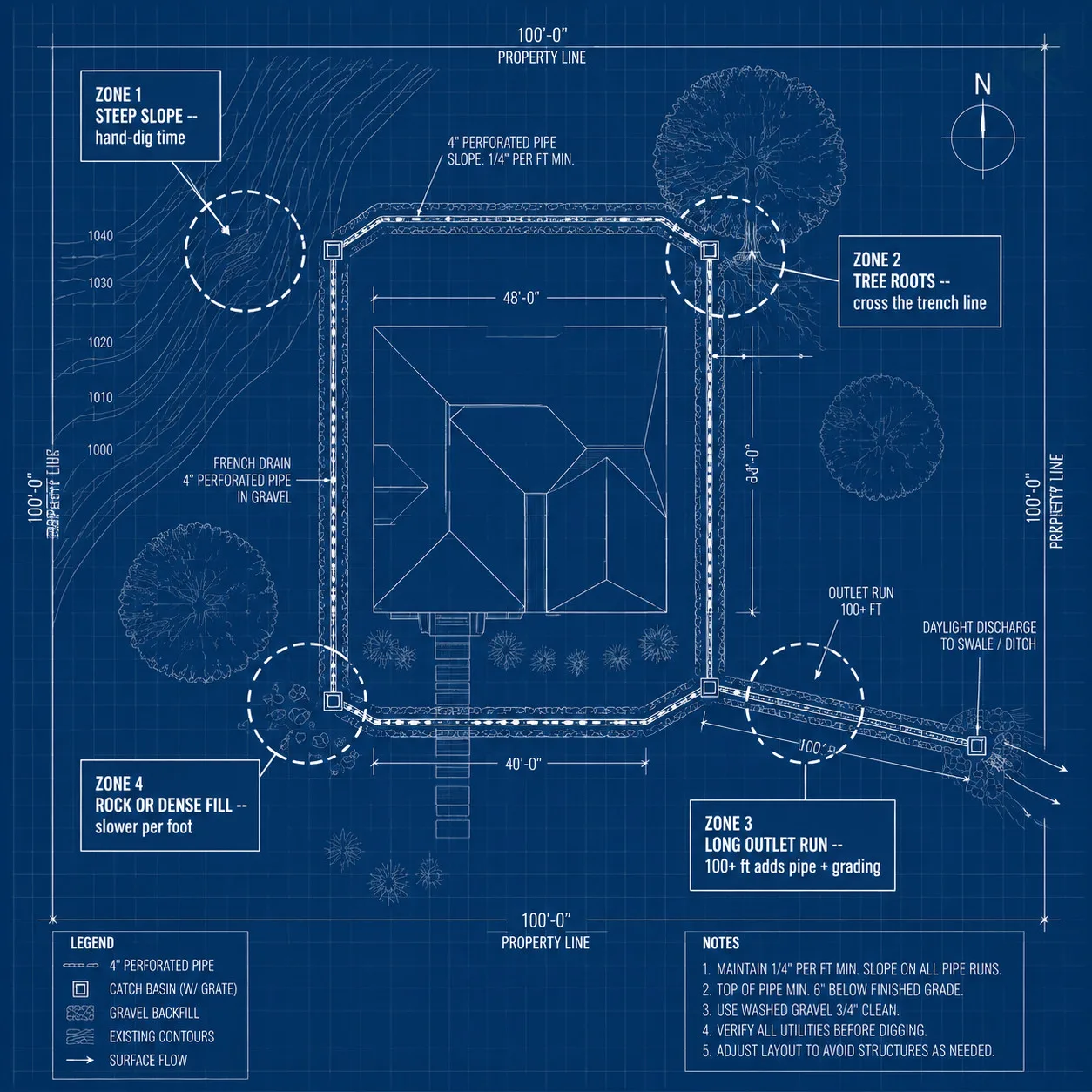
French drain project complications: standard install vs. cost-adding site conditions
Comparison. Standard install: Flat or gently sloped yard -- equipment can reach the drain run easily; No buried utilities or tree roots crossing the trench line; Outlet daylights close to the drain end -- short outlet run; Clay soil only -- no rock or unusually dense fill. Complication premium: Steep slope or narrow access -- limits equipment, adds hand-dig time; Tree roots across the trench line -- require hand excavation or root cutting; Long outlet run -- more pipe, more grading, separate labor cost; Rock or dense fill -- slower excavation, higher cost per foot.
- Flat or gently sloped yard -- equipment can reach the drain run easily
- No buried utilities or tree roots crossing the trench line
- Outlet daylights close to the drain end -- short outlet run
- Clay soil only -- no rock or unusually dense fill
- Steep slope or narrow access -- limits equipment, adds hand-dig time
- Tree roots across the trench line -- require hand excavation or root cutting
- Long outlet run -- more pipe, more grading, separate labor cost
- Rock or dense fill -- slower excavation, higher cost per foot
These complications are not in the calculator estimate. Add a buffer to the high end of the range if your site has any of them before comparing quotes.
Permits, access difficulty, tree roots, and existing drainage conflicts are not in this estimate.
The calculator produces a cost range for the drain itself. It does not include:
- Land-disturbance permit costs, which vary by county and project scale. See the NC county permit matrix for county-by-county thresholds.
- Difficult site access — steep slopes, narrow entry points, no equipment staging area, or soft yards that limit machine access.
- Existing buried utilities crossing the drain path.
- Tree root removal along the trench line. Significant roots add excavation time and often require hand digging.
If your project has any of these complications, add a buffer to the high end of the range before comparing quotes.
If the number from the calculator puts you in range for your project, the next step is a verified operator who can walk the site. Review the NC French drain hub for full context on what a proper French drain install looks like in North Carolina, then hire a grading operator in North Carolina who provides itemized bids.
Back to the NC grading and drainage calculators hub.