
Before you use the calculator
What does peak flow in cubic feet per second tell me?
It tells you how much water your drainage system needs to handle in a significant storm. Use it to sanity-check whether the drainage your contractor has proposed is sized for the actual stormwater load on your site.
What is a 10-year storm?
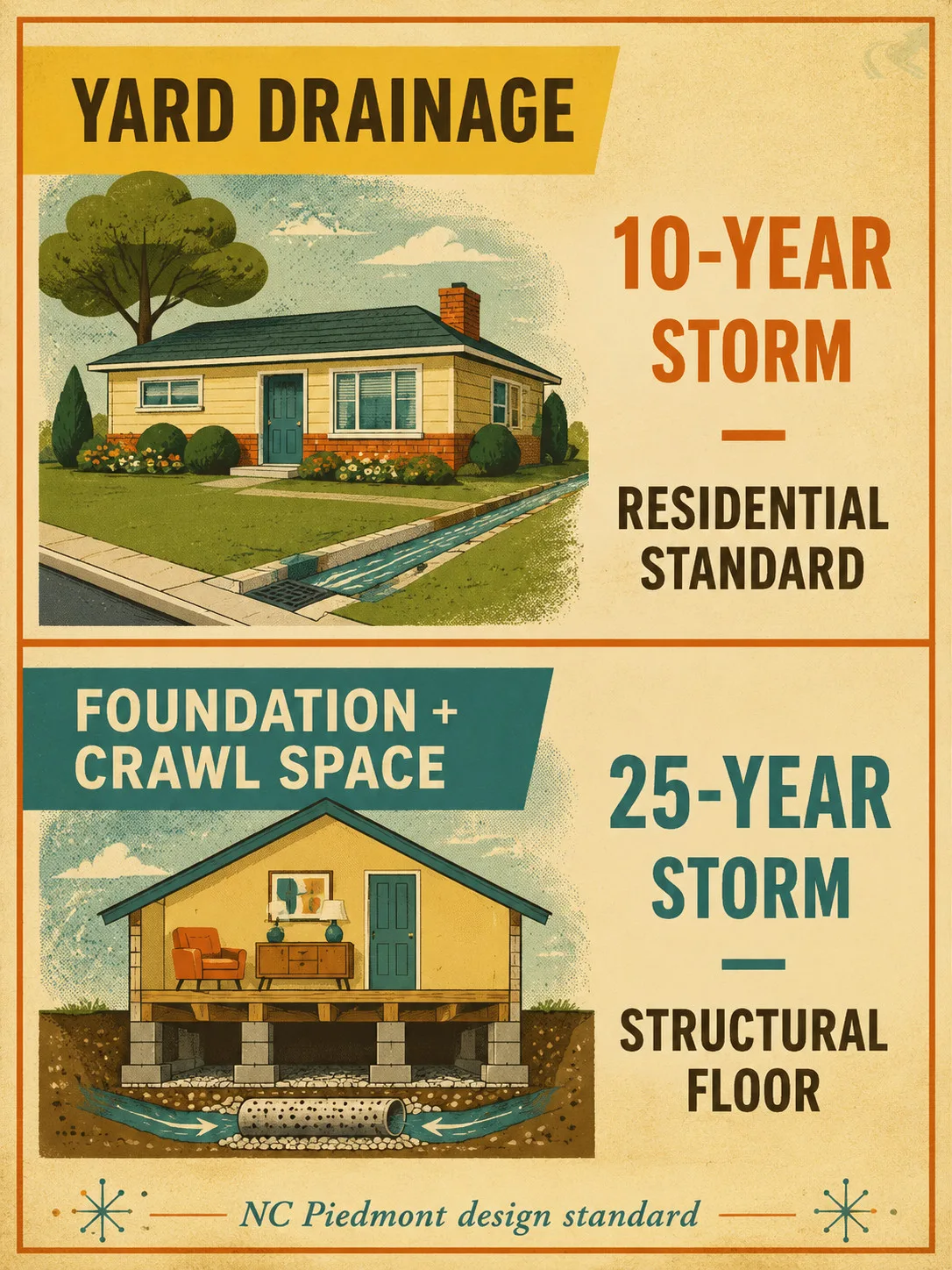
A 10-year storm is the rainfall intensity that occurs on average once every 10 years in your region. It is the design standard commonly used for residential drainage in NC -- not the worst-case storm, but a reasonable planning target.
Stormwater Runoff Calculator
Rational method estimate -- NC regional rainfall defaults. Adjust inputs to match your site.
Roof footprint + driveway + patio + compacted gravel areas
Full lot area or the portion that drains to your point of concern
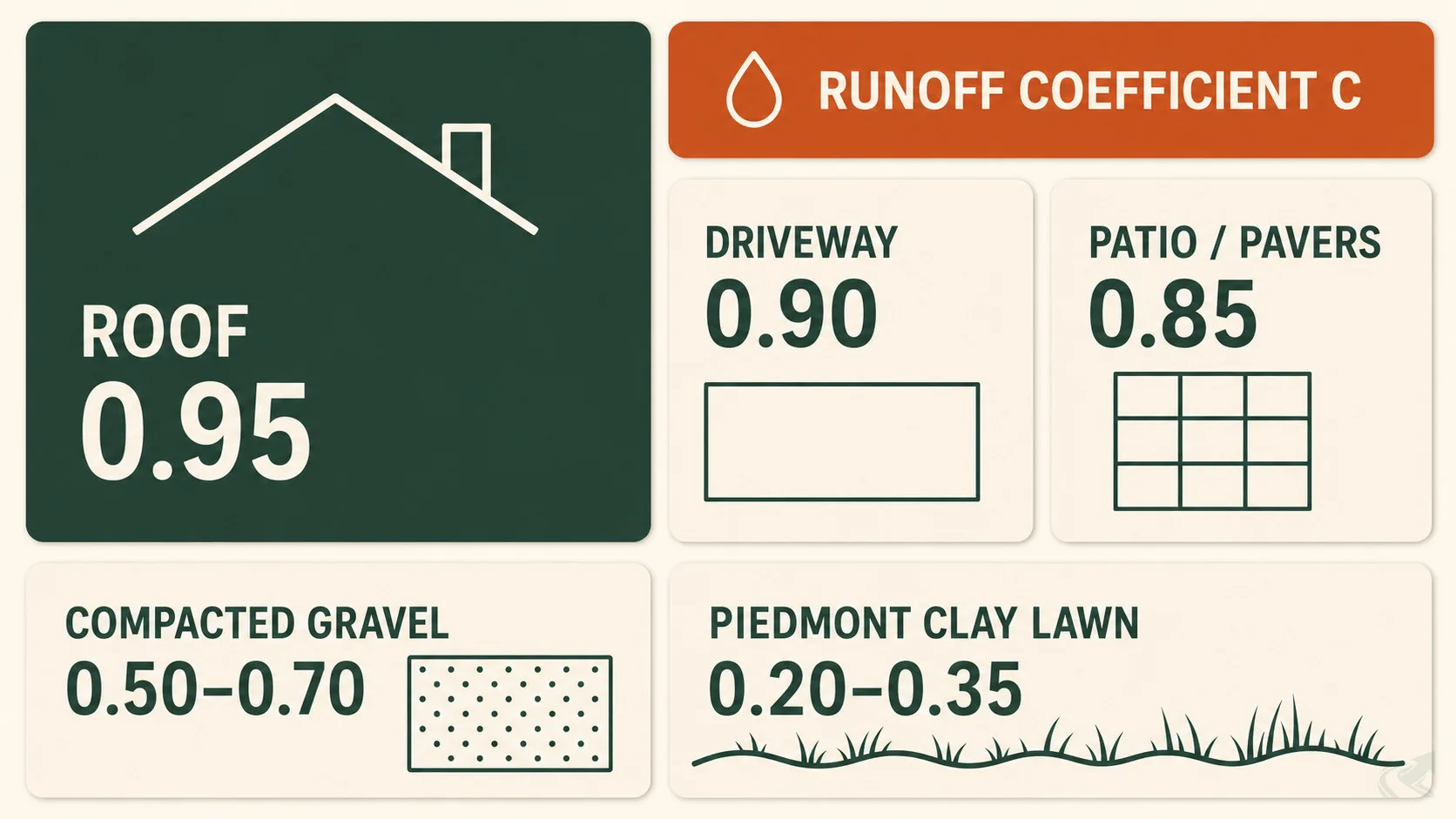
Typical ranges: lawn 0.20--0.35, compacted gravel 0.50--0.70, pavement/roof 0.85--0.95
What Impervious Surface Is and How to Measure Yours
Impervious surface is any hard, non-absorbing surface — roof, driveway, patio, compacted gravel — that sheds rainfall directly as runoff rather than allowing it to infiltrate the soil.
Here is how to measure each type:
- Roof: Measure the footprint from outside along the roofline. The roofline typically extends 1—2 feet beyond the walls. Use that exterior dimension, not your home’s interior square footage.
- Driveway: Length times width. Concrete and asphalt are fully impervious.
- Patio, deck, parking pad: Length times width per surface. Treat concrete, brick pavers, and asphalt as fully impervious.
- Compacted gravel: Treat as 50—70% impervious. Gravel absorbs some stormwater but also sheds, especially once NC Piedmont clay fines migrate up through the stone layer over time.
- Vegetated lawn (Piedmont clay): Typically 20—35% runoff coefficient in North Carolina Piedmont conditions. Clay limits infiltration significantly versus sandy coastal soils — if your yard sits on red clay and holds water after rain, use the higher end of that range.
New impervious surface from an uphill subdivision matters. Every square foot of roof and pavement added uphill of your yard increases the runoff volume that crosses your property line. The calculator lets you model what that looks like.
NC Rainfall Intensity — Why the Number Varies by Region
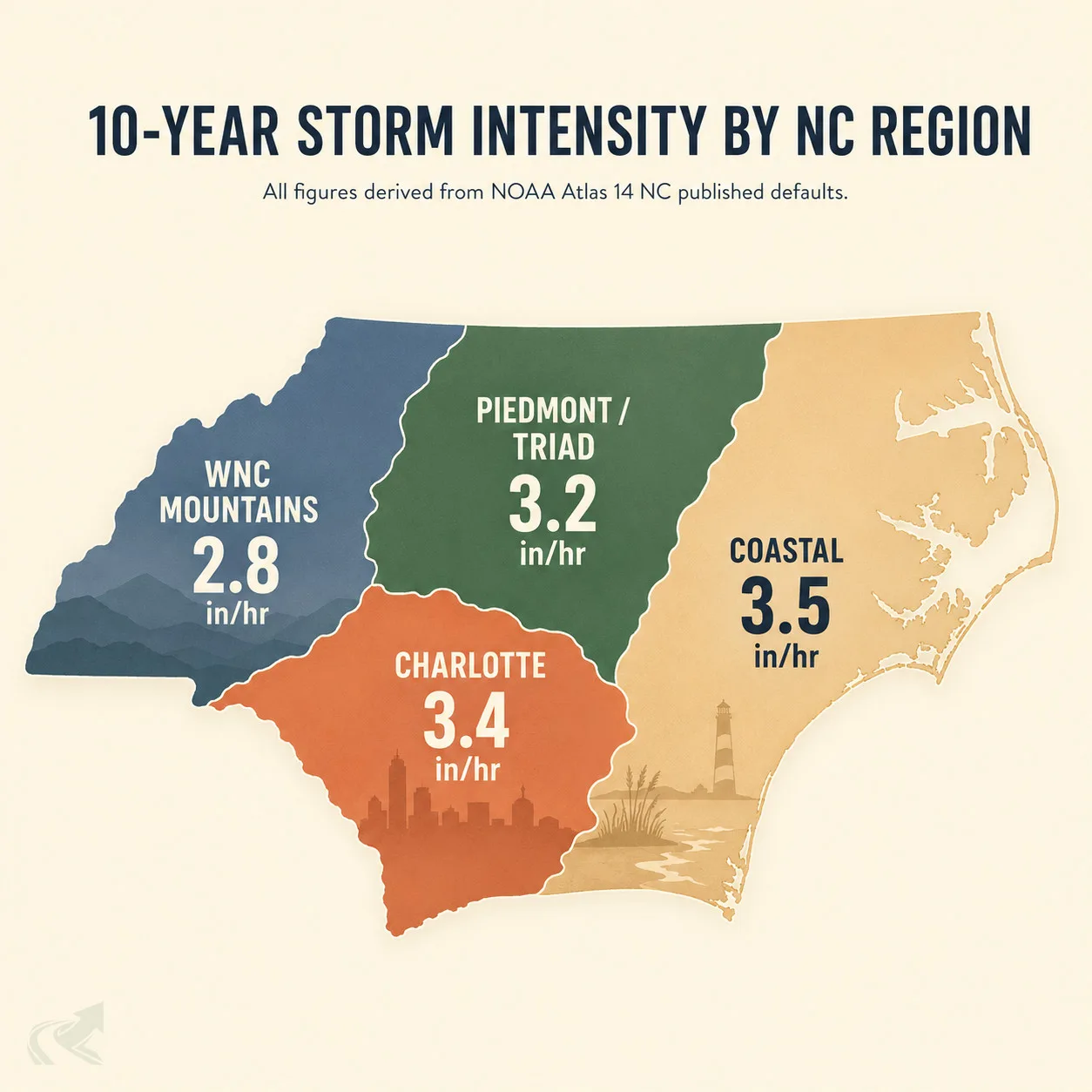
North Carolina spans multiple rainfall zones. Coastal areas receive more intense storms during peak season; the mountains receive more total annual rainfall but often at lower intensity. The calculator uses regional values that reflect where your site actually is.
A few things worth knowing about the intensity input:
- The regional defaults shown are approximate 10-year storm values for a typical residential time of concentration (20—40 minutes), derived from published NC rainfall data. They are starting points — confirm your site-specific value at NOAA Atlas 14 for your exact coordinates and design storm.
- NC Triangle counties see intense convective storms in summer that drive high 10-year intensity figures. Coastal NC sees hurricane and tropical system contributions. WNC mountain patterns differ from both.
- Design storm selection matters. A 10-year storm is the standard for residential yard drainage. If you are sizing drainage that protects a foundation, crawl space, or basement, use a 25-year storm intensity instead — a larger number that widens the sizing requirement. Most NC Piedmont design professionals use 25-year as their floor for foundation drainage NC.
- Custom input is there for a reason. If a local civil engineer or your county stormwater office has given you a specific intensity value for your site and recurrence interval, enter it directly.
How to Use the Output
The peak flow number — in — tells you the capacity your drainage system needs to handle. Compare it against standard pipe or swale capacity to see if your system is adequately sized.
Here is the practical translation:
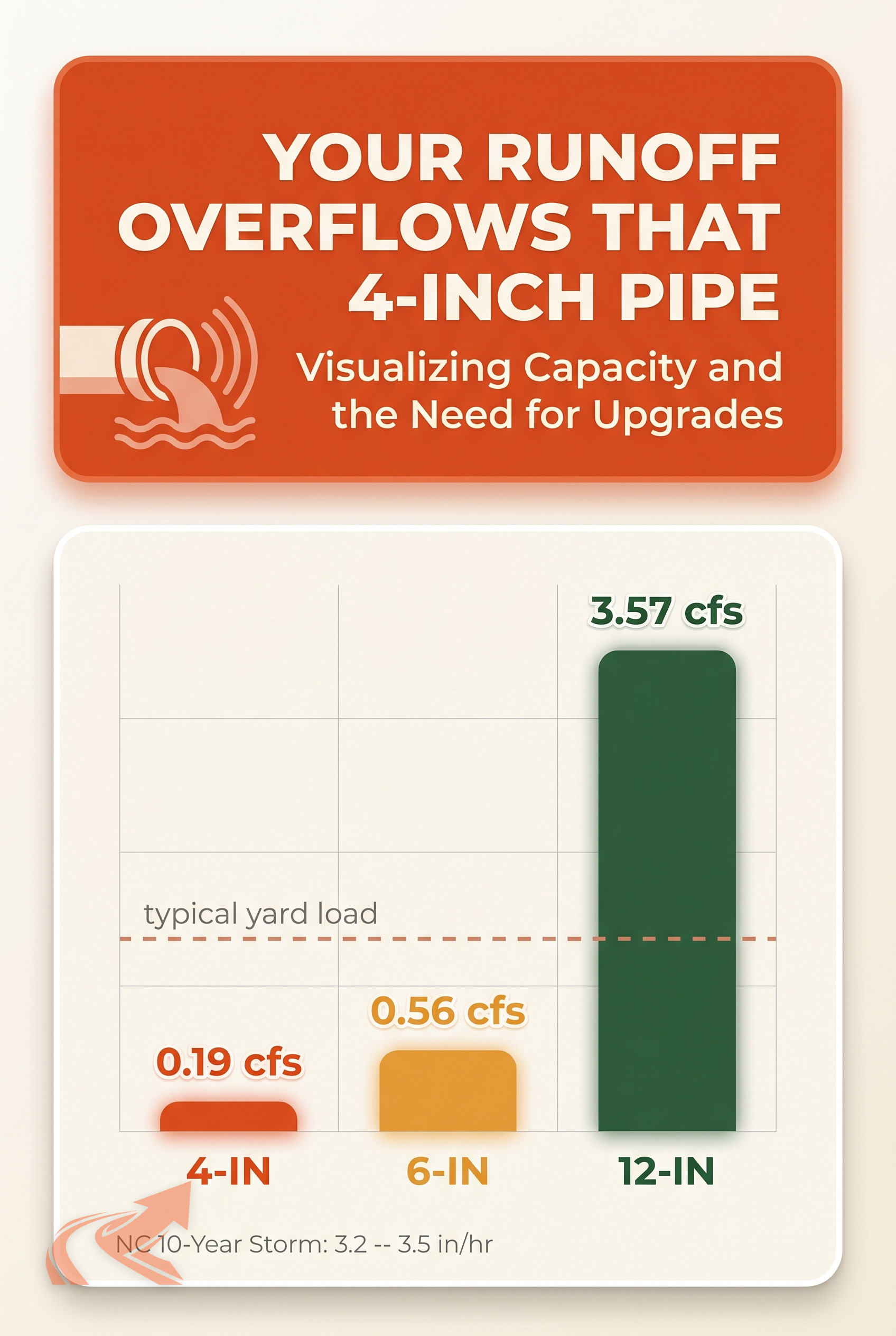
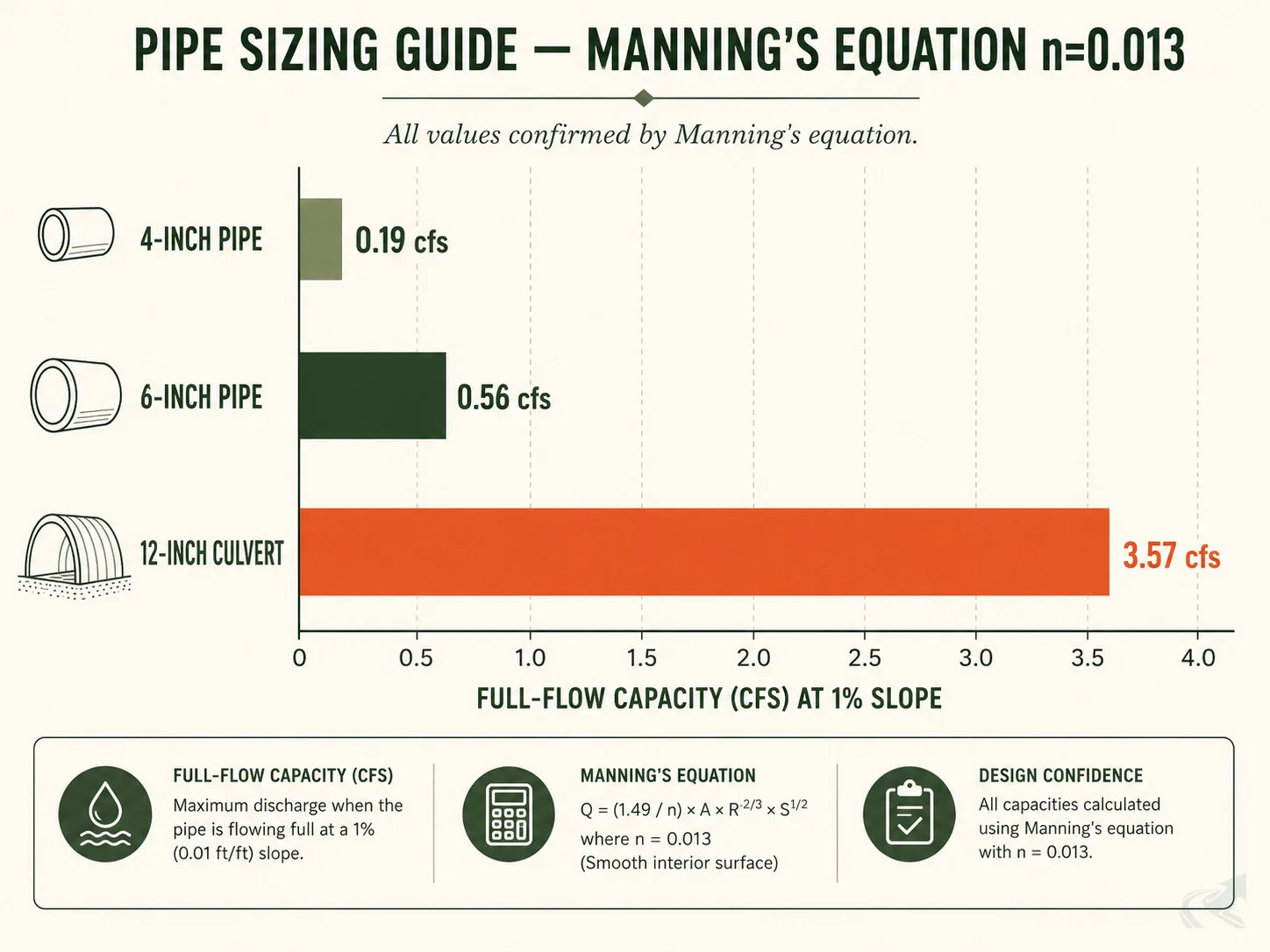
- 4-inch perforated French drain pipe at 1% slope: handles approximately 0.19 cfs at full flow.
- 6-inch pipe at 1% slope: handles approximately 0.56 cfs at full flow.
- 12-inch culvert at 1% slope: handles approximately 3.57 cfs at full flow.
- Residential swale: capacity depends on width, depth, and slope. A 2-foot-wide triangular swale at 2% slope handles substantially more than any pipe — but requires a clear daylight point and positive drainage to be effective.
Here is where the number becomes useful. If the calculator shows 0.8 cfs and your contractor has proposed a single 4-inch French drain, that is a significant sizing mismatch. That is the conversation to have before you sign, not after the yard still floods.
For context on what NC stormwater ordinances say about runoff thresholds — including when an impervious surface addition triggers a formal stormwater management requirement — see NC stormwater ordinances that apply to your runoff calculation.
permits apply when land disturbance crosses the NC acreage thresholds for grading permit requirements. The calculator does not replace that analysis, but it helps you understand the magnitude of the stormwater load you are working with.
If this output suggests your site is generating more runoff than your drainage system is sized for, a contractor walkthrough can verify it with actual site measurements. A contractor who can show you a sizing calculation — not just a proposal — is worth more than one who cannot explain why they chose the pipe they did. Get an itemized quote that includes drainage sizing logic from a grading contractor near me in NC.
For next steps on NC yard drainage solutions after calculating stormwater runoff, including swale design, positive drainage corrections, and what to tell your contractor, see the yard drainage guide.
Back to the NC grading and drainage calculators hub.