Two questions people often ask
Woven or non-woven geotextile for a French drain in NC?
Non-woven (4-6 oz) for most NC residential drainage -- it passes water in all directions and has better filtration for mixed-soil zones. Woven works for applications with vehicle loading or heavy surface pressure.
Does the fabric type matter for NC Piedmont clay specifically?
Yes. NC Piedmont kaolinite fines are fine enough to bridge across woven fabric's regular grid openings, restricting flow over time. Non-woven's random fiber matrix distributes the fine particles without bridging.
If you have already decided fabric may be appropriate for your drainage zone, the next question is which type of fabric to specify. A contractor’s product sheet says “non-woven 4 oz” — is that right for your yard in North Carolina? Almost certainly yes. Here is why the fiber structure matters in NC soils, and the one case where woven is the correct call instead.
Woven vs Non-Woven — The Core Difference
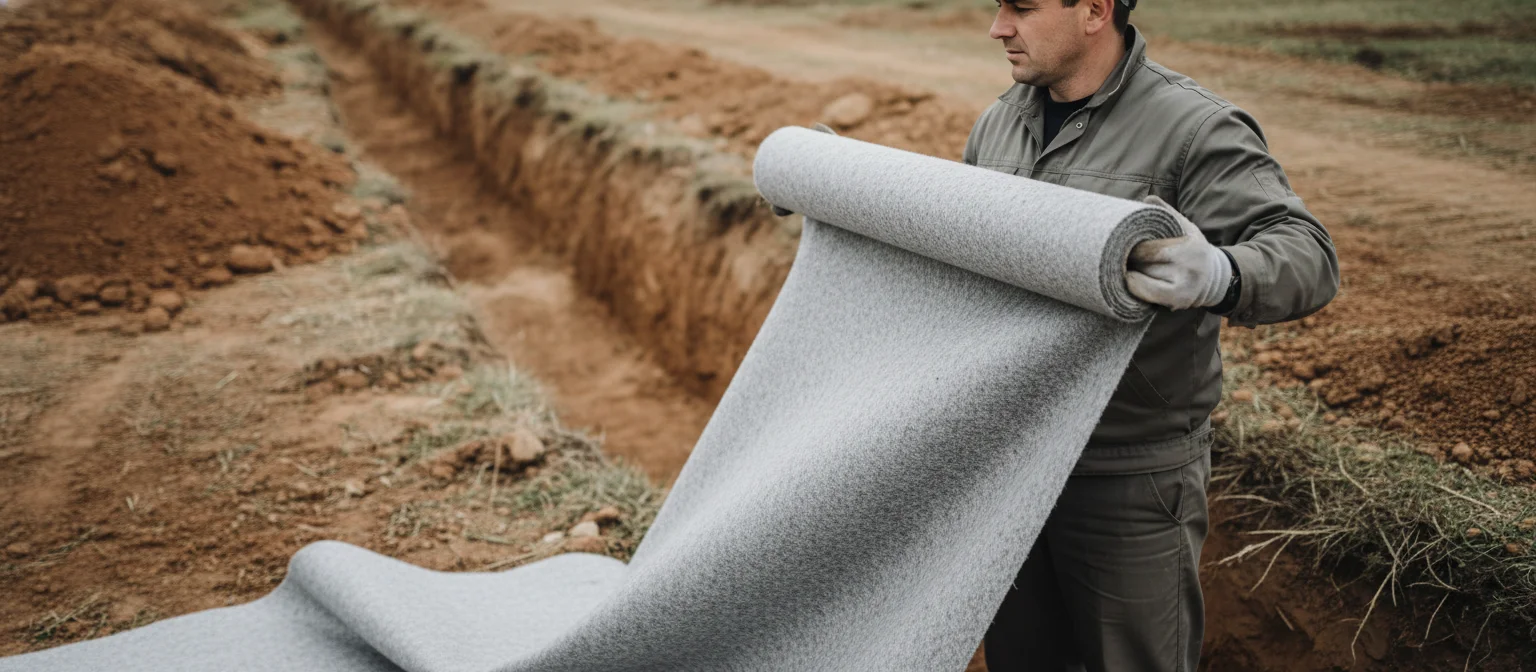
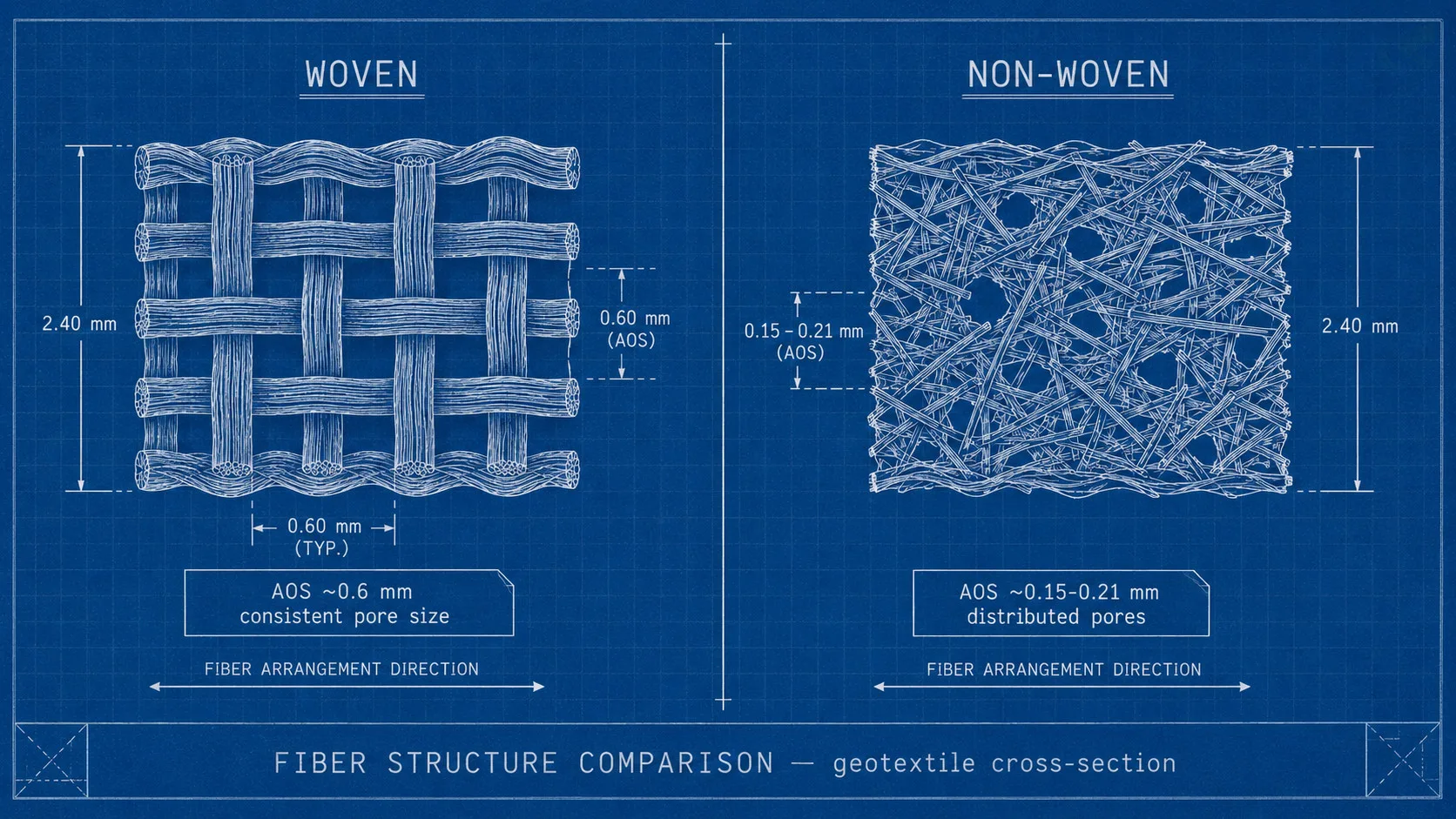
Woven geotextile has a regular grid structure — strong, permeable in one direction, good for separation under loads. Non-woven has a random fiber matrix — permeable in all directions, better filtration, and the standard choice for French drain trench-wrap applications.
The manufacturing difference drives every performance difference downstream. Woven fabric is made by interlacing continuous filaments in a regular over-under grid, the same way woven cloth is made. Non-woven fabric is made by bonding short fibers together randomly — heat-bonded, needle-punched, or both — producing a felt-like material with no consistent pore direction.
| Factor | Woven | Non-woven |
|---|---|---|
| Fiber structure | Regular interlaced grid | Random bonded fiber matrix |
| Flow direction | Primarily perpendicular to fabric plane | All directions through matrix |
| AOS (apparent opening size) | Larger, more consistent; ~0.6 mm at 4 oz equivalent | Smaller, distributed; ~0.15-0.21 mm at 4 oz |
| Typical weight | 4-12 oz per sq yd | 3-8 oz per sq yd |
| NC residential French drain use | Not standard; too large AOS for fines filtration | Standard spec — 4-6 oz |
| Load-bearing separation use | Yes — driveways, heavy equipment zones | Not ideal — lower tensile strength |
| Cost | Slightly higher | Slightly lower |
The AOS values above are representative of common North Carolina contractor-supply products (Mirafi 140N, Propex Geotex 401). Confirm your contractor’s specific product datasheet before specifying.
What NC Clay Does to Each Fabric Type
NC Piedmont kaolinite fines are small enough to pass through or clog both fabric types over time — the difference is that non-woven’s random matrix manages the migration better than woven’s regular grid in high-fines soil.
NC Piedmont clay is dominated by kaolinite, a platy fine-grained clay mineral. Kaolinite particles range from roughly 0.2 to 2 microns — far smaller than any geotextile pore. The question is not whether fines can pass; it is whether the fabric structure allows clogging to begin.
Woven fabric’s regular grid creates consistent pore openings. Fine clay particles in suspension can bridge across those consistent-sized openings, forming a cake layer that restricts flow. Research in geotextile engineering (Christopher and Fischer, 1992; Holtz et al. FHWA guidelines) shows that fabrics with a narrow pore-size distribution are more susceptible to bridging in high-fines soils.
Non-woven’s random fiber matrix produces a distributed pore structure — pore sizes vary continuously through the matrix rather than repeating at one consistent diameter. Fine particles that bridge one path find an adjacent path through a slightly different geometry. Water continues flowing even as some fines accumulate.
Geotextile in NC Piedmont clay: non-woven vs woven
Comparison. Non-woven holds up: Random fiber matrix -- pore sizes vary continuously; Bridged fines find an adjacent path, so water keeps moving; 4-6 oz needle-punched is the NC residential standard; Filters mixed-soil and sandy-transition zones well. Why woven clogs faster: Regular grid creates one consistent pore size; Kaolinite fines bridge across those openings; A cake layer forms and restricts flow over time; Large AOS makes it a separation fabric, not filtration.
- Random fiber matrix -- pore sizes vary continuously
- Bridged fines find an adjacent path, so water keeps moving
- 4-6 oz needle-punched is the NC residential standard
- Filters mixed-soil and sandy-transition zones well
- Regular grid creates one consistent pore size
- Kaolinite fines bridge across those openings
- A cake layer forms and restricts flow over time
- Large AOS makes it a separation fabric, not filtration
In high-fines NC Piedmont kaolinite clay, non-woven's distributed pore structure resists the bridging that clogs a woven grid.
This is why North Carolina contractors working in Piedmont soils default to non-woven. The fabric vs. no-fabric debate — covered at fabric vs no-fabric in NC clay — the real answer — is a separate question. Once fabric is appropriate, non-woven is the correct type for mixed or transitional NC Piedmont soils.
Weight Classes — 4 oz vs 6 oz vs 8 oz
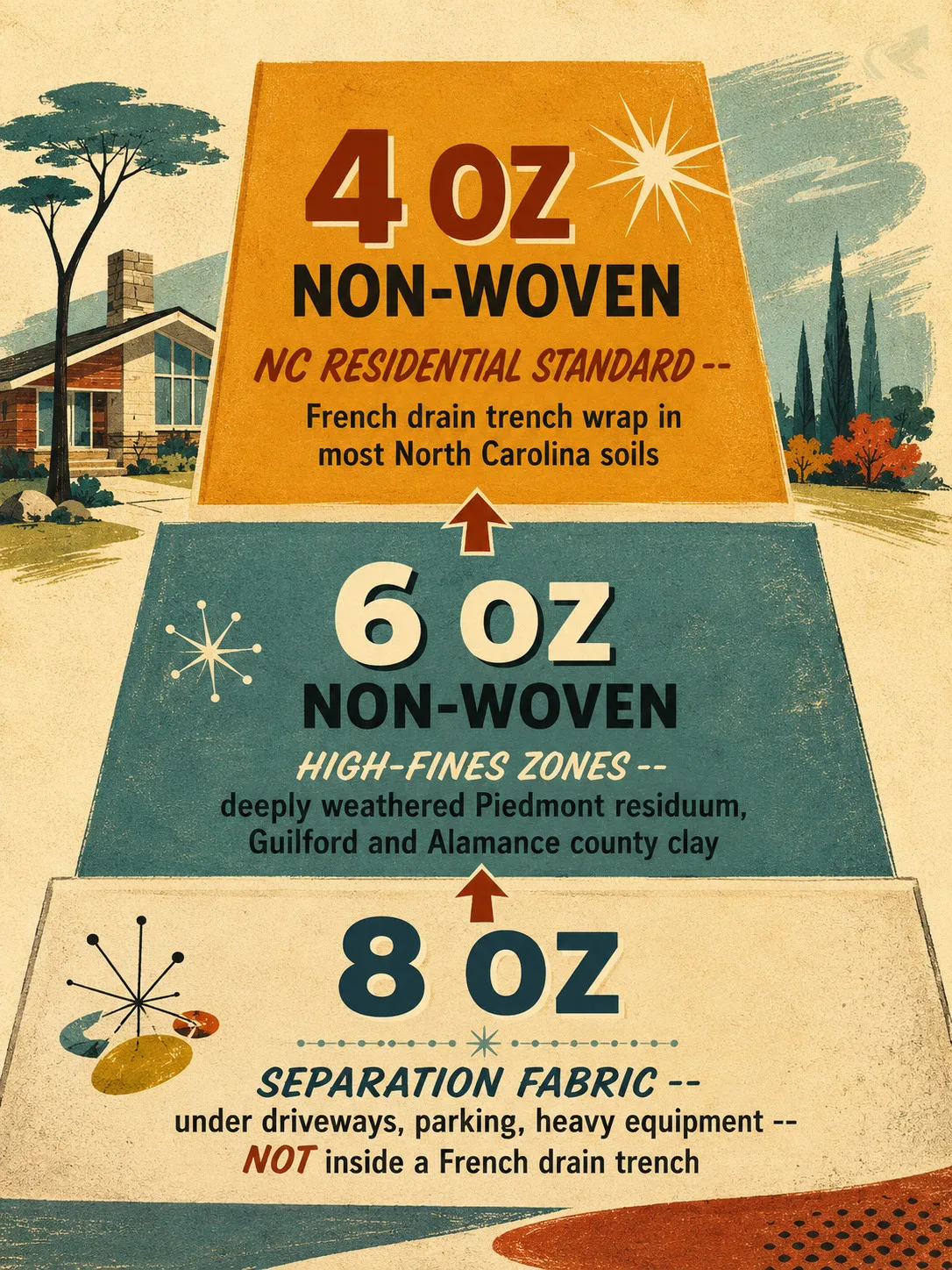
4 oz non-woven is the standard residential French drain spec in North Carolina. 6 oz adds longevity in higher-fines zones. 8 oz is a separation fabric, not a filtration fabric — it belongs under driveways and load-bearing surfaces, not inside a trench.
The weight classes serve different functions:
4 oz non-woven (3.5-4.5 oz/sq yd range): The default spec for residential French drains across most of North Carolina. Adequate filtration, flexible enough to conform to irregular trench walls, widely stocked at NC contractor supply houses. Mirafi 140N and Propex Geotex 315 are typical products at this weight.
6 oz non-woven: Appropriate when the soil profile shows high fines content throughout — deeply weathered Piedmont residuum, transitions from clay to saprolite, or areas where historical drainage issues suggest repeated fine-particle migration. The heavier fabric adds AOS stability over longer service life. Some North Carolina contractors specify 6 oz as their standard in Guilford and Alamance County soils.
8 oz woven or non-woven: A separation fabric, not a filtration spec. Use it under driveways, parking areas, and heavy-equipment access paths where the goal is keeping the aggregate base from migrating into subgrade — not filtering water through a drain trench. Specifying 8 oz inside a French drain trench is overkill and adds cost without drainage benefit.
The 4 oz vs 6 oz distinction matters in practice for French drains in NC red clay — deeper clay profiles often justify 6 oz even for residential trench widths. Ask the contractor which weight they are pricing and why.
The NCGH Position for NC Piedmont Residential
For NC Piedmont mixed-soil or sandy-transition zones where fabric is appropriate: specify 4-6 oz non-woven geotextile as trench wrap. Use pipe sock only (no trench wrap) in high-clay zones. No trench wrap at all in pure high-clay native soil.
This is not a blanket endorsement of fabric everywhere. The parent page at French drain installation in NC covers the full soil-type decision. In pure Piedmont high-clay soil, trench-wrap fabric often creates more problems than it solves.
Where fabric is appropriate — mixed profiles, sandy transition zones, areas with coarser parent material — the type distinction is clear: non-woven 4-6 oz for filtration, woven for separation under load.
When talking to a contractor about French drain installation process NC, ask directly: “What fabric spec are you using and why?” A contractor who specifies non-woven 4 oz in sandy-transition soil and can explain the AOS rationale is using current practice. A contractor who defaults to woven because it is stronger without explaining the filtration tradeoff may not be matching the spec to your specific soil profile.
To hire a licensed NC grading contractor who works in your county, the NCGH directory lists active-licensed contractors with their service areas. For background on NC Piedmont red clay soil engineering and why it complicates standard drainage specifications, that resource covers the soil science in more depth.
NC French drain fabric spec quick reference
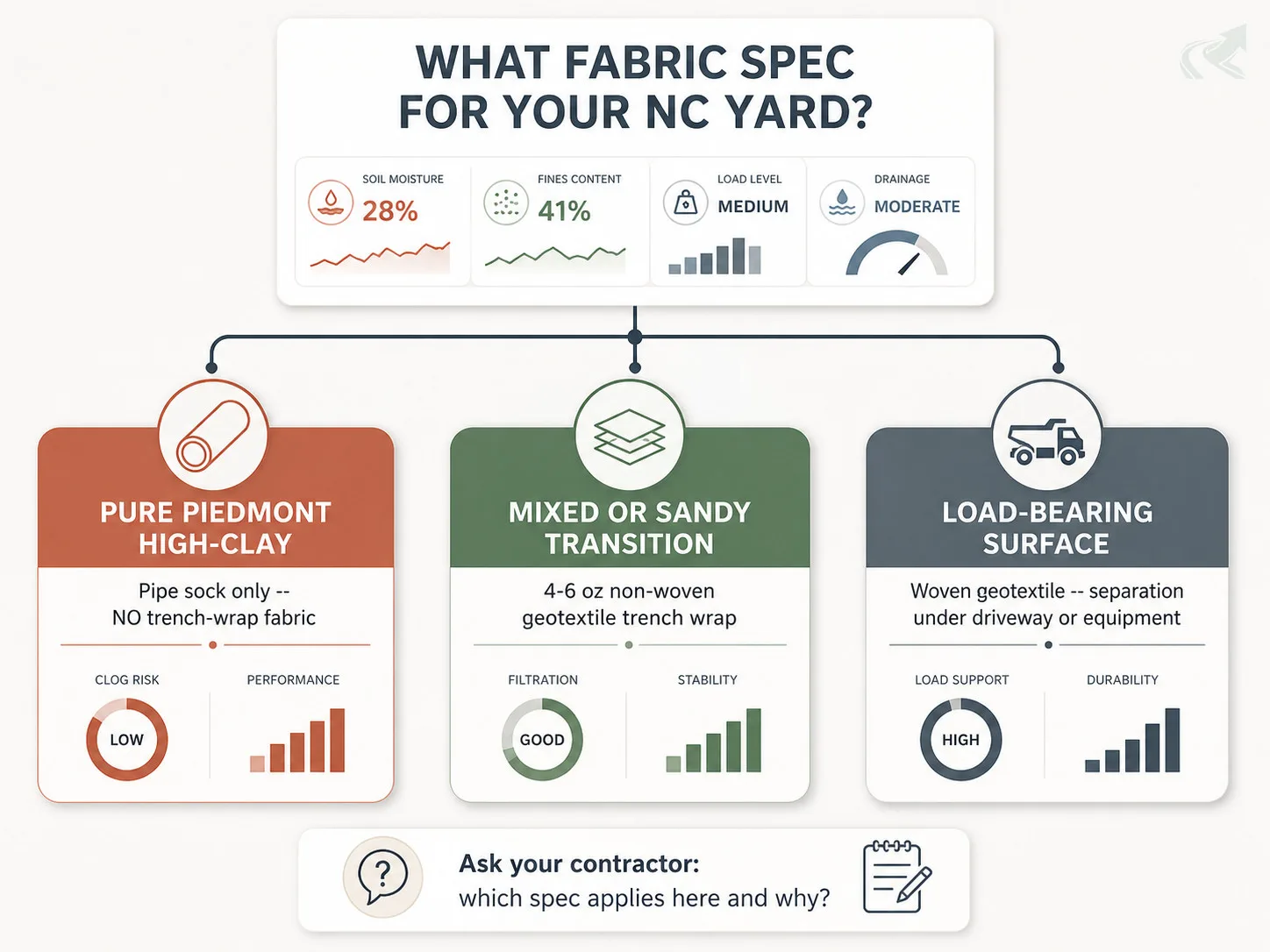
NC residential French drain fabric spec:
- Soil type: NC Piedmont high-clay — pipe sock only, no trench wrap
- Soil type: Mixed or sandy transition — 4-6 oz non-woven geotextile trench wrap
- Load-bearing (under driveway) — woven geotextile for separation
Ask your contractor which applies to your yard.