
The question homeowners search for
How long does a French drain last in NC?
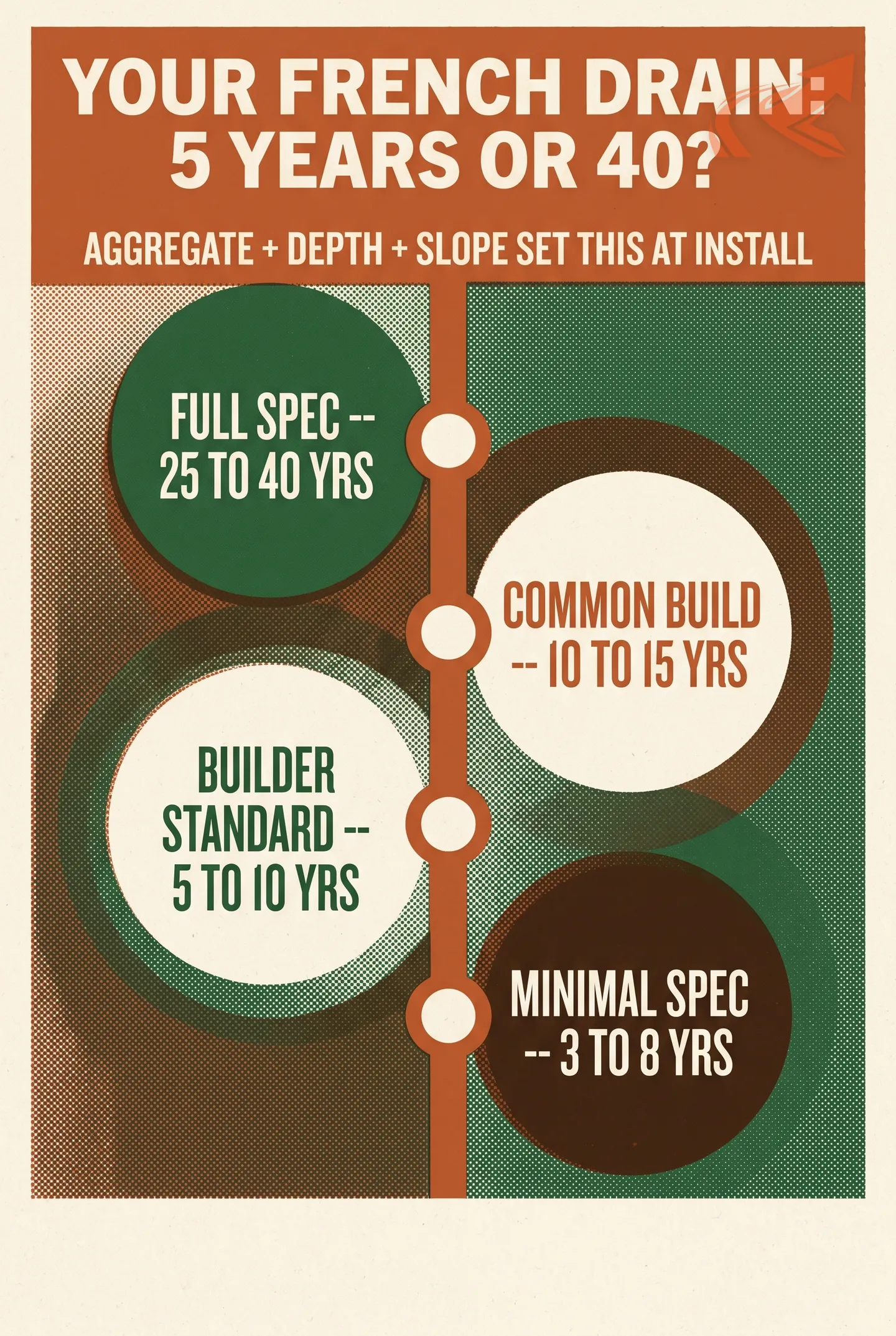
A properly installed NC French drain lasts 25-40 years. Common failure modes -- wrong aggregate, insufficient depth, flat grade -- cut that to 5-10 years. Here is how to tell which category your system is in.
Your French drain is in the ground. Now the question is whether it will still be working in 2035 or whether the yard will be standing in water again by 2029.
Lifespan for a North Carolina French drain is not a fixed number. It is an output of three installation decisions that were made before the first shovel of stone went in. This page maps those decisions, names the failure signals to watch for, and tells you the one maintenance step that actually matters.
What Determines French Drain Lifespan
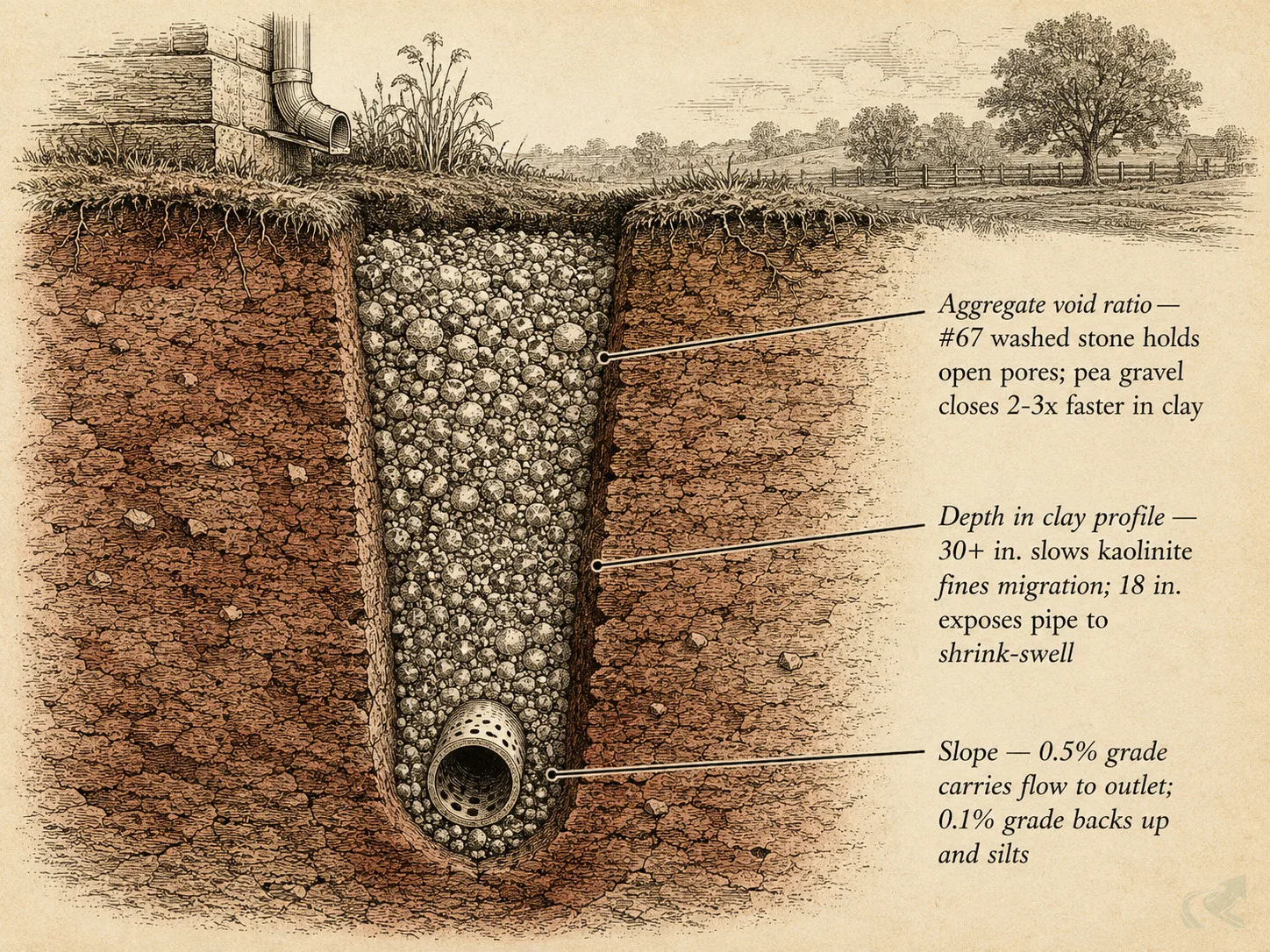
Three variables determine lifespan: aggregate quality (#67 vs pea gravel vs crusher run), depth relative to the clay profile, and original slope. These are installation decisions, not maintenance decisions.
By the time a French drain is installed, the lifespan range is already set. The homeowner cannot change aggregate choice, depth, or original slope after the trench is backfilled.
Aggregate void ratio is the key metric. A properly installed system uses #67 washed stone — 3/4 inch, screened, with fines rinsed out. The open void space between stones carries the water. When fines migrate in over time (or when the wrong stone was used from the start), those voids close and drainage capacity drops toward zero.
Depth matters in NC Piedmont clay because kaolinite fines migrate up and sideways differently than in sandy soils. A system at 18 inches is in a different clay profile than a system at 36 inches — the shrink-swell cycle acts on the pipe differently at each depth.
Slope verification at install determines whether water can reach the daylight outlet. A system at 0.1% grade will back up years earlier than one at 0.5%, all else equal.
Lifespan by Build Quality — The Reference Ranges
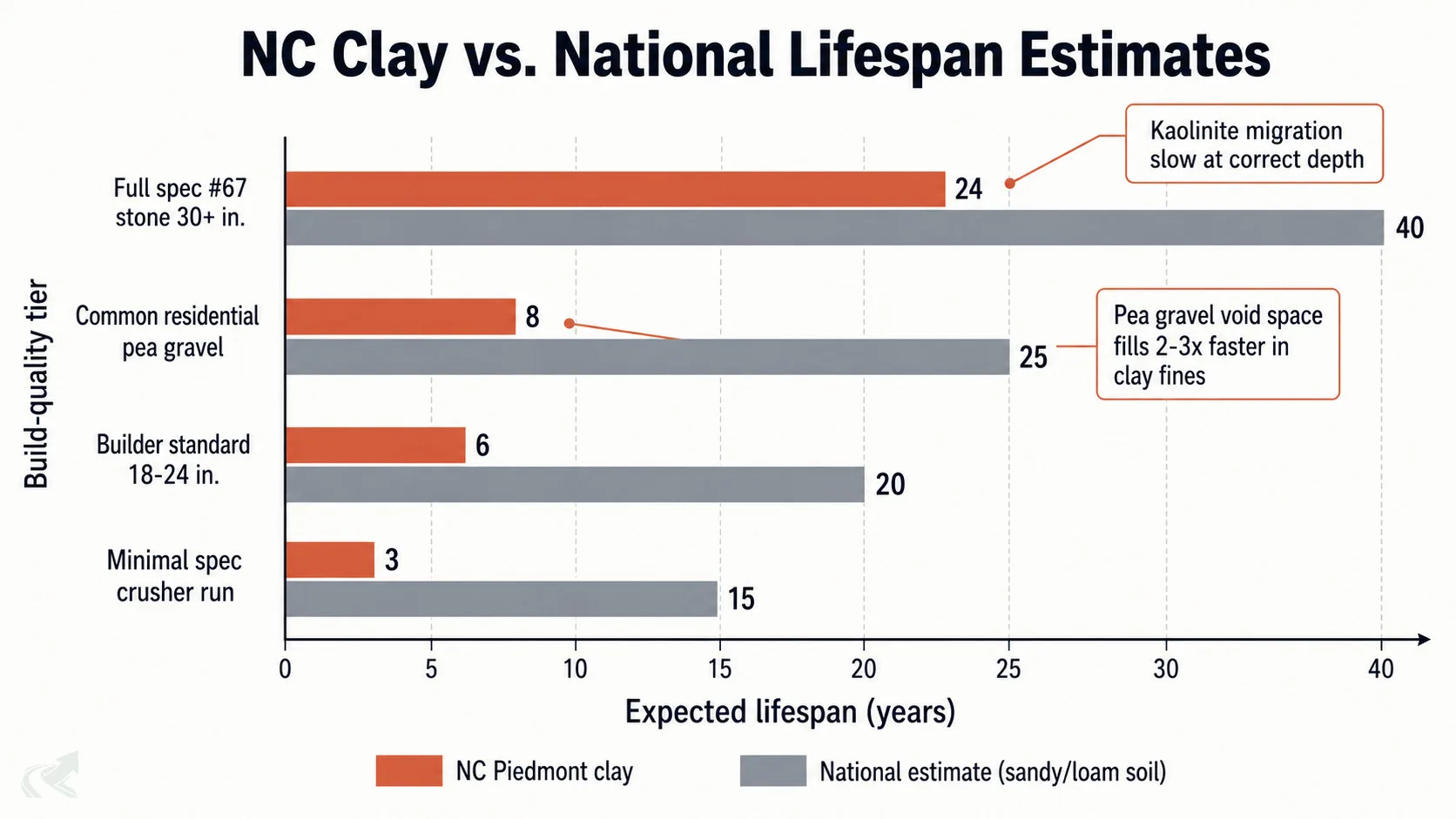
Correct spec (depth, #67 aggregate, verified slope): 25-40 years. Common residential compromise (adequate depth, pea gravel substituted): 10-15 years. Minimal spec (shallow, wrong aggregate, no slope verification): 3-8 years.
These ranges reflect NC Piedmont clay conditions specifically. National estimates typically run higher because they assume sandy or loam soils where fines migration is slower.
| Build quality | Expected lifespan | Primary failure mode | NC clay factor |
|---|---|---|---|
| Full spec — #67 stone, 30+ in. depth, 0.5%+ slope | 25-40 years | Outlet blockage (fixable) | Kaolinite migration slow at correct depth |
| Common residential — adequate depth, pea gravel, slope verified | 10-15 years | Aggregate void closure | Pea gravel pore space fills 2-3x faster in clay |
| Builder standard — 18-24 in., pea gravel, slope estimated | 5-10 years | Combined: void closure + occasional pipe pinch | Shrink-swell acts on shallow pipe |
| Minimal spec — shallow, crusher run, no slope check | 3-8 years | Rapid void closure, standing water returns | Clay fines seal system within a few wet seasons |
Note: these are operator-informed estimates aligned with drainage engineering guidance. A camera inspection of an existing system gives you actual data rather than a range.
French drain at 10 years in NC clay: still working vs failed
Comparison. Built to last 25-40 years: #67 washed stone keeps an open void ratio; Pipe slots stay clear, water moves freely; Verified slope carries flow to the daylight outlet; Correct depth slows kaolinite fines migration. Failed inside 8 years: Pea gravel substituted for #67 washed stone; Void space fills 2-3x faster in NC clay fines; Stone column and pipe choke with sediment; Standing water returns to the original zone.
- #67 washed stone keeps an open void ratio
- Pipe slots stay clear, water moves freely
- Verified slope carries flow to the daylight outlet
- Correct depth slows kaolinite fines migration
- Pea gravel substituted for #67 washed stone
- Void space fills 2-3x faster in NC clay fines
- Stone column and pipe choke with sediment
- Standing water returns to the original zone
Lifespan is set at install -- aggregate, depth, and slope are decided before the trench is backfilled and can't be changed after.
The Three Early Failure Signals
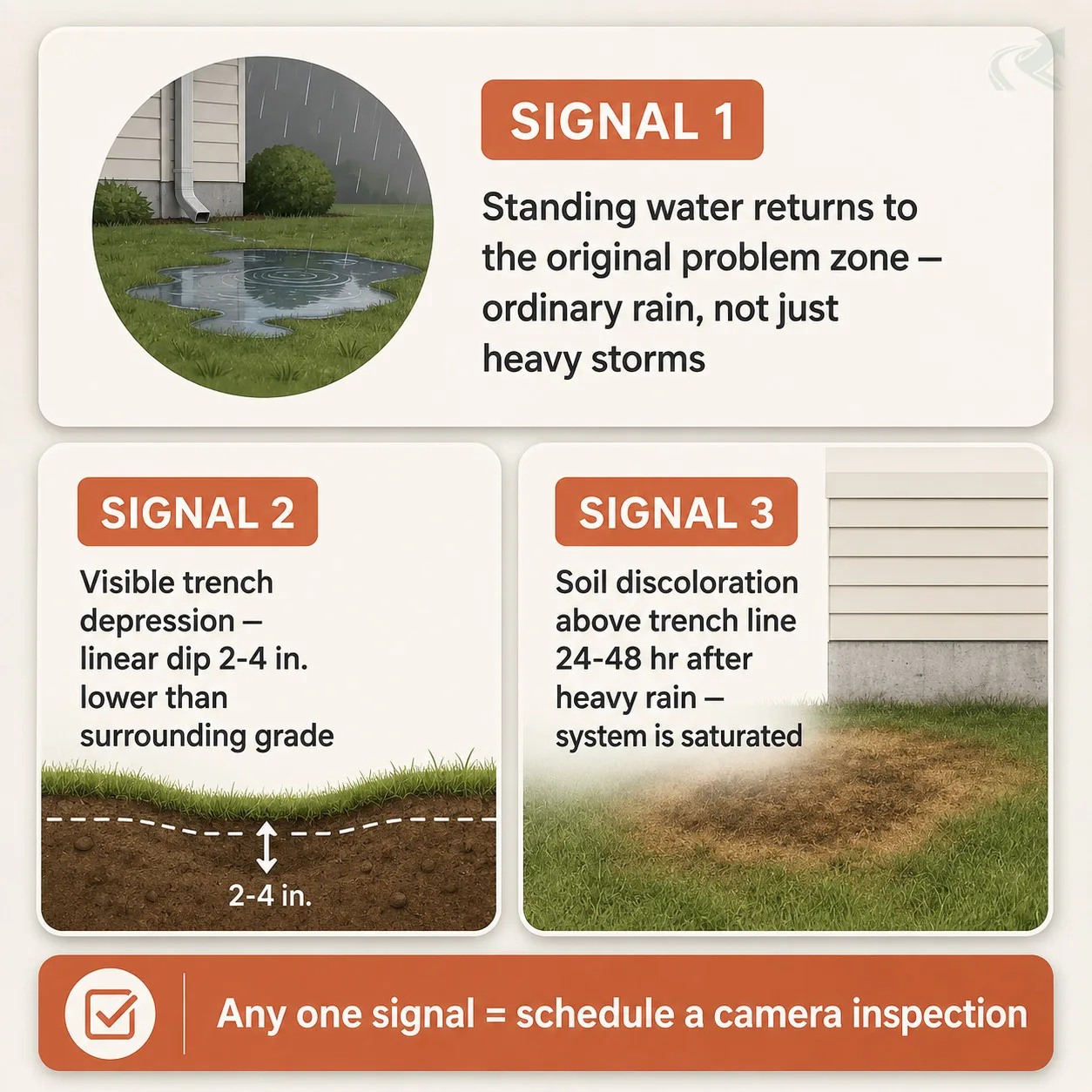
Standing water returning to the original problem zone, a visible trench depression in the yard, or soil discoloration above the trench line after rain — any one of these means the system needs a camera inspection.
These signals appear before the system fails completely. Acting at the signal stage often means a partial repair. Waiting until standing water is persistent usually means full replacement.
Signal 1: Standing water returns to the original problem zone
What it looks like: the area that had drainage problems before installation is wet again — not just during heavy storms, but after ordinary rain that the system previously handled.
What it usually means: the aggregate void ratio has dropped enough that the system can no longer move the volume it was designed for. In pea-gravel systems this can happen within 5-7 years in Piedmont clay.
What to do: schedule a camera inspection before replacing the system. A partial blockage near the outlet is a repair. Sediment throughout the run is a replacement.
Signal 2: A visible trench depression in the yard
What it looks like: a linear depression, 2-4 inches lower than surrounding grade, following the drain run. Sometimes a straight line, sometimes a slight curve.
What it usually means: the backfill over the stone column has settled and compacted. This is normal over time but can also signal that the stone column is losing void space and compressing from load above.
What to do: mark the depression line and measure it at two or three points six months apart. If it is deepening, the system needs inspection. A stable depression is cosmetic; a deepening one is structural.
Signal 3: Soil discoloration above the trench line after rain
What it looks like: a darker strip in the yard, following the drain run exactly, 24-48 hours after heavy rain when surrounding soil has dried.
What it usually means: moisture is tracking along the stone column but not draining away — the system is saturated and not moving water to the outlet. Often a sign that the outlet is partially blocked or that the pipe slope has dropped below effective gradient.
What to do: check the daylight outlet first (see maintenance section below). If the outlet is clear and water still sits in the trench zone, the problem is inside the pipe or stone column.
How NC Clay Accelerates Failure
NC Piedmont clay’s kaolinite fines and shrink-swell cycle act on French drain components faster than most national lifespan estimates predict.
Three mechanisms are specific to NC clay that most national guides underweight:
Pipe pinch from clay shrink. At depths under 24 inches, Piedmont clay’s shrink-swell cycle exerts lateral pressure on the pipe during dry periods. Corrugated pipe is more vulnerable than at this depth. Over years, repeated compression cycles can partially collapse the pipe walls. See the PVC vs corrugated pipe lifespan comparison for the depth-by-material breakdown.
Kaolinite fines migration into fabric. North Carolina’s Piedmont clay contains a high percentage of kaolinite — a fine-particle clay mineral that migrates into geotextile fabric over time. Systems installed with lighter-weight fabric (or no fabric, where that was an error) experience this faster. The how fabric choice affects French drain lifespan page covers the fabric weight and weave decisions that slow this process.
Trench-wall sealing on re-excavation. When a failing system is dug up for repair, NC clay that was disturbed during original installation has often re-consolidated around the stone column. The act of re-excavating this clay can smear the trench wall, creating a less permeable barrier than the original cut. Experienced contractors score or break up the trench wall on re-excavation to restore permeability.
Maintenance That Extends Lifespan
French drains in NC clay need one maintenance action: keep the outlet clear. If the daylight point is blocked — debris, vegetation, freeze-thaw heave — the system backs up and starts acting like a buried cistern instead of a drain.
The daylight outlet is the discharge terminus where the pipe exits at grade into a low area, ditch, or storm drain connection. It is the single maintenance point for most residential French drain systems.
Annual outlet check — what to do:
Walk to the outlet point after a moderate rain (at least half an inch over 24 hours) and check for water flow. A functioning system should show a visible trickle or stream from the outlet end during or just after rain.
If no flow: look for debris blocking the pipe end (leaves, sediment, animal nest material). Clear it manually. Check whether vegetation has grown over the outlet and restricted flow. Pull it back. Check whether freeze-thaw has heaved the pipe end above the surrounding grade — the outlet needs to discharge downhill, not level.
If clearing the outlet restores flow: you have caught a maintenance issue before it became a failure.
If clearing the outlet does not restore flow within the next rain cycle: schedule a contractor inspection. The blockage is internal, not at the outlet.
The one thing to avoid: do not flush water backward into the system from the outlet end as a DIY clearing method. This can push sediment deeper into the pipe run.
When It Is Time to Replace vs Repair
Replace if: the trench line has settled significantly, a camera inspection shows sediment blocking a significant portion of the pipe run, or standing water returns within six months of any clearing attempt.
The repair vs replace decision has one reliable input: a camera inspection. Without it, you are estimating based on surface signals that can point to either outcome.
Repair candidates: outlet blockage with clear pipe run, isolated sediment accumulation within 10 feet of the outlet, fabric failure at a single access point (uncommon but repairable if the stone column is still open).
Replacement candidates: sediment throughout the pipe run, stone column void closure across more than one-third of the system length, pipe collapse or deformation from clay pressure, system age beyond the original spec’s expected range.
The right first step is almost always a camera inspection — not a replacement quote. A rain-check post-storm documentation before calling a contractor gives the inspector a baseline for what the system is doing (or not doing) in real conditions.
If you are ready to talk to a contractor about an inspection or replacement, hire a grading operator in North Carolina in the NCGH directory. Every contractor listed has been cross-checked against the NC Licensing Board — active license confirmed, OSHA record reviewed.
French drain annual check — takes 10 minutes.
Once a year after winter:
- Check daylight outlet — is water flowing after rain? Is the outlet clear of debris?
- Walk the trench line — any visible settling or depression?
- Check original problem zone — is standing water returning?
If any item above is a problem: schedule a contractor inspection before the next wet season. A camera inspection is far cheaper than a full replacement.