
PVC or corrugated pipe for your NC French drain?
PVC or corrugated pipe for a French drain in NC?
PVC (SDR-35) is rigid, camera-able, and cleanable 15 years from now. Corrugated (HDPE) is flexible, cheaper, and adequate for short straight runs. In NC clay, PVC is the longer-term choice. Corrugated works when budget is the binding constraint and the run is short and straight.
Does the pipe type actually matter for a French drain?
It does -- but not for the reasons most people expect. Both types drain water. The difference shows up at year 12 when you need to camera-inspect, jet-clean, or diagnose a slow drain. SDR-35 PVC makes that maintenance call routine. Corrugated HDPE makes it difficult or impossible without excavating.
Your contractor’s quote says “perforated corrugated pipe.” Is that a problem?
Not automatically. Corrugated pipe goes into French drain systems NC every day without incident. But there are conditions — specifically the length of the run, the presence of cleanout ports, and how long you plan to own the house — that make corrugated pipe a worse long-term choice in NC Piedmont clay.
This page maps the comparison so you can evaluate what’s on the quote.
PVC (SDR-35) vs Corrugated HDPE — The Reference Table
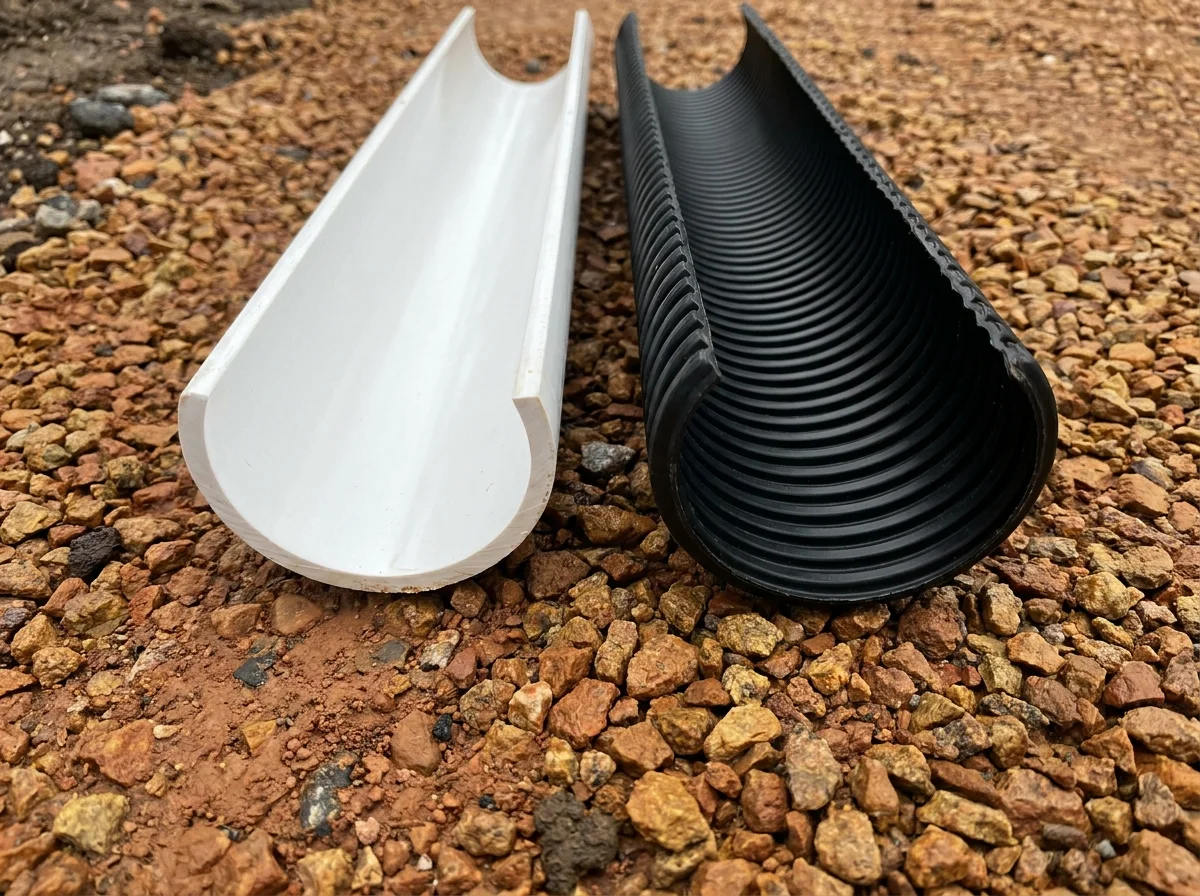
Both pipe types work in NC French drains. The difference is in long-term cleanability and sediment management.
and corrugated pipe both show up on NC drainage quotes. Here is the functional comparison that matters for your decision.
SDR-35 PVC vs HDPE Corrugated -- French drain pipe comparison
| Factor | SDR-35 PVC | HDPE Corrugated |
|---|---|---|
| Rigidity | Rigid -- holds shape through backfill and soil movement | Flexible -- conforms around obstacles; can deform under heavy load |
| Installed cost (NC Triangle) | ~$1.50--2.50 / linear foot (pipe only) | ~$0.60--1.20 / linear foot (pipe only) |
| Camera-inspectable? | Yes -- smooth interior accepts standard drain camera | Difficult -- corrugated ridges snag camera heads; many contractors decline to scope it |
| Sediment accumulation | Low -- smooth interior wall does not trap fines | Higher -- corrugated profile catches kaolinite clay fines over time |
| NC clay fit | Better for long runs with no cleanouts | Adequate for short straight runs with accessible cleanout ports |
| Cleanout port compatibility | Straightforward tee + riser installation | Flexible couplings required; less standard fit |
| Estimated lifespan (correct install) | 50+ years | 25--30 years (manufacturer spec); sediment shortens effective drainage life |
Rigidity
- SDR-35 PVC
- Rigid -- holds shape through backfill and soil movement
- HDPE Corrugated
- Flexible -- conforms around obstacles; can deform under heavy load
Installed cost (NC Triangle)
- SDR-35 PVC
- ~$1.50--2.50 / linear foot (pipe only)
- HDPE Corrugated
- ~$0.60--1.20 / linear foot (pipe only)
Camera-inspectable?
- SDR-35 PVC
- Yes -- smooth interior accepts standard drain camera
- HDPE Corrugated
- Difficult -- corrugated ridges snag camera heads; many contractors decline to scope it
Sediment accumulation
- SDR-35 PVC
- Low -- smooth interior wall does not trap fines
- HDPE Corrugated
- Higher -- corrugated profile catches kaolinite clay fines over time
NC clay fit
- SDR-35 PVC
- Better for long runs with no cleanouts
- HDPE Corrugated
- Adequate for short straight runs with accessible cleanout ports
Cleanout port compatibility
- SDR-35 PVC
- Straightforward tee + riser installation
- HDPE Corrugated
- Flexible couplings required; less standard fit
Estimated lifespan (correct install)
- SDR-35 PVC
- 50+ years
- HDPE Corrugated
- 25--30 years (manufacturer spec); sediment shortens effective drainage life
Cost figures are NC Triangle contractor-supply estimates as of 2026 (SiteOne, Ferguson, APEX Supply). Retail big-box pricing (Home Depot, Lowe’s) runs higher — corrugated perforated 4-in pipe at big-box is typically $0.90—1.20/LF in single quantities. Contractor supply in volume is the relevant benchmark for an installed project.
The Cleanout Question — Why It Matters in NC Clay
In NC clay, a French drain pipe accumulates more sediment than in sandy soil — and a pipe you can camera-inspect and jet-clean in 15 years is worth the premium.
A cleanout port is an accessible vertical riser — typically a 4-inch clean-out tee installed at each end of a pipe run and wherever the line changes direction. When a French drain slows down years after installation, a cleanout port lets a technician insert a drain camera to find the blockage, then jet-clean the line. Without one, diagnosis means excavating.
In North Carolina’s Piedmont clay, the sediment loading is higher than in sandy coastal or loamy soil. NC Piedmont red clay contains high levels of kaolinite — fine clay particles that stay suspended longer before settling. That suspension enters the French drain through the perforations and, over time, settles on whatever surface it contacts.
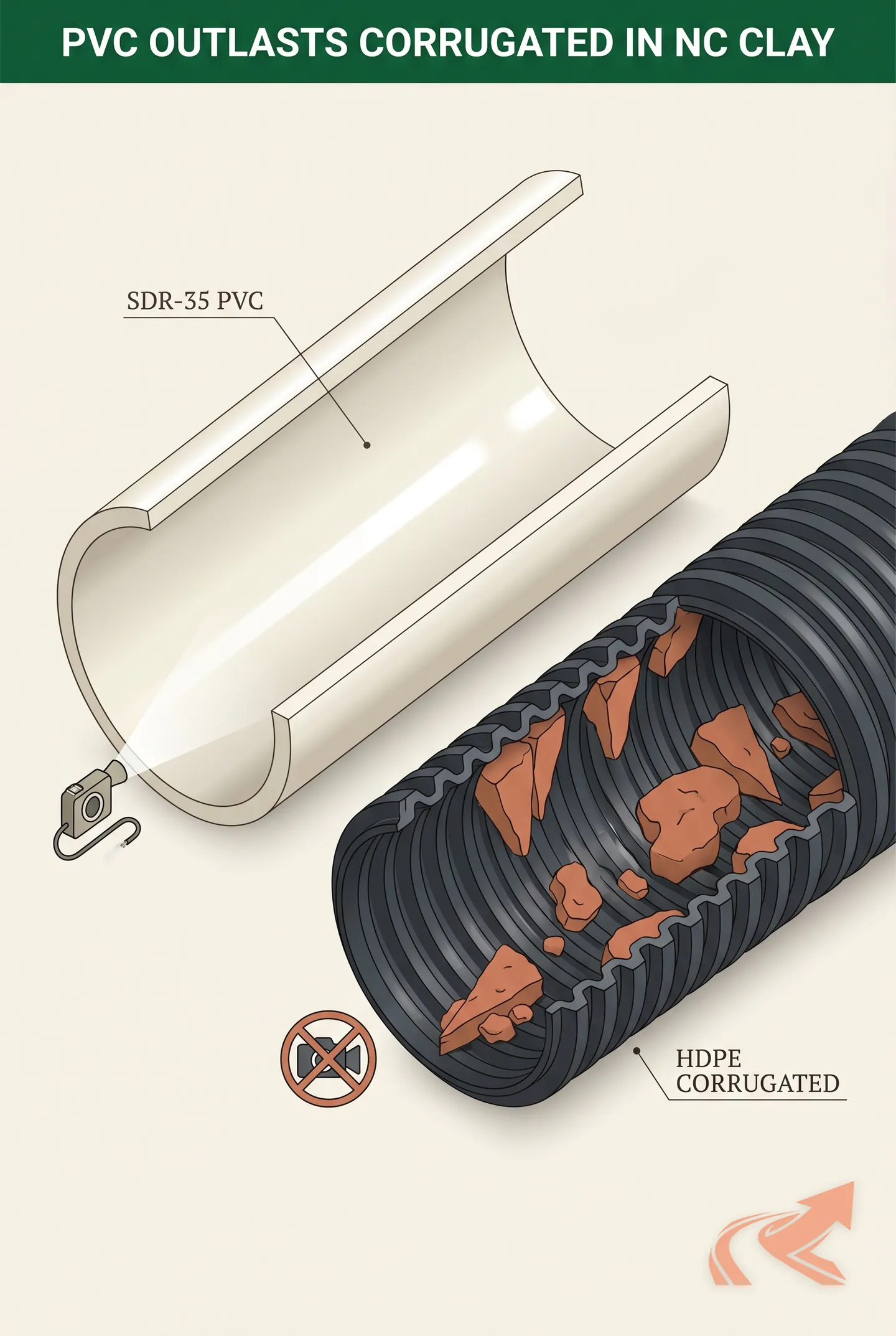
On smooth-wall pipe, kaolinite fines tend to accumulate as a thin layer that jet-cleaning handles easily. On corrugated pipe, the ridges of the corrugated profile act as sediment traps. Fines lodge in each valley and compact under subsequent drainage events. The flow restriction builds gradually — it rarely announces itself until the system is meaningfully degraded.
This is well-documented drainage practice: a smooth interior wall lets fines wash through, while the internal ridges of corrugated pipe trap silt and debris in each valley — the buildup compounds and restricts flow over time. Smooth-wall pipe also carries meaningfully more water at the same slope.
15 years in NC clay: SDR-35 PVC vs corrugated HDPE
Comparison. SDR-35 PVC holds up: Smooth interior wall lets kaolinite fines wash through; Sediment stays a thin layer a jet-clean handles; A drain camera runs the line to find blockages; Cleanout tee + riser makes maintenance routine. Corrugated HDPE silts in: Corrugated ridges trap NC clay fines in each valley; Sediment compacts and restricts flow gradually; Ridges snag camera heads -- many decline to scope it; Diagnosis on a clogged run often means excavating.
- Smooth interior wall lets kaolinite fines wash through
- Sediment stays a thin layer a jet-clean handles
- A drain camera runs the line to find blockages
- Cleanout tee + riser makes maintenance routine
- Corrugated ridges trap NC clay fines in each valley
- Sediment compacts and restricts flow gradually
- Ridges snag camera heads -- many decline to scope it
- Diagnosis on a clogged run often means excavating
Both pipes drain water on day one; NC Piedmont clay's high fines loading is what separates them at year 12.
Slot Orientation in NC Clay
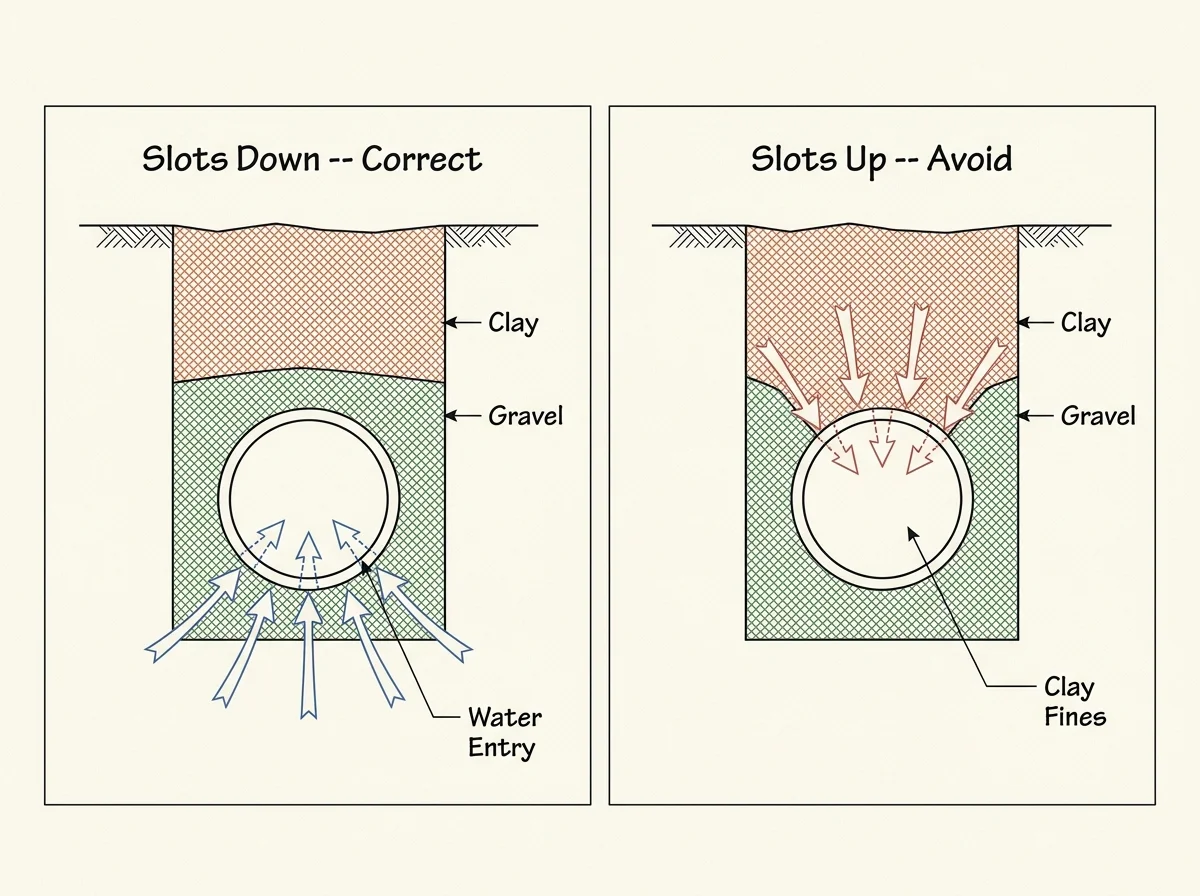
Slots-down is the correct orientation in NC clay. Slots-up allows clay pressure to drive fines directly into the pipe; slots-down lets water enter from below where pressure is lower.
Perforated drainage pipe — whether PVC slotted pipe or corrugated HDPE with perforations — can be installed with the perforations facing up, down, or on all sides depending on the pipe type.
For NC Piedmont clay, slots-down (perforations positioned at the 4 o’clock and 8 o’clock positions on the bottom half of the pipe) is the correct orientation. Here is why: saturated clay above the pipe exerts downward pressure. Perforations facing up are exposed directly to that pressure, which drives clay fines into the pipe rather than letting water migrate in through hydrostatic pressure from below.
With slots-down, water enters the pipe at the lowest pressure zone. Clay fines above the pipe encounter the solid upper half first. The #67 stone for French drain aggregate directly surrounding the pipe filters the water before it reaches the perforations.
Note the difference between pipe types: most corrugated drain pipe has perforations on all sides in a circumferential pattern — meaning slots-down orientation is less achievable with some corrugated products. SDR-35 PVC slotted pipe allows true directional control. Confirm with your contractor what the pipe’s perforation pattern is before assuming orientation is possible.
Slots-down is the conventional industry orientation for perforated drain pipe in cohesive soils. With perforations at the 4 and 8 o’clock positions, water enters from the low-pressure zone and sediment settles into the surrounding stone rather than into the pipe — the line silts in no higher than the perforations themselves.
Sock vs No Sock — A Different Decision From Fabric Wrap
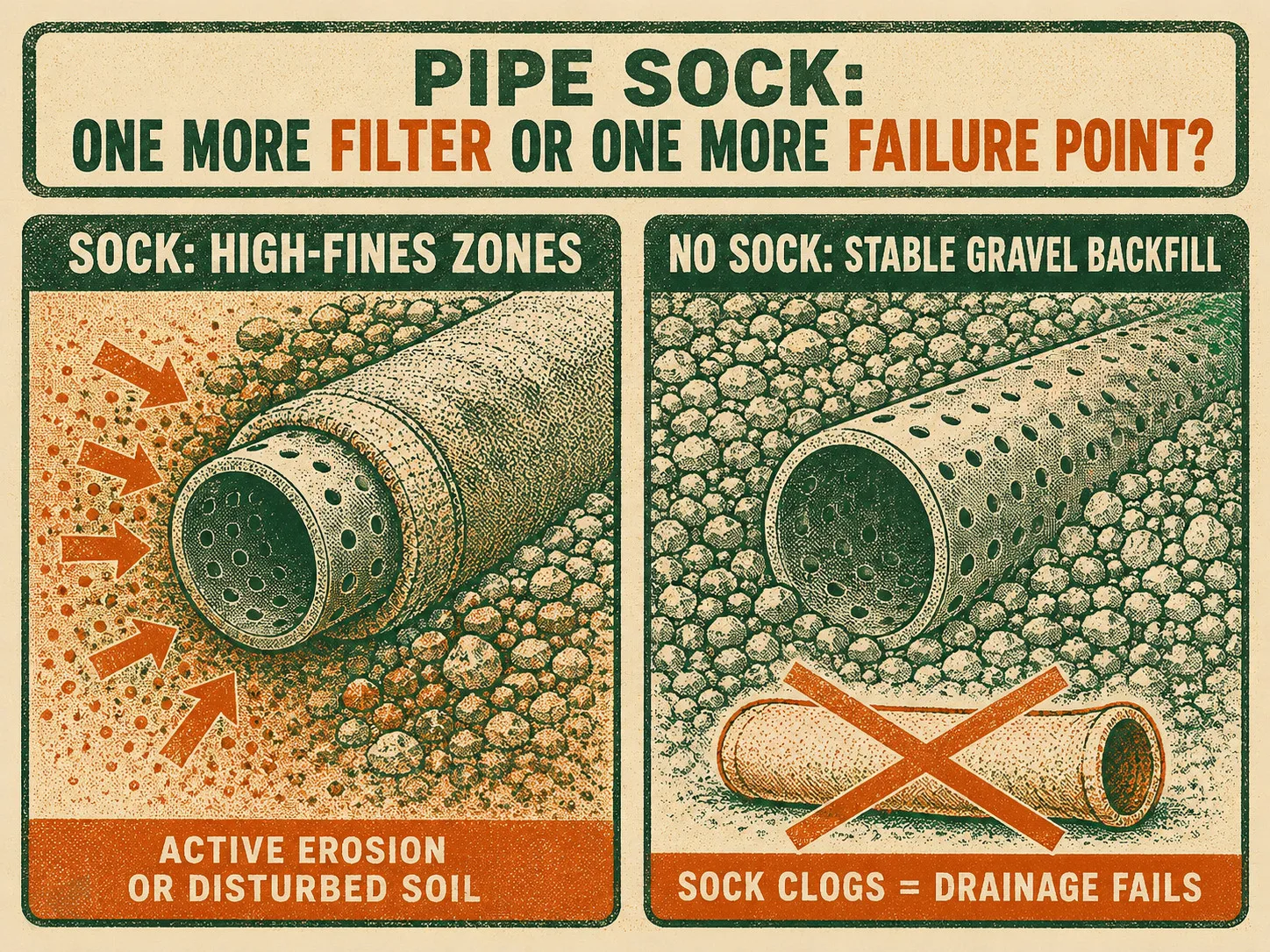
Pipe sock is the fabric wrapped directly on the pipe — it is a different decision from the trench-wrap fabric question. In NC clay, skip the trench wrap but consider a sock in zones with high fines.
Pipe sock is a geotextile tube that slides over the pipe before installation. It is not the same as the fabric that lines the trench walls. These are two separate decisions and they are frequently conflated on contractor quotes and homeowner forums.
The trench-wrap fabric question in NC clay — whether to line the trench walls with geotextile — has its own analysis. The short answer for NC clay is that trench-wrap fabric can impede lateral water movement in ways that defeat the drain’s purpose. Full discussion at fabric vs no-fabric in NC clay.
Pipe sock is a narrower question. A sock wrapped on the pipe provides one additional filtration layer at the point of water entry into the pipe. In zones with very high kaolinite fines — areas of active erosion, recently disturbed soil, or slopes above the drain — a sock can delay sediment entry into the pipe.
The tradeoff: a sock that clogs is worse than no sock. If the sock’s pores fill with clay fines, it blocks water entry entirely and the drain fails functionally. In stable soil with proper gravel backfill, a sock adds cost without proportional benefit.
Ask your contractor to specify: pipe sock or not, and why, given the soil conditions at your specific installation.
Methodology Notes: Gate City vs Apple Drains on Pipe
Shawn at Gate City Foundation and Drainage prefers PVC for cleanout and durability. Apple Drains uses corrugated pipe in Florida’s simpler soil environment. In NC clay, the Gate City logic applies.
You may have encountered Apple Drains’ methodology — they produce high-volume YouTube content and their process is well-documented. Their preference for corrugated pipe is grounded in Florida’s predominantly sandy soil: low clay content, lower kaolinite fines loading, and a more forgiving sediment environment. Corrugated pipe in sandy Florida soil performs differently than corrugated pipe in NC Piedmont red clay over a 15-year window.
Shawn’s documented preference for SDR-35 PVC on NC residential drainage work reflects a different soil reality. North Carolina clay — particularly in the Triad, Triangle, and Charlotte Piedmont — carries higher fines loading, higher sediment accumulation risk, and a stronger case for camera-inspectable pipe. His emphasis on cleanout port placement as a system design decision, not an afterthought, follows from the same logic.
NC Homeowner Takeaway: Apple Drains’ core drainage principles — proper slope, correct stone, adequate pipe diameter — translate directly to North Carolina. The pipe-material preference does not, because the soil is different. If you have watched Apple Drains content, apply their installation logic and upgrade their pipe spec for your soil type. See the Gate City Foundation Drainage (Shawn) method for documentation of the NC-adapted approach.
What to Ask Your Contractor About Pipe
Ask: what pipe type, what slot orientation, and does the system have a cleanout port? If no cleanout port and corrugated pipe on a long run — ask why.
When you receive a French drain installation NC quote that doesn’t specify pipe type, you cannot evaluate it against another quote. These are the questions that turn a vague line item into an accountable spec.
Pipe spec checklist — ask before signing:
- Pipe type specified (PVC SDR-35 or HDPE corrugated)?
- Slot orientation specified (slots-down)?
- Pipe sock specified or not (and why)?
- Cleanout port included on runs over 50 ft?
Request an itemized quote that names pipe type, slot orientation, and cleanout location. If the answer is corrugated with no cleanout port on a run longer than 50 feet, ask why. The question is not accusatory — it is the right question. A contractor who can answer it fluently has done the job before.
For sizing questions, see 4-inch vs 6-inch French drain pipe. For expected system lifespan based on installation variables, see how long does a French drain last.
Find a grading contractor in North Carolina who can provide an itemized quote with pipe type and cleanout location specified.