
The most expensive French drain mistake is the one you discover a year after install. The yard looks fine. Then a wet spring hits, the system backs up, and you realize the water has nowhere to go — except back toward the house. Diagnosing it means digging up the trench to find out why it stopped working.
Most failures in North Carolina fall into two groups: geometry mistakes (wrong slope, insufficient depth, no confirmed daylight) and clay-specific mistakes (skipped trench-wall prep, wrong aggregate, trench-wrap fabric, pipe orientation). The geometry mistakes are usually unfixable without full excavation. The clay-specific ones are often catchable before backfill — if you know what to look for.
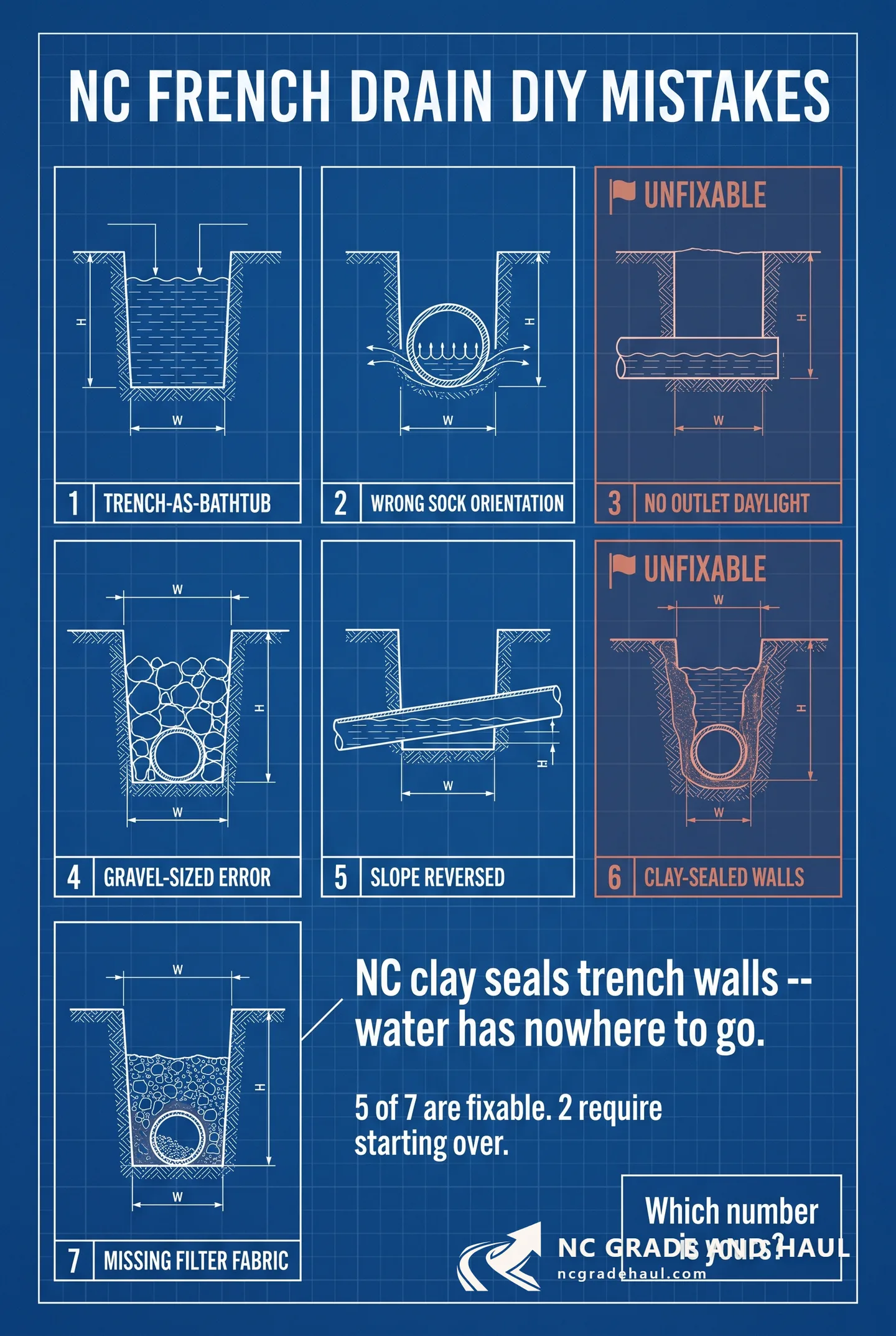
Mistake 1 — Wrong Slope (Flat or Back-Pitched Grade)
A French drain with no fall becomes a bathtub — water fills the pipe and sits, or flows backward toward the house.
The system needs a minimum 1% slope — one inch of drop for every eight to ten feet of run — to keep water moving toward the discharge point. Flat trenches let water pool. Back-pitched trenches push it the wrong direction. In NC Piedmont clay, where the surrounding soil drains slowly, a stalled pipe means the entire stone column saturates and goes static.
Catch it before backfill: verify grade at every 10-foot interval with a level and tape, not just at the ends. A trench that looks sloped can have a mid-run flat spot that kills flow.
Fixable? Usually not without full excavation and re-establishing fall. If the trench is still open, stop and check now. Once backfilled, the only diagnostic is a camera inspection — and the fix is digging it back up.
For the correct slope math, see French drain slope requirements NC.
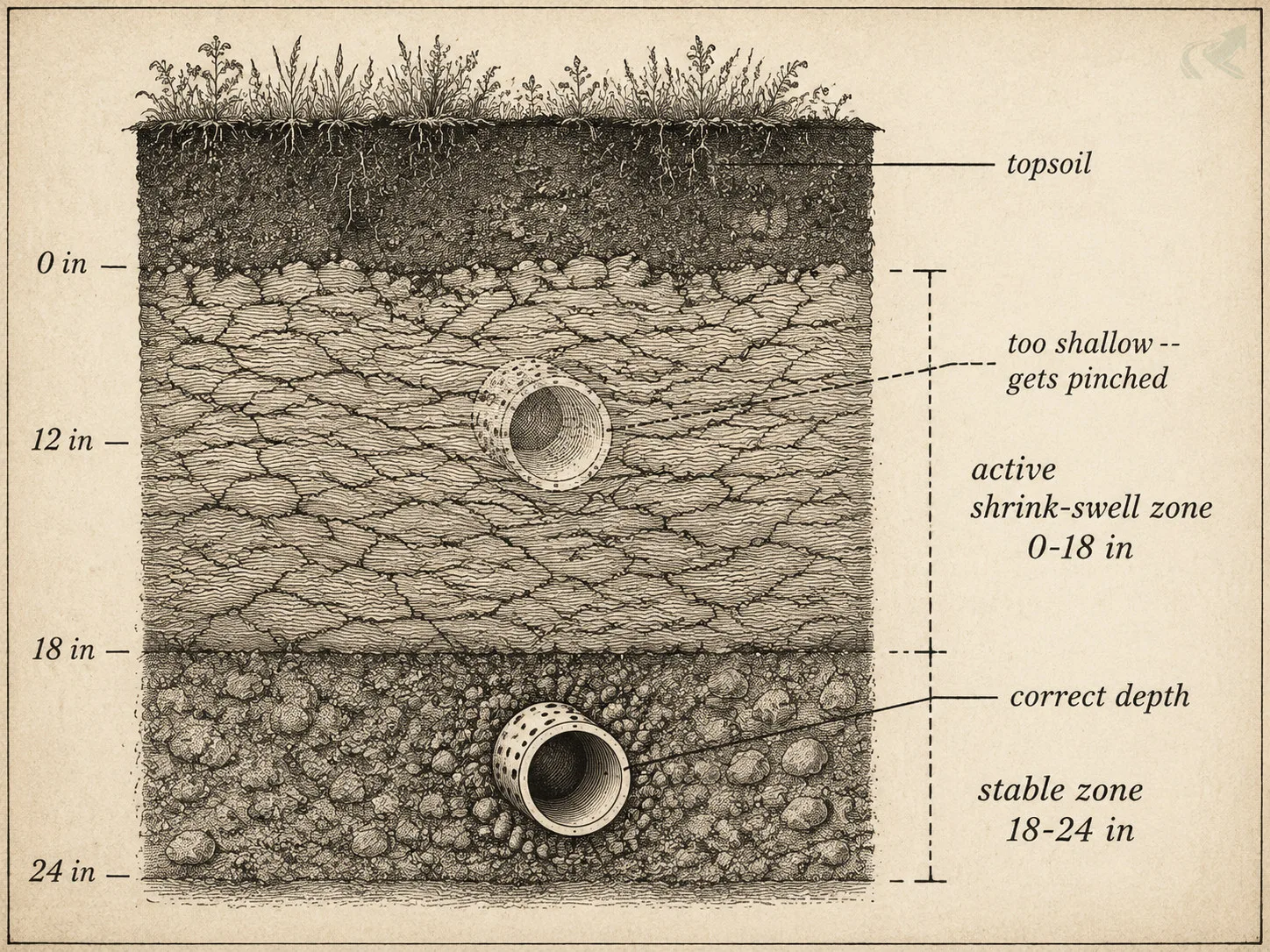
Mistake 2 — Insufficient Depth for NC Clay
Pipes laid at 12 inches in NC Piedmont clay sit inside the active shrink-swell zone and get compressed or crushed during drought cycles.
Most DIY tutorials specify 12-inch trenches. Those tutorials were filmed in Michigan loam or Texas sandy soil — soils that don’t move. North Carolina Piedmont clay shrinks in summer drought and swells back in fall. Pipe placed in that active zone gets pinched during cycles. Over time, the bore compresses and flow rate drops to near zero.
The corrected depth for NC clay is typically 18 to 24 inches, depending on site. The pipe needs to clear the shrink-swell zone. If your contractor specifies 12 inches on a Piedmont clay site, ask why.
Fixable? No. Depth errors require full excavation and reinstallation. There is no partial fix for a pipe that sits too shallow. See French drain depth guide NC for the NC-specific depth calculus.
Mistake 3 — No Confirmed Daylight Point
A system with no confirmed discharge terminus fills to capacity and water exits at the lowest accessible point — which may be the house foundation or a neighbor’s yard.
“Daylight” is the point where the pipe discharges: a pop-up emitter at grade, a drywell, a swale, a storm inlet. If the pipe is connected to nothing confirmed, the system has nowhere to send water when the stone column saturates.
This is a design error, not an installation error — but it’s common in DIY projects where the homeowner focuses on the trench and leaves the discharge as an afterthought.
Fixable? Sometimes. If a pop-up emitter or drywell can be connected to the pipe run’s terminus without disturbing the trench, it can be added after the fact. If the pipe run terminates mid-yard with no accessible end, that’s excavation work.
Mistake 4 — Skipping the Trench-Wall Scratch Pass (NC-Specific)
A bucket-excavated clay trench leaves a glazed, near-impermeable surface on the walls — the “clay slick” — that blocks water from entering the stone column except through the trench bottom.
NC clay trench walls: scratched vs left glazed
Comparison. Scratch pass done: Trench walls roughed up with a rake or trowel; Clay pores opened so water can percolate laterally; Water enters the stone column from the walls and bottom; Pipe receives close to its full design flow. Scratch pass skipped: Excavator bucket leaves a glazed, sealed clay surface; The clay slick blocks water entry through the walls; Water can only seep in from the trench bottom; Pipe gets a fraction of the flow it was sized for.
- Trench walls roughed up with a rake or trowel
- Clay pores opened so water can percolate laterally
- Water enters the stone column from the walls and bottom
- Pipe receives close to its full design flow
- Excavator bucket leaves a glazed, sealed clay surface
- The clay slick blocks water entry through the walls
- Water can only seep in from the trench bottom
- Pipe gets a fraction of the flow it was sized for
A trench-wall scratch pass is a one-minute-per-foot step national tutorials skip -- in NC Piedmont clay it is not optional.
A trench cut by an excavator bucket compresses and glazes the clay wall surface. The result is a near-sealed wall. Water that should percolate laterally through the clay and into the stone column can only enter from the trench bottom. The pipe gets a fraction of its design flow.
The fix is a trench-wall scratch pass: after cutting, drag a hand rake, trowel, or equivalent tool across every wall surface to break the glaze and open the clay pores. National tutorials filmed in loam soils skip this step because loam doesn’t form a clay slick. NC Piedmont clay always does.
NC Homeowner Takeaway: The scratch pass is a one-minute step per linear foot that most national guides don’t mention. It is not optional in NC clay. If your contractor doesn’t know what a trench-wall scratch pass is, that is diagnostic information.
Fixable? Partially. If stone has not yet been placed, the scratch pass can still be done. After backfill, the wall surface is inaccessible and the fix is excavation.
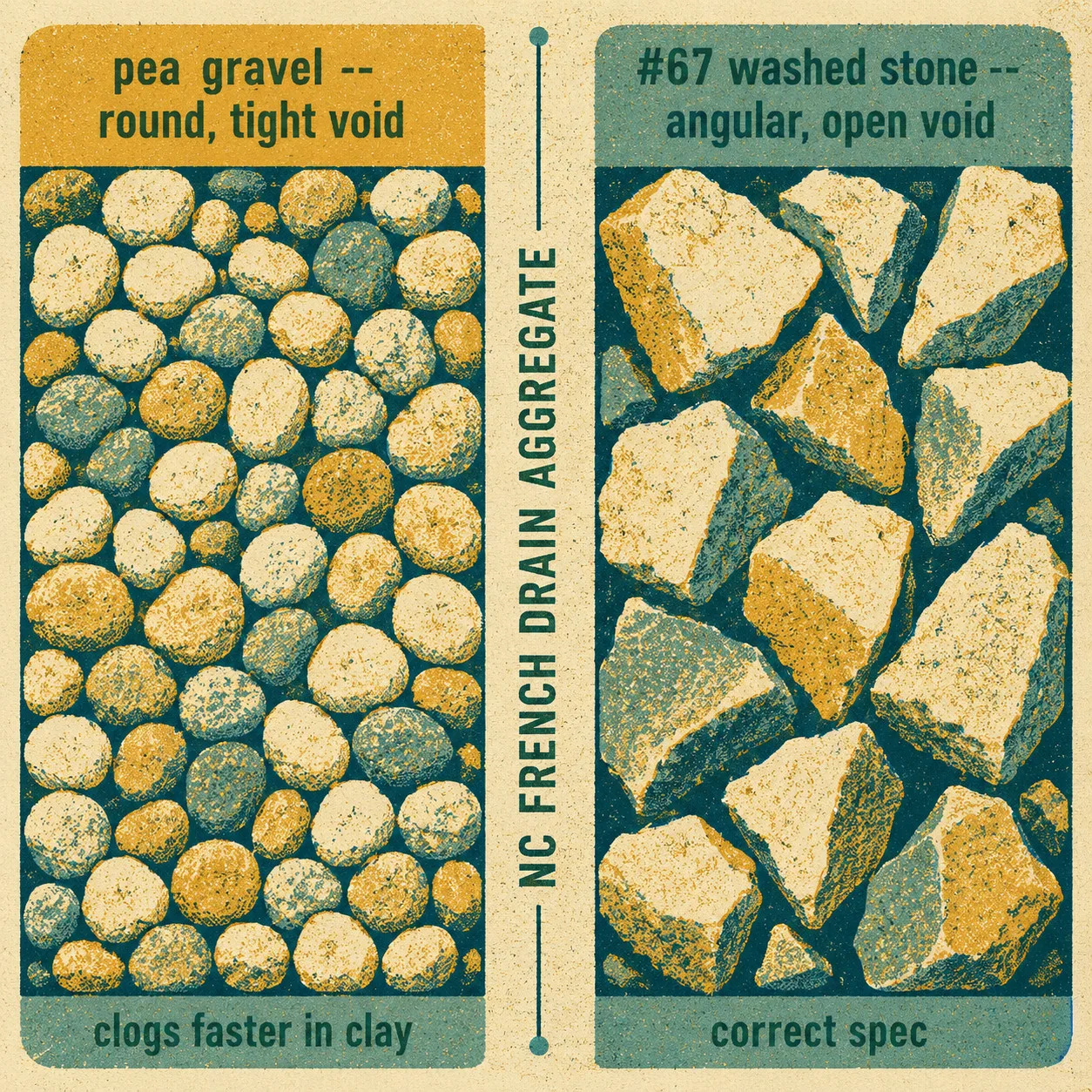
Mistake 5 — Wrong Aggregate (Pea Gravel or Crusher Run Instead of #67 Stone)
Pea gravel clogs faster in NC clay because its void ratio is lower; crusher run compacts and blocks flow within a season.
The correct aggregate for a French drain stone column in North Carolina is #67 washed stone — 3/4-inch washed angular stone. It has the void ratio and angular geometry that allow water to move through the column and resists packing under load.
Substitutes fail differently. Pea gravel is round and smaller — it packs tighter under the weight of clay backfill and has fewer air voids for water to move through. Crusher run is washed stone mixed with fines — those fines compact under any load and seal the column the same way ABC seals a driveway base.
Fixable? No. Removing the aggregate requires excavating the trench. The only correct fix is pulling the wrong material and replacing it with #67 stone.
Mistake 6 — Full Trench-Wrap Fabric in High-Clay Zones (NC-Specific)
Wrapping the entire trench in non-woven geotextile is correct in loam soils and counterproductive in NC Piedmont clay — kaolinite fines migrate into and through the fabric over time, collapsing flow rate.
Non-woven geotextile fabric slows migration initially, but kaolinite particles are small enough to work through the fabric over time. In loam or sandy soil, fines migration is low-volume and the fabric works as designed. In NC Piedmont clay, the fines volume is high — enough that the fabric becomes the filter failure mode rather than the fines themselves.
The evidence: systems built with full trench-wrap fabric in NC clay often show declining flow rates within five to ten years of installation, with fabric that is visibly clogged with orange-red clay at inspection.
NC Homeowner Takeaway: Pipe sock is still appropriate — it protects the pipe perforations from immediate sediment entry. The problem is the trench-wrap surrounding the entire stone column. That wrap is what drives kaolinite clog in NC clay. Sock: fine. Full trench-wrap: not recommended for Piedmont clay sites.
This is the source of the “fabric vs no-fabric” disagreement in drainage contractor forums. The right answer is soil-context-dependent. For a deeper look, see fabric vs no-fabric in NC clay — the mistake.
Fixable? No. The fabric is buried under the stone column and clay backfill. Replacing it requires full excavation.
Mistake 7 — Pipe Installed Slots-Up in NC Clay
Slots-up orientation allows clay fines and soil pressure to drive sediment directly into the pipe perforations; slots-down is the correct orientation for NC clay conditions.
Perforated French drain pipe has perforations at regular intervals around the pipe circumference. Orientation matters. With slots-up, the perforations face toward the soil above — and in clay, that means the weight and moisture pressure of the clay column works directly against the holes, driving fines into the pipe bore.
The correct orientation in North Carolina clay conditions is slots-down (some contractors specify 4 o’clock and 8 o’clock positions) — the perforations face toward the stone column below, where water collects. Water enters through the holes; clay fines are not pressed directly into them.
Fixable? No without excavation and reinstallation.
What To Do If Your Install Already Has One of These
If you’re pre-backfill and you’ve caught one of these: stop and fix it before covering the trench. Post-backfill, the diagnostic is a camera inspection — not a shovel.
A drain camera can confirm whether the pipe bore is clear, whether the slope is reading correctly, and whether the system is flowing at design rate. That inspection comes before any decision to excavate. Some systems function adequately despite one of the mistakes above; others fail hard within a season. The camera tells you which.
If you’re pre-install and want to make sure your contractor won’t make these mistakes, ask for an itemized quote that specifies: trench depth, aggregate spec (#67 stone by name), slope confirmation method, and fabric approach. A contractor who can answer those questions in writing knows what they’re doing. A contractor who gives you a round-number quote with no specs attached is asking you to find out later.
Find contractors who answer those questions at hire a licensed NC grading contractor.
For the full installation process, see correct French drain installation process NC.
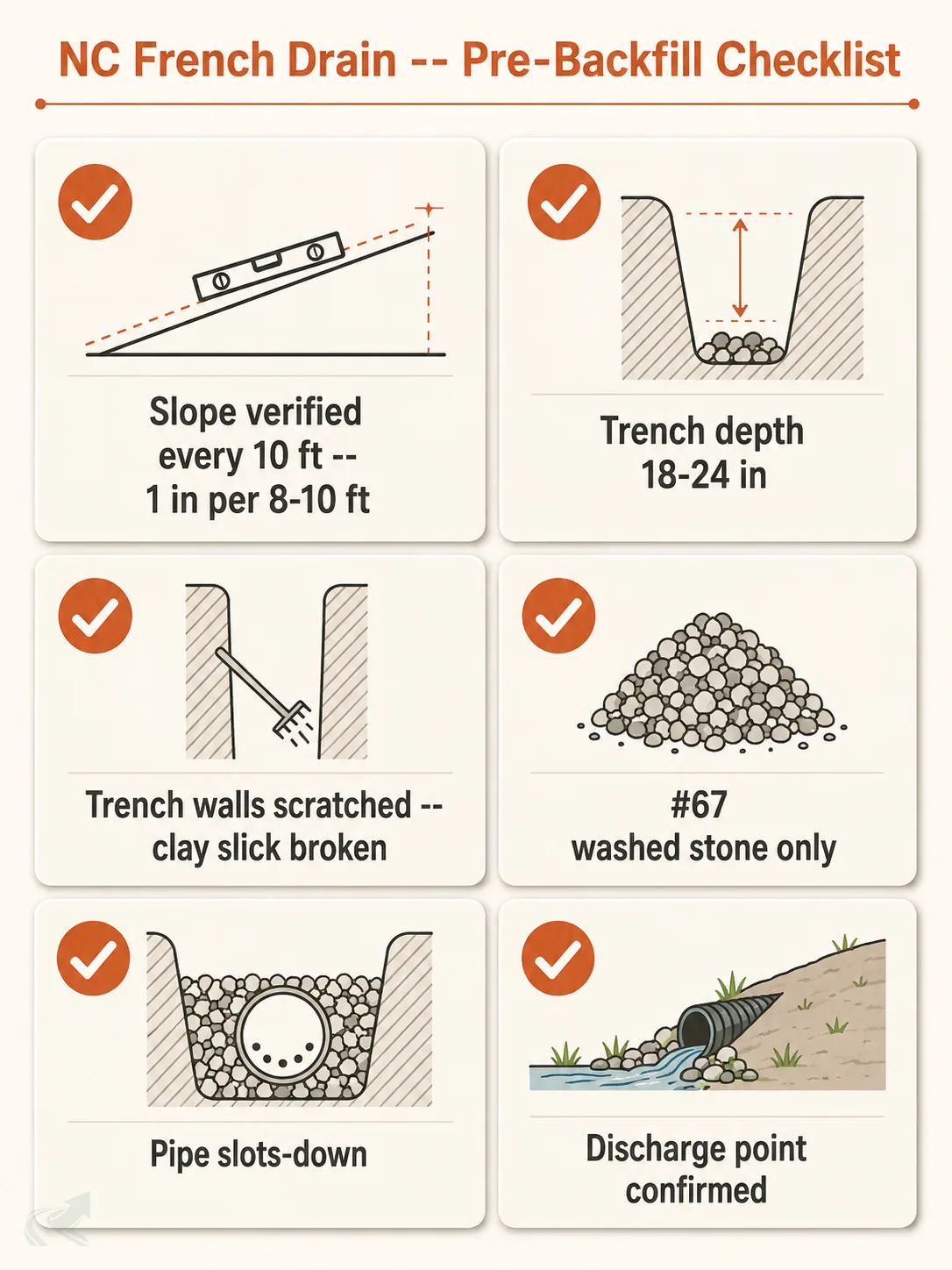
NC French Drain Pre-Backfill Checklist
Screenshot this before you cover the trench.
Before backfilling, confirm all of the following:
- Slope verified at every 10-foot interval (minimum 1% fall — 1 inch per 8 to 10 feet)
- Trench depth confirmed at the deepest point (18 to 24 inches in NC clay)
- Trench walls scratched — clay slick broken on all wall surfaces
- Aggregate confirmed as #67 washed stone (not pea gravel, not crusher run)
- Pipe oriented slots-down (perforations facing the stone column below)
- Discharge point confirmed and accessible (pop-up emitter, drywell, or named terminus)
If any box is unchecked, don’t backfill yet. The cost of digging it back up later is higher than the cost of getting it right now.
For the full picture on NC French drain installation for red clay and how to evaluate DIY French drain vs hiring a pro NC, those pages cover the decision from the beginning rather than the failure mode end.