
Do I have a surface or subsurface drainage problem?
How do I know if my drainage problem is surface or subsurface?
If water pools during rain and clears in 1-3 days -- surface. If the soil stays saturated for days without recent rain -- subsurface. NC clay often makes both look the same because the ground absorbs so slowly that even a high water table appears as a runoff problem.
Why does NC clay make this harder to diagnose?
NC Piedmont clay barely percolates. Rain that would soak into sandy soil within an hour sits on top for hours or days. A yard with a high water table in clay looks identical to a yard with a simple runoff problem -- until you dig a hole and see the truth.
Your yard flooded last Tuesday. You got two quotes. One contractor said swale along the back fence. The other said French drain under the side yard. Different systems, different price points — and both sounded confident.
The disagreement is not random. They are diagnosing different water types. One sees runoff from the neighbors’ lot hitting your yard from above. The other sees saturated soil that is wet between rain events, not just during them. Both can be right. Both can also be wrong if they never asked the right questions.
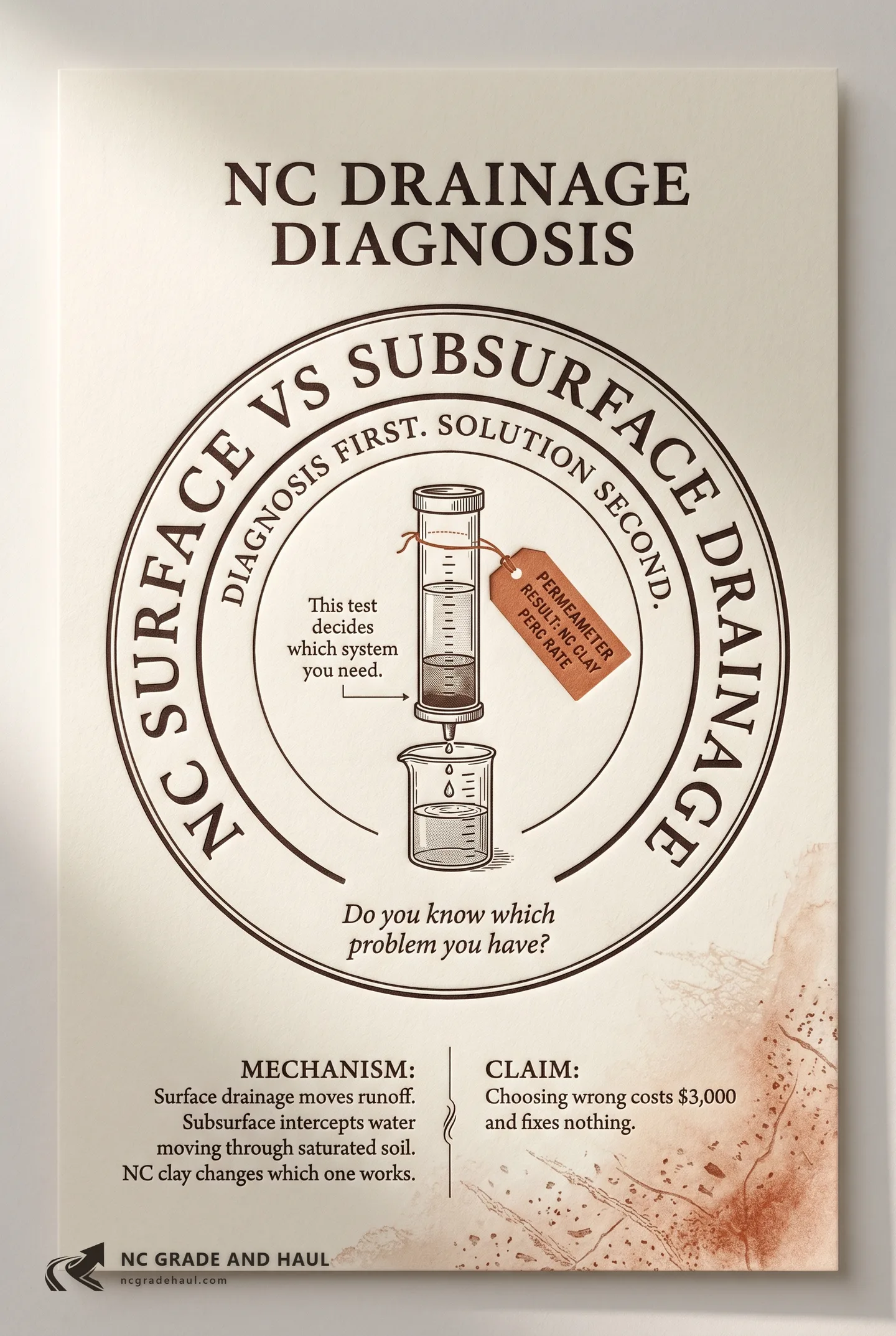
Getting the diagnosis right before any system gets installed is the only way to ensure the fix matches the actual problem.
What Surface Drainage Handles
Surface drainage systems move water that runs across the top of the ground — swales, catch basins, and regrading are the tools.
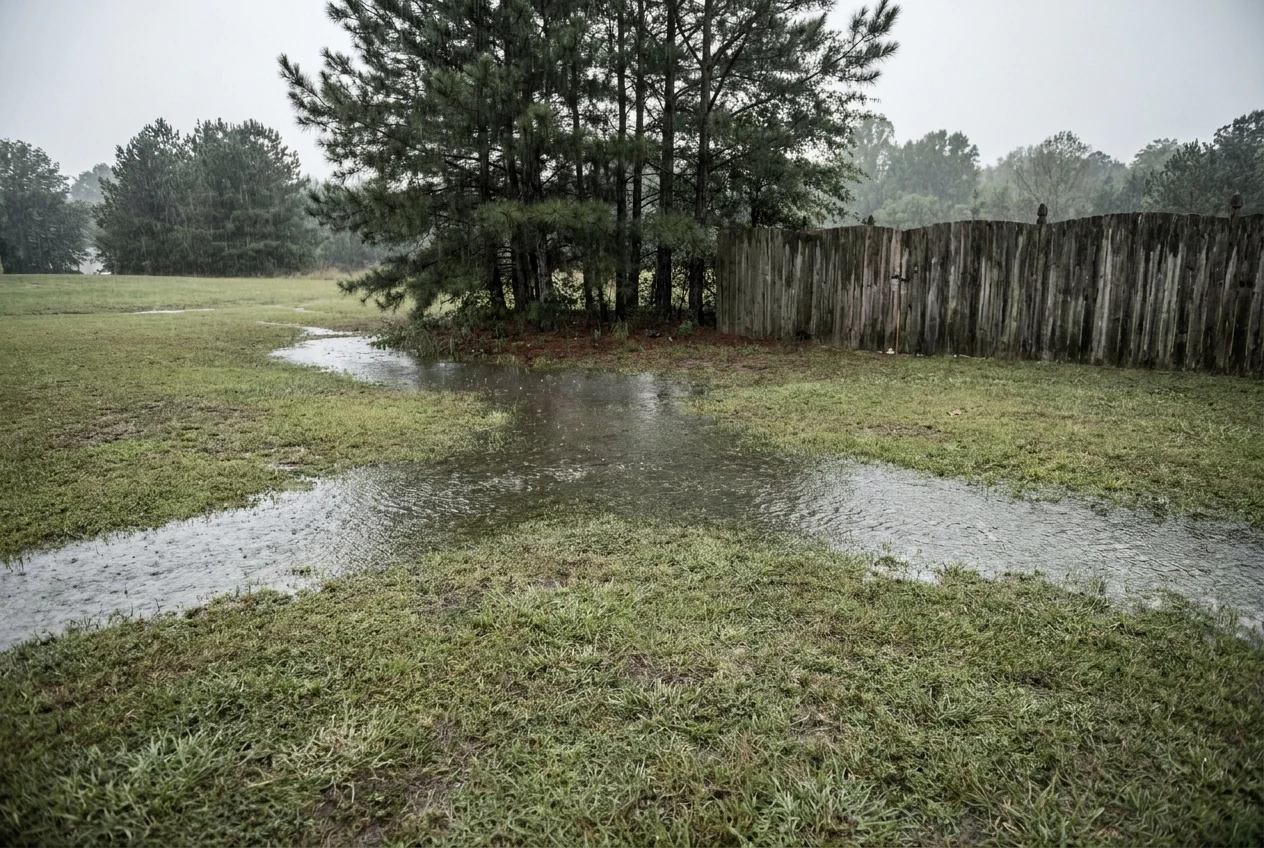
Surface water appears during or immediately after rain. You can watch it move — sheets flowing across the lawn toward a low spot, water collecting at the base of a slope, or pooling against a foundation because the yard doesn’t slope away. Between rain events, the soil dries to normal.
The diagnostic cue is simple: stand in your yard during a moderate rain. Do you see water flowing visibly across the surface? Can you trace it from a high point to a low point? That is surface water. It has a source and a path — intercept the path and the pool disappears.
Solutions for surface problems include drainage swales NC — design, cost and uses to redirect flow, catch basins for surface water NC at the low collection points, and regrading to establish positive drainage away from the foundation. The goal is always the same: give the water a route to daylight before it pools.
What Subsurface Drainage Handles
Subsurface drainage systems intercept water moving through or saturating the soil — French drains and curtain drains are the tools.
Subsurface water does not behave the way surface water does. The yard is wet when it should be dry. There is no visible source — no stream, no obvious runoff path — but the soil feels spongy even during a dry week. Basement walls show moisture after a rain event that ended two days ago. A corner of the yard never fully dries out through the summer.
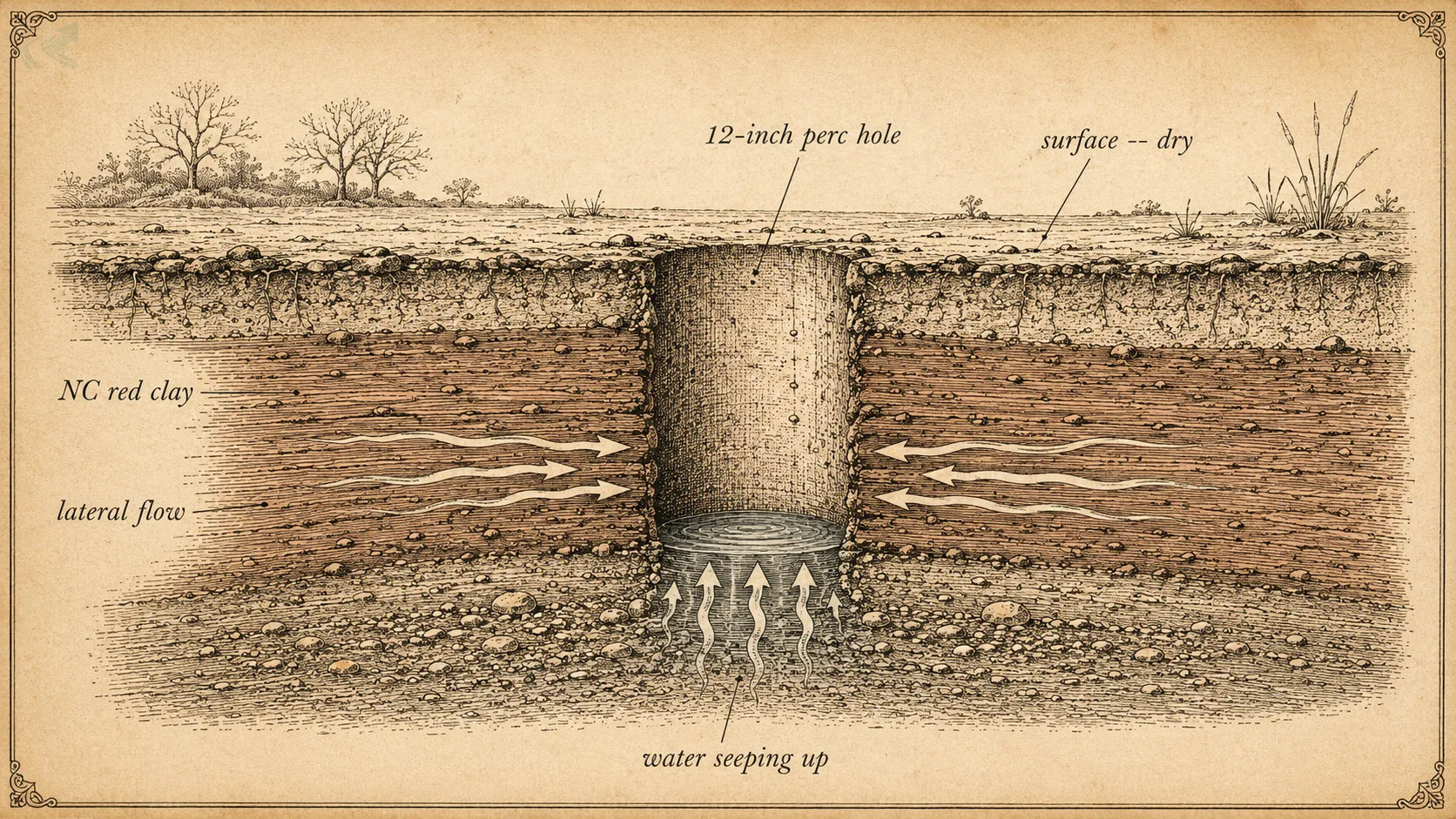
The field diagnostic is to dig a 12-inch hole in the suspect area. If that hole fills with water within a few hours without any recent rainfall, you have a subsurface condition: either a high water table pushing up from below, or lateral flow from uphill ground moving through the soil toward your lot.
Solutions include French drain systems NC to intercept lateral flow, curtain drains placed uphill of the soggy zone, and perimeter drains around the foundation perimeter. Every system routes collected water to a daylight outlet — gravity does the work.
Why NC Clay Makes Both Look the Same
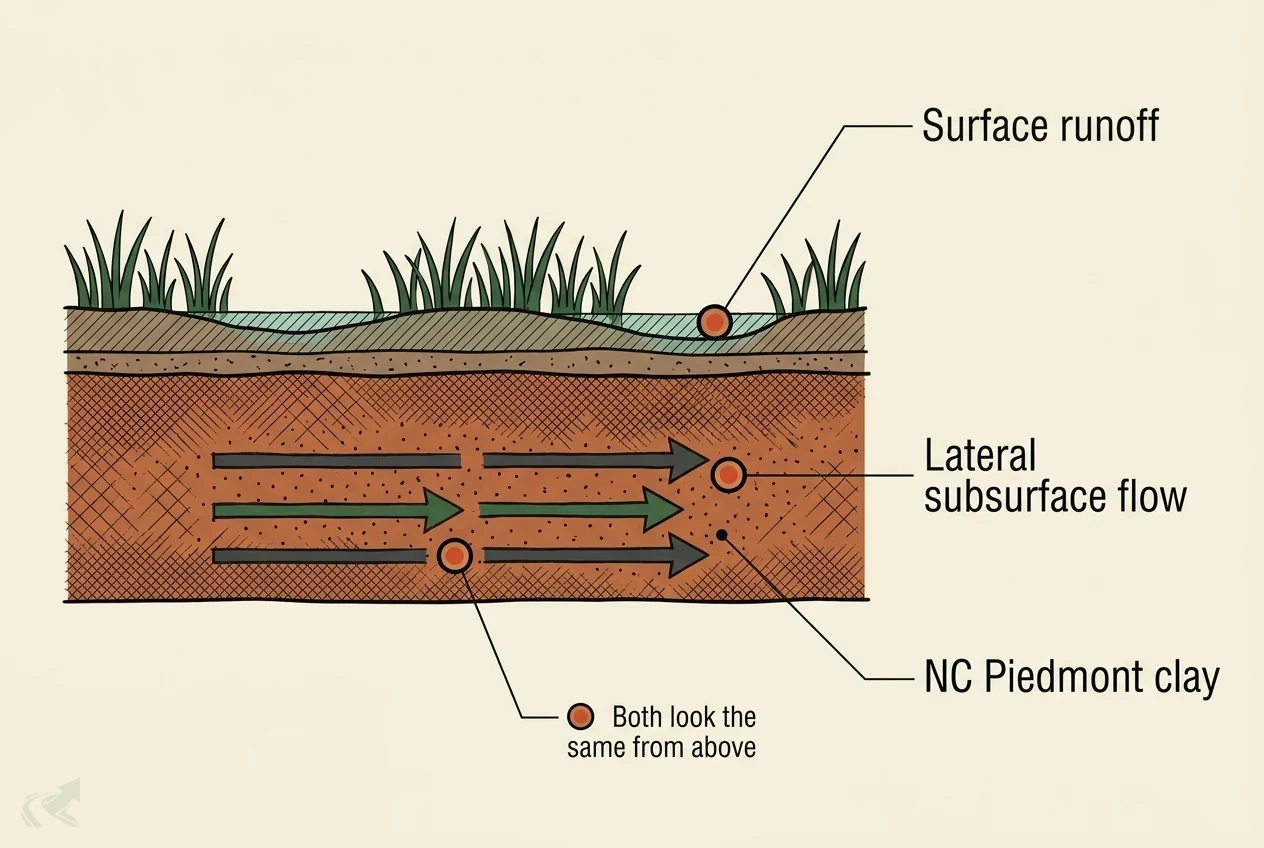
NC Piedmont clay absorbs water so slowly that subsurface problems often appear as surface problems — and vice versa.
In sandy soil, rain percolates quickly. Water moves from the surface to the subsurface within an hour or two. The two problem types stay visually distinct: surface water flows and drains; subsurface water shows up between events.
North Carolina Piedmont clay barely percolates at all. Saturated values for NC red clay typically run 0.02 to 0.2 inches per hour. Rain that falls faster than that — which is nearly every rain event of consequence — stays on the surface long after it should have moved underground.
Here is the problem that creates for diagnosis: a yard with a high water table in NC Piedmont clay looks like it has a runoff problem because the surface never drains fast enough to reveal what’s underneath. The soil is saturated from below, but the rain that sits on top masks the real source.
The practical implication is that if your yard floods during rain AND stays wet long after rain has stopped, you may have both a surface problem and a subsurface problem running simultaneously. The clay prevents you from separating them through surface observation alone.
The NC-specific diagnostic tool is a percolation test. Dig a hole, fill it with water, let it drain, then refill it and time how long it takes to drain the second time. A hole that still holds water 24 hours after the second fill is telling you the subsurface cannot absorb water at a functional rate — which is either a soil-permeability issue, a clay hardpan layer, or a high water table. NC Piedmont red clay drainage covers what those distinctions mean for system design.
The Hybrid Scenario: When You Need Both
Most large NC lots with drainage problems need a surface system for runoff AND a subsurface system for saturation.
This is not an upsell. It is the most common outcome on lots larger than a quarter acre in the Piedmont. The surface problem and the subsurface problem have different sources and different fixes, but they share a single daylight outlet.
A typical hybrid configuration on a North Carolina residential lot: a swale runs along the uphill lot line to intercept surface runoff before it enters the yard. A French drain runs along the foundation perimeter to intercept lateral subsurface flow moving toward the house. Both systems discharge to the same daylight point at the downhill corner.
The cost implication matters before you compare quotes. A surface-only bid and a hybrid bid are not the same scope. If one contractor quoted a swale and another quoted a French drain plus swale, they are not competing on the same job. Ask every contractor to walk the yard with you and identify both the surface flow path and the soil condition before they quote. Then ask for the quote itemized by system type.
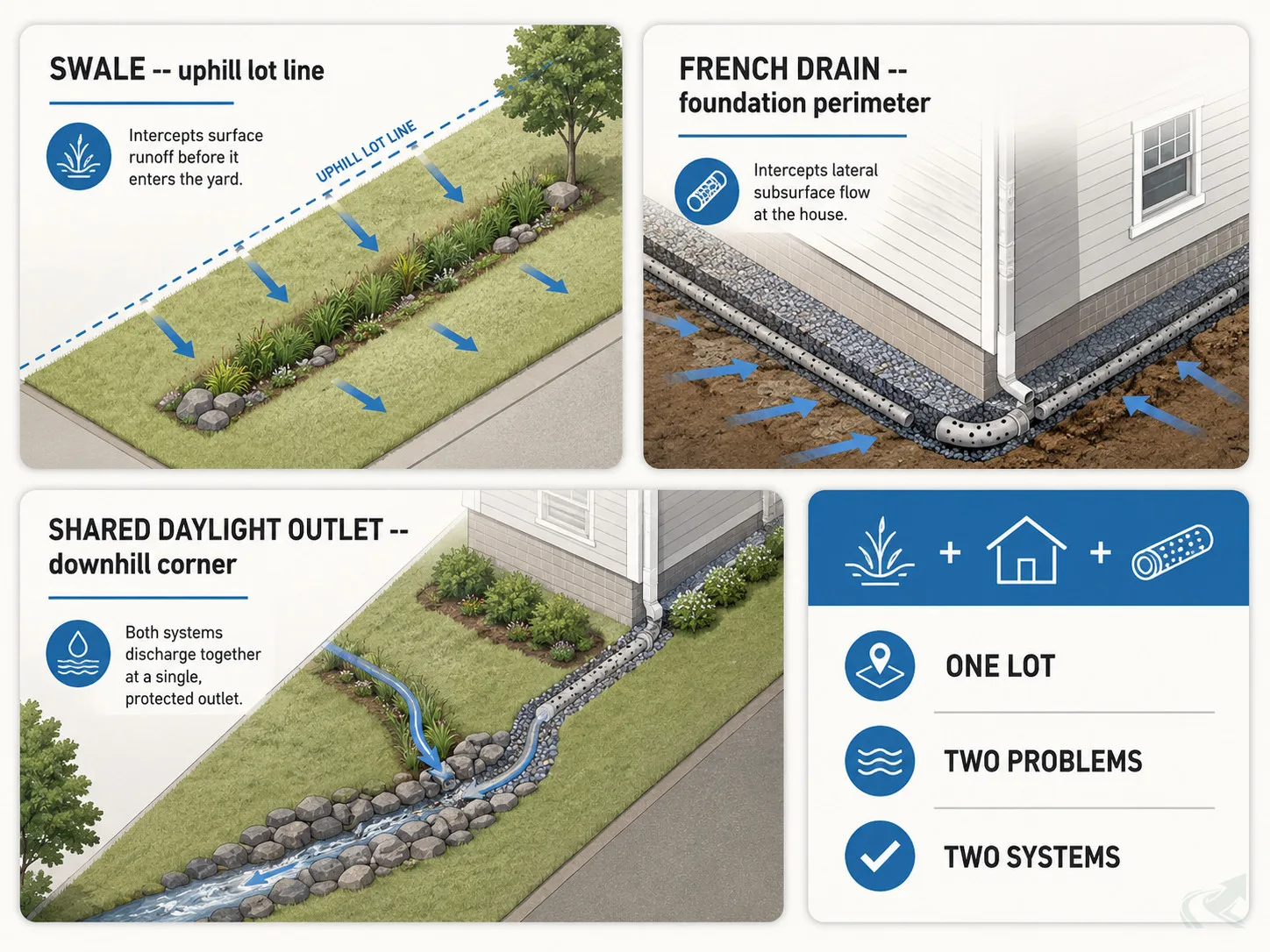
Diagnostic Summary: Three Questions to Ask Your Yard
Three field questions tell you which system type you need.
Walk your yard at the next moderate rain event — enough to produce visible flow, not a drizzle. Then return 72 hours later, after no additional rain, and walk it again.
Question 1: Does water flow visibly across the surface during rain? Watch for sheet flow across bare areas, water tracking toward a low spot, or the low spot itself collecting into a pool. Yes to any of these means you have a surface drainage problem. A drainage swale or catch basin belongs in the solution.
Question 2: Does the soil stay wet more than 72 hours after rain? Press your heel into the ground in the suspect area. Does water seep up around your boot? Is the soil spongy two or three days after a rain event with no new precipitation? That points to subsurface conditions worth investigating further.
Question 3: Does a 12-inch hole fill with water without recent rain? This is the perc test confirmation. If you dig down 12 inches on a dry week and the hole collects water overnight, you have a subsurface condition that a swale cannot fix. You need French drain installation or equivalent intercept system.
If you answered yes to Question 1 only — surface system. If you answered yes to Question 2 or 3 — subsurface system likely needed. If you answered yes to all three — you need both, and you need a contractor who will scope them separately.
Bring that diagnostic to the conversation before the contractor walks your yard. Then ask: hire a verified NC grading contractor who will walk the yard after a rain and show you the evidence before writing a single line on the quote.
Surface vs Subsurface: Side-by-Side
| Factor | Surface Drainage | Subsurface Drainage |
|---|---|---|
| When it appears | During or immediately after rain | Between rain events, or days after rain |
| Soil condition between rains | Dries to normal within 24-48 hours | Stays soggy; spongy underfoot when dry |
| Visible flow | Yes — water moves across the ground | No — water saturates from below or laterally |
| Fix type | Swale, catch basin, regrade | French drain, curtain drain, perimeter drain |
| NC clay note | Clay slows drain-down, extends pooling time | Clay masks subsurface problems as surface ones |