
Two questions homeowners ask about catch basins
What is a catch basin and when do I need one?
A catch basin is an underground collection box with a surface grate that intercepts surface water at a low spot and routes it through solid pipe to an outlet. You need one when regrading cannot eliminate the low spot. In NC Piedmont clay, expect to clean it annually -- clay sediment fills the sump faster than national guides suggest.
What is the difference between a grate inlet, a yard drain, and a French drain inlet?
The surface around the basin determines the right inlet. Mowed lawn gets a grate inlet -- flat cast iron or HDPE, flush with grade. Garden beds and patio edges get a yard drain -- smaller plastic round unit with lower flow capacity. A French drain system uses a French drain inlet box that accepts both surface and subsurface water.
Your contractor just sent a quote with a line item for a “12-inch grate inlet” at the back corner of the yard. Water always collects there after rain. You don’t know if that’s the right fix — or if the contractor is adding a $600 box you don’t need.
This page explains what a catch basin does, what it does not do, and how to read a quote that specifies one. It also covers the part most national guides skip: what NC Piedmont clay sediment does to a basin over time. That hidden maintenance cost is the difference between a drainage fix that works and one that fails quietly in year two.
What a Catch Basin Is (and Isn’t)
A catch basin collects surface water at a fixed point and routes it through solid pipe to an outlet — it does not solve a grade problem.
The anatomy is simple. An underground concrete or box sits at the low point. A cast iron or HDPE grate covers the top, flush with grade. Water flows across the surface into the grate, drops into the box, and exits through solid PVC pipe that runs to a daylight point or ties into a French drain system.
What it does NOT do: route water that isn’t already flowing to it. A catch basin placed at the wrong elevation — or in the wrong spot — sits dry while the yard floods. If the grade doesn’t move water toward the basin, the basin doesn’t intercept it.
The most common misuse: installing a catch basin near a foundation to “catch” water that pools because the grade slopes toward the house. The real fix is regrading to protect your NC foundation from water by establishing positive drainage away from the house. A basin in that situation catches the symptom, not the cause.
If the grade problem can be corrected, correct it first. If a persistent low spot remains after regrading, that’s when a catch basin earns its place in the quote.
Three Inlet Types: Grate, Yard Drain, French Drain Inlet
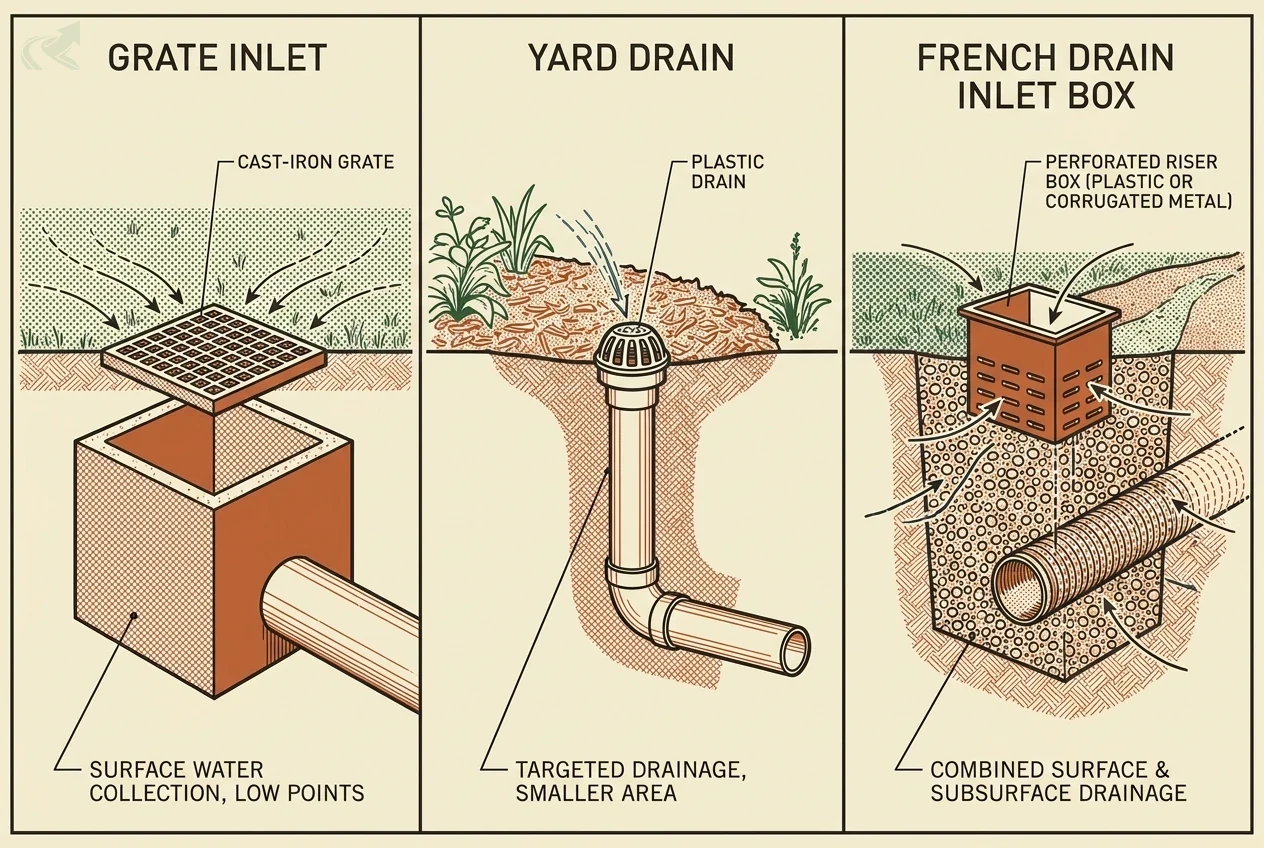
The right inlet type depends on the surface around it — mowed lawn gets a grate inlet; mulch or garden bed gets a yard drain; a French drain system uses a French drain inlet box.
Here’s how they differ in practice:
Grate inlet — flat cast-iron or HDPE grate, flush with grade, designed for mowed areas where a mower must pass over it. Water flows across the surface and falls through the grate opening. This is the standard choice for open-yard catch basins in North Carolina. Keep the grate clear of debris and mow close enough that grass blades don’t mat over the openings and block flow.
Yard drain — a smaller plastic round unit, typically 4 to 6 inches in diameter. Sometimes called a pop-up drain in product listings (distinguish this from a pop-up emitter, which is an outlet device). Yard drains suit garden beds, patio edges, and anywhere a full grate would be visually intrusive. The trade-off is lower flow capacity — a 4-inch yard drain handles noticeably less water per hour than a 12-inch grate inlet.
French drain inlet box — a perforated box or slotted riser inside a French drain trench that also accepts surface water at the top. It combines subsurface and surface collection into one structure. More expensive to install than either of the above. NC French drain installation guide covers the full system design if you’re evaluating this option. Appropriate when the drainage problem is both subsurface saturation AND a surface concentration point — not when it’s one or the other. See surface vs subsurface drainage — which do you need to sort out which applies to your yard.
Inlet Type Comparison
| Inlet Type | Best For | Flow Capacity | Maintenance Burden |
|---|---|---|---|
| Grate inlet | Mowed lawn, open yard | High -- 12-inch grate handles most NC residential storm events | Annual cleaning; keep grate clear of debris and grass mat |
| Yard drain | Garden beds, patio edges, tight visual situations | Lower -- 4- to 6-inch units; can overflow in heavy rain | More frequent cleaning; smaller opening clogs faster |
| French drain inlet box | Combined surface + subsurface drainage | Medium -- depends on trench stone and pipe sizing | Clean the box and inspect trench stone annually |
Grate inlet
- Best For
- Mowed lawn, open yard
- Flow Capacity
- High -- 12-inch grate handles most NC residential storm events
- Maintenance Burden
- Annual cleaning; keep grate clear of debris and grass mat
Yard drain
- Best For
- Garden beds, patio edges, tight visual situations
- Flow Capacity
- Lower -- 4- to 6-inch units; can overflow in heavy rain
- Maintenance Burden
- More frequent cleaning; smaller opening clogs faster
French drain inlet box
- Best For
- Combined surface + subsurface drainage
- Flow Capacity
- Medium -- depends on trench stone and pipe sizing
- Maintenance Burden
- Clean the box and inspect trench stone annually
Sizing a Catch Basin for NC Rainfall
Undersized basins overflow during NC spring storms — size for the 10-year storm event, not the average rain.
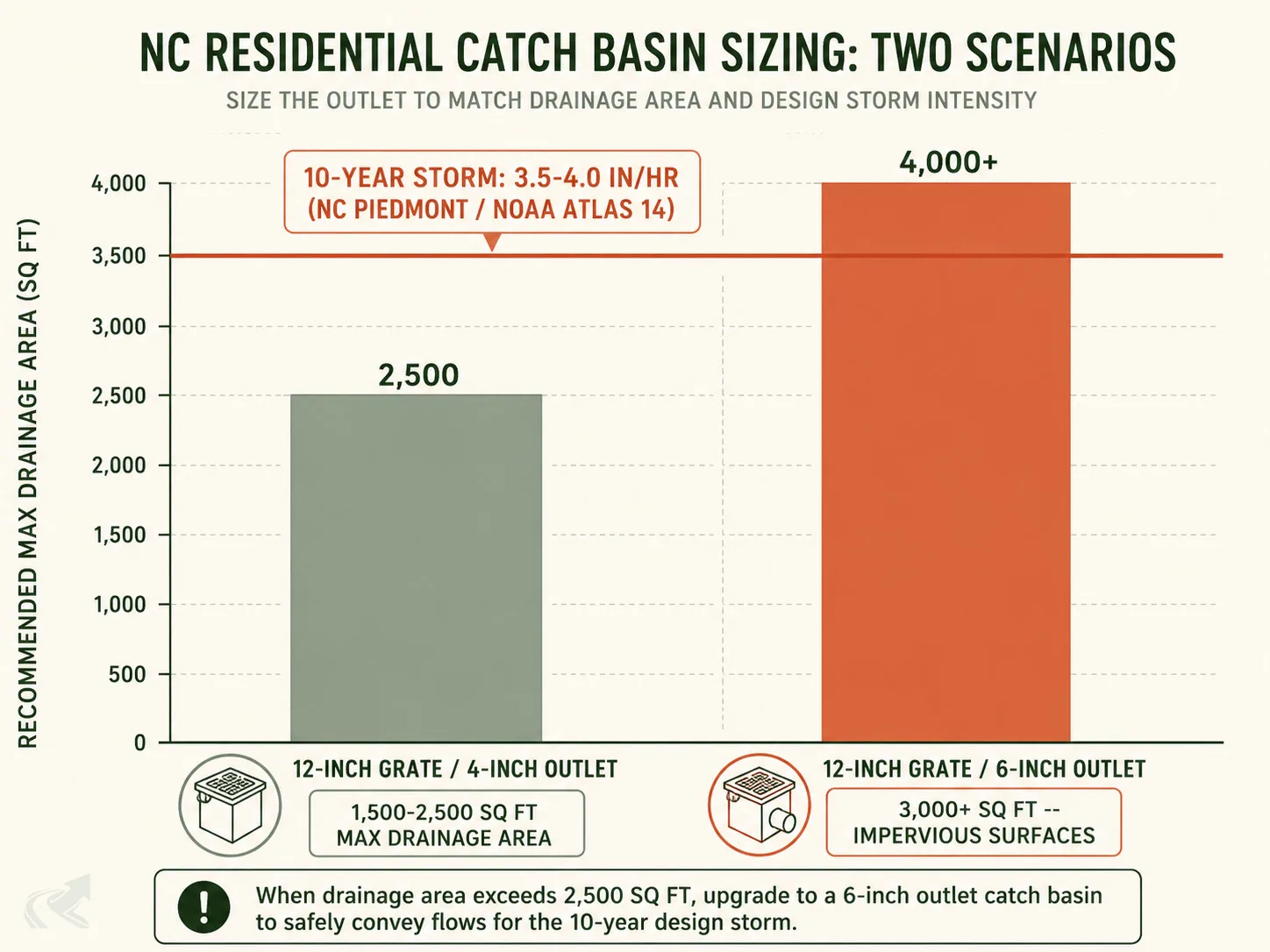
The basic logic: calculate the drainage area flowing toward the basin (in square feet), multiply by the NC rainfall intensity for the 10-year, 1-hour storm event for your region. The Triangle and Piedmont typically see 3.5 to 4.0 inches per hour at the 10-year recurrence interval, based on NOAA Atlas 14 data for North Carolina.
A working rule of thumb for residential NC: a 12-inch grate inlet with a 4-inch solid outlet serves a drainage area of roughly 1,500 to 2,500 square feet, depending on how much impervious surface (roof, patio, driveway) drains to that point. Steeper contributing slopes move more water faster — they need larger pipe or a larger basin, not just the same basin closer to the problem.
Once the drainage area climbs above 3,000 square feet, or you have a significant impervious contributor like a large roof section or driveway, move to a 6-inch outlet pipe. An undersized outlet backs up the basin before the storm clears. The basin overflows at exactly the moment you need it working.
Get a verified NC grading contractor to size it — not a YouTube video, not this page. The NC DEMLR stormwater design manual is the reference engineers use. A 20-minute site walk with a tape measure and a contractor who knows it is worth more than any rule of thumb.
NC Piedmont Clay Sediment: The Maintenance Reality
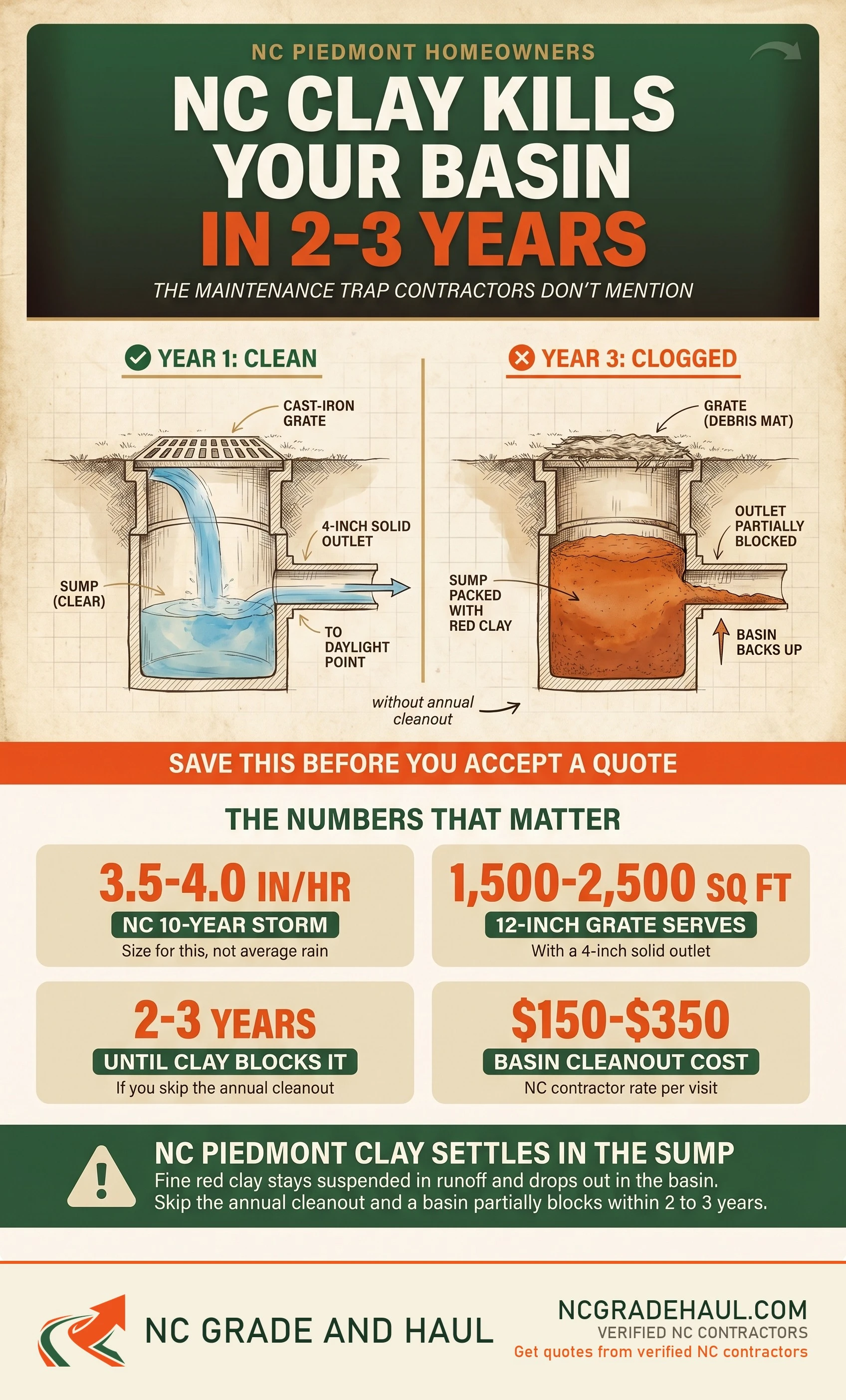
NC Piedmont clay suspends easily in runoff and settles in catch basins — a basin installed without annual cleaning will partially block within 2 to 3 years.
Here’s why: clay particles are fine enough to stay suspended in fast-moving surface water. When that water drops into the basin and slows, the clay settles to the bottom. That bottom compartment — the sump, the space below where the outlet pipe exits — is designed to collect sediment before it enters the pipe. It works. But it fills up.
Over two or three years of NC clay runoff, the sump packs with fine red sediment. Once it reaches the outlet pipe elevation, sediment starts entering the pipe. The basin loses its storage capacity. The outlet partially blocks. During the next heavy storm, the basin that was supposed to fix the problem now backs up and overflows.
Maintenance schedule: inspect after every major storm in year one to establish how fast your basin fills. In most NC Piedmont yards, that baseline points to annual cleanout at minimum. If the contributing area includes disturbed soil — a construction site next door, a bare clay slope after landscaping — clean it out every six months.
What cleaning involves: pull the grate; scoop or vacuum accumulated sediment from the sump; probe the outlet pipe with a garden hose to check for clay blockage. A professional catch basin cleanout in North Carolina typically runs $150 to $350 depending on access and how full the basin is. Some contractors include one post-installation cleanout in the quote — ask before signing.
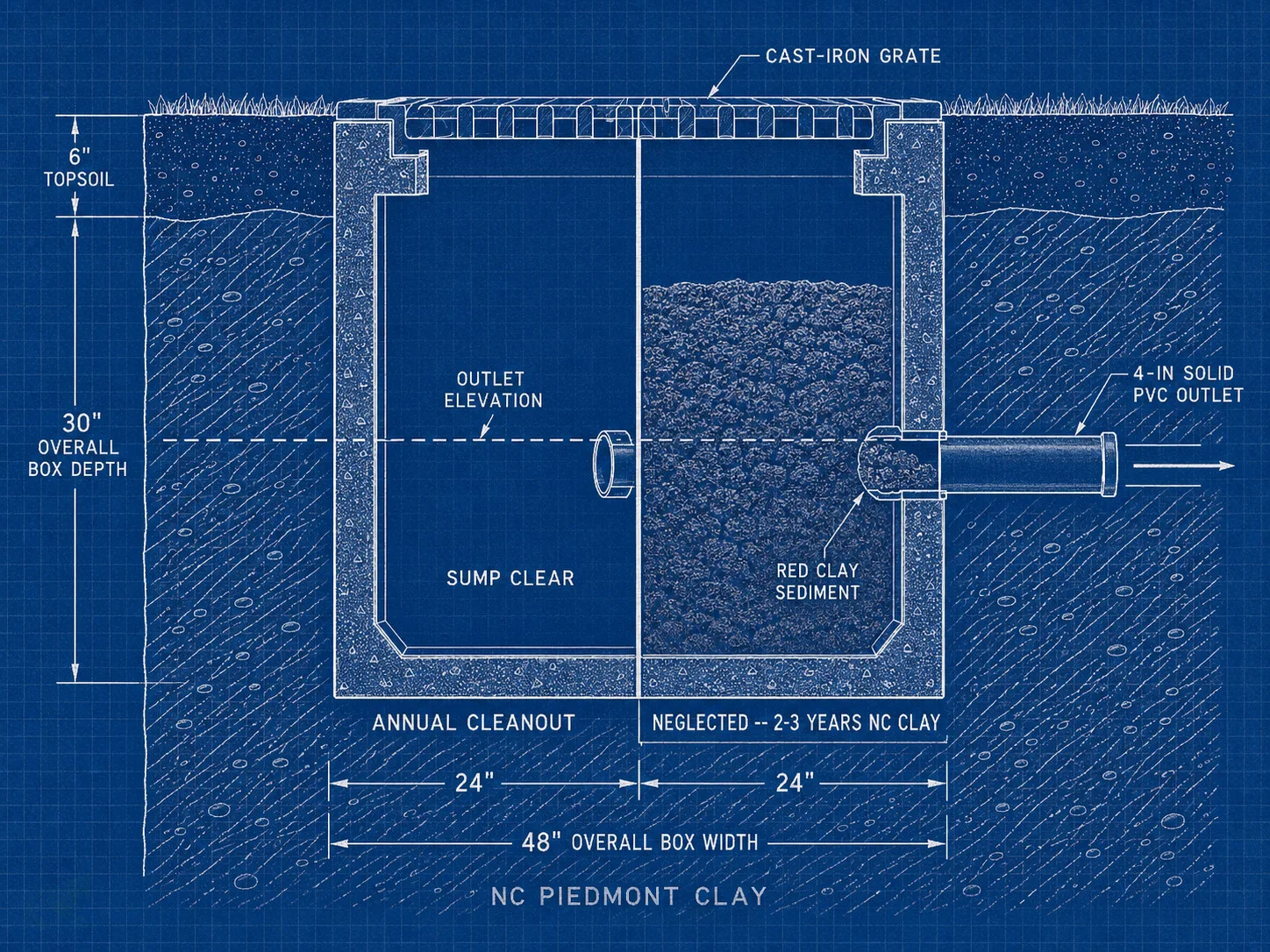
A maintained catch basin vs one packed with NC clay sediment
Comparison. Cleaned on schedule: Sump below the outlet pipe stays clear of sediment; Grate free of debris and matted grass, so flow enters freely; Full storage capacity available for the next storm; Outlet pipe runs clear -- water flows in and back out. Neglected in Piedmont clay: Sump packed with fine red clay sediment to the outlet elevation; Sediment starts entering and blocking the outlet pipe; Storage capacity lost -- the basin fills early in a storm; Basin backs up and overflows the low spot it was meant to fix.
- Sump below the outlet pipe stays clear of sediment
- Grate free of debris and matted grass, so flow enters freely
- Full storage capacity available for the next storm
- Outlet pipe runs clear -- water flows in and back out
- Sump packed with fine red clay sediment to the outlet elevation
- Sediment starts entering and blocking the outlet pipe
- Storage capacity lost -- the basin fills early in a storm
- Basin backs up and overflows the low spot it was meant to fix
NC Piedmont clay stays suspended in runoff and settles in the sump -- skip the annual cleanout and a basin partially blocks within 2 to 3 years.
Builder-installed basins in NC production subdivisions are particularly prone to this. A basin sized just large enough to clear an inspection — but not large enough to handle the contributing drainage area with a 10-year storm — fills within 18 months. The homeowner inherited a maintenance liability, not a drainage solution. This page exists partly because standing water in a yard in NC is almost always a multi-factor problem, and a neglected catch basin is one of the hidden contributors.
When a Catch Basin Is the Right Fix
Use a catch basin when: water concentrates at a low spot that can’t be regraded away, you have a fixed surface-water concentration point like a downspout or patio edge, or you need to intercept surface flow before it reaches the foundation.
Three scenarios where it belongs in the quote:
-
Persistent low spot after regrading. A contractor grades the yard to direct water away from the house. But there’s a topographic bowl at the back corner that can’t drain by gravity alone without hitting the neighbor’s property. A catch basin at that bowl, with a pipe to daylight at the rear setback, is the correct mechanical fix.
-
Downspout concentration point. The roof drains a large area to one corner downspout, and the volume overwhelms the surrounding lawn. A catch basin at the downspout transition point — tied into solid pipe that runs to daylight — is the right approach. This is what downspout to underground pipe done right looks like in practice.
-
Surface flow intercept before the foundation. Water runs across a slope toward a crawl space vent or foundation wall. A catch basin plus a diversion swale intercepts it before it reaches the structure.
When it is NOT the right fix: when the core problem is subsurface saturation (that’s a French drain, not a catch basin), or when regrading alone would eliminate the problem. The wrong sequence is to install the mechanical solution first and find out later that the grade was fixable.
Getting the Quote Right
An itemized catch basin quote should specify the basin type and size, the outlet pipe diameter, the daylight point, and maintenance responsibilities.
A quote that says “install catch basin — $650” tells you almost nothing. You don’t know what size basin, what inlet type, what outlet pipe diameter, or where the water is going. You can’t evaluate whether it’s right for the job or compare it to a second quote.
A quote that works looks like this: 12-inch HDPE catch basin with cast-iron grate inlet, 4-inch solid PVC outlet pipe sloped to daylight at the rear property line, #57 stone bedding, compacted ABC gravel backfill, installed at the northeast corner low spot. That version you can evaluate, and a second contractor can price the same scope.
Maintenance language matters too. Ask explicitly: “Is annual cleanout included in the warranty period? What’s your cleanout rate if I call you in year two?”
Find a grading contractor in North Carolina who specifies the basin type, outlet pipe size, and daylight point in writing. If the quote doesn’t include those details, the scope is incomplete.
Before you accept any catch basin quote, ask these three questions:
- What is the basin size and inlet type?
- What is the outlet pipe diameter and the daylight location?
- What maintenance does this basin require annually — and who does it?