
You called two contractors about water flowing across your yard from the neighbor’s lot uphill. Contractor 1 says French drain. Contractor 2 says swale. Neither explained why they disagreed.
Here’s the difference: a French drain handles subsurface saturation — water moving through soil. A swale handles surface runoff — water moving across soil. Those are two different problems. NC Piedmont clay makes surface runoff more common than national guides suggest, because clay sheds water rather than absorbing it.
If you’re in the Triad, Triangle, or Charlotte area, you’ve probably got Piedmont clay. And if your yard floods during rain rather than staying soggy for days, the problem is likely surface runoff — which a properly graded swale can fix.
This page explains what a swale actually is, when it’s the right fix, when it isn’t, and what NC clay does to maintenance schedules.
What a Swale Actually Does
A swale is a shallow, vegetated channel that intercepts surface water and routes it to an outlet — it moves water, it doesn’t absorb it.
Water flows into the swale from the surrounding yard, travels along the channel to a discharge point (called the daylight end), and exits the property. The channel is graded to maintain positive drainage — a steady fall from inlet to outlet — so water keeps moving rather than pooling.
A swale is not a French drain. A French drain is a perforated pipe buried in gravel that collects and routes subsurface water. A swale sits on the surface. They solve different problems. Confusing them leads to expensive rework.
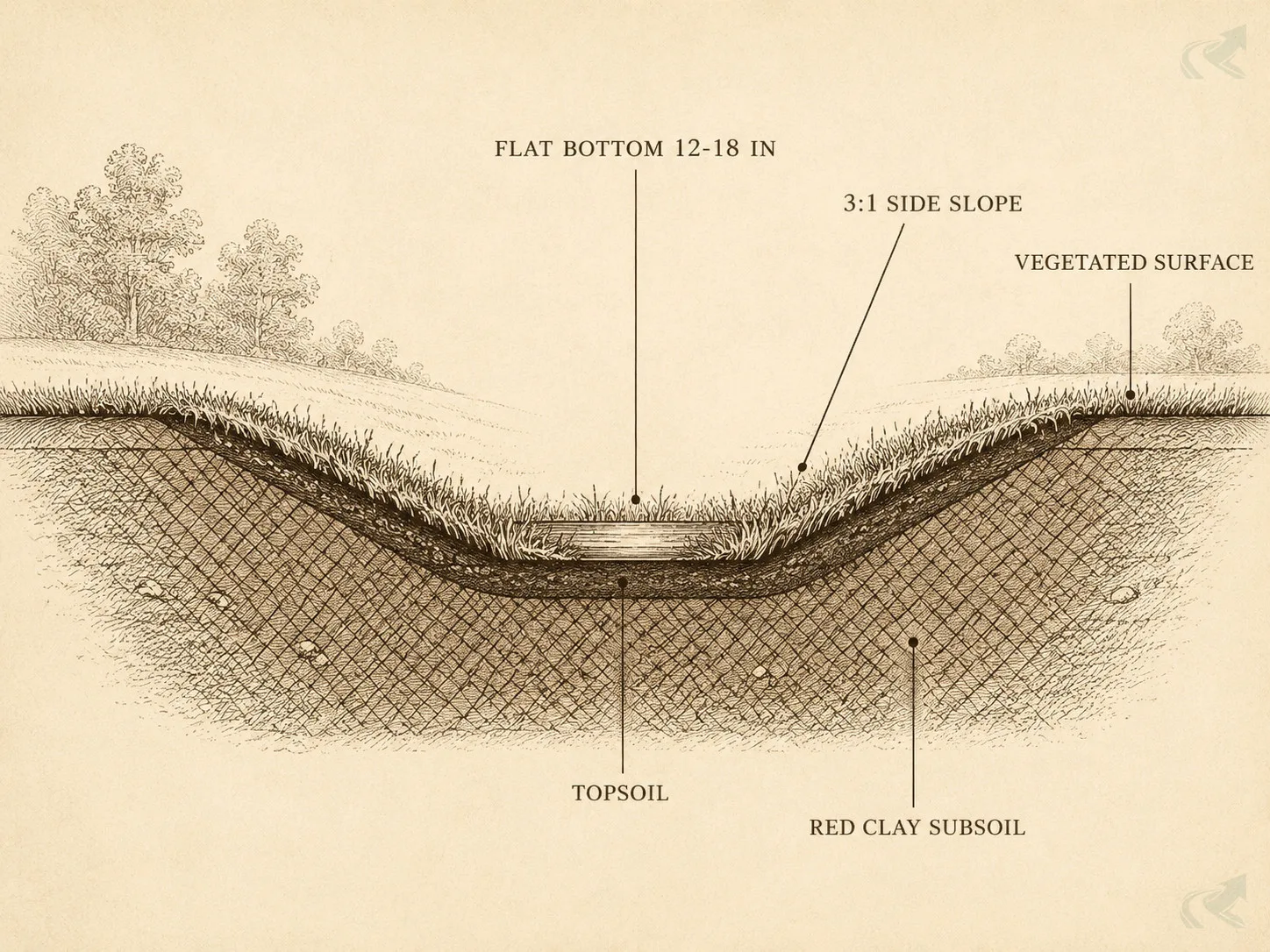
A swale is also not a drainage ditch. A ditch is an excavated trench with no engineered cross-section — it tends to erode, grows weeds, and most HOAs hate it. A swale has a defined shape: flat bottom 1 to 2 feet wide, side slopes at 3:1 (three feet of horizontal run for every foot of vertical rise) per North Carolina erosion and sediment control standards, and a vegetated surface to resist scour.
The vegetation does real work. Grass roots bind the soil. The turf slows velocity. Without cover, even a correctly shaped channel erodes in NC rain events.
When a Swale Is the Right Fix
Use a swale when you have visible surface runoff, enough slope to let it move, and room to build the channel.
Three conditions make a swale viable:
-
Water runs across the surface during rain rather than soaking in. If you can watch water traveling in sheets across the yard, that’s surface runoff — swale territory. If the yard stays saturated for two days after rain stops, that’s a soil saturation problem — French drain territory.
-
Your lot has at least 1% slope from the swale inlet to the outlet. On flat ground, water won’t move. One percent means a 1-foot drop over 100 feet of run — modest, but necessary. Less than that and the water will stall in the channel.
-
You have 3 to 5 feet of width available for the channel cross-section plus mowing access. A swale is a permanent feature in the yard. It needs to fit without eliminating usable space.
North Carolina new construction often has swales already built into the subdivision drainage plan. If your home is in a DR Horton or similar development, check the recorded plat — drainage easements on the lot frequently follow the swale line. Those easements may constrain what you can do with that corridor.
When a French Drain Beats a Swale
If the water is coming up from below or the soil stays saturated for days after rain, a swale won’t fix it — you need subsurface drainage.
A swale only intercepts water moving at the surface. It cannot pull water out of saturated soil. If your yard’s problem is a high water table, clay hardpan trapping perched water, or a spring, a swale is the wrong tool.
Swale vs French Drain -- which does your problem need?
| Factor | Swale | French Drain |
|---|---|---|
| Water type | Surface runoff (visible sheet flow) | Subsurface saturation or perched water |
| Slope required | 1%+ to outlet (required) | Less critical -- pipe can be flat |
| Space required | 3-5 ft wide channel corridor | Trench width only (12-18 in) |
| NC clay maintenance | Annual de-silting; re-seeding scoured areas | Periodic flushing; clay fines clog filter fabric |
| Cost tier | $800-$2,500 basic; more with rip-rap | $1,500-$5,000+ depending on length and depth |
| HOA visibility | Visible grassed channel -- some HOAs restrict | Buried -- invisible from the surface |
| Best use case | Uphill runoff crossing the yard | Soggy soil, wet basement perimeter |
Water type
- Swale
- Surface runoff (visible sheet flow)
- French Drain
- Subsurface saturation or perched water
Slope required
- Swale
- 1%+ to outlet (required)
- French Drain
- Less critical -- pipe can be flat
Space required
- Swale
- 3-5 ft wide channel corridor
- French Drain
- Trench width only (12-18 in)
NC clay maintenance
- Swale
- Annual de-silting; re-seeding scoured areas
- French Drain
- Periodic flushing; clay fines clog filter fabric
Cost tier
- Swale
- $800-$2,500 basic; more with rip-rap
- French Drain
- $1,500-$5,000+ depending on length and depth
HOA visibility
- Swale
- Visible grassed channel -- some HOAs restrict
- French Drain
- Buried -- invisible from the surface
Best use case
- Swale
- Uphill runoff crossing the yard
- French Drain
- Soggy soil, wet basement perimeter
The NC clay note: Piedmont clay sheds water at the surface because it doesn’t absorb rain fast enough. This means surface runoff is far more common in NC than in sandy-soil states. A swale is often the appropriate first fix where a contractor from the Southeast’s coastal plain would recommend a French drain. Know your soil zone.
For the full decision matrix, see swale vs French drain — which solves your problem.
What NC Piedmont Clay Does to Swales
NC clay swales need more maintenance than national guides suggest — clay alternates between slippery and erosion-prone when wet, and rock-hard when dry.
Two failure modes are common in North Carolina:
Silt accumulation. During rain events, clay particles wash off surrounding soil and travel into the swale channel. When water velocity slows — especially in low spots or at the daylight end — those particles deposit. Over one to three seasons, a swale that started at 6 inches deep can fill to 3 or 4 inches. Positive drainage disappears. Water backs up into the yard.
Scour. When a fast-moving storm sends a high volume of water through the channel, the clay surface at the swale bottom erodes. Scour concentrates at curves, at points where the slope steepens, and at the outlet. Left bare, those scoured patches grow into gullies.
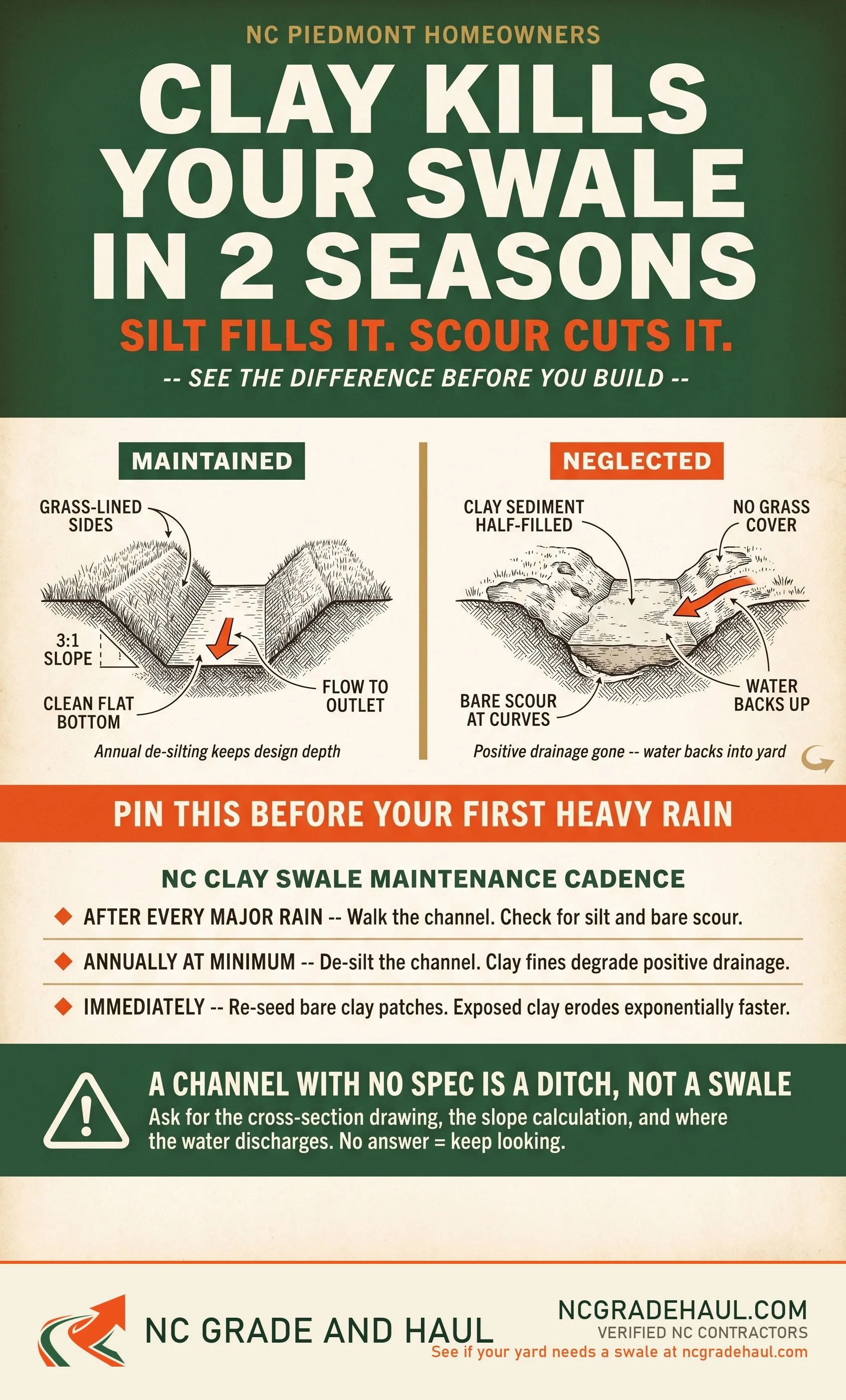
A maintained NC clay swale vs one left to silt and scour
Comparison. Maintained swale: Grass-lined sides at 3:1 slope, clean 1-2 ft flat bottom; Channel de-silted on schedule keeps its design depth; Steady fall carries water to the outlet, no ponding; Scoured patches re-seeded before they grow into gullies. Neglected swale: Channel half-filled with washed-in clay sediment; Bare clay scour cutting in at the curves; No grass cover left on the channel bottom; Positive drainage gone -- water backs up into the yard.
- Grass-lined sides at 3:1 slope, clean 1-2 ft flat bottom
- Channel de-silted on schedule keeps its design depth
- Steady fall carries water to the outlet, no ponding
- Scoured patches re-seeded before they grow into gullies
- Channel half-filled with washed-in clay sediment
- Bare clay scour cutting in at the curves
- No grass cover left on the channel bottom
- Positive drainage gone -- water backs up into the yard
Piedmont clay swales silt up and scour faster than national guides assume -- annual de-silting and rip-rap at velocity points is standard practice, not optional.
Maintenance cadence for a NC Piedmont swale:
- After every major rain event: walk the channel. Look for silt deposits in low spots and bare scour patches at curves.
- Annually at minimum: de-silt the channel. This is hand work or a small excavator pass — the accumulated clay fines need to come out or positive drainage degrades.
- Immediately when bare soil appears: re-seed scoured patches. Bare clay erodes exponentially faster than vegetated clay.
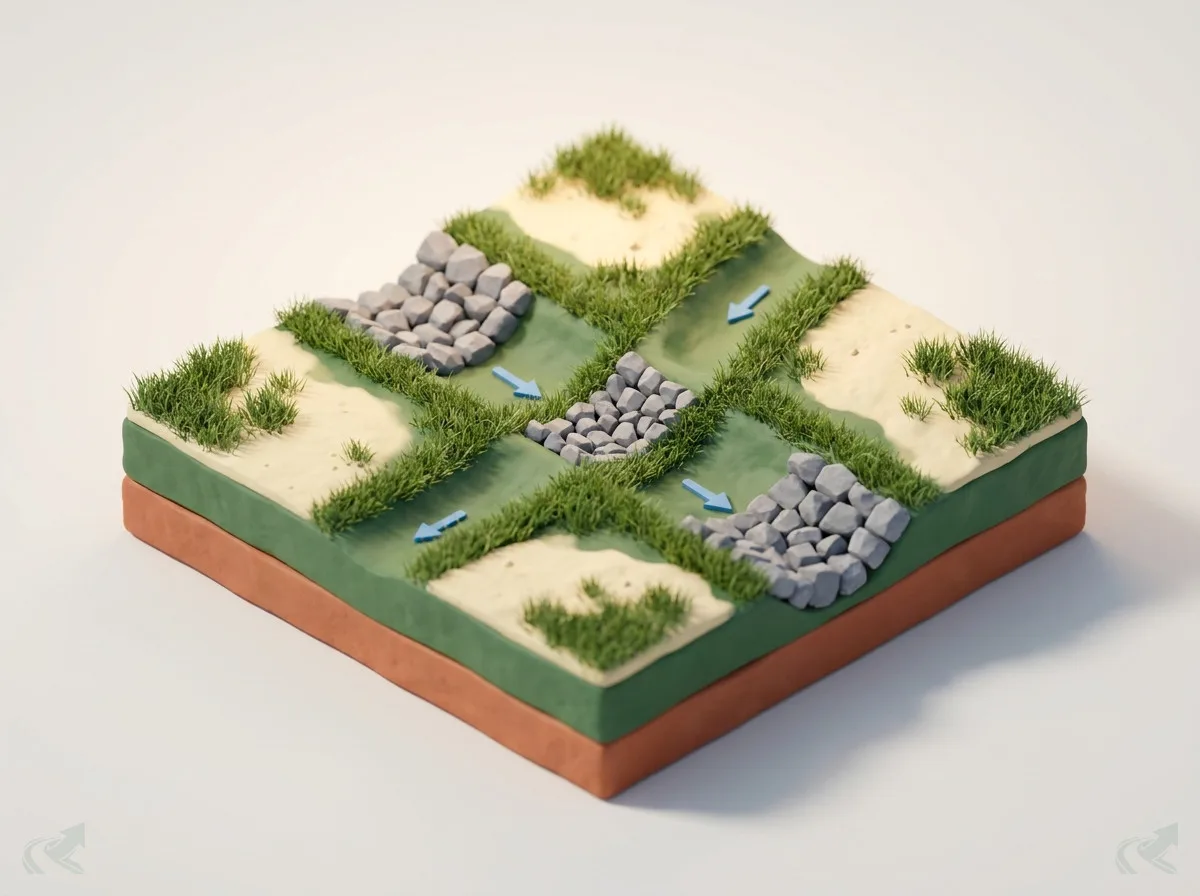
When rip-rap is required: at velocity-transition points — where the swale steepens, at bends, and at the daylight outlet. Rip-rap (angular stone, typically #57 or #4 stone) lines the channel where grass can’t hold against the water velocity. See rip-rap in swales NC — when and where you need it for the full guidance.
Swale Cost Ranges in NC
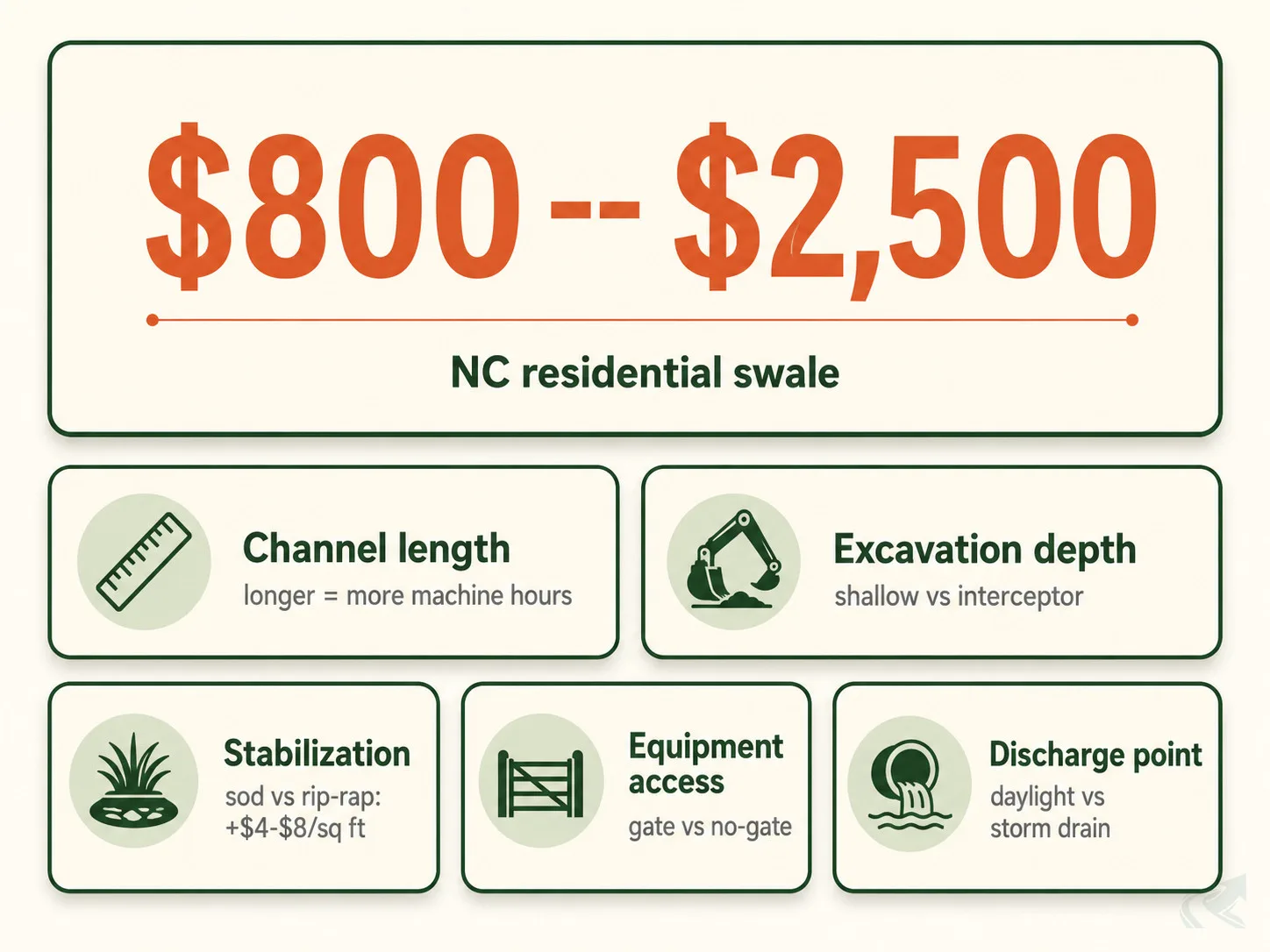
A basic yard swale runs $800 to $2,500 depending on length and stabilization needed; rip-rap lined sections cost more.
Cost factors that move the number:
- Length of channel. A 30-foot swale and a 120-foot swale are different jobs. Longer channels require more excavation, more sod, and more equipment time.
- Depth of excavation. A shallow diversion swale and a deep interceptor channel are both called swales — the machine hours differ significantly.
- Stabilization method. Sod is the standard finish for NC residential swales. Native grass mixes are cheaper upfront but slower to establish. Rip-rap lining at velocity points adds material cost ($4 to $8 per square foot for stone placement) but is required at curves and outlets in higher-velocity channels.
- Access for equipment. A yard with gate access for a compact excavator is a different job than hand-excavating behind a fence.
- Discharge point. Where does the water go? If the outlet can daylight at a curb or into a drainage easement, the job is straightforward. If it needs to connect to a storm drain or extend to a distant outlet, the cost climbs.
A fair itemized quote includes: excavation to cross-section spec, grading to establish positive drainage, silt fence during construction, stabilization material (sod quantity or rip-rap specification with stone size), and a note about post-rain inspection. A quote that lists only “excavation and grading” with no stabilization spec is under-specified.
Selecting a Contractor for Swale Work
Ask for the cross-section spec, the slope calculation, and the outlet plan before signing.
A qualified swale contractor can hand you three things before the job starts:
-
Cross-section drawing. Bottom width, side slopes (minimum 3:1 in North Carolina), and depth at the deepest point. If the contractor can’t sketch this, they’re guessing at the channel geometry.
-
Slope calculation. The elevation of the inlet vs the elevation at the outlet, and the percent fall over that distance. You need at least 1% to maintain positive drainage. Less than that and water stalls.
-
Outlet specification. Where does the water exit the channel, and what happens at that point? Daylight into a buffer strip? Into a drainage easement? Connected to a storm drain? An unspecified outlet frequently creates a new problem at the neighbor’s property line.
Red flag: a contractor who says “we’ll just cut a channel” without specifying any of the above. That’s a ditch, not a swale.
The question to ask before signing any swale quote:
“Can you show me the cross-section drawing, the slope calculation from inlet to outlet, and where the water discharges at the daylight end?”
If the answer is a shrug, keep looking. Hire an NC grading operator who can provide those specs in writing before equipment shows up.
Swale Spoke Pages — Start Here for Your Specific Problem
This hub routes you to the right sub-page — the comparison guide or the construction overview depends on where you are in the decision.
This cluster has five more pages depending on what you need:
-
Swale vs French drain — which solves your problem — if you’re still deciding between the two, this page has the full comparison matrix with NC clay context for both options.
-
Rip-rap stabilization in NC swales — when to use stone lining, which stone sizes work, and what a properly specced rip-rap section looks like.
-
Surface drainage vs subsurface drainage — which do you need — the broader decision between above-ground and below-ground drainage systems.
-
French drains NC — installation, cost and clay guide — the comparison hub for the subsurface drainage option.
-
Standing water in yard NC solutions — if you’re not sure whether runoff or saturation is the core problem, start here.
If a contractor has already recommended a swale and you want to evaluate the quote, go directly to the contractor selection section above or use the NC yard regrading guide if the slope problem is more fundamental than a single channel fix.