
Three culvert questions to answer in order
Does my driveway need a culvert at all?
If natural water flow crosses your driveway path -- a swale, a creek branch, or a seasonal drainage channel -- a culvert is required to carry it underneath without washing the drive out. The tell: a driveway that washes out at the same spot every significant rain, usually right over where a pipe is buried.
Is my culvert the right size, or just whatever NCDOT required?
NCDOT specifies a minimum diameter for driveway approach culverts, but minimum is not the same as adequate. The correct size depends on the drainage area above the crossing. A 12-inch pipe may satisfy the permit but fail during a real storm if your upslope drainage area is larger than one or two acres.
Do I need an NCDOT permit to install or replace the culvert?
Yes -- if your driveway connects to a state-maintained road (any NC highway or SR-numbered secondary road), an NCDOT Driveway Encroachment Agreement is required before any culvert work. Work done without it may have to be redone at your cost. County roads, city streets, and private roads follow different rules.
Six years ago, whoever built the driveway put a 12-inch corrugated pipe in the ground where a natural drainage channel crossed the path. It worked. For a while.
Now the driveway washes out twice a year at the same spot — right over that pipe. The gravel migrates downhill, the base erodes, and the repair holds for one season before the cycle repeats.
Usually it’s one of three things: the culvert is clogged, it has collapsed, or it was undersized from day one. The diagnosis changes the fix entirely. Installing a bigger pipe in a collapsed-culvert situation is a waste of money. Clearing a clogged pipe when the real problem is undersizing gets you one more storm before the next washout.
This hub walks you through the culvert decision in order: do you need one, is it the right size, and what does North Carolina require before you touch it.
When Does a Driveway Need a Culvert?
Any time a natural drainage channel crosses your driveway path — a swale, creek branch, or seasonal flow — a properly sized culvert is required to carry that water under the drive without washing it out.
The tell is usually obvious once you know what to look for. A driveway that washes out consistently at the same spot, especially during or right after rain, almost always has water crossing at that location. The fill material backs up, the water finds the easiest path — usually over or through the fill — and strips gravel and base material on the way out.
What happens without a culvert:
Water doesn’t stop moving because a driveway is in the way. It backs up behind the fill, builds pressure, and eventually overtops or tunnels through. Every storm removes more base material. The washout repeats until the crossing is engineered correctly.
If a pipe is already there:
Check for three things before assuming you need a bigger pipe. First, look for physical collapse — corrugated metal culverts corrode over time, particularly in NC’s clay soils, which tend toward lower pH and accelerate metal corrosion. Second, check for displacement — vehicle load or freeze-thaw cycling can push a pipe out of alignment so water bypasses the inlet entirely. Third, check for blockage — debris from upstream collects at the culvert inlet and can reduce a 15-inch pipe to the flow capacity of something far smaller.
No visible water?
If your driveway doesn’t have obvious water flow across it, you likely don’t need a culvert at that location. One caveat: upslope development can increase runoff to your area after the driveway was originally built. If neighbors have cleared land or paved surfaces above you in the last few years, check whether the drainage picture has changed.
A culvert that carries the crossing vs one the storm runs around
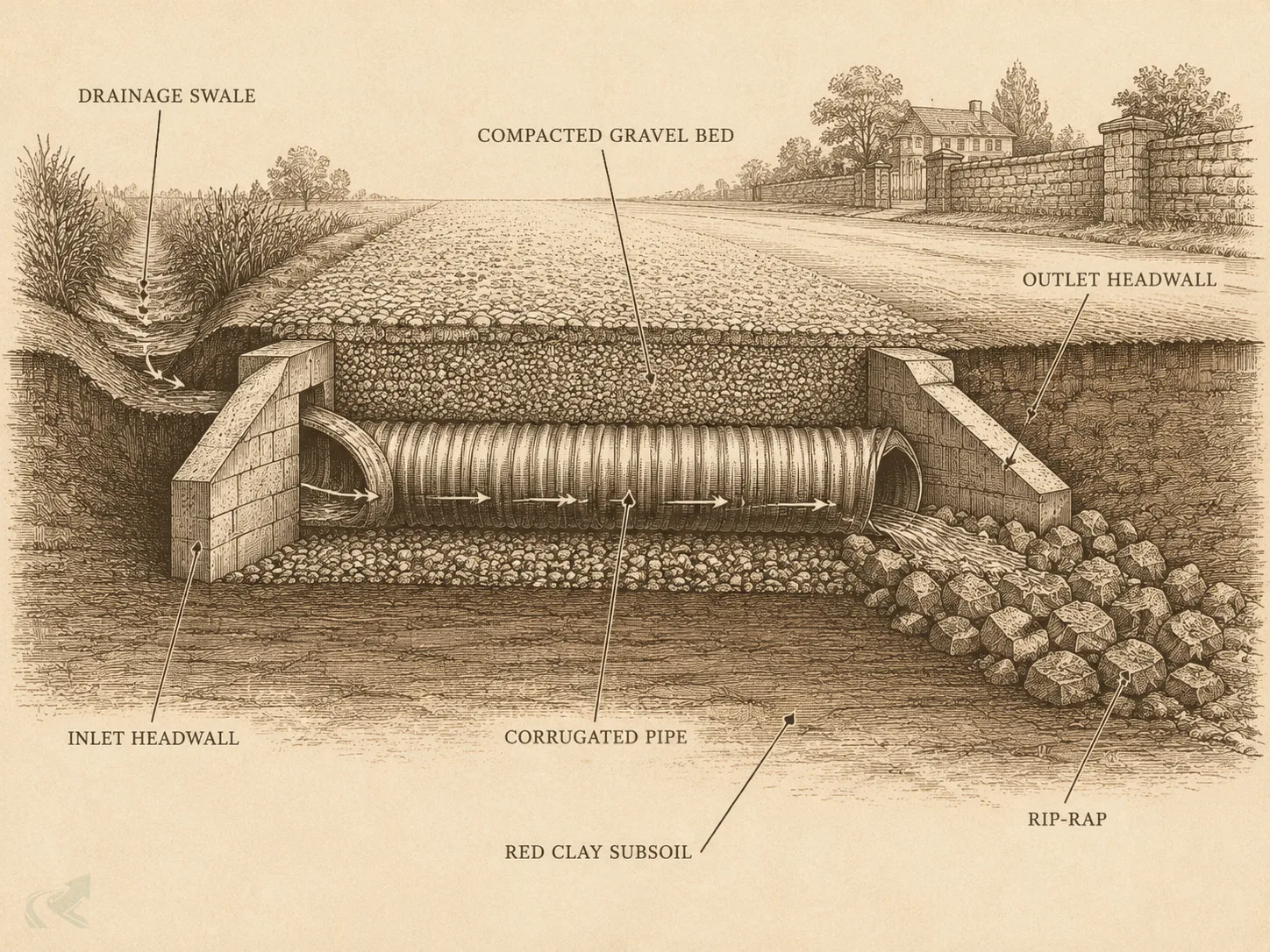
Comparison. Working culvert: Pipe sized to the actual upslope drainage area; Clean inlet, gravel cover, rip-rap headwall at the outlet; Storm flow passes under the driveway through the pipe; Apron and driveway fill stay stable storm after storm. Failed culvert: Undersized or clogged -- pipe can't pass peak flow; Water backs up and bypasses the inlet entirely; Scour cuts in at the apron edge and outlet; A washout channel carves straight through the driveway fill.
- Pipe sized to the actual upslope drainage area
- Clean inlet, gravel cover, rip-rap headwall at the outlet
- Storm flow passes under the driveway through the pipe
- Apron and driveway fill stay stable storm after storm
- Undersized or clogged -- pipe can't pass peak flow
- Water backs up and bypasses the inlet entirely
- Scour cuts in at the apron edge and outlet
- A washout channel carves straight through the driveway fill
A 12-inch pipe can satisfy the NCDOT minimum and still fail -- the right size is set by the drainage area above the crossing, not the permit floor.
Culvert Sizing Basics — 12-Inch vs 15-Inch
specifies a minimum culvert diameter for state-road-connected driveways, but minimum doesn’t mean adequate — the right size depends on the drainage area above the crossing.
NCDOT’s residential minimum for driveway approach culverts is typically 12 inches in diameter. That number satisfies the permit. It does not necessarily satisfy the watershed above your driveway.
A drainage area larger than one to two acres upstream can overwhelm a 12-inch pipe during a significant rain event. This is the failure mode that produces the repeating-washout pattern — the culvert was correctly installed and meets code, but it can’t handle peak storm flow for the actual drainage area it serves.
The rule of thumb that matters:
If you’ve had a culvert replaced and still experience washout at the same spot, assume the replacement was sized to the NCDOT minimum rather than to your actual drainage area. A contractor who says “we’ll put in a 15-inch to be safe” without doing a drainage-area calculation is still guessing.
How sizing is actually calculated:
The standard method uses three inputs: drainage area in acres above the crossing, a runoff coefficient based on ground cover and soil type, and a storm design frequency — typically a 10-year or 25-year storm event for residential driveways. NC clay soils (Piedmont, specifically) have lower permeability than sandy soils, which raises the runoff coefficient and means more water moves off the surface faster.
The itemized quote for culvert work should name the drainage area assessment, not just “12-inch pipe, labor and material.”
See the full sizing walkthrough at driveway culvert sizing NC — including the drainage-area calculation method and what the difference between a 10-year and 25-year design storm means in practical terms.
The NCDOT Permit Requirement — When It Applies
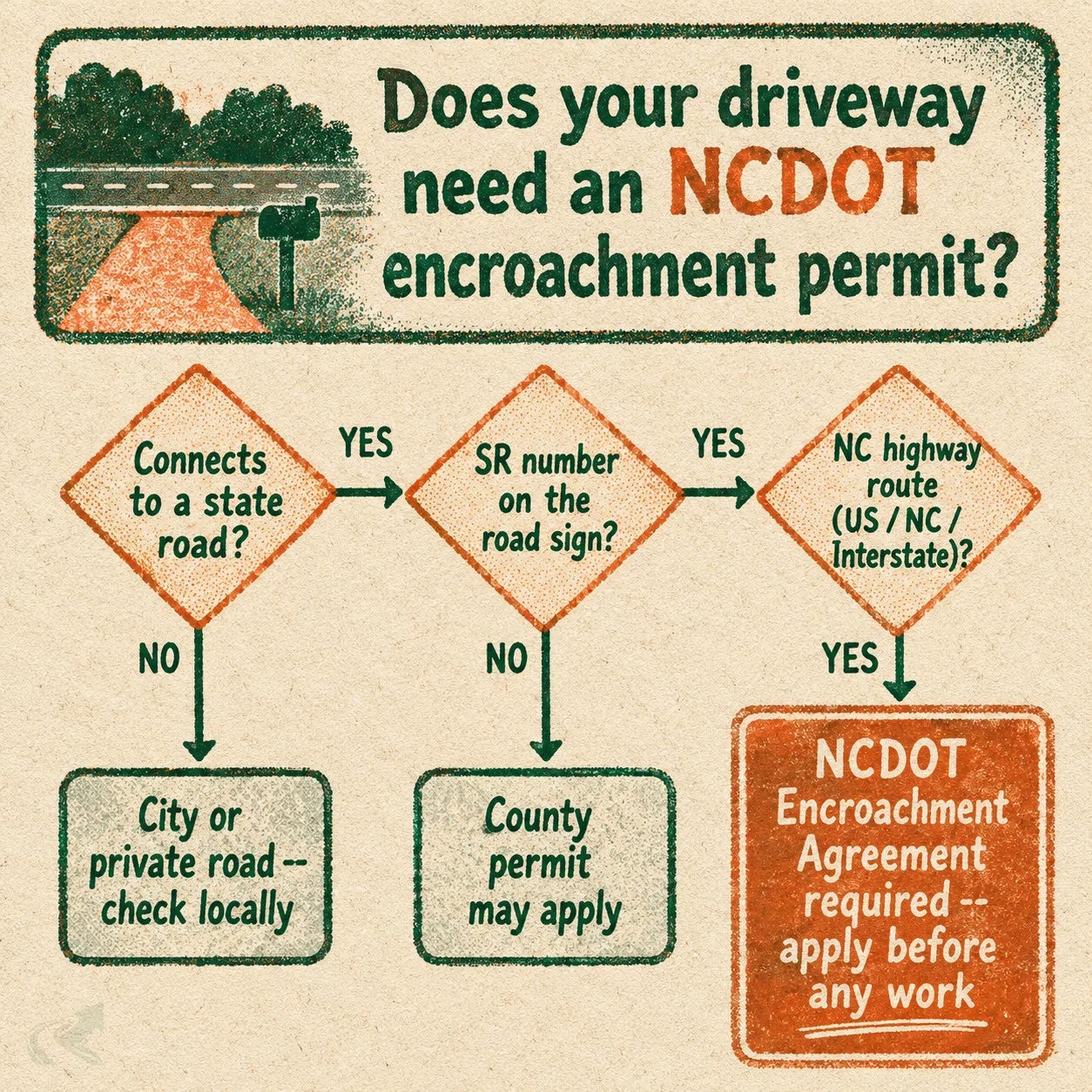
An NCDOT Driveway Encroachment Agreement is required before you install or replace a culvert at any driveway approach on a state-maintained road. It’s not optional — work done without it may have to be redone.
This is the thing most NC homeowners don’t know about until after the fact.
Applies to:
- All NC highway routes (US, NC, and Interstate designations)
- All -numbered secondary roads
Does not apply to:
- County-maintained roads (a county permit may still apply — check with your county)
- City or town streets (municipal permit process)
- Private roads (no permit from NCDOT required, though HOA or easement rules may apply)
How to check which applies to your road:
Look at the road sign. If there’s an SR number posted, NCDOT maintains that road and the encroachment agreement requirement applies. When in doubt, call your NCDOT Division office — North Carolina has 14 Divisions covering the state, each handling encroachment permits for its geography.
Typical process:
Your contractor submits an application with a site plan showing the culvert size, driveway approach geometry, and drainage area. NCDOT reviews for culvert adequacy and approach geometry compliance. An agreement is typically issued within two to six weeks for straightforward residential applications, though complex sites or peak-season volume can extend that.
The full permit process — what the application includes, who submits it, and what the site plan must show — is covered at NCDOT driveway culvert permit NC.
Road Apron Drainage — Why the Culvert Isn’t Enough
A properly sized culvert handles the water crossing under the driveway, but the road apron — the first 20 feet of driveway from the road edge — needs its own drainage plan or it washes out at the apron edge.
This is the part contractors skip and homeowners discover a year later.
The failure pattern: the culvert carries water successfully under the driveway. But overflow or splash from the culvert outlet scours the apron edge. The apron starts to slump and fail even though the culvert itself is working correctly.
The fix involves three things:
Rip-rap at the culvert outlet headwall to dissipate the energy of water exiting the pipe. Proper grading of the apron surface to maintain positive drainage — slope away from the road edge. And attention to the crown grade at the apron so water sheds both ways and doesn’t pool at the road connection.
A culvert installation that doesn’t address the apron drainage is a partial fix. The apron will fail at the outlet within a few years.
Full treatment of apron drainage design at road apron drainage and culvert relationship NC.
Washout and Culvert Failure — The Connection
If your driveway washes out at the same spot every storm, the culvert is either failed, clogged, or undersized — and fixing the surface without fixing the culvert is a temporary repair at best.
NC Grade and Haul surfaces this connection because the most persistent driveway washout patterns in North Carolina trace to culvert problems, not surface gravel problems. Contractors who resurface without diagnosing the culvert are selling you a one-season fix.
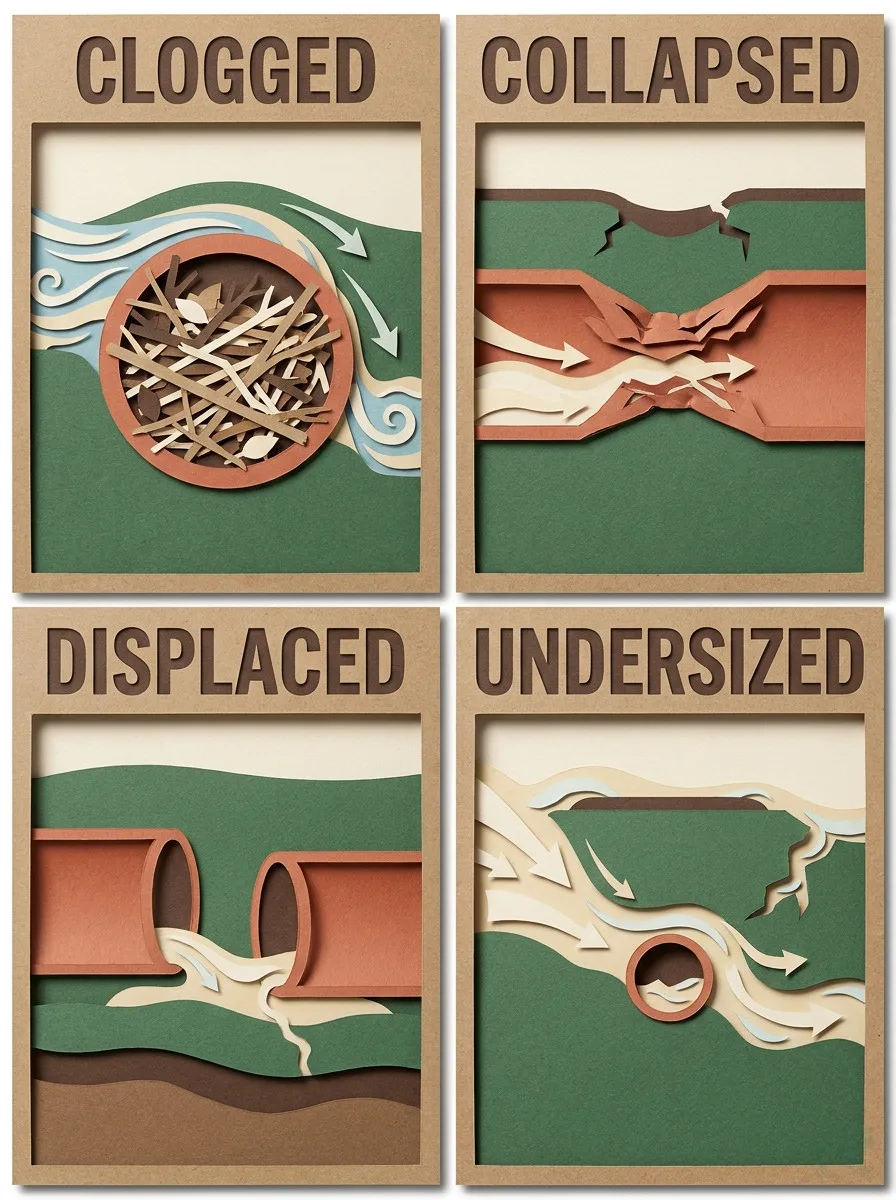
Failure modes, in order of ease to diagnose:
- Clogged: Debris from upstream — sticks, leaves, sediment — collects at the culvert inlet. The culvert is structurally sound but acting like a smaller pipe. Cleanout restores function.
- Collapsed: Corrugated metal culverts corrode and collapse over time. NC clay soils accelerate this. Collapse can be partial (reduced flow) or complete (no flow). Replacement is required; cleanout won’t help.
- Displaced: Vehicle load or ground movement has shifted the pipe out of alignment. Water enters the inlet but exits underground, bypasses the outlet, and scours the driveway fill from below.
- Undersized: The culvert is functioning as designed but can’t handle peak storm flow for the actual drainage area. Replacement with a correctly sized pipe is the fix.
The daylight test:
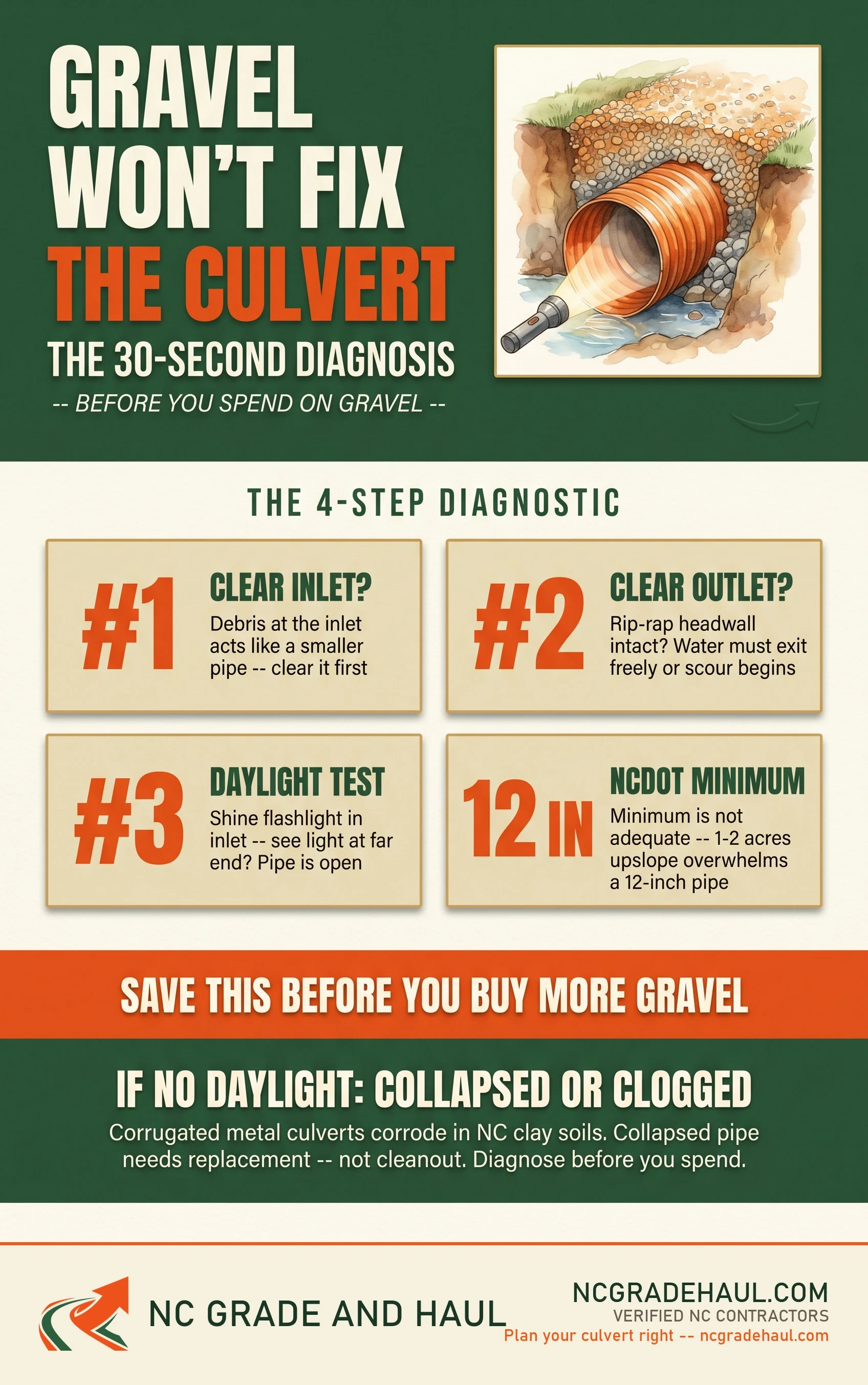
Shine a flashlight into the culvert inlet. If you can see daylight at the other end, the pipe is open. If you can’t, debris or collapse is blocking flow. This is the 30-second first diagnosis before calling anyone.
For post-Helene culvert failures in Western NC, see post-Helene driveway washout repair in WNC — the failure modes in WNC’s rock-and-shallow-soil context differ from Piedmont clay.
Connect the culvert fix to the full driveway washout repair workflow — the surface repair, compaction, and gravel re-establishment all depend on the culvert being right first.
What to Ask Before Signing a Culvert Quote
An itemized quote for culvert work should answer four questions before you sign anything.
First: what is the drainage area above the crossing, in acres? If the contractor can’t name this number, the pipe size is a guess. Second: is the proposed pipe diameter based on that drainage area, or on NCDOT’s minimum? Those are often two different answers. Third: if your driveway meets a state road, is the encroachment permit included in the scope, or is that your responsibility to pull? Fourth: what is the apron drainage plan at the outlet — rip-rap, grading, or both?
If your contractor doesn’t mention the drainage-area assessment, ask how they sized the pipe. The answer tells you whether you’re getting a culvert install or just a pipe in the ground.
Find a grading contractor in North Carolina who can pull the permit and complete the drainage-area assessment as part of the scope — not as an afterthought.
Culvert OK? Quick diagnostic checklist:
- Check the inlet — is it clear of debris?
- Check the outlet — is it clear and is the headwall intact?
- Shine a flashlight in the inlet — can you see daylight at the outlet end?
- Check the drainage area — has upslope land use changed since the culvert was installed?
If any of these fail, you have your diagnosis. Start there before spending money on driveway gravel.