
Two questions people often ask
Why does my gravel driveway wash out every spring?
Almost always one of two things: the crown is gone (water runs down the driveway instead of off the sides) or the culvert at the road is plugged or undersized (roadside water backs up across the surface). Adding more gravel without fixing the drainage path resets the same problem on a 6-to-18-month clock.
Is gravel migration a spec problem or a base problem?
Usually base. A correctly compacted Aggregate Base Course subbase holds the top course in place. When #67 stone wanders to the edges and bare clay shows through ruts, the subbase never got proof-rolled — or it was never there.
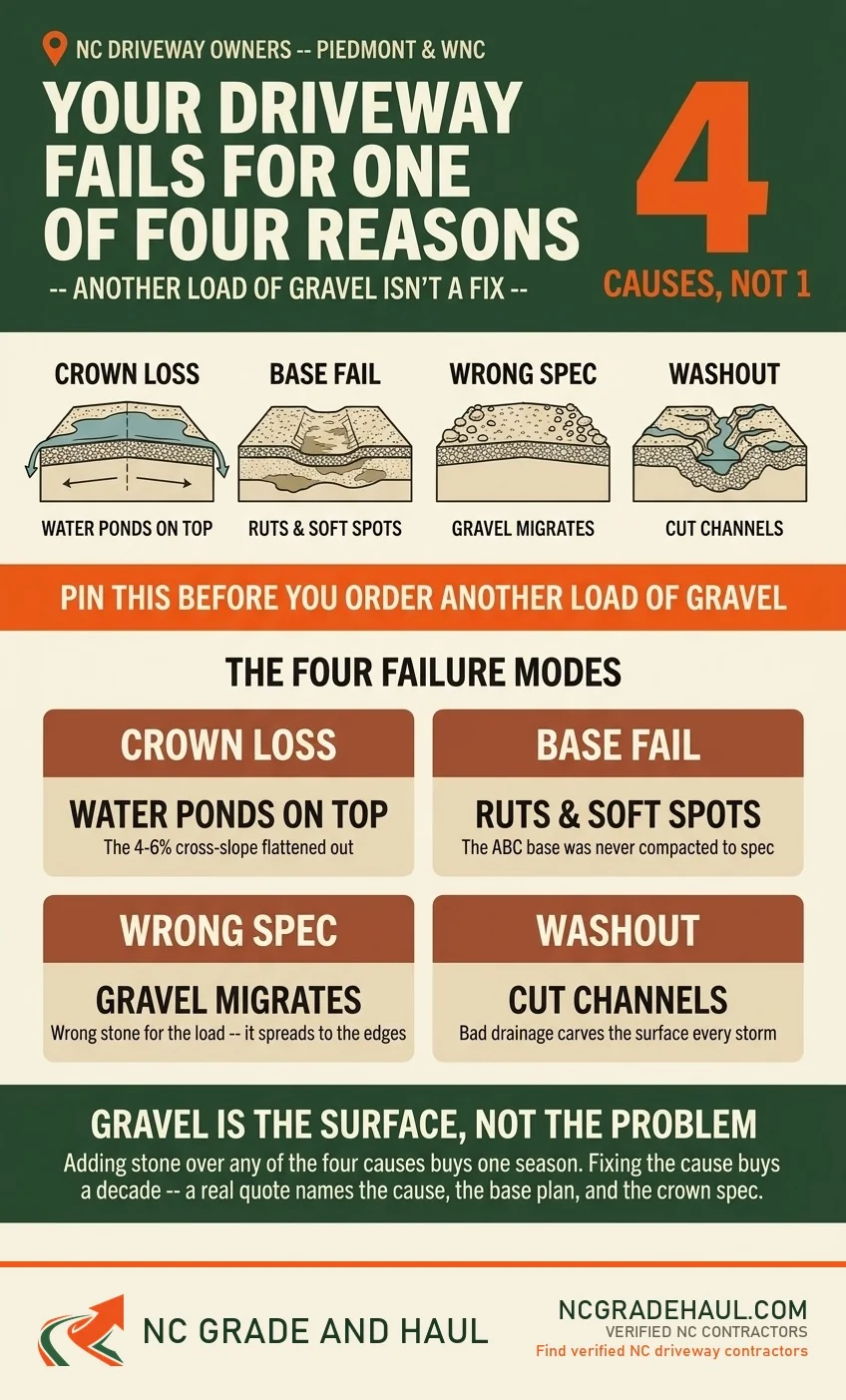
Driveway problems in NC almost always trace back to one of four things: lost crown, failed compaction, wrong gravel spec, or washout from bad drainage. Throwing another load of stone on top buys a season. Fixing the cause buys a decade.
This hub maps the driveway work we do — grading, gravel, washout repair, and culvert/permit — and points you to the specific sub-topic that matches your actual problem.
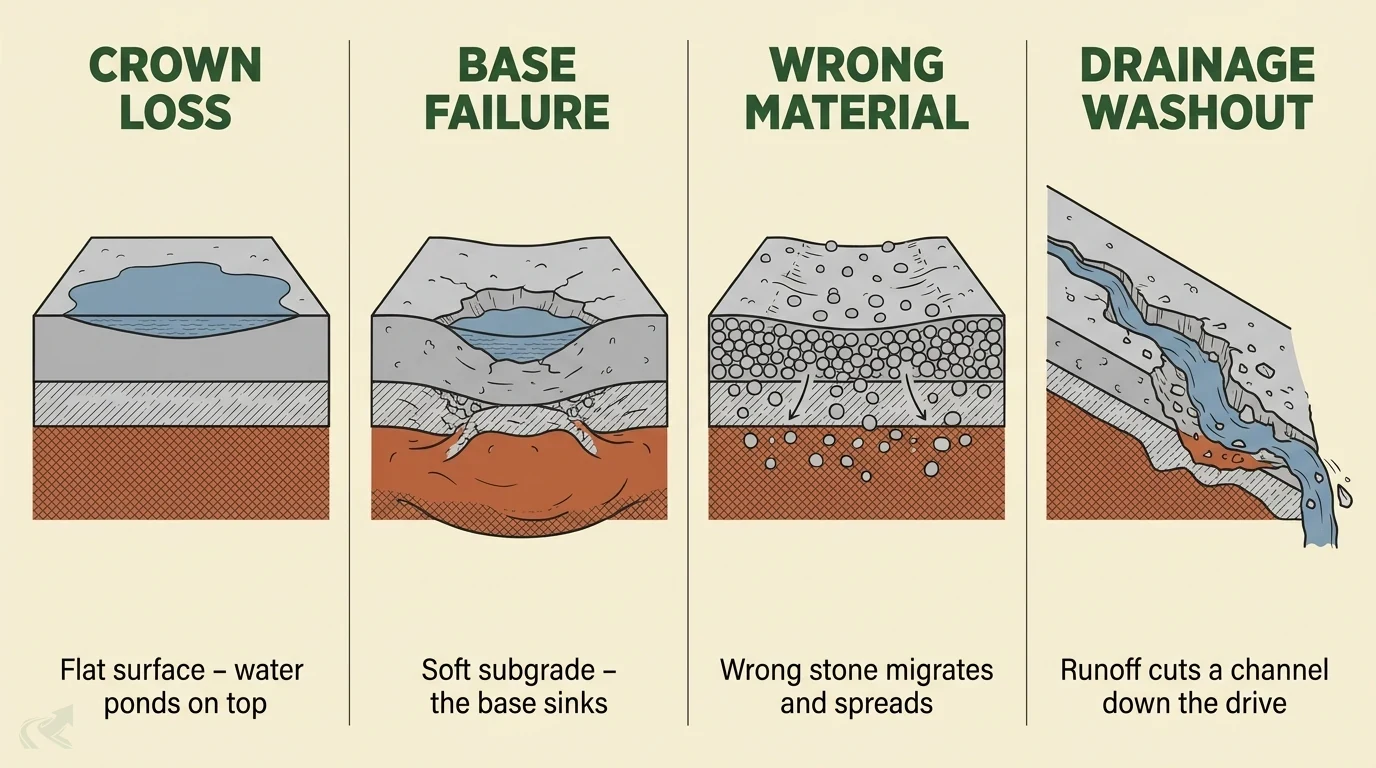
The Four Causes — Match Your Symptom to a Cause
Most NC driveway failures fall into one of four cause buckets. Diagnose the cause first; the fix follows.
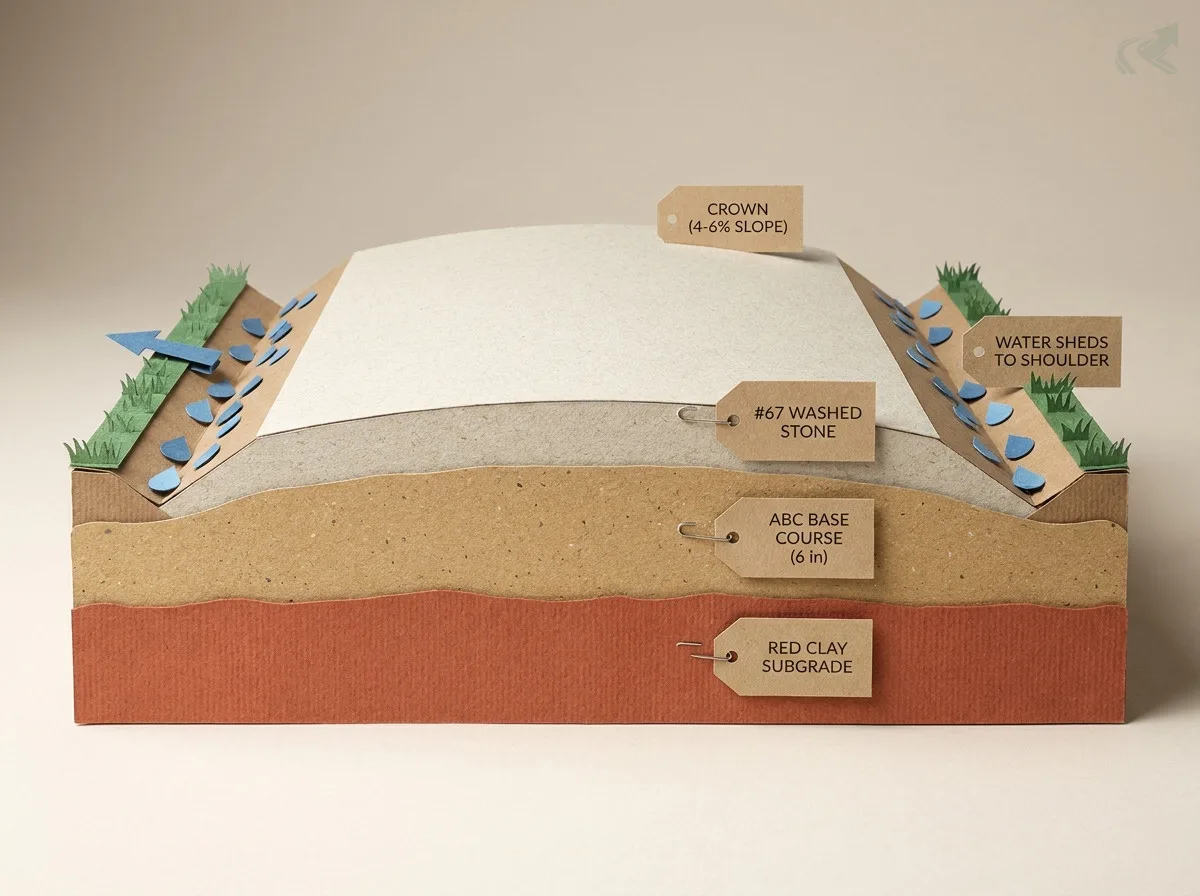
- Crown loss — water pools on the surface or runs down the wheel tracks instead of shedding to the shoulders. The driveway has flattened out, often from years of regrading without re-establishing the 4–6% crown that gravel surfaces need. (The 2% you’ll see on paved-road specs is too flat for gravel — gravel sheds water less efficiently than asphalt and needs more cross-slope.) If that sounds like yours, start here: crown restoration.
- Compaction failure — soft spots, ruts under tires, gravel that disappears into the subgrade after every rain. The ABC base was never proof-rolled, or there was no real base under the top course. If that sounds like yours, start here: compaction and proof-rolling.
- Wrong gravel spec — #57 stone used as a driving surface (rolls under tires); unwashed crusher run used where #67 was needed (clogs and packs); topsoil-contaminated “gravel” that turns to mud. The material was wrong for the job. If that sounds like yours, start here: gravel types and installation.
- Washout / drainage-driven damage — gullies down the centerline, gravel piled at the bottom of the slope, road-side water crossing the driveway after every storm. The problem is upstream of the surface. If that sounds like yours, start here: washout repair.
The Driveway Sub-Clusters
Four service tracks. Each one has its own spec, its own price band, and its own way to be done wrong.
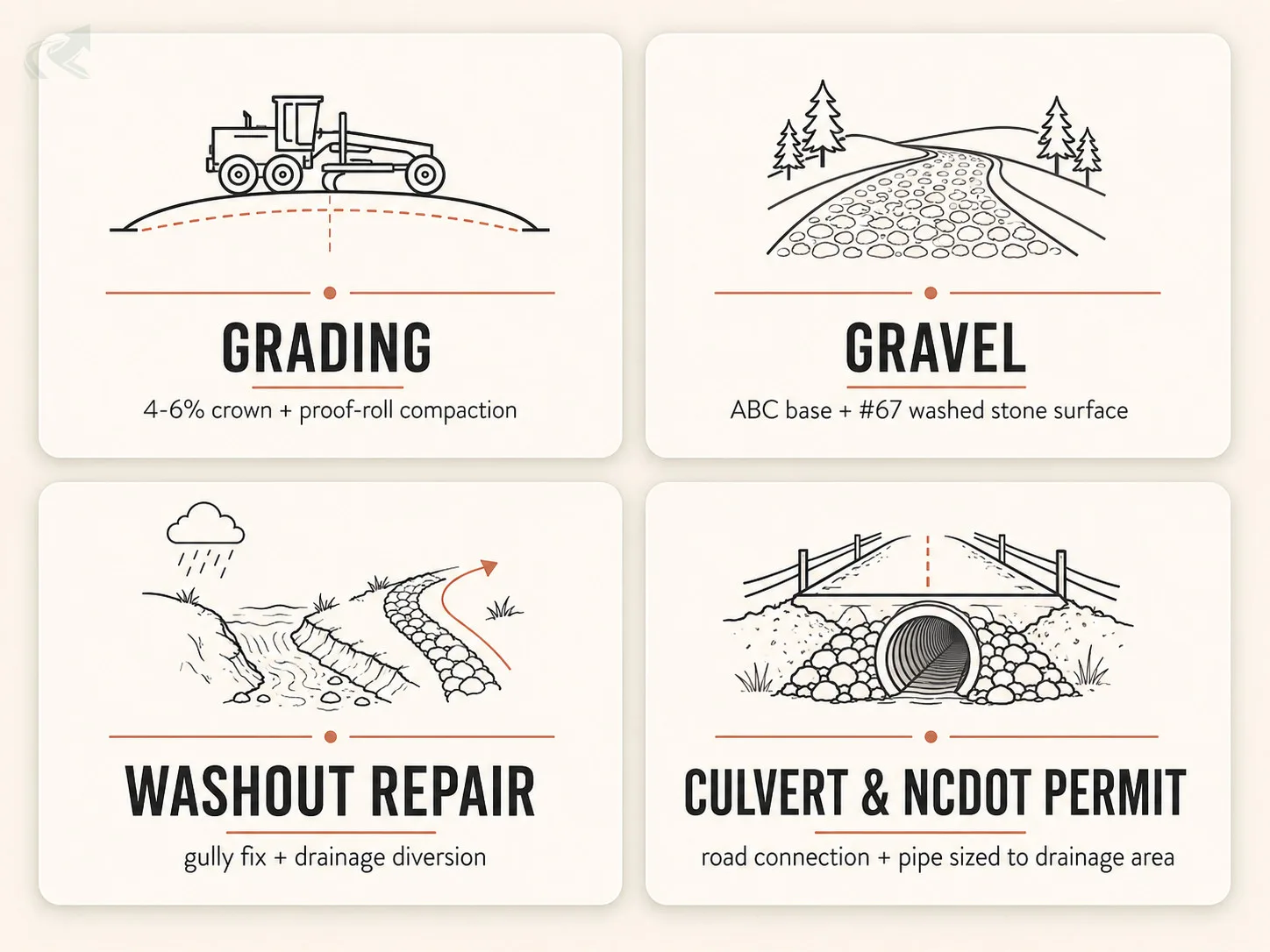
- how NC driveway grading works — the core service. Re-establishing the crown to a gravel-appropriate 4–6% cross-slope, proof-rolling the base, blading and rolling the top course. Crown and compaction are the two sub-pages that cover the failure modes in detail.
- driveway gravel types and installation — ABC for the base, #67 washed stone for the surface or drainage layer, CABC as a base alternative where pricing favors it. Spec drives the result. A driveway built on the wrong stone fails the same way every time, regardless of how thick it is.
- driveway washout repair in NC — including active-recovery Helene WNC work. Repair is rarely just refilling the gully — the water that cut the gully is still going to be there next storm. Diversion, swales, and culvert resizing usually need to be part of the same scope.
- driveway culverts and NCDOT permits — the transition from driveway to road. An undersized or clogged culvert backs water onto the surface; a missing culvert on a new driveway means no NCDOT permit and no legal road connection. Pipe diameter is sized to the drainage area, not picked from the rack.
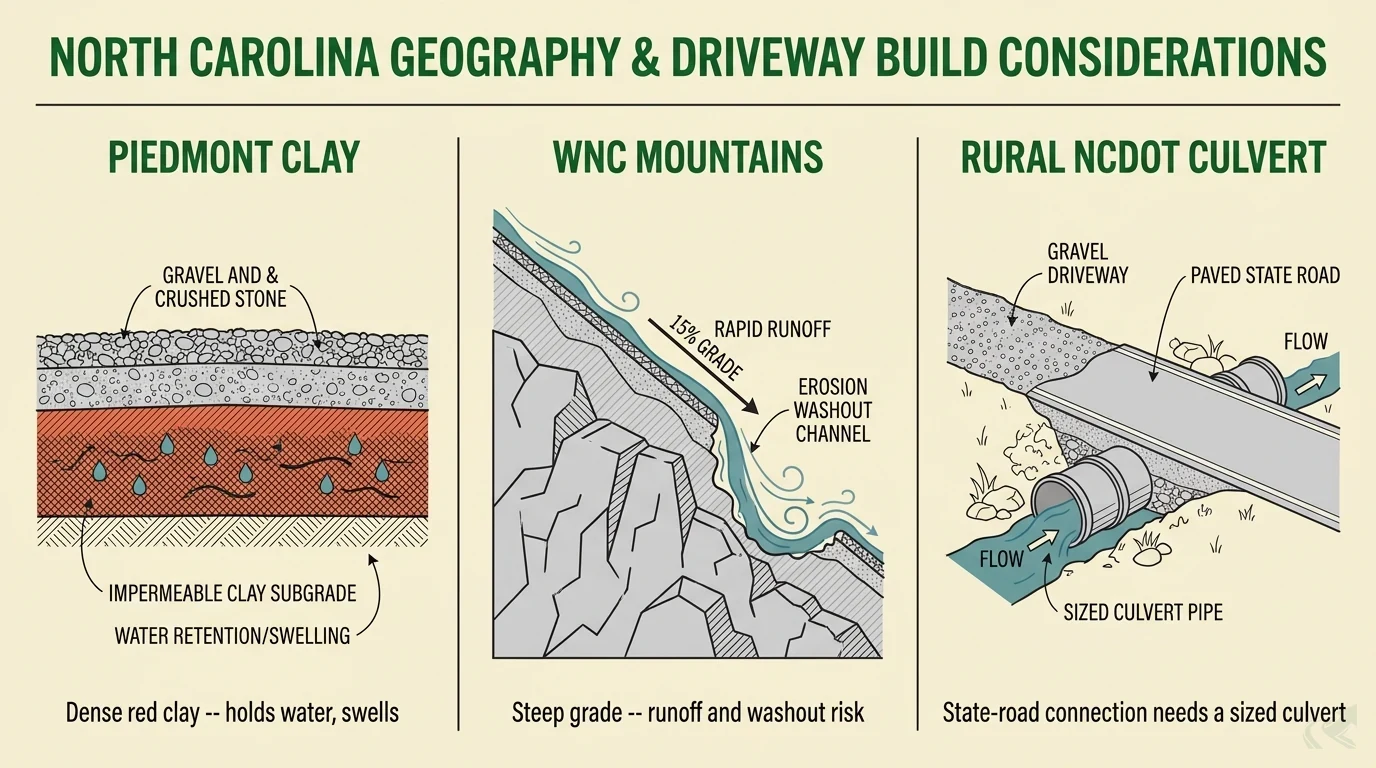
NC-Specific Considerations
Soil and geography shift the spec. A driveway built right in Wake County isn’t built the same way as one in Buncombe.
- Piedmont red clay subgrade (most of the Triangle and Charlotte metro) — clay holds water, pumps under load when wet, and shrinks when dry. Driveways over Piedmont clay need a compacted ABC base thick enough to bridge the soft season — typically 6 inches minimum on residential, more on long approaches. Skipping the base course because the clay “feels firm in August” is a common shortcut that fails by April.
- WNC post-Helene driveways — washouts, lost culverts, undermined approaches across Buncombe, Henderson, and Rutherford. Many of these aren’t repair jobs; they’re rebuilds with rerouted drainage. The Helene WNC washout page covers the recovery-specific patterns and what FEMA / insurance documentation usually requires.
- Rural long driveways in Guilford and Wake — 800-foot driveways with grade changes, drainage crossings, and an NCDOT connection at the road. Permitting matters more here: the culvert at the road is NCDOT’s, every cross-drain is yours, and the slope sets whether the surface can be loose gravel or has to step up to a stabilized base.
Hiring a Driveway Contractor
A driveway quote that doesn’t name the gravel spec, the base thickness, and the drainage plan is incomplete — no matter what the number is.
The vetting questions, the red flags, and what an itemized driveway quote should actually contain are covered on the hire a grading contractor for driveway work page. The short version: ask whether the quote includes proof-rolling the base, what the gravel spec is by name (ABC and #67, not “gravel”), and what the drainage plan does with the water that’s currently causing the problem.
If the answer is “we’ll just add another load of stone,” that’s not a fix. That’s a rebooked job.