
Brenda Bryant’s contractor replaced the 12-inch culvert with a new 15-inch pipe. The next month, another heavy rain. The apron at the road edge washed out again — same area, same pattern.
She called the contractor. He said “the culvert is fine, that’s just the apron.” He is not wrong. The culvert is fine. But the apron drainage was never addressed. Now she is looking at the same visible problem she paid to fix.
This page explains why the culvert and the apron are two separate problems that require two separate solutions. North Carolina contractors who install a culvert without addressing outlet protection and crown geometry are installing half the system.
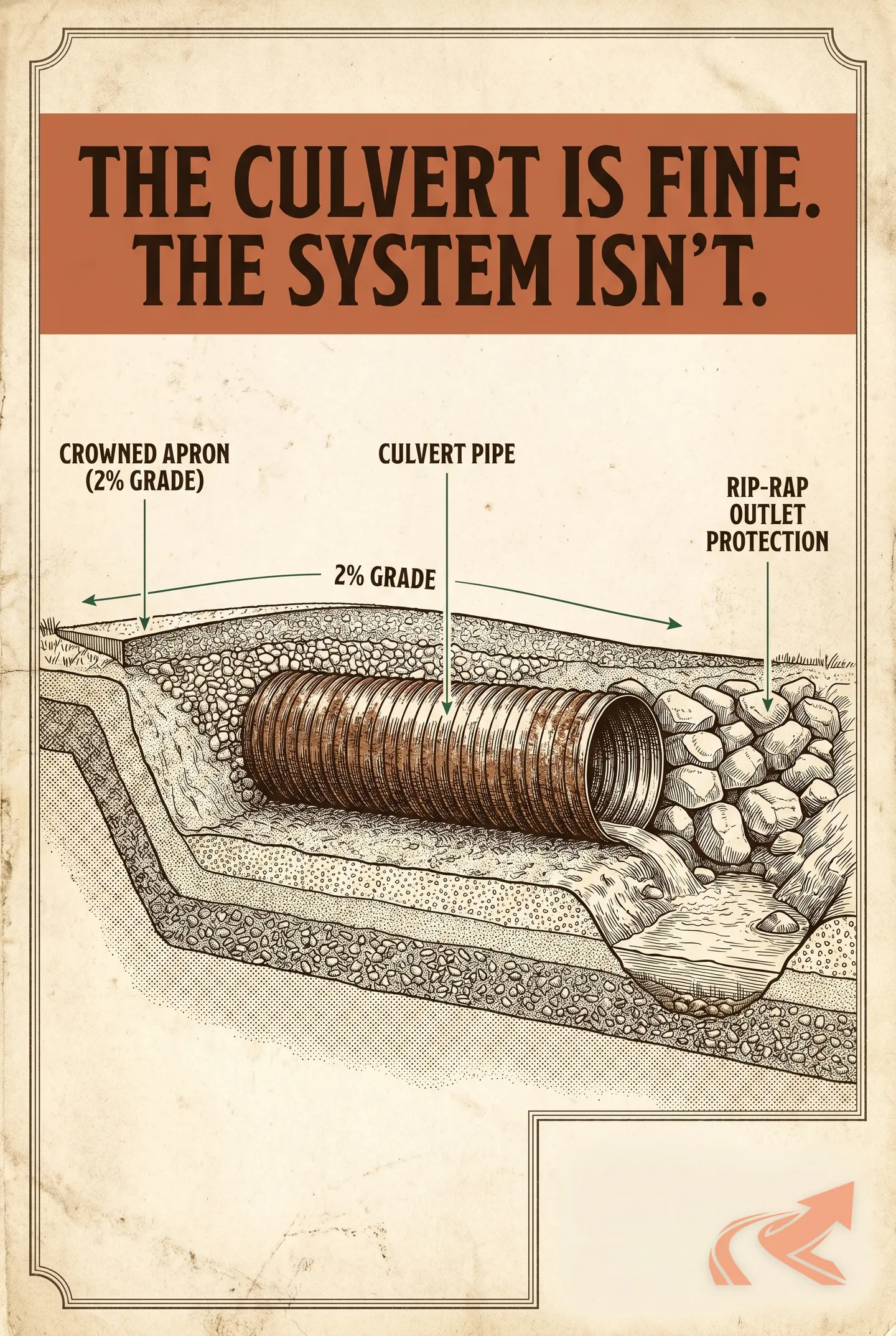
The Drainage Triangle — Culvert, Crown, Ditch
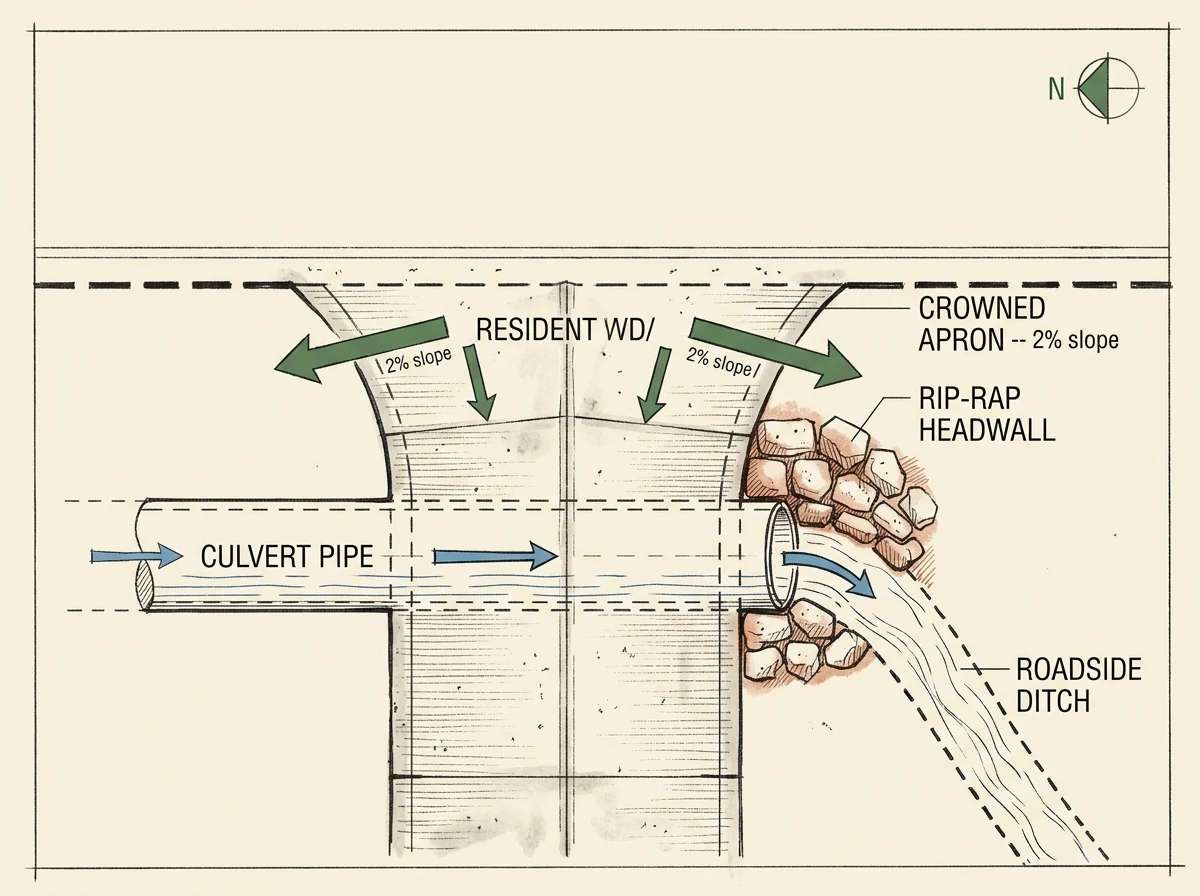
A driveway approach that does not wash out has three drainage components working together: the culvert carries water under the drive, the crown sheds surface water to both sides, and the roadside ditch or swale carries away what exits the culvert outlet.
Here is how each element functions:
- Culvert: handles the subsurface crossing. Properly sized and installed, it carries the design storm flow under the driveway without overtopping. This part most contractors do correctly.
- Crown at the apron: the first 20 feet of a driveway from the road edge need positive drainage too. If the apron is flat or slopes toward the road, surface runoff from the driveway concentrates at the road edge and scours it.
- Ditch or swale at the outlet: water exiting the culvert outlet must go somewhere. Without a drainage channel or rip-rap dissipation pad at the outlet headwall, the exit velocity scours the soil around the pipe end.
When one element is missing, the others compensate — but not well enough. A correctly sized culvert with no outlet protection will scour the ground at the pipe end. A crowned apron without a proper outlet structure diverts surface water directly into that scour zone and compounds the damage.
The result is a pattern that repeats every storm — and fixing road apron washout NC means addressing all three elements, not just repairing the pipe. The culvert is working. The system is not.
Driveway apron: the full drainage triangle vs the half-installed pipe
Comparison. Complete system: Culvert sized for the crossing carries water under the drive; Crowned apron sheds surface water off both sides; Rip-rap headwall plus a ditch carry outlet water away. Pipe only: Culvert in, but no rip-rap at the outlet -- the pipe end scours; Flat apron concentrates runoff at the road edge; A scour channel opens beside the headwall and washes out.
- Culvert sized for the crossing carries water under the drive
- Crowned apron sheds surface water off both sides
- Rip-rap headwall plus a ditch carry outlet water away
- Culvert in, but no rip-rap at the outlet -- the pipe end scours
- Flat apron concentrates runoff at the road edge
- A scour channel opens beside the headwall and washes out
The culvert can be flawless and the apron still washes out -- outlet protection and crown are the other two-thirds of the system.
Erosion at the Apron — Where It Starts
Apron erosion almost always begins at one of three points: the outlet headwall, the apron edge where gravel meets road pavement, or the low side of the apron where crown is absent or reversed.
Understanding the failure mode tells you which part of the system is missing.
Outlet headwall scour: when water exits the culvert at velocity, it digs a hole at the outlet if the surrounding soil is not armored. The tell is a washout channel that radiates from the pipe end into the field or yard. Rip-rap or a concrete headwall protects this zone.
Apron edge erosion: the transition from gravel driveway to asphalt road edge is a structural vulnerability. Gravel settles and the edge drops. Surface water from the road concentrates at the seam and undercuts the apron gravel from below. A concrete or asphalt edge treatment — a lip — prevents this, as do erosion barriers at the road apron when a permanent edge treatment isn’t in scope.
Reversed crown: an apron that slopes toward the road instead of away channels all surface driveway runoff directly to the road edge. This is the most aggressive apron erosion pattern. Fix: regrade the first 20 feet of driveway to establish positive drainage away from the road at 2% or better.
Common contractor mistakes that produce these failure modes:
- Installing the culvert without outlet protection. Scour at the pipe end is predictable within 6 to 12 months.
- Leaving the apron flat. Surface water concentrates at the road edge with nowhere else to go.
- Skipping the ditch outlet. Culvert outlet water has nowhere to travel except around the headwall and back into the apron.
The diagnostic: walk the apron during rain and observe where water is moving. If erosion reappears in the same location after every storm, one of these three failure modes is active.
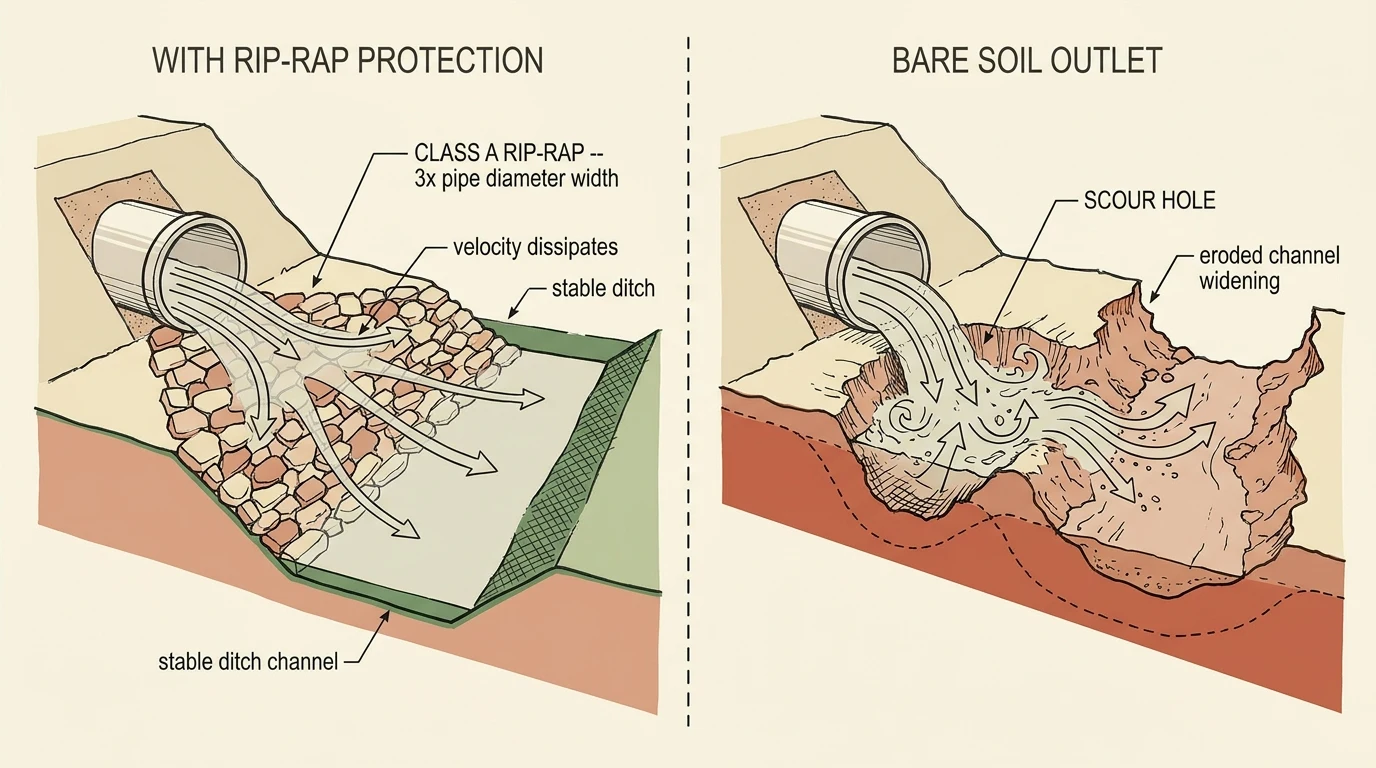
Rip-Rap Spec — What NCDOT Requires and Why
classifies rip-rap by stone size in its Standard Specifications. Class A rip-rap — the size used for low-velocity outlet protection on residential driveway culverts — runs from a 2-inch minimum to a 6-inch maximum stone, with a 4-inch midrange (Section 1042, Table 1042-1). NCDOT does not mandate outlet rip-rap on most residential driveway approaches, but specifying it is standard erosion-control practice.
What rip-rap does that bare soil cannot:
- Dissipates the exit velocity of water leaving the culvert so it does not excavate the soil below the outlet
- Prevents the pipe end from being undermined, which causes pipe displacement and repeat washout cycles
- Creates a stable transition zone from pipe velocity to sheet flow in the ditch or yard
For North Carolina residential driveway culvert outlets, the applicable spec is typically Class A rip-rap — a 2-inch to 6-inch stone (4-inch midrange) per NCDOT Standard Specifications Table 1042-1 — placed around the outlet headwall.
A common sizing reference for the coverage zone is a total apron width of roughly 3 times the pipe diameter at the outlet end, tapering back to the pipe diameter at the pipe end — with length determined by outlet velocity, typically 2 to 4 times the pipe diameter for low-head residential culverts. These are general hydraulic-engineering practice figures drawn from standard outlet-protection design guidance (NRCS, USDA, Charlotte-Mecklenburg stormwater manuals) — NCDOT does not specify a fixed residential outlet rip-rap apron dimension. Size the rip-rap apron to the outlet velocity on a given job; the design engineer or NCDOT Division office sets the site-specific dimension. (Driveway culvert sizing NC covers the pipe-sizing side of the same calculation.)
What to look for in a NC culvert quote:
- Rip-rap outlet protection listed separately, with material type and coverage dimensions named
- Headwall — concrete or compacted earth — at both inlet and outlet ends
If the quote shows only “pipe + labor” with no rip-rap line, the outlet protection is being skipped. That is the apron washout you will be calling about six months from now.
NCDOT Requirements for Apron Drainage
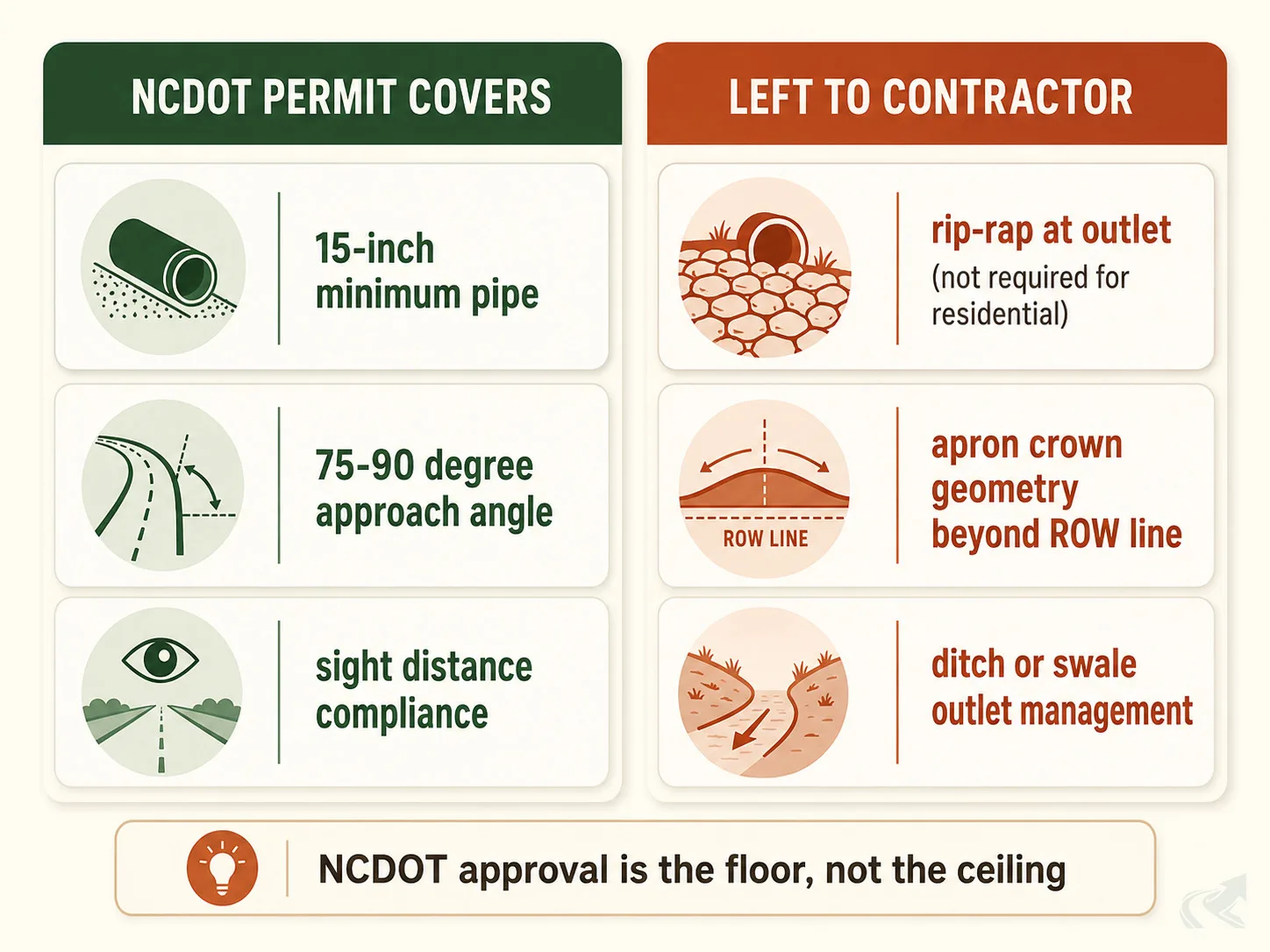
The Driveway Encroachment Agreement specifies minimum culvert size and approach angle — but apron drainage design is typically left to the contractor, which is exactly where corners get cut.
What the NCDOT permit covers on a residential driveway approach:
- Minimum culvert diameter for the drainage area at that location (NCDOT’s standard minimum entrance pipe is 15-inch — Roadway Design Manual, Entrance Pipes 10-3)
- Approach angle to the road (NCDOT prefers driveway and intersection angles of 75 to 90 degrees — as close to perpendicular as the site allows)
- Sight distance compliance based on road speed
What NCDOT does not dictate for most residential approaches:
- Rip-rap spec at the outlet (NCDOT does not require special end treatment on most residential driveway pipe — endwalls are mandated only on the inlet end of 36-inch and larger pipe — so outlet rip-rap on a residential drive is good practice, not a permit condition)
- Apron crown geometry beyond the right-of-way line — driveway grading around culvert installs is where contractors address the crown spec and approach slope
- Ditch or swale outlet management beyond the permitted zone
The practical implication: NCDOT approval does not mean the apron drainage is correctly designed. A culvert that meets every permit requirement can still produce apron washout within one storm season if the contractor did not address outlet protection and crown geometry.
The NCDOT encroachment agreement is the floor, not the ceiling. For more on the permit process, see NC driveway culvert permit requirements.
Contractor Evaluation — Apron Questions to Ask
If your contractor is replacing or installing a culvert, two apron questions reveal whether they are thinking about the full system.
Ask both before signing any culvert quote:
Ask your contractor
Question 1: “What rip-rap spec are you using at the outlet headwall, and is it included in your quote?”
Question 2: “How are you grading the first 20 feet of the driveway from the road — what is the crown on the apron?”
The wrong answer to question one is “we’ll throw some rock at the end of the pipe.” The right answer names a spec: “Class A rip-rap, coverage out to 1.5 times the pipe diameter on each side of the headwall.”
The wrong answer to question two is a blank stare. The right answer names a number: “2% crown draining away from the road edge, graded over the first 20 feet of the approach.”
A contractor who answers both correctly is thinking about the full drainage system. A contractor who answers neither correctly is installing the pipe and leaving. When you hire that contractor, you are scheduling the next washout.
Get an Itemized Quote With Three Line Items
An itemized culvert quote should show three separate line items: culvert pipe (diameter and length), rip-rap outlet protection (material type and coverage dimensions), and apron regrading (crown spec and first 20 feet of approach).
If those three are not separate line items, you cannot evaluate what is included. A single “driveway culvert — installed” number tells you nothing about whether outlet protection and apron regrading are in scope.
Ask for the itemized version before you approve the work. If the contractor cannot produce it, that is the answer.
For the full picture on how driveway culvert and apron drainage NC works as a system, or to understand how driveway crowning works with apron drainage, those pages cover the mechanics in detail.
Hire an NC grading operator who can answer the two questions above before the first truck arrives.