Two questions Denise asked this week
Is a 15-inch culvert enough for my driveway?
NCDOT rule 19A NCAC 02D .0421 sets a 15-inch minimum inside diameter for driveway pipe on state-maintained roads (maximum 48 inches, minimum 20 feet long) -- but minimum is a floor, not a specification. If the drainage area feeding your crossing is larger than 1 to 1.5 acres, a 15-inch pipe can be overwhelmed in a significant storm. The driveway washes out. The culvert may be perfectly installed and still be the wrong size. A 12-inch pipe is below the NCDOT minimum and will not pass permit review on a state road.
What should I ask my contractor before signing?
Ask: 'What is the drainage area in acres for this culvert crossing, and what storm frequency did you design for?' A contractor who has sized the culvert properly can answer both. A contractor who quoted the NCDOT minimum without sizing cannot.
Two contractors quoted the same driveway culvert. One said 15-inch. One said 18-inch. The price gap was $800. Neither explained why.
When Denise asked the lower bidder, she got “15-inch is fine for drainage.” That’s not an explanation — that’s a preference. The higher bidder said “NCDOT requires 15-inch minimum, so we go bigger.” Also not an explanation.
What actually determines culvert size is the drainage area feeding that crossing — how many acres of land shed runoff to that single pipe during a storm. This page explains the logic so you can evaluate both quotes on their merits, not their confidence level.
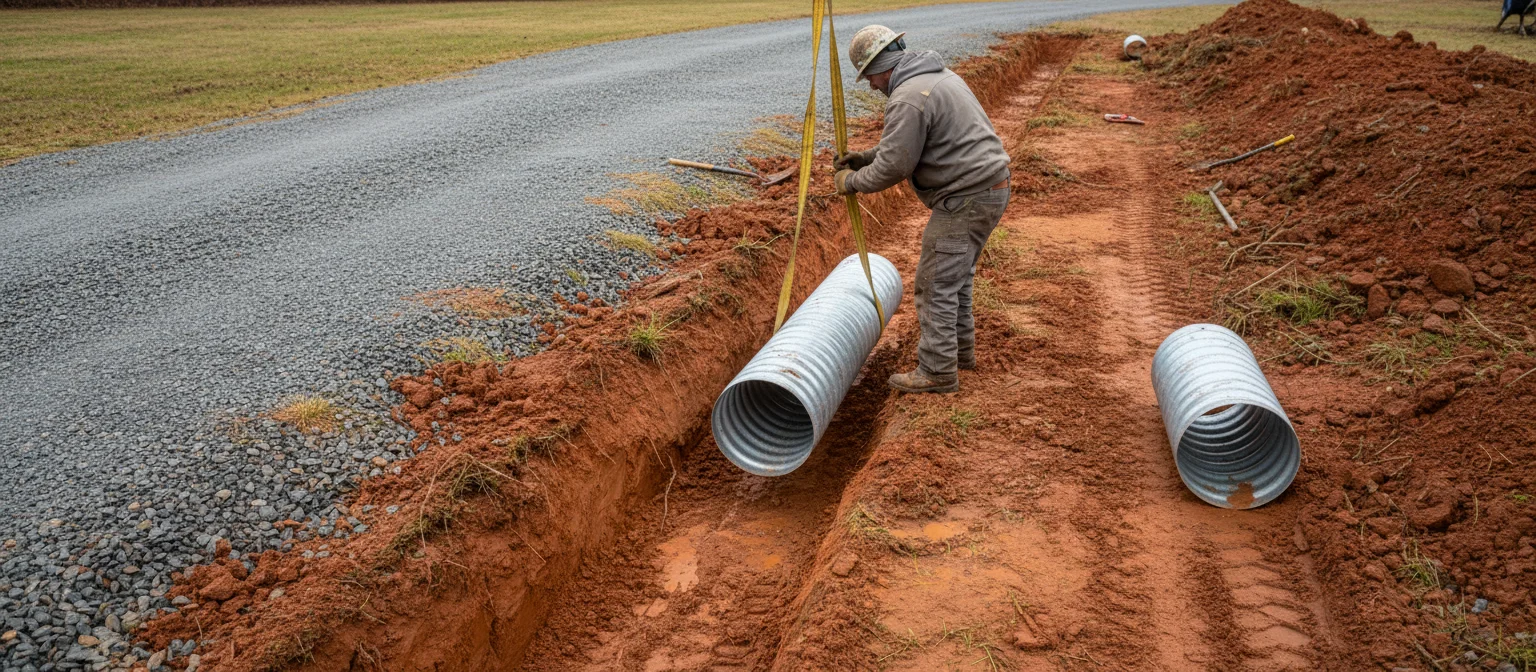
How Culvert Sizing Actually Works
Culvert size is determined by the drainage area — the number of acres that shed water to that crossing during rain — combined with a target storm design frequency.
The rational method (simplified for homeowners):
- Drainage area (acres): trace uphill from the culvert and estimate the land area that feeds that one point. A 1-acre lot with 2 acres of slope above it has a 3-acre drainage area.
- Runoff coefficient: how much of the rain runs off versus soaks in. Heavily wooded slopes hold 30-40% runoff. NC Piedmont clay with sparse vegetation sheds 60-80%. Most residential sites in the NC Piedmont run 55-70%.
- Storm frequency: residential driveways are commonly designed for a 10-year storm event — the storm statistically expected once every 10 years — as a standard civil engineering practice. NCDOT rule 19A NCAC 02D .0421 does not itself specify a design storm frequency for driveway pipe; some jurisdictions or road classifications design for a 25-year event. Confirm the applicable design storm with NCDOT hydraulic guidance for your road classification.
The calculation produces a peak flow rate. The pipe diameter must be large enough to pass that flow without the water overtopping and scouring the fill underneath the driveway.
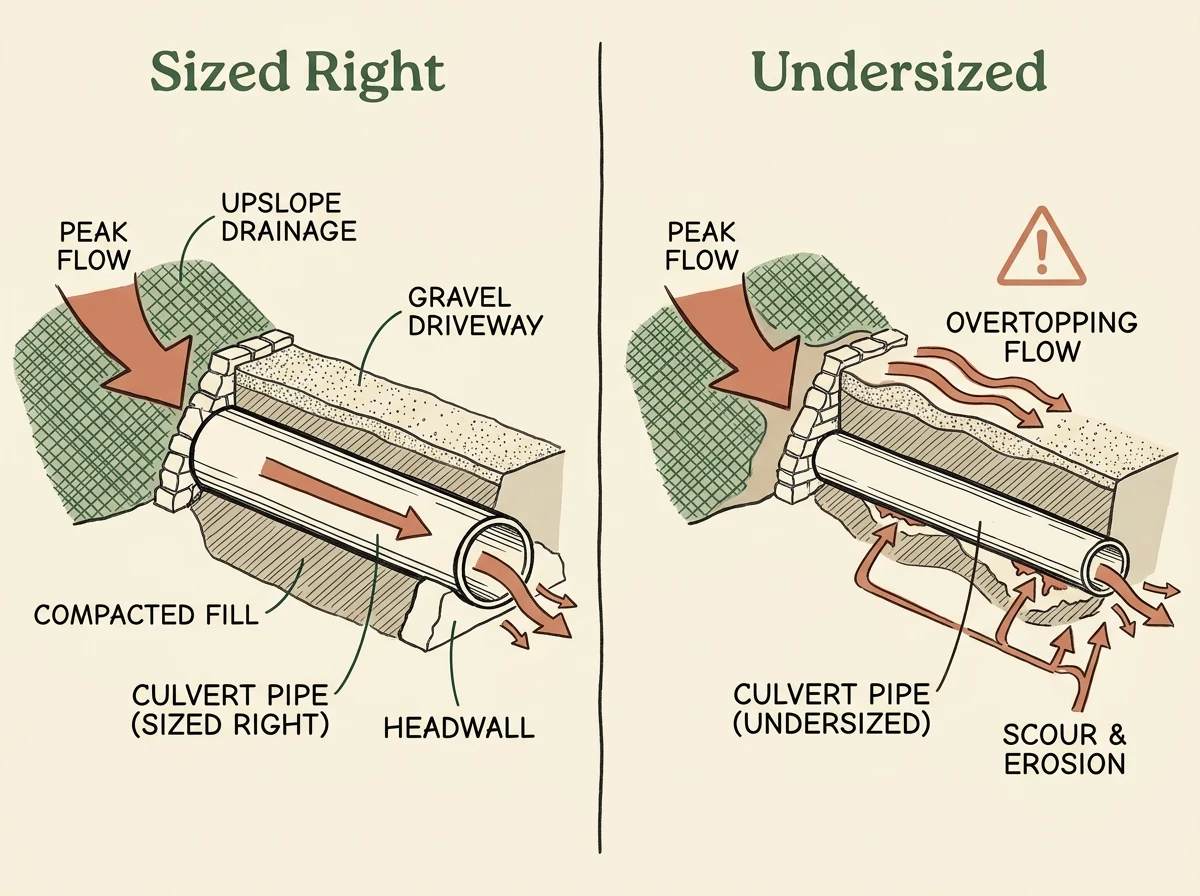
Why the minimum pipe fails on larger sites: if the drainage area above your crossing exceeds roughly 1 to 1.5 acres, peak storm flow in a 10-year event can exceed a 15-inch pipe’s capacity. The water overtops, undercuts the compacted fill, and washes the driveway. The culvert itself may be flawlessly installed — and still be the wrong answer.
Driveway culvert: sized for the drainage area vs the undersized minimum
Comparison. Sized right: Pipe diameter set from the drainage area and a 10-year storm; Peak flow passes through the pipe without overtopping; Headwall and rip-rap outlet hold -- stable driveway surface above. Undersized: 15-inch minimum dropped in without sizing the drainage area; Storm flow exceeds capacity and tops over the driveway fill; Water undercuts the compacted fill and washes the driveway.
- Pipe diameter set from the drainage area and a 10-year storm
- Peak flow passes through the pipe without overtopping
- Headwall and rip-rap outlet hold -- stable driveway surface above
- 15-inch minimum dropped in without sizing the drainage area
- Storm flow exceeds capacity and tops over the driveway fill
- Water undercuts the compacted fill and washes the driveway
On NC clay, 65-75% of rain runs off fast -- a drainage area over 1-1.5 acres overwhelms the 15-inch minimum even when the pipe is perfectly installed.
NC Clay Drainage Load — Why Sizing Matters More Here
NC Piedmont clay vs sandy loam -- runoff during a 2-inch rain event
Comparison. NC Piedmont red clay: Dense, low-permeability soil absorbs slowly; Saturates quickly -- all additional rain runs off; 65-75% of rainfall becomes surface runoff; Peak runoff can exceed 1.5 inches per hour. Sandy loam: Porous structure allows water to percolate down; Absorbs a large share of rainfall before runoff begins; 30-50% of rainfall becomes surface runoff; Culvert sizing demand is significantly lower.
- Dense, low-permeability soil absorbs slowly
- Saturates quickly -- all additional rain runs off
- 65-75% of rainfall becomes surface runoff
- Peak runoff can exceed 1.5 inches per hour
- Porous structure allows water to percolate down
- Absorbs a large share of rainfall before runoff begins
- 30-50% of rainfall becomes surface runoff
- Culvert sizing demand is significantly lower
NC Piedmont clay changes the sizing math -- contractors who learned culvert sizing in sandier regions routinely underestimate the drainage load.
NC Piedmont clay does not absorb rain the way sandy soil does. During a heavy storm, 65-75% of rainfall runs off almost immediately, concentrating more water at the culvert than a simple area estimate suggests.
NC-specific factors that affect culvert sizing:
- Piedmont clay impermeability: clay absorbs water until it saturates, then sheds all additional rainfall as surface runoff. In a 2-inch rain event, peak runoff off Piedmont red clay can exceed 1.5 inches per hour.
- Mountain versus Piedmont: Western North Carolina soils are shallow and also impermeable, but slope concentrates flow velocity as well as volume. A 15-inch culvert on a 15% grade conveys less effective volume than the same pipe on a flat grade because high velocity increases scour at the outlet.
- Development upslope: if the land above your culvert crossing has been cleared, graded, or built on since your driveway was installed, the runoff coefficient has increased. A culvert sized correctly 10 years ago may now be undersized without any change to the pipe itself.
- Tree cover loss: significant canopy removal — whether from development or storm damage — substantially increases downstream culvert loads in NC. WNC watersheds recovering from Hurricane Helene driveway damage western NC face this exact problem on culverts that were adequately sized before the storm.
That’s not how it works in other regions with sandier soils. NC clay changes the math, and contractors who learned culvert sizing outside the Piedmont sometimes underestimate it.
15-Inch Minimum vs Upsizing — When to Go Bigger
The 15-inch NCDOT minimum is adequate only for drainage areas under 1 acre with good vegetative cover and driveway slope limits in NC under 5%. Upsize to 18-inch or larger for anything above that — the material cost difference is modest compared to a $2,000-8,000 driveway washout repair.
Decision table (directional ranges drawn from standard civil engineering practice for NC conditions — not regulatory values; confirm with NCDOT hydraulic guidance or a licensed engineer):
| Drainage area (acres) | Slope | Soil type | Recommended minimum |
|---|---|---|---|
| Less than 1 | Less than 5% | Sandy or forested | 15-inch (NCDOT minimum) |
| 1 to 2 | Less than 5% | Piedmont clay | 15-inch to 18-inch |
| 1 to 2 | 5-10% | Any | 18-inch |
| 2 to 4 | Any | Any | 18-inch or larger, engineer assessment |
| Greater than 4 | Any | Any | Engineer assessment required |
Important note on the table: sets the minimum pipe for permit approval — a 15-inch minimum inside diameter under rule 19A NCAC 02D .0421. An engineer or experienced contractor sets the appropriate size for the site conditions. The two are often the same for small drainage areas. For larger areas, the NCDOT minimum is not a sizing recommendation — it is the lowest threshold that passes permit review.
When in doubt, upsize. The cost difference between a 15-inch pipe and the next size up in corrugated metal pipe is trivial compared to the cost of regrading a washed driveway and reinstalling the culvert correctly.
Contractor Evaluation — What the Right Answer Sounds Like
A contractor who has done the sizing answers the drainage-area question with a number. A contractor who quoted the NCDOT minimum gives a code reference instead.
Ask your contractor before signing: “What is the drainage area in acres for this culvert crossing, and what storm frequency did you design for?”
Three types of answers:
- Sized answer: “I walked the drainage area — it’s roughly 2 acres. I am sizing for a 25-year storm per NCDOT guidance for this road classification. That spec calls for an 18-inch pipe with a proper headwall and rip-rap at the outlet.” This contractor ran the numbers.
- Minimum-only answer: “NCDOT requires a 15-inch pipe for residential driveways, so that is what we install.” Technically compliant. Not a sizing calculation. May be correct for your site — or may not be.
- No-idea answer: “We will use whatever size fits in there.” No assessment was done. Walk away.
Copy this question before your next contractor call: “What is the drainage area in acres for this culvert crossing, and what storm frequency did you design for?”
The distinction matters because both bids may be technically permitted — NCDOT issues the permit at the 15-inch minimum — but only one of them is sized for your actual site conditions.
Find a grading contractor in North Carolina who can answer the drainage-area question directly.
The Math Behind the Decision
Upsize now vs repair later -- the cost math
Comparison. Upsize to 18-inch at installation: Material difference: $80-120 for a 20-foot crossing; Installed with headwall and rip-rap: $300-600 more; Correct culvert size for drainage area; No washout. No repair. No reinstallation.. Washout repair after the failure: Regrade the driveway approach; Replace fill and base course; Reinstall culvert at the correct size; Total repair cost: $2,000-8,000.
- Material difference: $80-120 for a 20-foot crossing
- Installed with headwall and rip-rap: $300-600 more
- Correct culvert size for drainage area
- No washout. No repair. No reinstallation.
- Regrade the driveway approach
- Replace fill and base course
- Reinstall culvert at the correct size
- Total repair cost: $2,000-8,000
The cost difference is not the pipe -- it is the washout repair that follows an undersized one.
The cost difference between a correct culvert and a wrong one is not the pipe — it is the washout repair that follows.
A 15-inch corrugated metal pipe runs roughly $12-20 per linear foot. An 18-inch pipe runs roughly $16-26 per linear foot. On a standard 20-foot driveway crossing, the material difference is $80-120. Installed, with headwall and rip-rap, the total upgrade from the 15-inch minimum to 18-inch is typically $300-600 more than the minimum spec.
A driveway washout — failed fill, washed gravel, scoured outlet, possible subgrade damage — runs $2,000-8,000 to repair properly. That includes NC driveway grading process work on the approach, replacing fill and base course, and reinstalling the culvert at the correct size.
That math is obvious. Ask for an itemized quote that includes the drainage-area assessment and the pipe sizing rationale.
If the contractor cannot answer the drainage-area question, they have not done the sizing. They have quoted a pipe.
Check the full NCDOT driveway permit and culvert size requirements before your permit application. For context on culvert work in North Carolina, start at the driveway culvert installation sizing context NC hub.
If your driveway has already failed, see driveway washout repair when culvert fails for what the remediation typically involves.