
Tanya Stokes’s contractor handed her a one-page scope sheet that said “NCDOT permit required” and left it at that. She searched online, landed on a 47-page NCDOT document, and closed the tab. That is not a useful outcome.
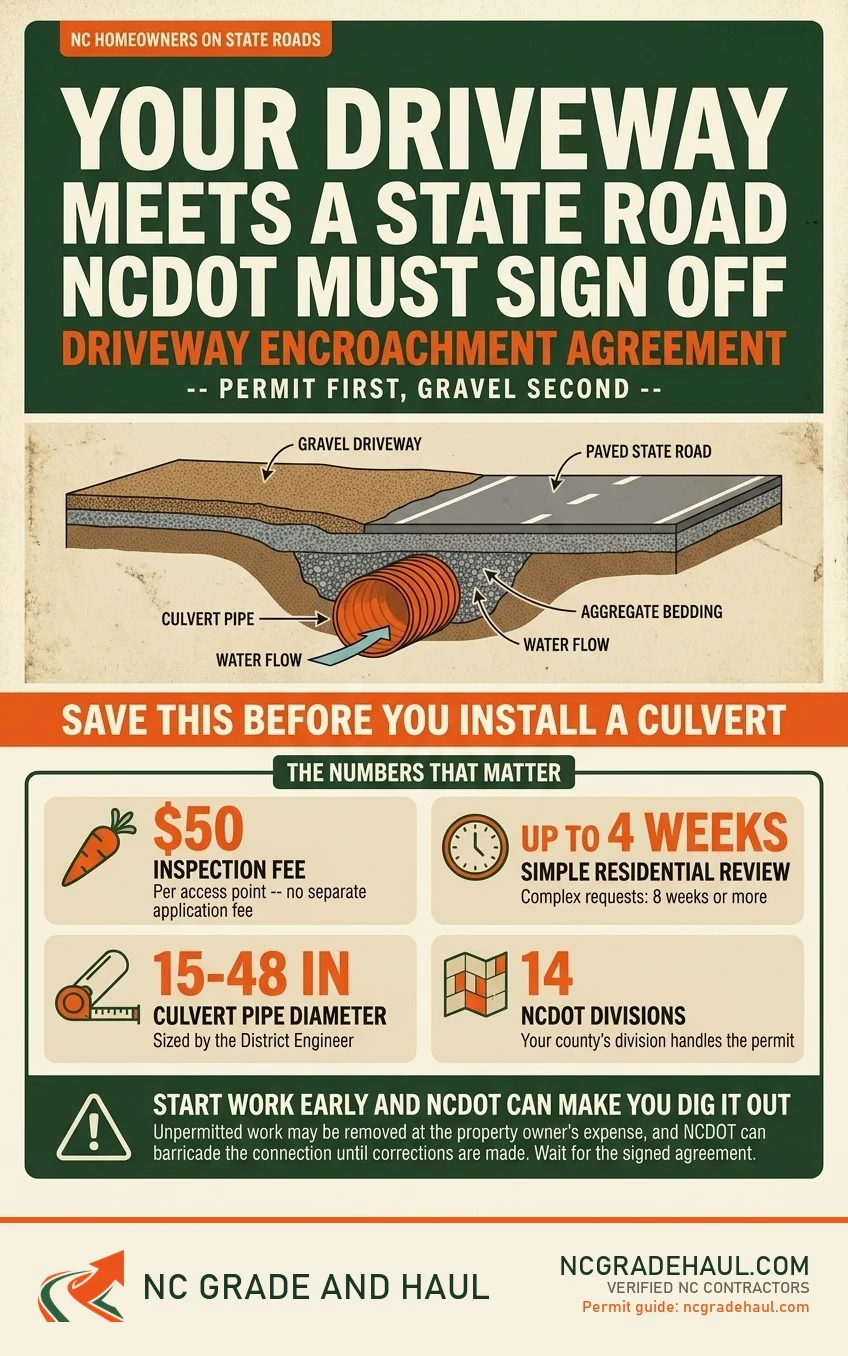
Here is what the document actually means for a residential driveway culvert: the permit is called a Driveway Encroachment Agreement. The contractor typically files it. NCDOT policy says simple residential requests are typically reviewed in up to 4 weeks; complex requests can take 8 weeks or more. NCDOT charges a $50 construction inspection fee per access point. There is no separate application fee for the permit itself. Work cannot begin until the signed agreement comes back.
That is the whole mechanism. The sections below walk through each piece.
When You Need the Permit vs When You Don’t
Does Your Driveway Require an NCDOT Permit?
Comparison. State-Maintained Road -- Permit Required: NC highway routes (NC-54, US-70, US-1, etc.); SR (Secondary Road) numbered routes -- SR number on the road sign; NCDOT Driveway Encroachment Agreement required before work begins; $50 NCDOT construction inspection fee per access point; Culvert diameter and approach angle set by District Engineer. Non-State Road -- No NCDOT Permit: City and town streets within municipal limits -- contact city or town engineering; County roads transferred out of NCDOT maintenance; Private roads and subdivision interior streets; Local municipality or county may still have separate requirements; Check with the appropriate local entity, not NCDOT.
- NC highway routes (NC-54, US-70, US-1, etc.)
- SR (Secondary Road) numbered routes -- SR number on the road sign
- NCDOT Driveway Encroachment Agreement required before work begins
- $50 NCDOT construction inspection fee per access point
- Culvert diameter and approach angle set by District Engineer
- City and town streets within municipal limits -- contact city or town engineering
- County roads transferred out of NCDOT maintenance
- Private roads and subdivision interior streets
- Local municipality or county may still have separate requirements
- Check with the appropriate local entity, not NCDOT
The key question: does your road have an SR number on the sign or carry an NC/US highway designation? If yes, NCDOT permitting applies before any culvert work.
You need an permit only when your driveway connects to a state-maintained road.
Private driveways connecting to county roads, city streets, or subdivision internal streets do not trigger NCDOT permitting. The local municipality or county may still have their own requirements — but that is a separate process from the NCDOT Driveway Encroachment Agreement.
State-maintained roads in North Carolina that trigger NCDOT permitting:
- NC highway routes (NC-54, US-70, US-1, etc.) — always state-maintained
- numbered routes — state-maintained; the SR designation appears on the road sign
- Interstates — NCDOT jurisdiction, but residential driveway connections to interstates are not permitted
Roads that do NOT require NCDOT permitting (check with the appropriate local entity):
- City and town streets within municipal limits — go to city or town engineering
- County roads transferred out of NCDOT maintenance — G.S. 136-55.1 governs the road abandonment process: NCDOT must provide 60-day written notice to adjoining property owners before abandoning a road segment, and municipalities within one mile of their corporate limits may assume maintenance of an abandoned road. Roads removed from the state system this way become the local government’s responsibility.
- Private roads and subdivision interior streets
How to confirm your road type: NCDOT maintains county and bridge maps online at connect.ncdot.gov/resources/State-Mapping/Pages/County-Bridge-Maps.aspx that show state-maintained routes by county. The Division Engineer’s office for your county can also confirm by phone.
If you are unsure, call the NCDOT Division office for your county before scheduling work. That one call prevents the scenario where a contractor pours gravel over an unpermitted culvert and NCDOT orders it removed.
What the NCDOT Driveway Encroachment Agreement Covers
The Driveway Encroachment Agreement sets the minimum culvert diameter, the allowable approach angle, and the required sight-distance clearance — all specific to your road classification.
This is what separates the NCDOT permit from a county grading permit. The county cares about land disturbance and erosion. NCDOT cares about how your driveway connects to the state road and whether a culvert will handle the drainage area.
What NCDOT reviews and specifies in the agreement:
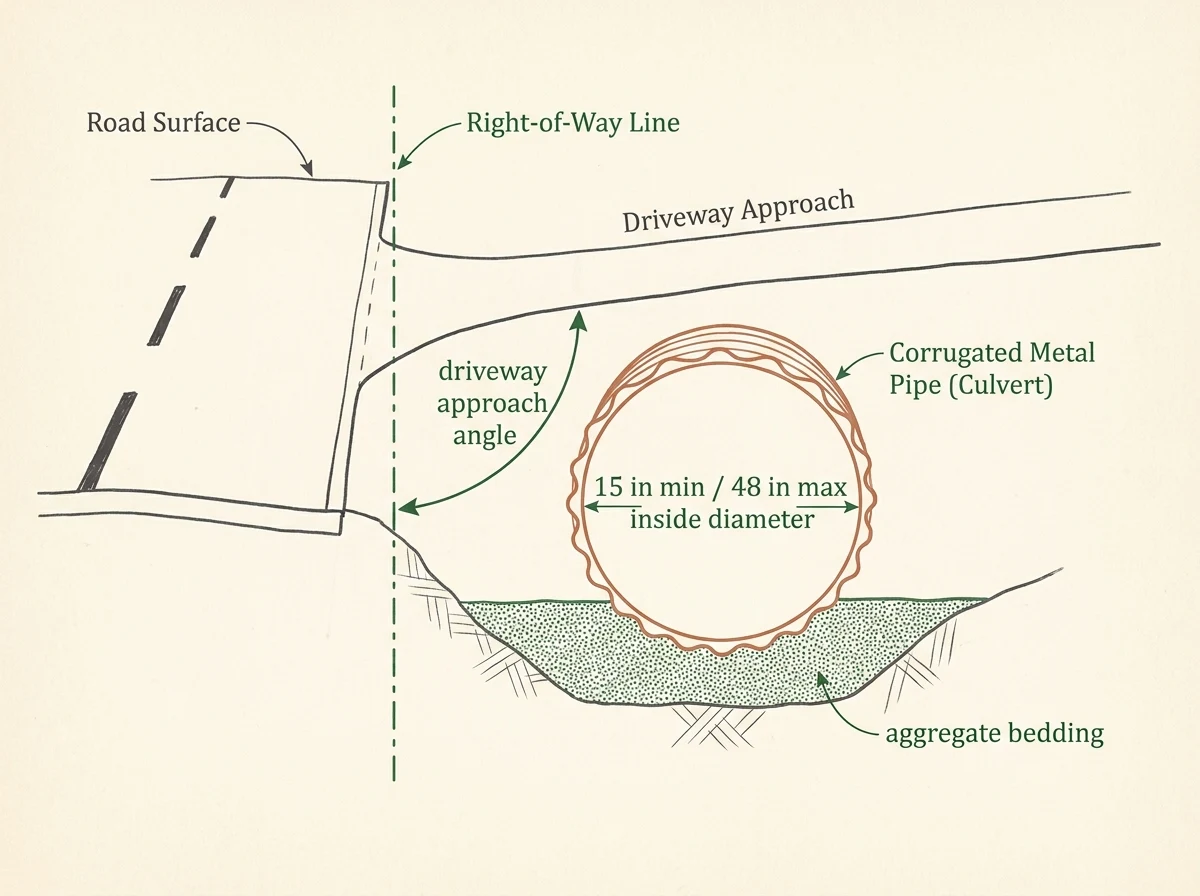
- Minimum culvert diameter: NCDOT sets the size based on the drainage area at your specific location, as determined by the District Engineer. For single-family residential driveway pipe that NCDOT installs, NCDOT policy (19A NCAC 2D.0421) restricts pipe size to a minimum inside diameter of 15 inches and a maximum of 48 inches unless otherwise directed by the District Engineer. The District Engineer may require a larger diameter based on drainage calculations. See culvert sizing for the NCDOT driveway permit for how the drainage-area calculation works.
- Approach angle: the driveway-to-road angle must meet NCDOT’s access policy requirements — typically a near-perpendicular approach. Sharp-angle approaches can be prohibited for sight-line safety reasons. The District Engineer specifies the allowable angle for your specific location and road classification per the NCDOT Policy on Street and Driveway Access.
- Sight distance: NCDOT specifies how far a driver must be able to see in each direction at your approach, based on the road’s posted speed limit. On faster roads this can constrain exactly where the driveway meets the pavement.
- Material and installation spec: the permit specifies that the culvert must be bedded in aggregate and extended to cover the full clear-width of the approach. NCDOT inspects the installation before the approach surface is placed, and the permit application includes a $50 construction inspection fee per access point.
What the permit does NOT cover: your private driveway beyond the right-of-way line. Everything past the right-of-way is yours and does not require NCDOT approval. Local grading permits from your county may still apply to that portion.
Who Applies — Homeowner or Contractor?
Either can apply, but most contractors handle it — because NCDOT ties permit compliance to whoever is present during the inspection.
Here is the practical breakdown:
- Contractor applies in their name: the Driveway Encroachment Agreement is typically issued to the contractor performing the work, with the property owner listed. This is standard for a residential culvert install on a state road.
- Homeowner applies: possible, but North Carolina still requires that the contractor performing the physical work be identified on the application. If you are not doing the work yourself, let the contractor file it.
- Changing contractors after permit issuance: if you switch contractors after the agreement is signed, contact the District Engineer’s office. NCDOT requires written approval for any alteration to an approved permit, so a contractor change typically requires an amended filing or a new application at the District Engineer’s discretion.
Any contractor doing state-road culvert work in NC should know this process automatically. If they don’t bring it up, that is a signal worth paying attention to. See does your driveway contractor handle NCDOT permits for what to ask during the quote process.
Ask your contractor
”Are you pulling the NCDOT driveway approach permit, or is that my responsibility?”
Get an itemized quote that lists permit handling as a named line item. If the quote has a single lump number and no mention of permit handling, ask specifically whether the Driveway Encroachment Agreement is part of their scope — and whether they will be there for the NCDOT inspection.
The Application Process — Step by Step
NCDOT Driveway Encroachment Permit -- 7 Steps
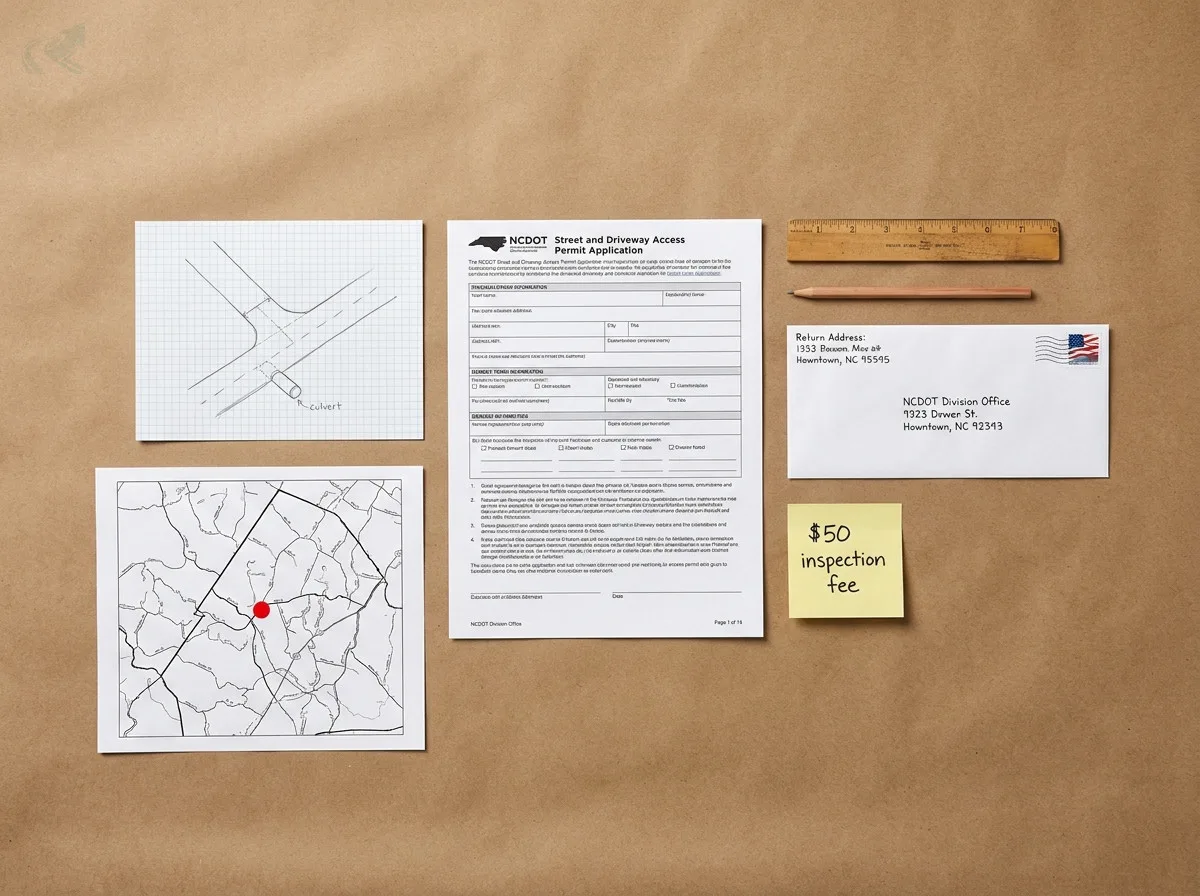
1. Identify your NCDOT Division -- NC has 14 divisions. Use the NCDOT Division map at connect.ncdot.gov to find the Division covering your county and the District Engineer office contact. 2. Download the application form -- NCDOT Street and Driveway Access Permit Application (Appendix 3 of the Policy on Street and Driveway Access to North Carolina Highways) -- available at connect.ncdot.gov. 3. Prepare a site sketch -- Shows driveway location, approach angle, culvert location, and sight distance. Your contractor prepares this. Engineer stamp not required for simple residential unless the District Engineer requires drainage analysis. 4. Submit to the Division office -- Via NCDOT online portal (requires Business NCID), in person, or by mail at the District Engineer office. Electronic payment accepted via myNCDOT/Payit. 5. NCDOT reviews the application -- Staff check sight distance, culvert sizing against the drainage area, and approach angle. Simple residential requests: up to 4 weeks. Complex requests: 8 weeks or more. 6. Receive the signed Driveway Encroachment Agreement -- Work cannot begin until the signed agreement is returned. Starting before approval risks removal at the property owner's expense and NCDOT may barricade the connection. 7. NCDOT inspects after installation -- Before the approach surface (gravel or pavement) covers the culvert, NCDOT inspects. The $50 construction inspection fee per access point is included in the permit application.
-
Identify your NCDOT Division
NC has 14 divisions. Use the NCDOT Division map at connect.ncdot.gov to find the Division covering your county and the District Engineer office contact.
-
Download the application form
NCDOT Street and Driveway Access Permit Application (Appendix 3 of the Policy on Street and Driveway Access to North Carolina Highways) -- available at connect.ncdot.gov.
-
Prepare a site sketch
Shows driveway location, approach angle, culvert location, and sight distance. Your contractor prepares this. Engineer stamp not required for simple residential unless the District Engineer requires drainage analysis.
-
Submit to the Division office
Via NCDOT online portal (requires Business NCID), in person, or by mail at the District Engineer office. Electronic payment accepted via myNCDOT/Payit.
-
NCDOT reviews the application
Staff check sight distance, culvert sizing against the drainage area, and approach angle. Simple residential requests: up to 4 weeks. Complex requests: 8 weeks or more.
-
Receive the signed Driveway Encroachment Agreement
Work cannot begin until the signed agreement is returned. Starting before approval risks removal at the property owner's expense and NCDOT may barricade the connection.
-
NCDOT inspects after installation
Before the approach surface (gravel or pavement) covers the culvert, NCDOT inspects. The $50 construction inspection fee per access point is included in the permit application.
Key numbers: up to 4 weeks for simple residential review, 8+ weeks for complex requests, $50 NCDOT inspection fee per access point. The signed agreement must be in hand before any culvert goes in.
The NCDOT driveway encroachment application is filed with the local Division office. For a simple residential culvert on a non-highway route, NCDOT policy states the process typically takes up to 4 weeks; complex requests can take 8 weeks or more.
North Carolina has 14 highway divisions. The Division covering your county handles the permit. The Division map is available at connect.ncdot.gov/resources/State-Mapping/Pages/Division-Map.aspx.
- Identify your NCDOT Division. Use the NCDOT Division map at connect.ncdot.gov/resources/State-Mapping/Pages/Division-Map.aspx to find the Division covering your county and the corresponding Division Engineer’s office address and phone.
- Download the application form. NCDOT provides the Street and Driveway Access Permit Application (Appendix 3 of the Policy on Street and Driveway Access to North Carolina Highways). The full policy manual, including the permit application form, is available at connect.ncdot.gov/projects/Roadway/RoadwayDesignAdministrativeDocuments/Policy%20on%20Street%20and%20Driveway%20Access.pdf.
- Prepare a site sketch. The application typically requires a simple drawing showing the driveway location, approach angle, culvert location, and sight distance. Your contractor prepares this. Simple residential applications typically do not require a licensed engineer’s stamp unless the District Engineer determines that drainage analysis or engineered plans are needed. Commercial and subdivision applications do require sealed plans.
- Submit to the Division office. NCDOT operates an online Driveway Permit Submission portal at connect.ncdot.gov/site/Permits/Pages/default.aspx that requires a Business NCID (not an individual NCID — create one at myncid.nc.gov before filing). Electronic payment is accepted via myNCDOT/Payit for applicable fees. Applications can also be submitted in person or by mail at the District Engineer’s office. Email submission may be accepted by some District offices — call to confirm.
- NCDOT reviews the application. Staff check sight distance, culvert sizing against the drainage area, and approach angle compliance. NCDOT policy states simple requests are typically processed in up to 4 weeks; complex requests can take 8 weeks or more.
- Receive the signed agreement. Work cannot begin until the Driveway Encroachment Agreement is signed and returned. Do not let a contractor start the culvert installation while the permit is pending — NCDOT policy states that unpermitted work may result in removal of the driveway or street connection at the property owner’s expense, and NCDOT may barricade the connection from further use until corrections are made.
- NCDOT inspects after installation. Before the approach surface (gravel or pavement) goes over the culvert, NCDOT inspects the installation. The permit application includes a $50 construction inspection fee per access point, making inspection standard for permitted work.
Dave Kowalski in WNC is dealing with post-Helene culvert replacement on a state-road-connected driveway in the mountains — the same 7 steps apply. No published modified encroachment processing rules for Helene-damaged residential driveway culverts were located; call the Division 13 (Asheville) or Division 14 (Sylva) office to confirm whether any local expediting is available.
Application Fees and Costs
NCDOT driveway encroachment applications for residential properties are typically low-cost or free. The larger expense is the culvert material, or corrugated metal pipe, and installation labor.
Typical cost breakdown for a residential culvert permit:
- NCDOT inspection fee: $50 per access point for the construction inspection. No separate application fee is charged by NCDOT for the driveway permit itself. Additional charges may apply for traffic signal plan review or other special services.
- Engineering stamp (if required): simple residential applications typically do not require a licensed engineer’s stamp unless the District Engineer determines that drainage analysis or engineered plans are needed. Commercial and subdivision applications require sealed plans.
- Contractor permit-handling fee: varies. Ask for this itemized in your quote as a separate line. A contractor who buries the permit time in labor rates cannot tell you how long the permit process takes — because they have not separated it.
The permit fee itself is not the financial risk. The risk is a contractor who skips the permit, gets caught during or after installation, and your project stalls while an unpermitted culvert gets dug out. That cost is unrecoverable.
Common Mistakes
Starting work before the permit arrives. NCDOT policy states that unpermitted work may result in removal of the driveway or street connection at the property owner’s expense, and NCDOT may barricade the connection from further use until corrections are made. The permit is not the long pole — the up-to-4-week review for simple applications is. Plan the culvert work into the project schedule before anything goes in the ground.
Installing the minimum culvert size without checking the drainage area. NCDOT policy (19A NCAC 2D.0421) restricts single-family residential driveway pipe to a minimum inside diameter of 15 inches and a maximum of 48 inches unless otherwise directed by the District Engineer. For contractor-installed culverts, the District Engineer sizes the pipe based on the drainage area. Undersized culverts wash out. The plan that came with your grading permit accounts for that flow — the culvert sizing should match it. See how to size a driveway culvert for NC runoff for how to read the drainage area.
Not listing permit handling in the quote. If the contractor does not explicitly carry permit handling as a line item in the quote, ask about it before signing. A forgotten permit stops the project. An itemized quote that names permit handling gives you a paper trail if there is a dispute.
Conflating NCDOT permits with county grading permits. These are separate processes with separate agencies. A culvert on a state-road driveway may require both the NCDOT Driveway Encroachment Agreement and a county grading or land-disturbance permit — especially if your project disturbs more than a certain acreage. See NC county permit requirements alongside NCDOT for how the two layers interact.
Get an Itemized Quote That Covers the Permit
An NCDOT Driveway Encroachment Agreement is a 2-page form and an up-to-4-week wait for simple residential applications. It is not a major obstacle. But it must happen before the culvert goes in — not after.
Any contractor doing state-road-connected culvert work in North Carolina should know this process. If they do not mention it, ask. If they cannot explain the application steps, that is a signal worth weighing before you hire.
Hire a verified NC grading contractor who works state-road approaches. When you call, ask specifically: are you pulling the Driveway Encroachment Agreement, and is that included in the quote or billed separately? Get the answer in writing. That one question separates contractors who know this process from those who will learn it on your project.
For more on how NC driveway grading works and how culvert installation fits into the full project scope, see how driveway grading works in NC and the NC driveway culvert installation overview.