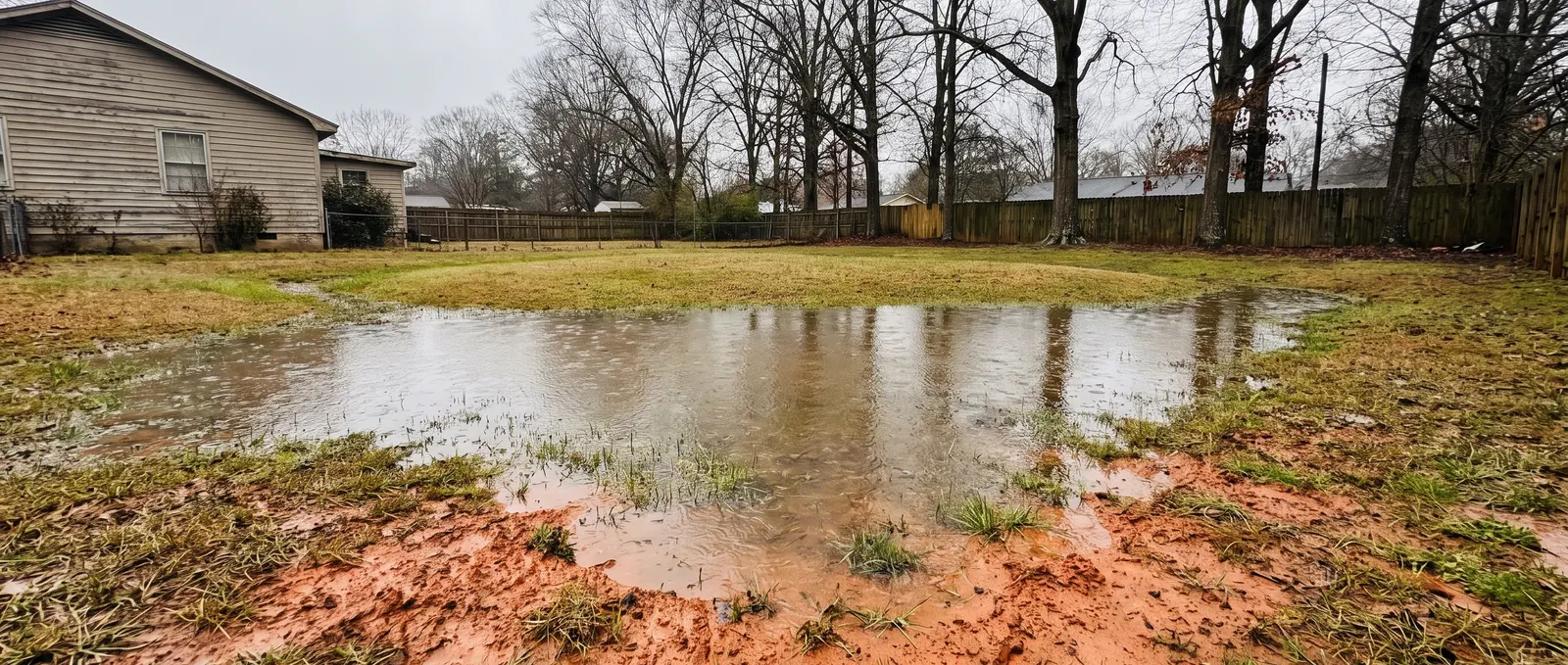
Two things Durham homeowners ask first
Does a Durham drainage project need a land-disturbance permit?
Durham's trigger is 12,000 square feet of disturbance — well under the statewide one-acre rule, so projects cross it roughly three times more often here than the state minimum would suggest. Most single back-yard regrades stay below it. Bigger scopes, multi-lot work, or anything in a Falls Lake or Jordan Lake water-quality area should be checked before work starts.
Which office handles drainage permits in Durham?
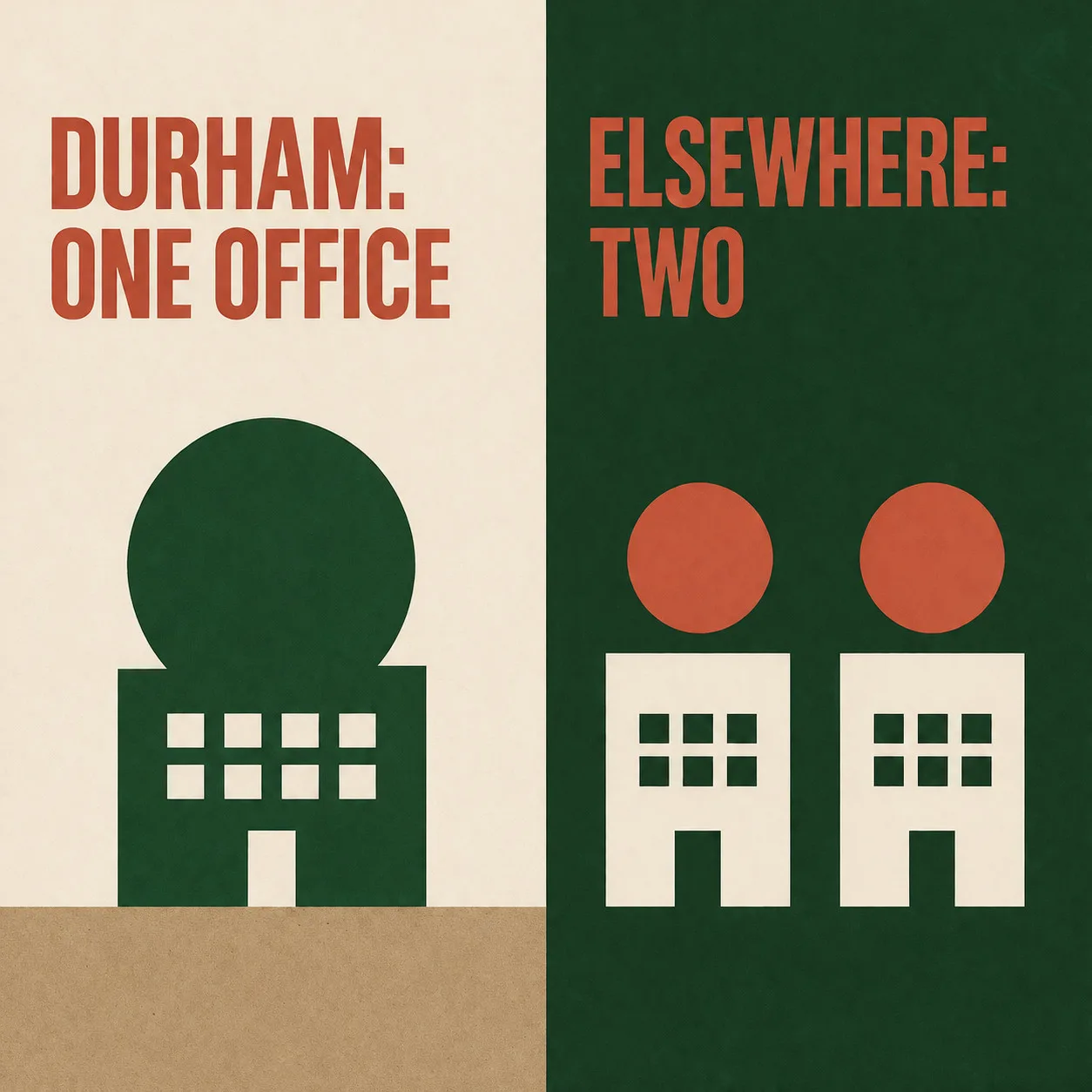
One. Durham runs a joint City-County programme, so the same office covers the City of Durham and the unincorporated county. That's genuinely unusual in North Carolina — in most of the Triangle the answer depends on which side of a municipal line your lot sits on. Here you don't have to work that out first.
Most of the Triangle makes you answer a jurisdiction question before you can ask a drainage question. Durham doesn’t.
That single fact — one joint City-County programme instead of a patchwork — makes Durham the simplest place in the region to get a straight answer about a drainage project. It also comes paired with a threshold that is stricter than the statewide rule, which surprises people the other way.
This page is the diagnosis layer: why Durham yards hold water, how to tell which cause you have, and where the local rules actually touch a homeowner’s project.
For thresholds, the process, and the water-quality overlays in full, see Durham County’s permit rules. For the underlying method — how a French drain is built for this soil — see the NC clay French drain methodology.
What’s actually different about drainage in Durham
One office, a low threshold, and clay with a reputation earned honestly.
The programme is joint. City of Durham and unincorporated Durham County are administered together. Compare that to Wake, where a lot inside Raleigh city limits and a lot outside it follow different rules and different offices.
The threshold is 12,000 square feet, not the statewide acre (43,560 sq ft). That is roughly a third of the state minimum, so Durham projects cross the line at a size that would be exempt elsewhere in North Carolina. Most single back-yard jobs still fall under it — but “it’s under an acre” is not the safe assumption here that it is in some counties.
Water-quality overlays raise the stakes. Parts of Durham drain to Falls Lake and Jordan Lake, both nutrient-sensitive. Requirements tighten inside those areas, and a lot can sit in one without the owner knowing.
The clay is dense Piedmont red clay. It behaves the way it does across the region: water sits on top rather than soaking in, and a hole dug into it fills and stays full.
Three causes of a wet Durham yard
Diagnose before you buy. The three causes look similar and need different work.
| Why the water is sitting there | What you'd see | What actually fixes it |
|---|---|---|
| Surface grade with nowhere to send water | A broad shallow pool that lingers a day or more after rain, often along a fence or property line | Reshaping the surface, and finding a real outlet. Clay makes the outlet the hard part, not the digging |
| Roof water concentrated at the foundation | A wet patch starting at a downspout, worst during rain, mostly gone within a day | Carrying downspout discharge well away from the house to daylight |
| Construction compaction | A hard, slow-drying patch where equipment or materials once sat, distinct from the rest of the yard | Breaking the compacted layer and rebuilding soil structure — hardware alone won't restore infiltration |
Surface grade with nowhere to send water
- What you'd see
- A broad shallow pool that lingers a day or more after rain, often along a fence or property line
- What actually fixes it
- Reshaping the surface, and finding a real outlet. Clay makes the outlet the hard part, not the digging
Roof water concentrated at the foundation
- What you'd see
- A wet patch starting at a downspout, worst during rain, mostly gone within a day
- What actually fixes it
- Carrying downspout discharge well away from the house to daylight
Construction compaction
- What you'd see
- A hard, slow-drying patch where equipment or materials once sat, distinct from the rest of the yard
- What actually fixes it
- Breaking the compacted layer and rebuilding soil structure — hardware alone won't restore infiltration
On clay the binding constraint is almost always the outlet. Water has to end up somewhere lower than where it started, on your property or legally off it. A design that has no answer to “where does it go” is not a design.
Why the outlet is the hard part here
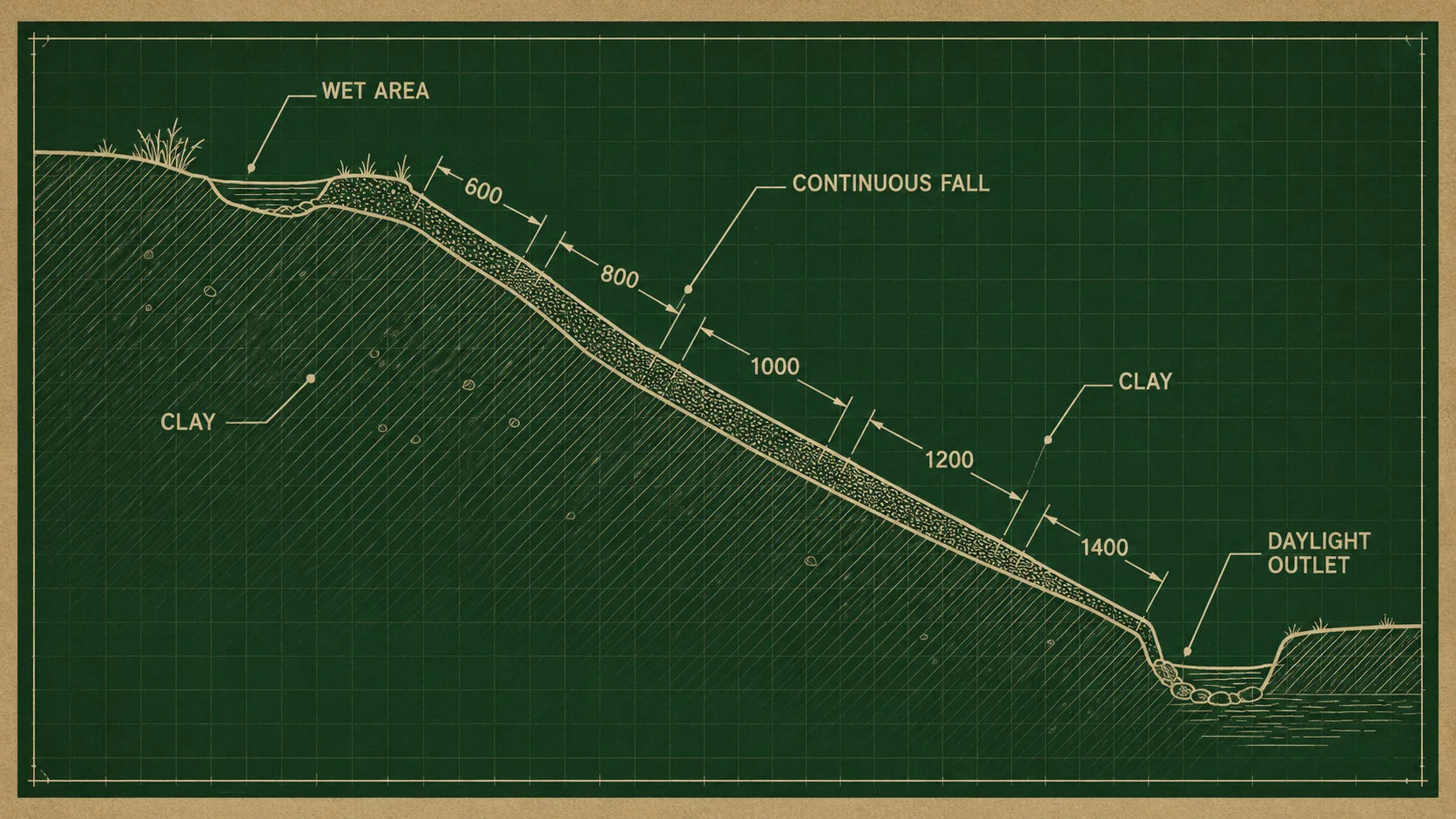
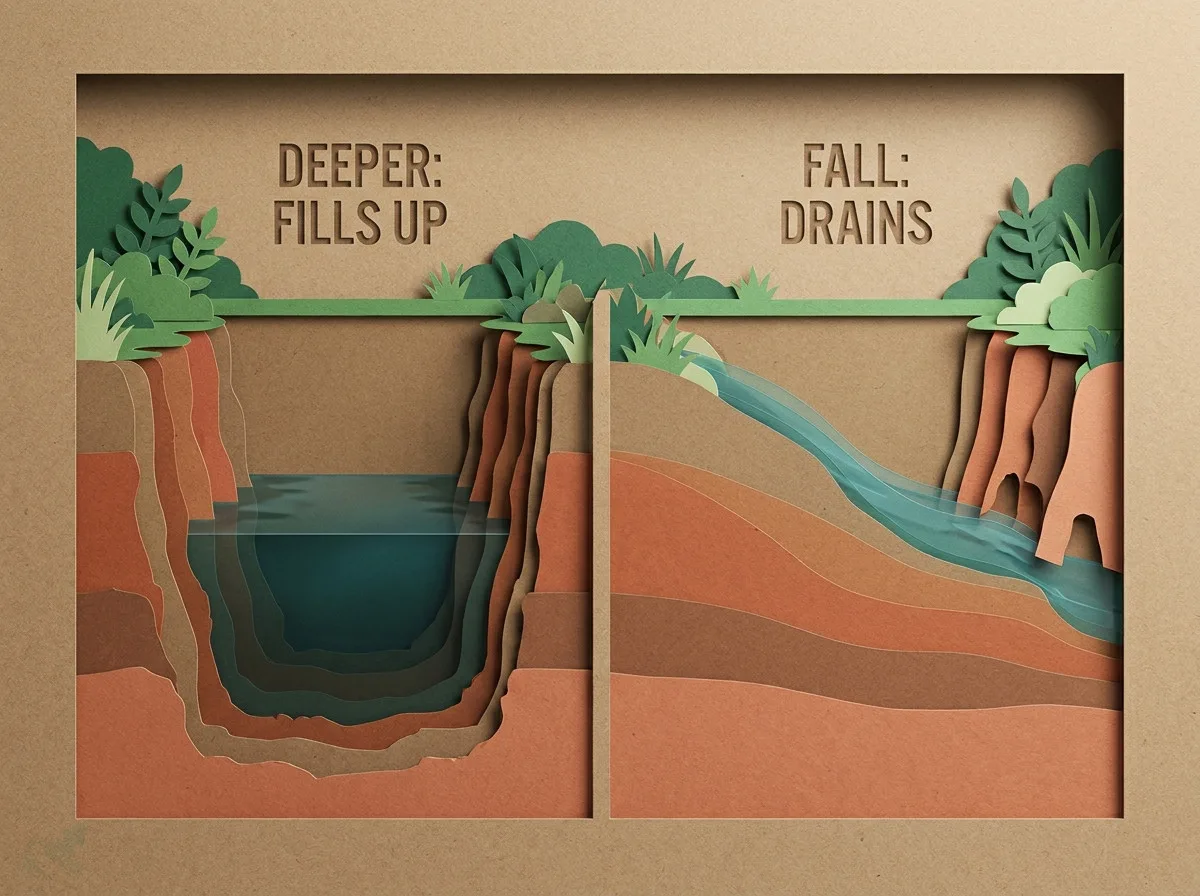
In sandy soil water leaves downward. In Durham clay it has to leave sideways.
That single difference drives most of what makes clay drainage expensive. A system in permeable soil can end in a dry well and let the ground take the water. Dense Piedmont clay will not take it at any useful rate, so the water must be carried — with continuous fall — to a point where it can daylight.
Two consequences follow:
Depth is not the answer. Digging deeper into clay produces a deeper hole that holds water. Fall matters more than depth, every time.
The last twenty feet decide the project. Where a run can daylight — a swale, a ditch, a lower corner — often sets what is possible for the whole yard. It’s worth establishing before anything else is priced.
The full method, including what changes about materials and sequencing, is at the NC clay French drain methodology.
What to ask before you hire
Three questions, and the first one matters most.
- “Where will the water go, and can you show me?” The outlet is the project. A contractor who can walk you to the discharge point has designed something; one who hasn’t identified it yet has quoted a trench.
- “Is my lot in a Falls Lake or Jordan Lake water-quality area?” A contractor working Durham regularly will know how to check, and it changes what applies.
- “How much are you disturbing?” Not because a back-yard fix will approach 12,000 square feet, but because the answer tells you whether they know the local number at all.
Check the licence first — how to check an NC contractor licence takes about two minutes and rules out the most common problem before it starts.
What this page does not cover
Permit thresholds, fees, water-quality overlay detail, and the application process are on Durham County’s permit rules. Sewer conversion is a separate project with its own rules — see septic to sewer in Durham. The location-independent diagnostic walkthrough is at standing water in your yard.
From our directory
Verified drainage contractors near Durham
Every listing is cross-checked against the NC Licensing Board public record before it appears. Pick your city:
Or browse the full NC contractor directory.