
Ray Pettiford has a 14-acre property in Guilford County and an old tobacco barn coming down. The contractor hauling it away gave him three different prices depending on what was in the load. Clean concrete floor: one rate. Tin roofing mixed with wood framing: higher. Anything that looked like old roofing felt or Transite pipe: “we don’t touch that without an abatement report.” Ray wanted to know why — and what he could sort himself to keep the bill down.
This page maps the three disposal routes for North Carolina demo debris, explains what drives cost at each, and draws the hard line on asbestos-containing materials.
The Three Disposal Routes for NC Demo Debris
Recycling, landfill, and on-site disposal — the right path depends on what the material is, whether it is contaminated, and your county’s rules.
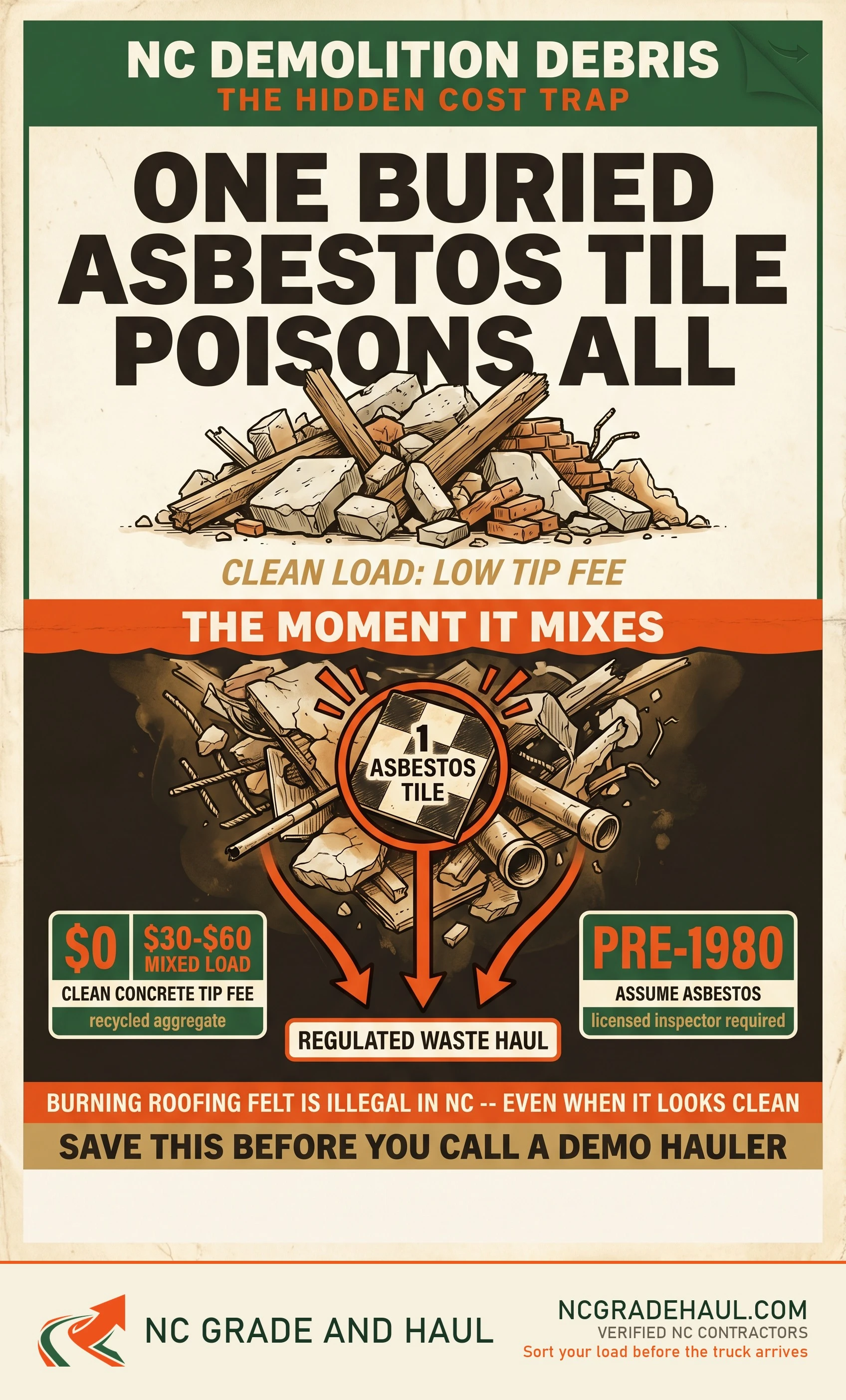
The most important thing to understand before any demo haul: mixing contaminated material with clean material routes the entire load to the most expensive disposal path. A hauler who finds asbestos tile in a load of otherwise clean concrete has to treat the whole thing as regulated waste.
Here is how the three routes break down:
Recycling applies to concrete, asphalt, clean brick, and metals. At many North Carolina recycling facilities, you pay little or nothing in tip fees because the material has value as recycled aggregate. This is almost always the lowest-cost path for clean single-material loads.
Landfill is the route for mixed demolition debris — wood framing, drywall, roofing, vinyl siding, insulation. landfills are the designated facility type. Not every county landfill accepts C&D loads; some counties direct residents to privately operated C&D facilities. Tip fees apply, and mixed loads cost more per ton than single-material loads.
On-site disposal is limited to vegetative debris only — unprocessed wood, stumps, brush. North Carolina allows open burning of vegetative material under specific conditions. Construction debris, treated lumber, and roofing materials are prohibited from open burning under NC air quality rules.
Concrete and Asphalt — The Recycling Path
Clean concrete and asphalt almost always have a recycling path in North Carolina — and at many facilities, you will not pay tip fees because the material has value as recycled aggregate.
Crushed concrete becomes recycled aggregate used as road base, drainage stone, and structural fill. It is in steady demand. Asphalt millings are equally marketable — NC contractors use recycled asphalt millings as base material for driveway grading in NC and road repair on private drives statewide.
“Clean” means something specific here. For concrete: rebar is either removed before delivery, or the facility offers rebar-removal as an add-on service. No asbestos-containing materials mixed in. No contamination from lead paint chips, soil, or other debris.
For asphalt: no asbestos-based roofing material mixed in. Roofing asphalt and paving asphalt are different products — do not mix them.
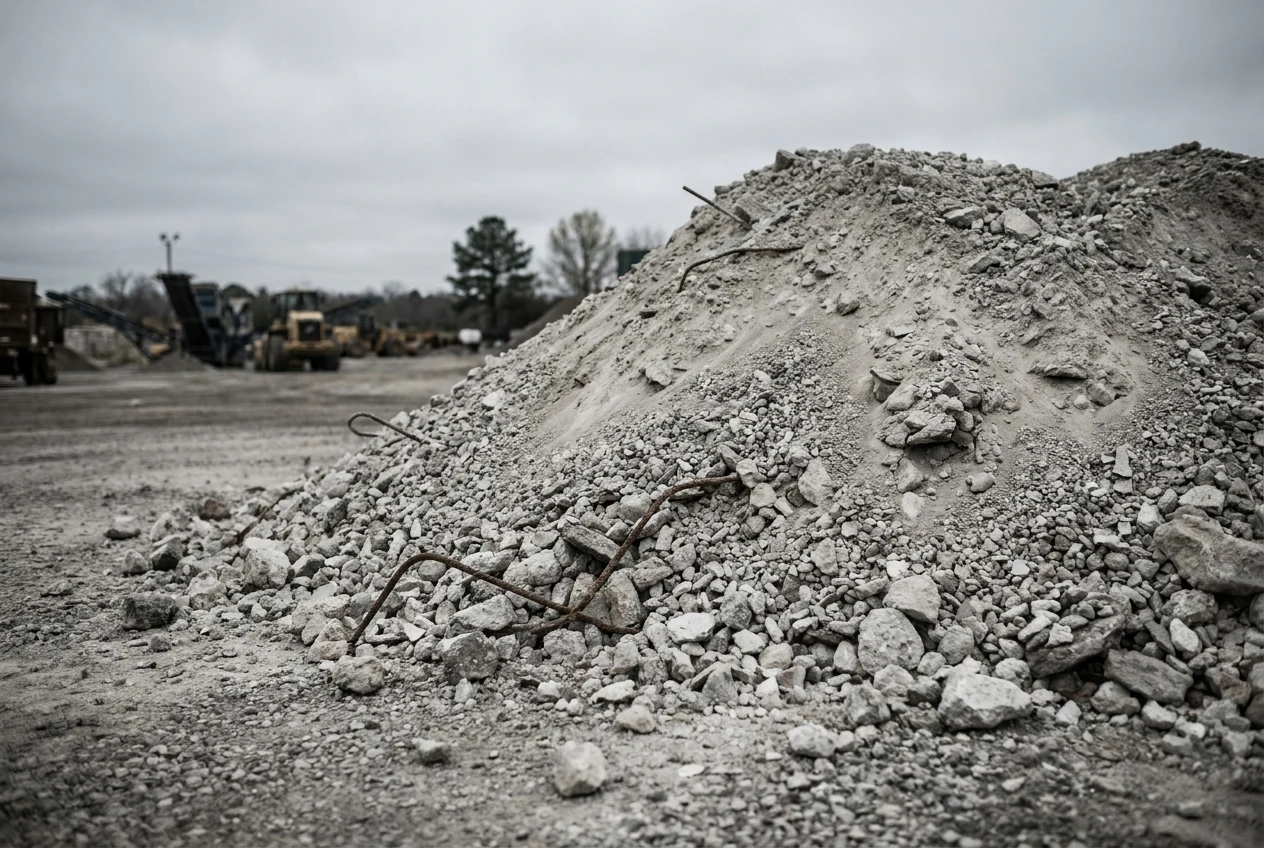
Concrete and asphalt recycling facilities operate in the Triangle, Triad, and Charlotte metro areas. Verify facility locations and current acceptance policies before loading trucks — some facilities require pre-scheduling for large loads. See the concrete and asphalt recycling in NC page for facility listings and pricing guidance.
Mixed Loads — C&D Landfill
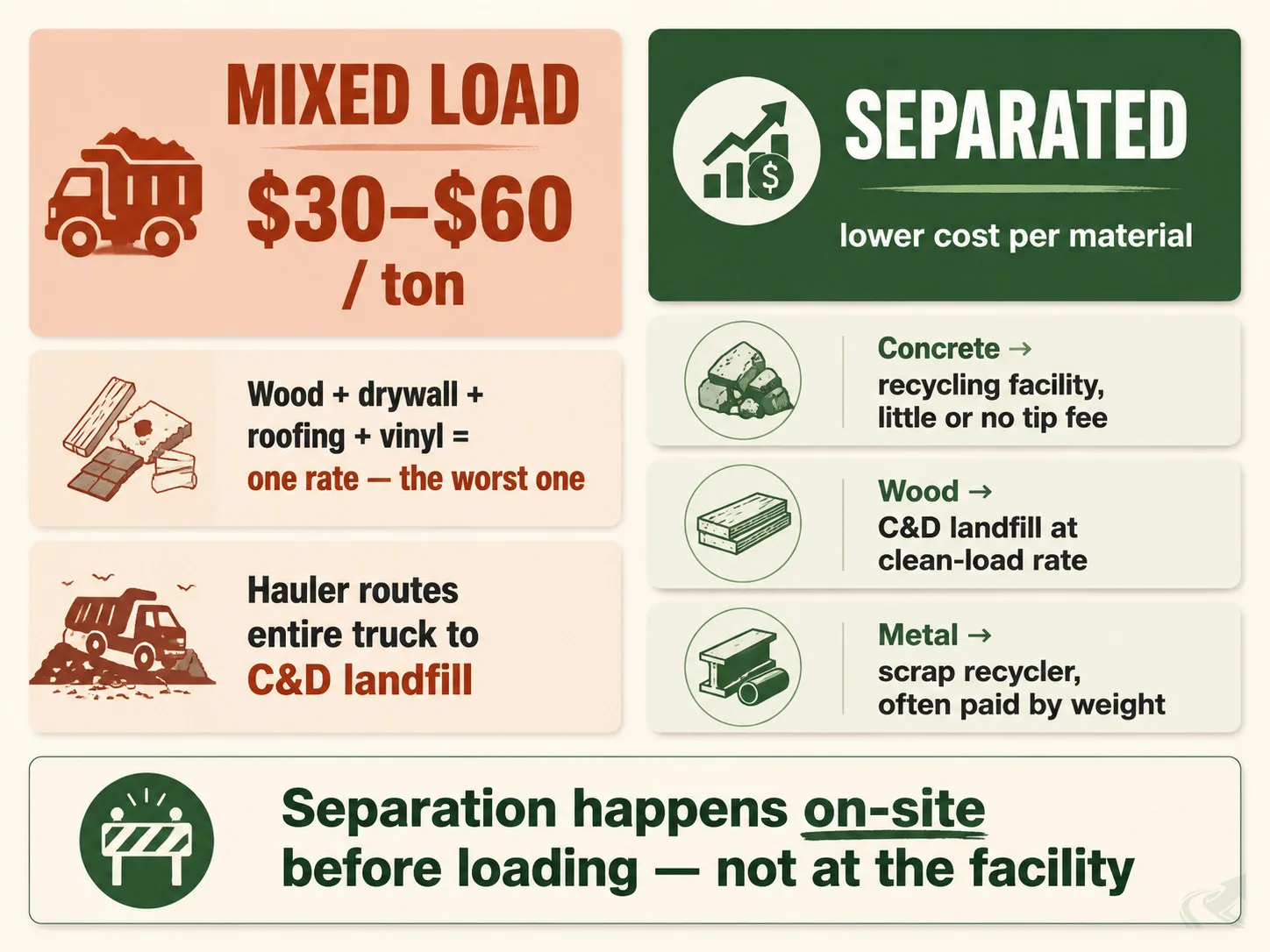
Mixed demolition debris — wood framing, roofing, drywall, insulation, vinyl siding — routes to a C&D landfill. Tip fees in NC typically run $30—$60 per ton for mixed loads.
The tip fee range reflects significant variation: facility location, load classification, and current market conditions all affect the final number. The scale operator at the facility classifies the load when the truck pulls onto the scale. A mixed load with visible contamination or unusual materials gets classified at a higher rate than a clean wood-only load.
C&D landfills are not the same as municipal solid waste landfills. Demolition debris goes to C&D specifically. Not every county operates its own C&D facility. The NC Division of Environmental Quality maintains a list of permitted solid waste facilities — verify your county’s options before hauling. Your hauler also operates under NC hauling regulations overview that govern load weight limits and facility routing; make sure they know which C&D facility accepts your load classification before the truck rolls.
The single biggest lever Ray has on his disposal cost: material separation on-site before the truck loads. Clean concrete to one pile. Wood framing to another. Metal roofing to another. Each material can route to its optimal destination rather than defaulting to the mixed-load landfill rate.
That separation takes labor up front. Whether it saves money depends on the volume of clean recyclable material in the load and how far the recycling facility is from the site.
On-Site Burning — NC Rules
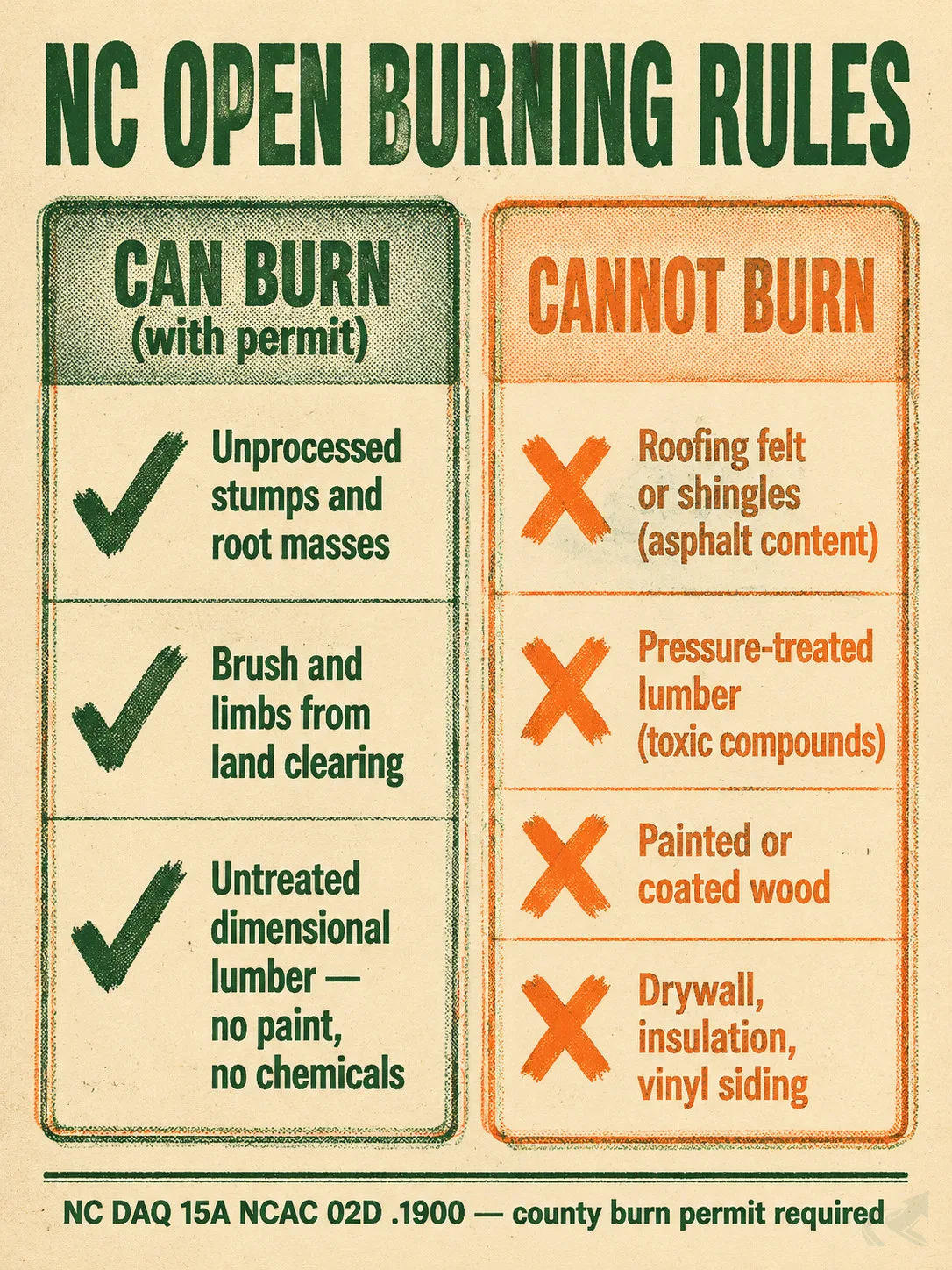
NC allows open burning of vegetative material — stumps, brush, unprocessed wood — with some conditions, but prohibits burning of construction debris, roofing materials, and treated lumber.
This is the rule Ray grew up with: burn the brush pile, call the county, be done. It still works, within limits.
The regulates open burning under 15A NCAC 02D .1900. The rule permits open burning of “land-clearing debris” and “vegetative material” but explicitly prohibits burning of construction debris, demolition material, and solid waste. Roofing material, treated wood, painted wood, plastics, insulation, and drywall are all prohibited.
What you can burn (with proper permits):
- Unprocessed stumps and root masses
- Brush and limbs from clearing
- Untreated dimensional lumber that is genuinely unprocessed — no paint, no treatment chemicals
What you cannot burn:
- Roofing felt or shingles (even if no asbestos — the asphalt content is the problem)
- Treated lumber (pressure-treated wood releases toxic compounds)
- Painted or coated wood
- Drywall, insulation, vinyl siding, or any petroleum-based material
Most NC counties require a burn permit for open burning. Some impose seasonal restrictions during dry conditions. Call your county’s fire marshal office or check the county website before striking a match. The process is usually straightforward — permit cost is minimal — but burning without a permit can result in fines and mandatory fire suppression costs.
Hazardous Materials — Asbestos and Lead
Pre-1980 structures often contain asbestos-containing materials and lead paint. These cannot be disturbed without a licensed abatement contractor’s assessment first — this is NC and federal law.
The EPA’s National Emission Standards for Hazardous Air Pollutants (NESHAP) requires a prior inspection by a licensed asbestos inspector before demolition or renovation of any structure that may contain . North Carolina enforces these requirements through the NC Department of Health and Human Services Radiation Protection Section.
Ray’s tobacco barn predates 1980 by decades. That means he needs an inspection before anyone swings a sledgehammer.
Common ACM locations in pre-1980 structures:
- Floor tiles (9-inch vinyl floor tiles are a high-probability ACM)
- Roofing felt and tar paper underlayment
- Pipe insulation (especially on boiler and hot-water systems)
- Transite board (a cement-asbestos composite used for siding, flue pipes, and utility panels)
- Textured ceiling material and joint compound
The inspection involves a licensed NC asbestos inspector collecting samples and sending them to an accredited laboratory. If ACM is confirmed, a licensed abatement contractor removes and disposes of the material under regulated conditions before demo proceeds.
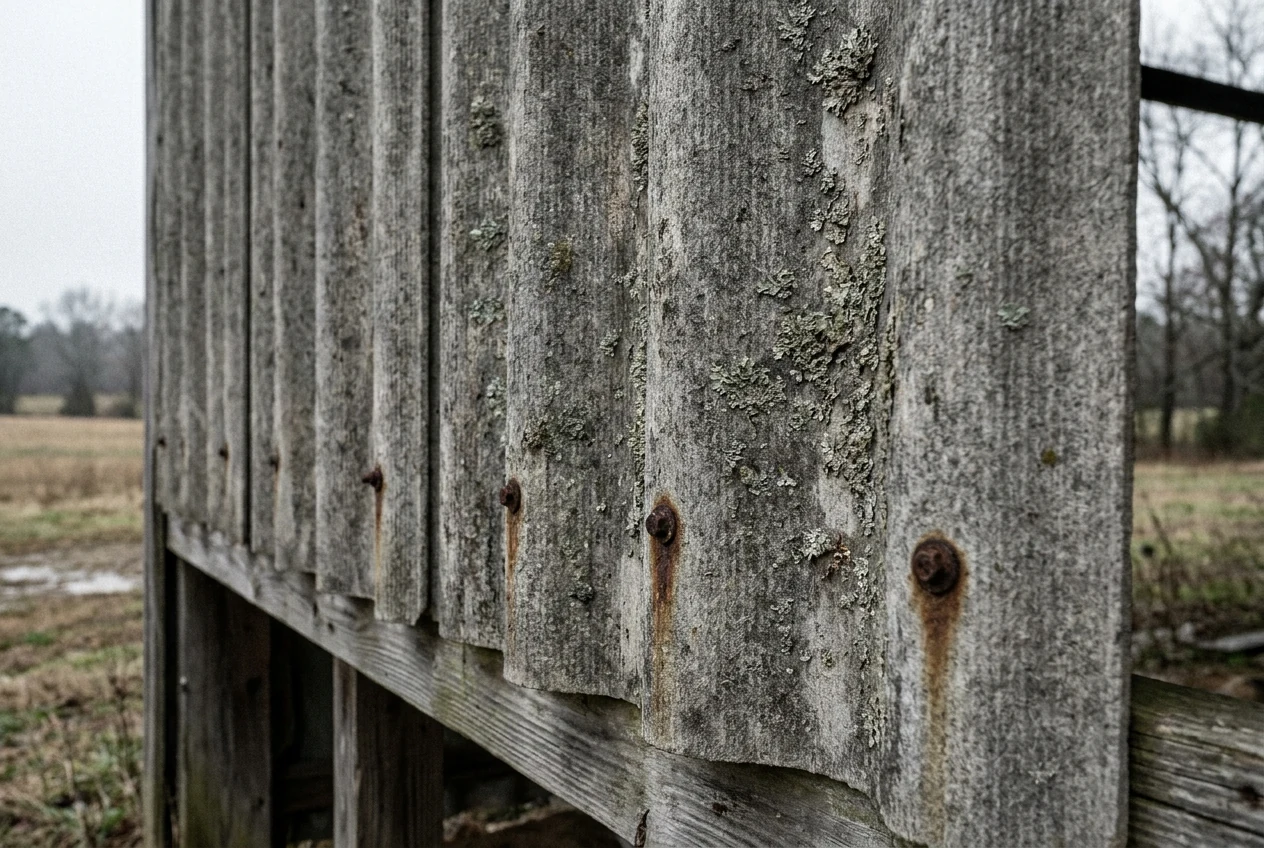
Survey cost varies by structure size and number of samples. Abatement cost is project-specific and priced per linear foot for pipe insulation or per square foot for floor tiles or roofing. Skipping the survey is not a cost-saving move — it is both illegal and creates liability exposure for everyone involved in the demo. A hauler who quotes a pre-1980 demo job without asking about prior inspection results is one of the warning signs in NC hauling contractor quotes worth catching before you commit.
Material Routing — Quick Reference
| Material | Disposal route | Typical cost | Key restriction |
|---|---|---|---|
| Clean concrete | Recycling facility | Low to no tip fee | No ACMs; rebar separation may be required |
| Asphalt paving | Recycling facility | Low to no tip fee | No ACM-based roofing material mixed in |
| Mixed wood and debris | C&D landfill | $30—$60 per ton (verify locally) | None beyond ACM separation |
| Roofing materials | C&D landfill | $30—$60 per ton (verify locally) | Inspect for asbestos-containing felt |
| Vegetative debris | On-site burn or chip/grind | County burn permit cost | County rules and DAQ restrictions apply |
| ACM-containing material | Licensed abatement contractor | Project-specific | Federal NESHAP + NC DHHS enforcement |
| Scrap metal | Metal recycler | Often paid by weight | Separate from other materials on-site |
Common Mistakes
Mixing ACM-containing material with clean debris. Once an asbestos-containing material enters the load, the entire load becomes regulated waste. The cost difference between a clean concrete load at a recycling facility and a regulated-waste haul is not small. Keep suspect material physically separated from the moment demo begins.
Assuming pre-1980 structures are asbestos-free. They are not, until a licensed inspector proves otherwise with lab results. The age threshold is the practical starting point — not every pre-1980 building contains ACMs, but enough do that the industry treats it as the default assumption.
Burning roofing material. Roofing felt often contains asphalt and may contain asbestos-based materials. Burning it is illegal in North Carolina under DAQ open burning rules and creates both a health hazard and an enforcement risk. This applies even when the material “looks clean” and smells like ordinary tar.
What the Hauler Needs to Know Before Quoting
Your hauler needs to know the material types, approximate volume, whether the structure predates 1980, and the intended disposal destination — before they can write a real number.
A hauler who quotes demo debris without asking about asbestos is either not planning to haul the risky material — or doesn’t know to ask. Either way, that is information Ray needs before he signs anything.
Pre-quote information checklist (copy this before calling):
- Structure type and age — tobacco barn, shed, detached garage; year built if known
- Materials present — concrete floor, tin or asphalt roofing, wood framing, insulation, pipe, drywall, other
- Known or suspected ACMs — any prior inspection results; whether structure predates 1980
- Approximate volume — rough cubic yards or number of truckloads if estimating yourself
- Preferred disposal route or budget constraint — “recycle everything you can” vs “haul it all, I want it gone by Friday”
- Site access — driveway clearance, soft ground conditions, septic line locations, overhead clearance
An itemized quote should break out: haul cost per load, C&D landfill tip fee pass-through (if applicable), recycling routing credit (if applicable), and abatement line-item if ACMs are confirmed or suspected.
Find a Contractor for Your Demo Haul
If you’re tearing down a structure in North Carolina and aren’t sure how to route the materials, the right move is a conversation with a contractor who separates loads on-site and can explain exactly where each material goes.
Hire a verified NC grading and hauling contractor — every listing includes license verification, OSHA safety record, and workers’ compensation status. Get an itemized quote, not a round number.
For more on NC county permits related to demolition debris disposal, see NC county permits for demolition debris disposal.
For land-clearing debris that accompanies a demo project — stumps, brush, cleared trees — the routing is different. See hauling land-clearing debris off a NC site and land-clearing debris disposal alongside demo hauling NC.