Two questions people ask first
How much does excavation cost per cubic yard in North Carolina?
We don't print a number, because we haven't found one in a public record that fits a home job. The price swings with access, soil and rock, depth, and where the dirt has to go. What we can show you is what a per-yard price is meant to cover, from the state's own highway contract rules, and how to make two quotes comparable.
Why is one quote so much higher than another for the same job?
Often the two quotes are not for the same job. One may count hauling, rock or the 811 ticket and the other may not. Ask both to put the same pieces in writing, and the gap either closes or tells you something.
You came here for a number. Here is the honest version: this page doesn’t have one.
We could print a range per cubic yard. It would look helpful, and it would be a guess dressed up as a fact. We looked for a public source that fits a home dig in North Carolina, and what is public was built for something else. What we can give you is the thing that actually protects your wallet: why the price moves, how contractors build it, and how to hold two quotes side by side without being fooled by either.
We’re a directory of site-work contractors, each checked against public records. We don’t dig, and we don’t set prices. For the job itself, start with the excavation guide. This page picks up where that one stops: you know the dig you need, and now someone has to put a number on it.
Why This Page Has No Price On It
The public prices that do exist come from road projects. The state’s highway department buys dirt moved by the cubic yard, on contracts with their own rules about what the price has to cover. Those aren’t a home trench, a footing or a pond. Lifting one onto a back-yard job would be like pricing a bedroom repaint from the cost of painting a bridge.
So we don’t. A price online with no named source, no job description and no date is somebody’s marketing, not a measurement. If we find a source we can read and stand behind, it goes on this page with the link.
What the highway rules do give us is something better than a price: a look at what a per-yard price is supposed to include. That comes up below.
What Moves the Price
Picture a trench of the same length and depth on two different lots. Same on paper. Very different invoices. These are the usual reasons.
Does it push the price up?
Read each condition, guess whether it makes the dig cost more, then tap to check.
1 The machine can't easily reach the dig: a narrow side gate, a fence, a steep yard, or a septic field it has to go around.
Yes. Access decides which machine can do the work, and a smaller machine usually means more hours. If dirt has to be carried out in small loads, the job slows further.
Ask the contractor: Which machine are you planning to use, and how does it get in?
2 The ground is not what it looked like: rock, big roots, old concrete, or soil that is hard to dig.
Often yes, and nobody can see it from the surface. That is why a quote should say what happens to the price if the machine hits rock.
Ask the contractor: If you hit rock, who decides, and how is the extra priced?
3 The hole is deeper than it first sounded.
Yes, in more than one way. A deeper hole means more dirt. And at 5 feet or more in anything but stable rock, federal rules require protection for anyone working in the trench: sloped walls, shoring, or a trench box. That is equipment and time on the bill.
Ask the contractor: How deep is this, and how will the crew be protected?
4 The dirt that comes out can't stay on your lot.
Yes. Hauling it away takes trucks, drivers and a place that will take it. This is the line people forget to ask about.
Ask the contractor: Is hauling in the number, and where does the dirt go?
5 The job needs to be located, permitted or both.
Yes. The 811 notice has to go in at least three full working days before digging, and the utilities mark their lines in that window. Land disturbance of more than an acre needs an approved erosion plan filed first. Someone has to do that work, and it has to sit in somebody's price.
Ask the contractor: Who files the 811 ticket, and does the job need an erosion plan?
6 It rained all week.
Often. Wet ground tends to slow the work, and federal rules require a competent person to inspect a trench after every rainstorm while anyone is working in it.
Ask the contractor: What happens to the schedule and the price if the weather turns?
7 It's a short job.
Often more per foot than a long one. The machine still has to get to you and back, and that trip is a fixed cost spread over very little digging.
Ask the contractor: Is there a minimum, and what does it cover?
None of these is a trick. They are the real reasons an honest contractor’s price changes from one yard to the next. A good estimator walks the site for exactly that reason. A quote given over the phone, sight unseen, has to either pad for the unknowns or leave them out, and either way you may be the one who pays.
The same trench on two different lots
Comparison. Easy to price: Open lawn, a gate wide enough for the machine; Soil that digs the way it looks; Dirt can be spread or stored on site; A shallow trench, no one working below 5 feet. Hard to price: Narrow gate, fence or steep yard; Rock, roots or old concrete under the surface; Every load has to be hauled away; A deep trench that needs shoring, a box or sloped walls.
- Open lawn, a gate wide enough for the machine
- Soil that digs the way it looks
- Dirt can be spread or stored on site
- A shallow trench, no one working below 5 feet
- Narrow gate, fence or steep yard
- Rock, roots or old concrete under the surface
- Every load has to be hauled away
- A deep trench that needs shoring, a box or sloped walls
The length and the depth on the plan can be identical. Everything else on the page changes the bill.
The Dirt Has to Go Somewhere
Dig a hole and you also make a pile. If the pipe, the footing or the tank takes up part of the hole, some of the dirt goes back in. The rest has to be spread on your lot, stored, or hauled away.
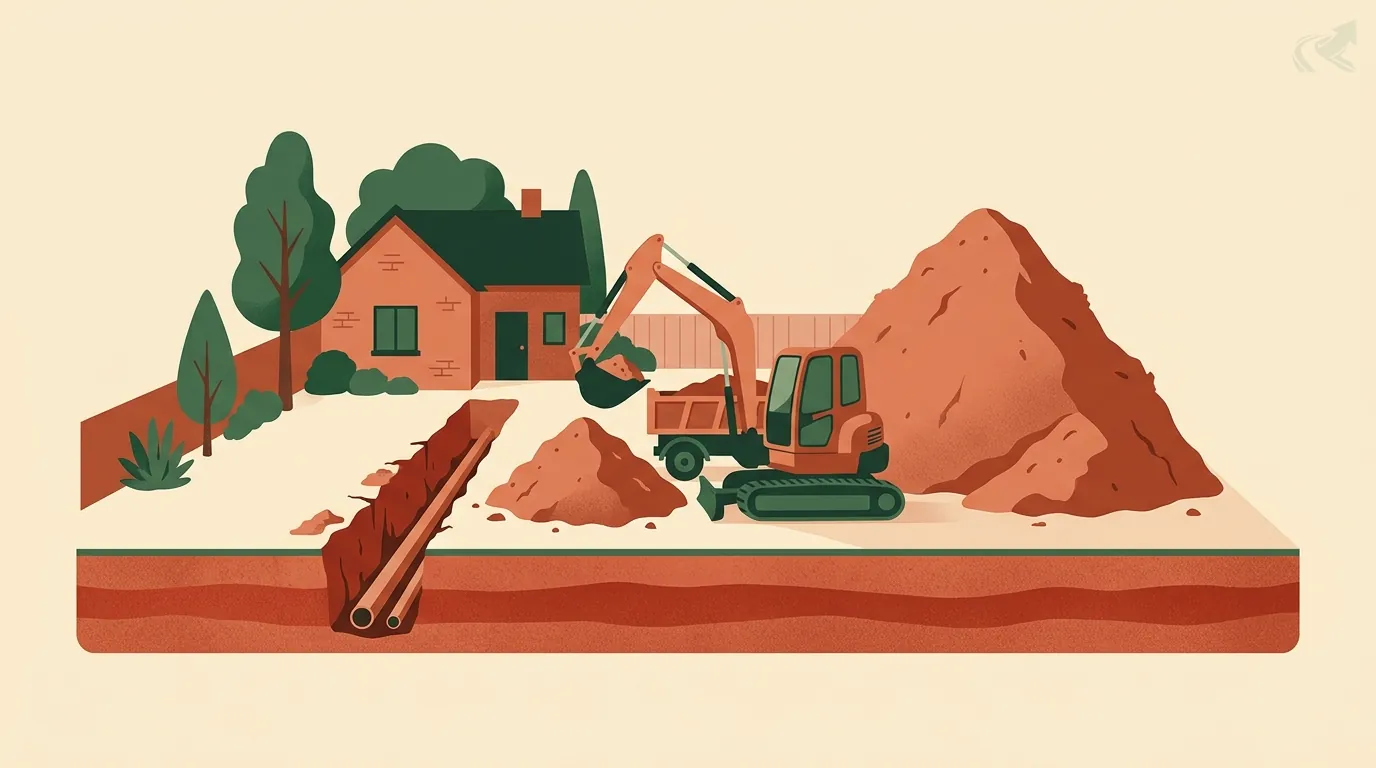
Hauling is its own piece of work, with its own trucks and its own bill. The hauling guide covers what moves dirt, and yards versus tons explains why two haulers can describe the same load in different units. When you compare excavation quotes, check first whether the dirt leaving your site is in the number or is somebody else’s problem.
Three Ways a Contractor Can Price a Dig
However the number is built, it usually takes one of three shapes. A cubic yard, for reference, is a cube three feet on every side. Each shape hands the risk to a different person.
Suppose you hire a mover by the hour, and then find out the stairs at the new place are far longer and narrower than you were told. Who pays for the extra time?
You do. Hourly pricing is honest about the work, and it leaves the surprise with you. Excavation has the same three shapes, and the same question to ask of each: who carries the unknowns?
Who carries the risk?
Guess who pays when the job turns out harder than expected, then tap to check.
1 By the hour, machine and operator
You carry it. If the soil is harder or the access is tight, the hours go up and the bill follows. It can be a fair way to price work nobody can measure in advance, such as digging to find a leak.
What to ask: What is the hourly rate, is there a minimum, and does the clock run while the machine travels to you?
2 By the cubic yard
It is shared, if the quote says how yards are counted. The price follows how much dirt moves, so a bigger hole costs more and a smaller one costs less.
What to ask: Is a yard measured in the ground or in the truck, and who does the measuring?
3 One lump sum for the whole job
The contractor carries it, up to the limits written into the quote. That is why a lump sum should say exactly what it includes and what changes it.
What to ask: What is in the number, and what counts as a change that adds to it?
Even the state works this way. In its current standard specifications for road building (the 2024 edition), the North Carolina Department of Transportation pays for unclassified excavation at the contract unit price per cubic yard, and pays for grading as a lump sum on the contract. For the per-yard price, the specification spells out what the money covers: excavation, blasting, hauling, disposal of the material, forming and compacting the fill, any backfill, and the removal of things like old driveways, drainage structures and buried tanks.
That list is the useful part. A per-yard price is only comparable to another one if both cover the same list.
Why Two Quotes Can Be Miles Apart
In one North Carolina thread, a Wilmington homeowner asked two companies to put in drain pipe for the gutters in the yard. A small outfit quoted on the spot, at $5,500 by the owner’s account. The second was disorganized about the appointment, came out, and sent back $31,000 the following week. The owner wrote back asking if it was a mistake.
Commenters didn’t treat it as one. They said a very high quote is sometimes how a contractor says “we don’t want this job” without having to say it. That is one reading, not a fact about that company. The lesson for you is simpler: a number with nothing under it can’t tell you which kind of quote you’re holding.
What would you ask for if a restaurant handed you a bill with one line on it: “Dinner for four, one total”?
An itemized bill, so you can see what each charge is for. Quotes work the same way. A lump sum with no breakdown can’t be checked. It can only be accepted or refused, which is a poor way to spend thousands of dollars.
When two excavation quotes are far apart, there are usually only a few reasons:
- They don’t include the same things. Hauling, rock, backfill, compaction and cleanup are the usual gaps.
- They assume different ground. One estimator walked the site and the other didn’t.
- They carry the risk differently. One is hourly, one is a lump sum, and the unknowns sit with different people.
- One of them isn’t really bidding. A very high number may mean the contractor doesn’t want the job.
- One of them has left out a legal step. The 811 ticket, trench protection, an erosion plan, or the license on a larger job.
How to Compare Two Quotes
Put the quotes next to each other and go through the same steps with both. If a contractor can’t answer one, that is information too.
Making two excavation quotes comparable
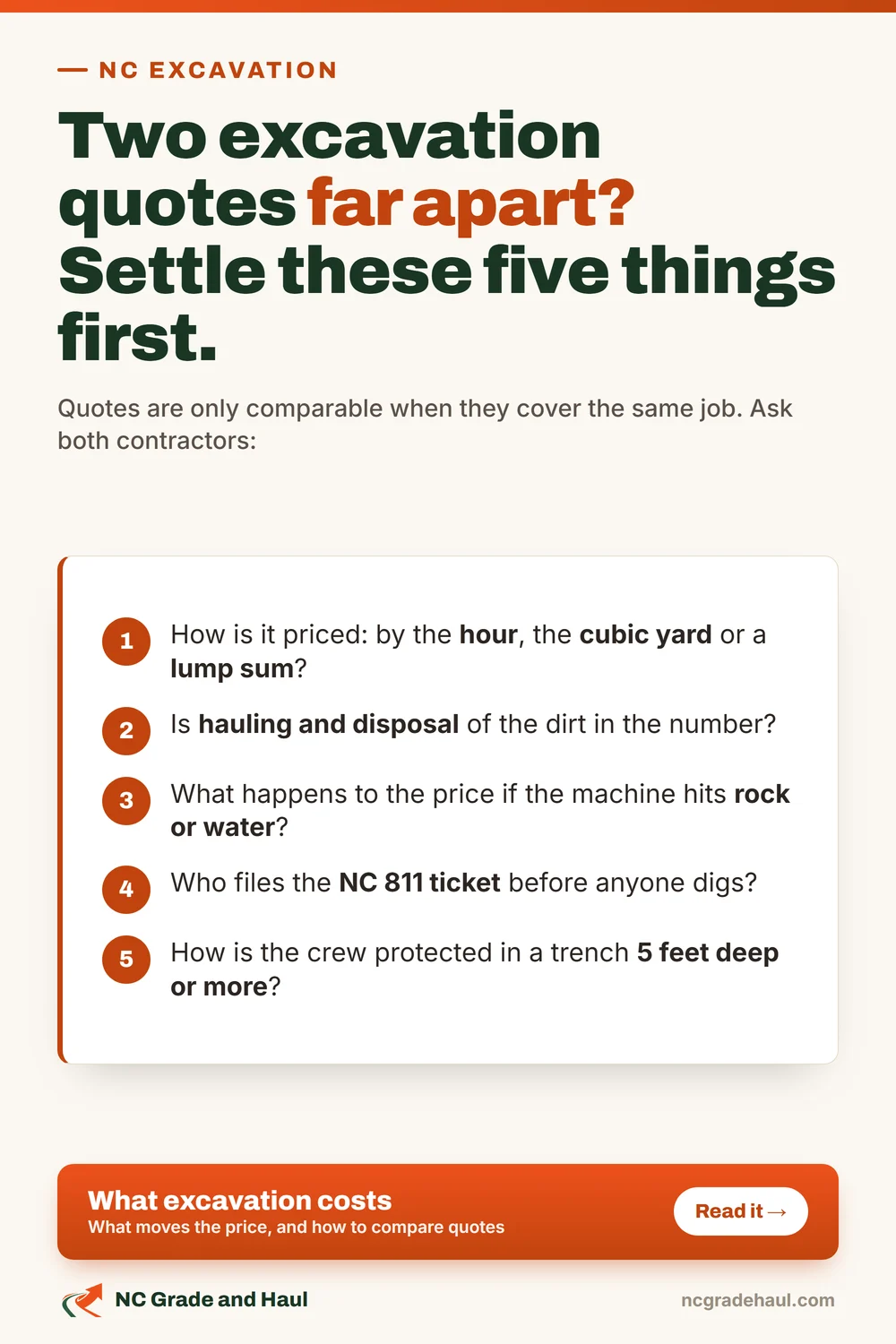
1. Describe the job the same way -- Give every contractor the same length, depth, purpose and site description, and the same photos. Different questions get different quotes. 2. Ask what is in the number -- Mobilization, digging, backfill and compaction, hauling and disposal, and cleanup. Ask for each as its own line, or ask what is left out. 3. Ask how it is measured -- Hours, yards or a lump sum? If yards, are they measured in the ground or in the truck? 4. Ask what changes the price -- Rock, water in the trench, buried utilities, a change in depth. Get the answer in writing, not on the phone. 5. Ask who handles the legal steps -- Who files the NC 811 ticket, how the crew will be protected in a deep trench, and whether the job needs an erosion plan or a licensed general contractor. 6. Check who is quoting -- Look up the license, ask for the insurance certificate, and see what the public record says.
-
Describe the job the same way
Give every contractor the same length, depth, purpose and site description, and the same photos. Different questions get different quotes.
-
Ask what is in the number
Mobilization, digging, backfill and compaction, hauling and disposal, and cleanup. Ask for each as its own line, or ask what is left out.
-
Ask how it is measured
Hours, yards or a lump sum? If yards, are they measured in the ground or in the truck?
-
Ask what changes the price
Rock, water in the trench, buried utilities, a change in depth. Get the answer in writing, not on the phone.
-
Ask who handles the legal steps
Who files the NC 811 ticket, how the crew will be protected in a deep trench, and whether the job needs an erosion plan or a licensed general contractor.
-
Check who is quoting
Look up the license, ask for the insurance certificate, and see what the public record says.
A quote that survives these six questions is one you can compare. A quote that doesn't is a guess.
Comparing quotes is a skill of its own, and the quote comparison guide goes further than this page can. Why site-work quotes differ and itemized versus lump-sum quotes go deeper on the two pieces that matter most here.
Before You Sign
Two checks apply to almost every dig, and one applies to the bigger ones.
North Carolina’s Underground Utility Safety and Damage Prevention Act requires whoever is responsible for an excavation to notify the NC 811 Notification Center at least three full working days before digging (G.S. 87-122). When you hire a firm, that is usually the contractor. Ask who files it, and ask for the ticket number.
On a trench 5 feet deep or more in anything but stable rock, federal rules require protection for the people working in it ( 29 CFR 1926.652). A contractor who has priced that in has thought about the job. One who hasn’t may be about to cut a corner you will pay for.
And where the cost of the undertaking is $40,000 or more, North Carolina’s general contractor law covers the job, and that work requires a general contractor license, with narrow exceptions (G.S. 87-1). The licensing guide shows how to read one.
Checking the contractor is the work our directory does for you. We check contractors against the state licensing board, the Secretary of State’s business registry, OSHA’s inspection records and the NC Industrial Commission’s workers’ compensation coverage, and a checked contractor links to the record behind each check. Find a checked excavation contractor near you, or read how to check any contractor first.
Where to Go Next
- What the work is: excavation in North Carolina.
- Comparing bids: how to compare quotes.
- Moving the dirt: hauling, fill dirt and gravel.
- Hiring: how to check a contractor and excavation contractors in our directory.