One North Carolina owner posted a question online: they wanted a small patch of back yard graded, had expected a modest cost, and had just been handed a quote of roughly two to three times that. The first reply: “‘Grade,’ ‘small,’ you aren’t giving us … much to work with. Get more quotes.” Then the owner added the details: the patch was to be raised, with a retaining wall and a drainage channel. Another reply: the grading isn’t the expensive part, you’re paying for the retaining wall. A third: make sure you’re asking for the right stuff.
Until those details arrived, nobody in that thread could say whether the quote was fair, because nobody knew what job it priced. Once they did, several replies said the price sounded reasonable for that work. That is the whole problem with a stack of quotes that don’t agree. This page is how to fix it before you pick one.
We’re a directory of site-work contractors, checked against public records. We don’t do the work, and we don’t print prices on this page: no public record we can read gives one. What follows is how to read what you’ve been handed.
Three Quotes, Three Different Jobs
Three people are each handed a different, handwritten grocery list and asked how much it will cost. One comes back with a number far lower than the other two. What is the most likely reason?
They priced different lists. Quotes for site work behave the same way. When three quotes for one yard disagree, the usual reasons are these:
- They were told different things. “Fix my drainage” gets a different answer from a contractor who walks the lot than from one who hears it on the phone.
- They priced different work. One adds a drain line, one only regrades, one includes a wall. Each is honest about its own job.
- They left different things out. Hauling away extra dirt, erosion control, the permit, the clean-up. A quote that never mentions them is not cheaper. It is shorter.
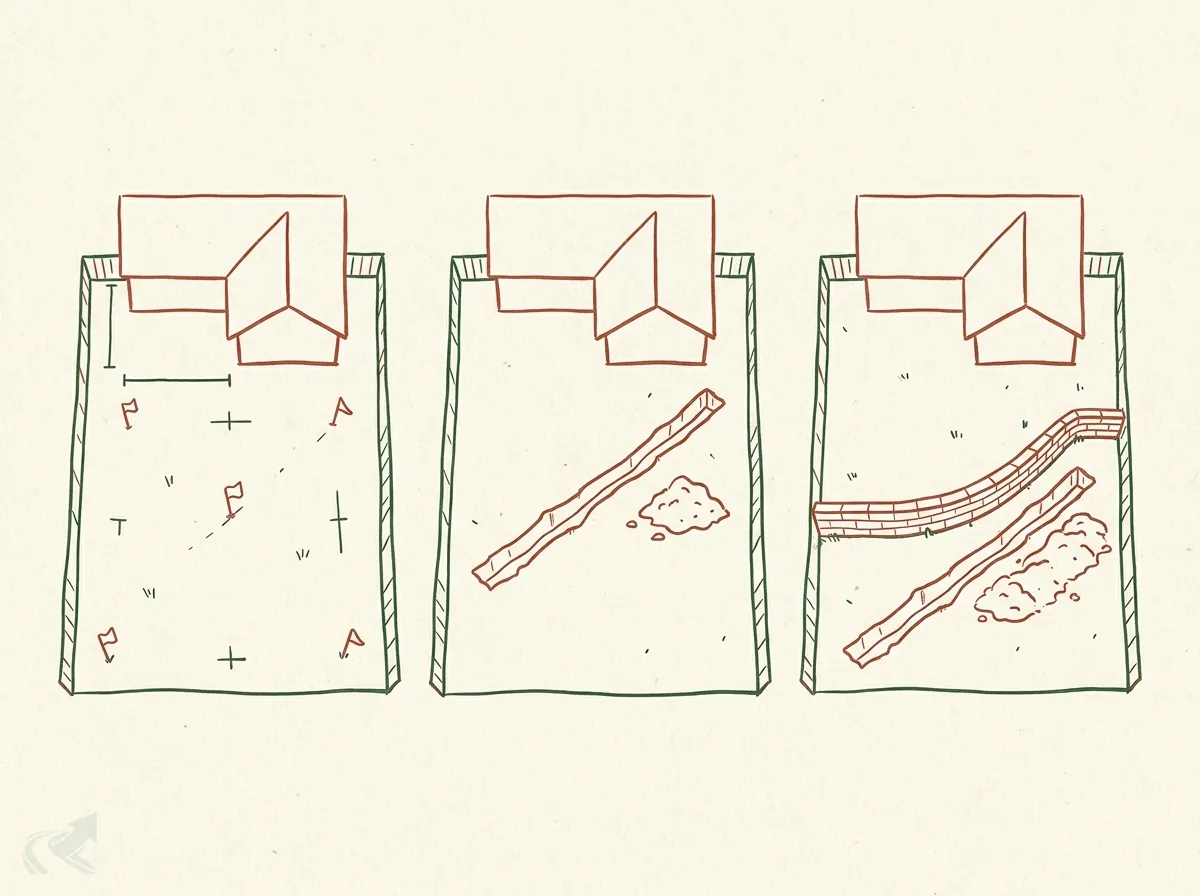
So the first step is not collecting more numbers. It is writing the job down once, in plain words, with photos, and sending the same description to every contractor. One commenter in another North Carolina thread had a related tip for bundled work: when clearing and grading are quoted together, ask for each piece separately too, because a company that subcontracts one part may mark it up. That is one owner’s advice, not a rule, but it shows why the pieces matter.
What a Quote You Can Compare Contains
Two North Carolina state offices say nearly the same thing about what belongs in writing. The Licensing Board says an estimate should include the total price, the materials to be used, a timetable for payments and the expected timeline for the work, and to compare more than the bottom line: the cost, quantity and quality of materials in each. The Attorney General’s office lists the price, the payment schedule, the work to be done, the quality of materials and the deadline, and adds warranties, start and finish dates and who is responsible for clean-up and trash removal.
The second panel is where “cheaper” quotes often hide their difference. The permit is a good example. State law requires an erosion and sedimentation control plan for land disturbance over one acre, and some local governments run their own programs, which can be stricter, so who files what depends on the site. Our permits guide is the place to start; for the quote, the only question is who is responsible and whether the fee is in the number. A word on the words themselves: if a line on a quote reads like a foreign language, the glossary of site-work terms explains what the words on a quote mean.
Itemized or One Number
A single lump-sum number is not automatically dishonest. It is just hard to read. You cannot see what is inside it, so you cannot compare it with a quote that shows its parts, and you cannot point to a line later and say “this wasn’t done.”
One North Carolina owner described getting a quote “that had all the things to be fixed and a price for each,” and said it seemed reasonable for what they were getting. That is the point of itemizing: not that every line is cheap, but that every line can be questioned. Ask each contractor to break theirs out the same way. If one will not, that is information, though not proof of anything on its own.
Two things about the trades we cover. How an excavation job gets priced (by the hour, the yard or a lump sum) is on our page about what excavation costs, and the same questions for a septic job are on the septic cost page. Both explain the pricing; this page is about reading the paper.
The other half of a good quote is what happens when the ground surprises you. Rock, water and old pipe do show up. The Licensing Board says any changes should be noted in writing, and the Attorney General’s office adds a warning: unexpected problems a contractor “notices” after work has started may not exist, and a contractor trying to move the date or the cost is a warning sign. The fix is dull and effective. Agree before the work starts that any extra cost is written down and approved by you before the extra work begins.
Questions to Ask Every Contractor
Six questions that make quotes comparable
1. What exactly is in the number, and what is left out? -- Ask about the permit, hauling away extra dirt, erosion control and clean-up by name. 2. What happens if the ground surprises you? -- Get the answer in writing: extra cost is written down and you approve it before the extra work starts. 3. Who will be on my property? -- Your contractor's own crew, or subcontractors? The Licensing Board says to get the names of subcontractors and suppliers. 4. What weather stops you, and what happens to the schedule and my deposit? -- A clear answer on rain delays is worth more than a promised date. 5. Can I call three recent customers? -- The Board suggests written references, and asking each owner whether the contractor kept to the schedule and the contract terms. 6. What is your license number? -- Then look it up yourself. The next sections show how.
-
What exactly is in the number, and what is left out?
Ask about the permit, hauling away extra dirt, erosion control and clean-up by name.
-
What happens if the ground surprises you?
Get the answer in writing: extra cost is written down and you approve it before the extra work starts.
-
Who will be on my property?
Your contractor's own crew, or subcontractors? The Licensing Board says to get the names of subcontractors and suppliers.
-
What weather stops you, and what happens to the schedule and my deposit?
A clear answer on rain delays is worth more than a promised date.
-
Can I call three recent customers?
The Board suggests written references, and asking each owner whether the contractor kept to the schedule and the contract terms.
-
What is your license number?
Then look it up yourself. The next sections show how.
Send the same six questions to every contractor. How they answer is as useful as the answers.
Deposits, Payments and Paperwork
If you paid a babysitter their full fee for the evening before they walked in the door, what would you have left to settle things with if the evening went badly? Nothing. A large deposit is the same trade: the one thing that makes a bad job fixable, the money you haven’t paid yet, is gone before you know.
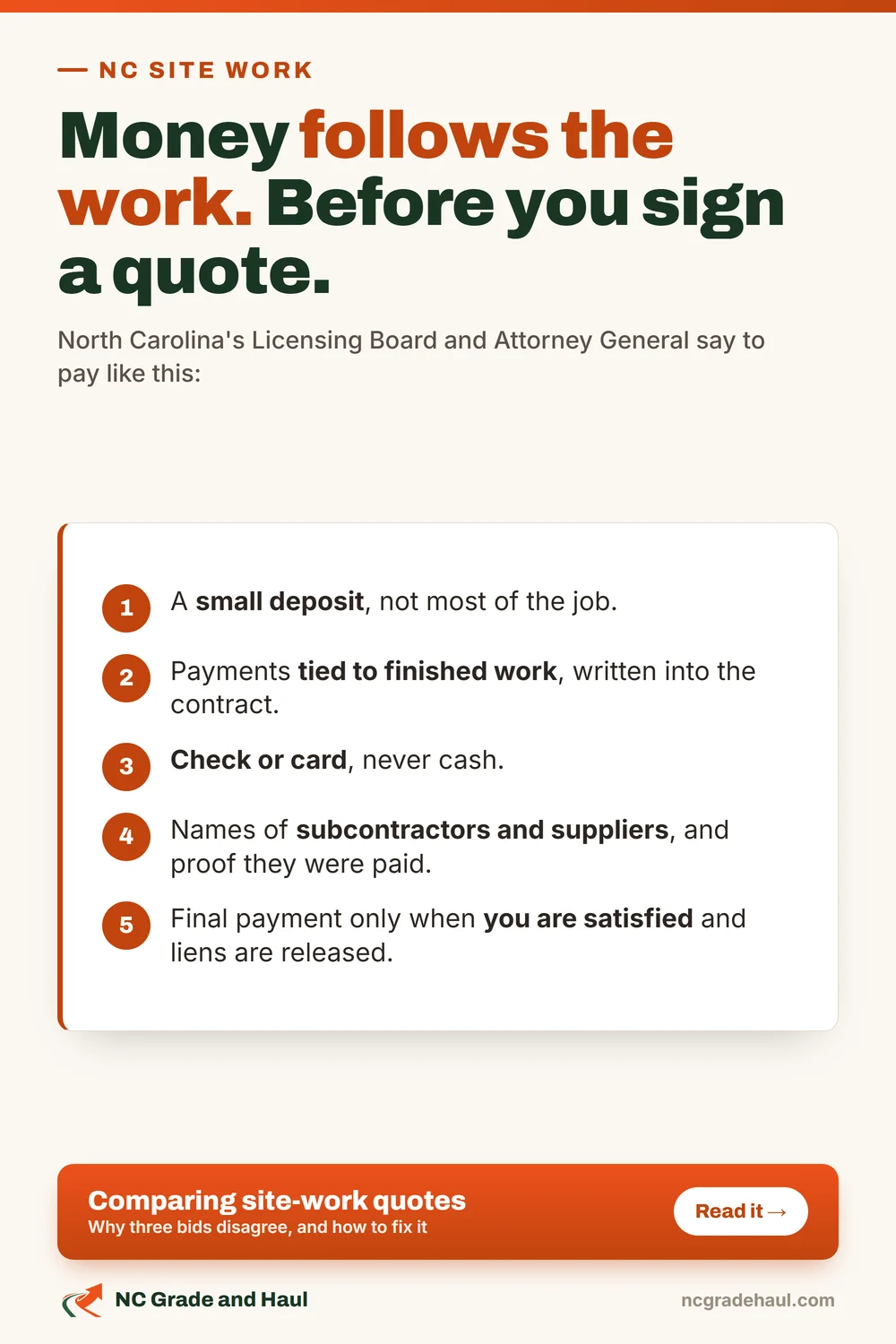
North Carolina’s two offices put it this way. The Licensing Board says the down payment you pay to get work started “should be minimal,” that you should set a payment schedule that follows the work as it is completed, and never pay for something that has not been done. The Attorney General’s office says it is reasonable for a contractor to ask for a deposit, but you should not pay for most or all of the work before it is completed, and to be suspicious of a contractor who repeatedly asks for money to buy materials. We found no percentage at either office, so we don’t print one. A figure you see elsewhere is a rule of thumb, not the law.
Money follows the work
1. A small deposit, in writing -- Enough to hold your place in the schedule, not enough to fund the whole job. 2. Payments tied to finished work -- Write the schedule into the contract: each payment follows a stage that is actually done. 3. Check or card, not cash -- Both the Board and the Attorney General say do not pay in cash. The Attorney General adds: if possible, use a credit card. 4. Names of subcontractors and suppliers -- Ask for confirmation that they have been paid. The Board says to get both the names and the confirmation. 5. Final payment only when you are satisfied -- Walk the finished work first, and verify that any liens have been released. 6. Keep every piece of paper -- The contract, written changes, invoices, receipts and photos of the job in progress.
-
A small deposit, in writing
Enough to hold your place in the schedule, not enough to fund the whole job.
-
Payments tied to finished work
Write the schedule into the contract: each payment follows a stage that is actually done.
-
Check or card, not cash
Both the Board and the Attorney General say do not pay in cash. The Attorney General adds: if possible, use a credit card.
-
Names of subcontractors and suppliers
Ask for confirmation that they have been paid. The Board says to get both the names and the confirmation.
-
Final payment only when you are satisfied
Walk the finished work first, and verify that any liens have been released.
-
Keep every piece of paper
The contract, written changes, invoices, receipts and photos of the job in progress.
The order matters. Each step keeps something in your hands until the work earns it.
Why does the Board keep mentioning liens? North Carolina’s lien statute lets people who supply labor, materials or rented equipment under a contract with the owner file a claim of lien on the property (G.S. 44A-8), and it lets a contractor’s subcontractor, to the extent of its own claim, enforce the contractor’s lien (G.S. 44A-23). In plain terms, a crew your contractor didn’t pay can end up with a claim against your property. We are not lawyers, and this is not legal advice; it is why the Board’s steps (confirm payment, verify releases before the last payment) are worth following.
Two more protections are worth knowing. The Attorney General’s office says that under state law a contract signed somewhere other than the seller’s normal place of business, such as at your home, can generally be canceled within three business days after you sign, and that the seller must give you a copy of the signed contract when you sign. The statute (G.S. 14-401.13, which follows the federal Cooling-Off Rule) applies even when you invited the contractor out, as long as the price is $25 or more. It has exceptions, among them an emergency repair you asked for and waived the right for in your own handwriting, and some repair visits you requested. And if a licensed general contractor does take your money and fail you, the Board’s Homeowners Recovery Fund exists for owners of single-family homes, but the Board calls it a last resort: you generally must have won an unpaid court judgment first, and recovery is not guaranteed.
Is the Lowest Bid Licensed for the Job?
A license is the cheapest check you can run, and it matters most on the quote that looks too good. North Carolina’s contractor statute, G.S. 87-1, defines a general contractor as anyone who, for a fee, undertakes “to bid upon or to construct” a building, highway, grading or other improvement “where the cost of the undertaking is forty thousand dollars ($40,000) or more.” Grading is named in the statute. So is the word “bid”: under G.S. 87-13, bidding on or contracting for such work without a license is a Class 2 misdemeanor, as is claiming or suggesting a license you do not hold.
Below that line, no general contractor license is required, which does not mean anything goes. The Attorney General’s office says an unlicensed contractor “may be reputable,” and that a licensed one offers some protection because the Board oversees licensed contractors and can act against them. Other trades have their own boards: electricians, plumbers and, for septic systems, certified installers (see how septic work is certified).
How to check, in a few minutes:
- Ask for the license number, not just the company name. Look it up yourself in the Board’s free public search at portal.nclbgc.org. The license lookup guide walks through it, and our guide to checking a contractor covers the rest, and the licensing page explains how North Carolina classifies licenses.
- Search the owner’s name as well as the business name. The Attorney General’s office notes that scam contractors often change their business names, so the current name may show nothing.
- Ask to see the insurance policy or bond, then contact the insurance company to verify it. A certificate someone hands you is not the same as the insurer saying the policy is in force.
Then, and only then, compare prices. The directory lists contractors checked against public records, and the excavation directory is the place to start for a dig.
Spot the Red Flag
What would you do?
Read the situation, decide your first move, then tap to check.
1 A crew knocks on your door after a storm, says they have leftover materials and can start today.
Close the door and call someone you found yourself. The Attorney General's office says to avoid anyone who knocks on your door, and warns that out-of-state door-knockers may collect money from several homeowners and disappear.
Then: Get at least three written bids, even in a hurry. The Licensing Board says do not rush into repairs.
2 The price comes by text message. The contractor will "put the paperwork together" after you send a deposit.
Ask for the written contract first. It should list the work, the materials, the price, the payment schedule and the deadline before any money moves.
Then: Verbal promises are the ones you cannot point to later. Changes belong in writing too.
3 They want most of the money up front "to buy materials."
Say no. A deposit is reasonable; most or all of the work paid in advance is not, and repeated requests for materials money may mean the contractor lacks the resources to finish.
Then: The Attorney General's suggestion if you still want to use them: buy the materials yourself and pay the labor after the job is finished.
4 Halfway through, they tell you they have found a new problem and the price is going up.
Stop and ask for it in writing, with what they found and what it costs, before any extra work. The Attorney General's office warns that new problems noticed after work begins may not exist.
Then: Compare the request against your contract. A contractor trying to move the date or the cost is a warning sign.
5 They will only take cash.
Offer a check or a credit card instead. Both state offices say not to pay in cash.
Then: If the answer is still no, you have learned something about the paperwork you will never see.
6 It is a big job. You ask for a license number and hear "don't worry, we're licensed."
Ask again for the number, then look it up yourself at the Board's public search. For work of $40,000 or more, state law requires a general contractor license.
Then: A number that pulls up a different name, or an expired license, is your answer.
7 A salesperson wants you to sign on a tablet at your kitchen table today to lock in the price.
Read every term, and take the time to. The Attorney General's office says you should be given enough time to understand what you sign.
Then: Contracts signed at home can generally be canceled within three business days, with exceptions, and you must be given a copy of the signed contract.
8 Your lowest quote is far below the others and never mentions hauling away dirt or erosion control.
Ask in writing whether they are included before you compare prices. A missing line makes it a different job, not a bargain.
Then: If they are included, ask for them on the quote. If they are not, add them and compare again.
When to Book: Seasons, Weather and Storms
Here is the pattern from people who have hired: the good crews are busy. One North Carolina poster wrote that most contractors are “slammed for months or vanishing mid project.” Another, recommending two septic companies, said both do solid work and are scheduled out for a while. Neither is proof of how long any contractor will take, but together they say what to expect. A calendar with room is not always a good sign, and not always a bad one.
The week before a big holiday, every bakery in town has a line out the door. One bakery has no line and offers to start your order right now. You wouldn’t call that a scam. You’d ask why, and get the price, the pickup time and the terms in writing. Treat an open calendar the same way: ask why, and write down the answer.
Weather is the other half of timing. NC State Extension’s guidance for farm machinery says that working soil when it is wet and weak causes more compaction than working it dry. That is farm advice, and we aren’t a soil lab, but the plain principle (heavy machines and wet ground don’t mix) is one reason a contractor may hold a job for drier days, and why you should ask the question from the checklist above: what weather stops you, and what happens to the schedule and my deposit? Our own suggestion, not a legal requirement: write a walk-through after the first hard rain into the contract, so you see the finished grade shed water before the last payment.
Storm season has dates. The National Hurricane Center says the Atlantic hurricane season runs June 1 to November 30, with the peak on September 10. After a damaging storm, the Attorney General’s office has warned about contractor fraud in the rebuilding that follows.
Any time of year, and after a storm
Comparison. Any time of year: Describe the job once and send it to every contractor; Ask what weather stops the work and what happens to your deposit; Expect good crews to be booked; Ask why if a calendar is wide open. After a storm: Do not rush into repairs, however badly they are needed; Get at least three bids anyway; Be wary of door-to-door offers and out-of-state crews; Check the license before the first dollar moves.
- Describe the job once and send it to every contractor
- Ask what weather stops the work and what happens to your deposit
- Expect good crews to be booked
- Ask why if a calendar is wide open
- Do not rush into repairs, however badly they are needed
- Get at least three bids anyway
- Be wary of door-to-door offers and out-of-state crews
- Check the license before the first dollar moves
A rush is when you most need three bids. The advice does not change after a storm. It matters more.
Prices after a storm get their own rule. Under G.S. 75-38, once a state of emergency is declared (or an abnormal market disruption is found), it is a violation, in the area covered, to sell goods or services used because of the emergency or to protect people and their property with the knowledge and intent to charge a price that is “unreasonably excessive under the circumstances.” The statute weighs, among other things, whether the price reflects added costs and how it compares with the seller’s average price in the prior 60 days. It is not a ban on higher prices as such, and it runs for a limited time: the earlier of 45 days after the triggering event or its end, unless the Governor extends it. If you think you have been overcharged, the Attorney General’s Consumer Protection Division takes complaints at 1-877-5-NO-SCAM.
Where to Go Next
Once the quotes match, the licenses check out and the deposit is small, you are comparing contractors rather than guessing. Start with our guide to checking a contractor, run the license lookup, and see what excavation costs or what septic work costs if you want to understand the pieces. To find someone, the directory lists site-work contractors checked against public records, and the excavation directory is the place for a dig.