Two questions GCs and homeowners ask after an inspection
What NC law requires erosion control on construction sites?
The Sedimentation Pollution Control Act -- codified at GS 113A-50 through 113A-67 -- and its implementing rules at 15A NCAC 04 (Subchapter 04B covers erosion and sediment control). The state threshold is more than 1 acre of disturbance. Most NC counties add lower thresholds via local ordinance. DEMLR enforces state law; county Soil & Water offices enforce locally.
Does my project need an E&S plan if it's under 1 acre?
Probably yes -- if it's in NC. Durham County enforces at 12,000 square feet. Most other major counties use the 1-acre state threshold. The 1-acre state threshold is the floor for state permits, not the floor for all permits. If your site is in Wake, Mecklenburg, Durham, or Guilford County, county rules almost certainly apply before you hit 1 acre.
Here’s the most common E&S compliance confusion in North Carolina: a builder on a half-acre lot gets a Notice of Violation from a county inspector. The builder says “state law doesn’t apply — we’re under 1 acre.” The inspector writes the citation anyway.
Both sides are technically right and wrong at the same time. The state threshold is 1 acre. In Durham County, the local threshold is 12,000 square feet; in most other major metros, the county threshold is also 1 acre. The county inspector is the one standing on the site.
That gap — between what the state law says and what the county enforces — is where most residential grading projects live. This page translates both layers.
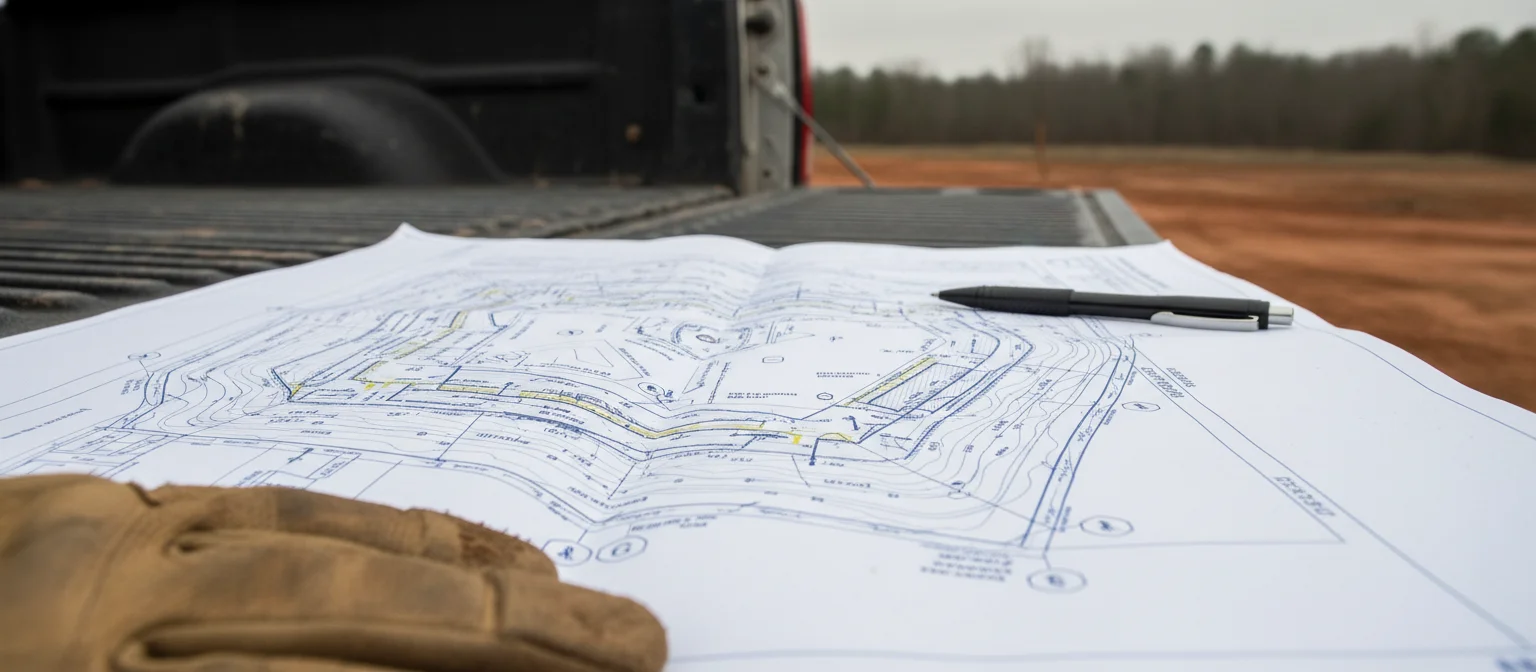
The Sedimentation Pollution Control Act — What It Is
The , passed in 1973, is the foundation of North Carolina erosion law. It established as the state enforcement authority and set 1 acre as the threshold for required E&S plans.
The SPCA is codified at GS §113A-50 through §113A-67. Plain English: if your project disturbs more than 1 acre, you must submit and receive approval for an plan before land-disturbance begins.
The Act covers anyone who grades, clears, or excavates land for construction, development, or land disturbance at that threshold. It is not limited to commercial projects. A 1.2-acre residential lot-clearing job triggers state law the same as a commercial pad.
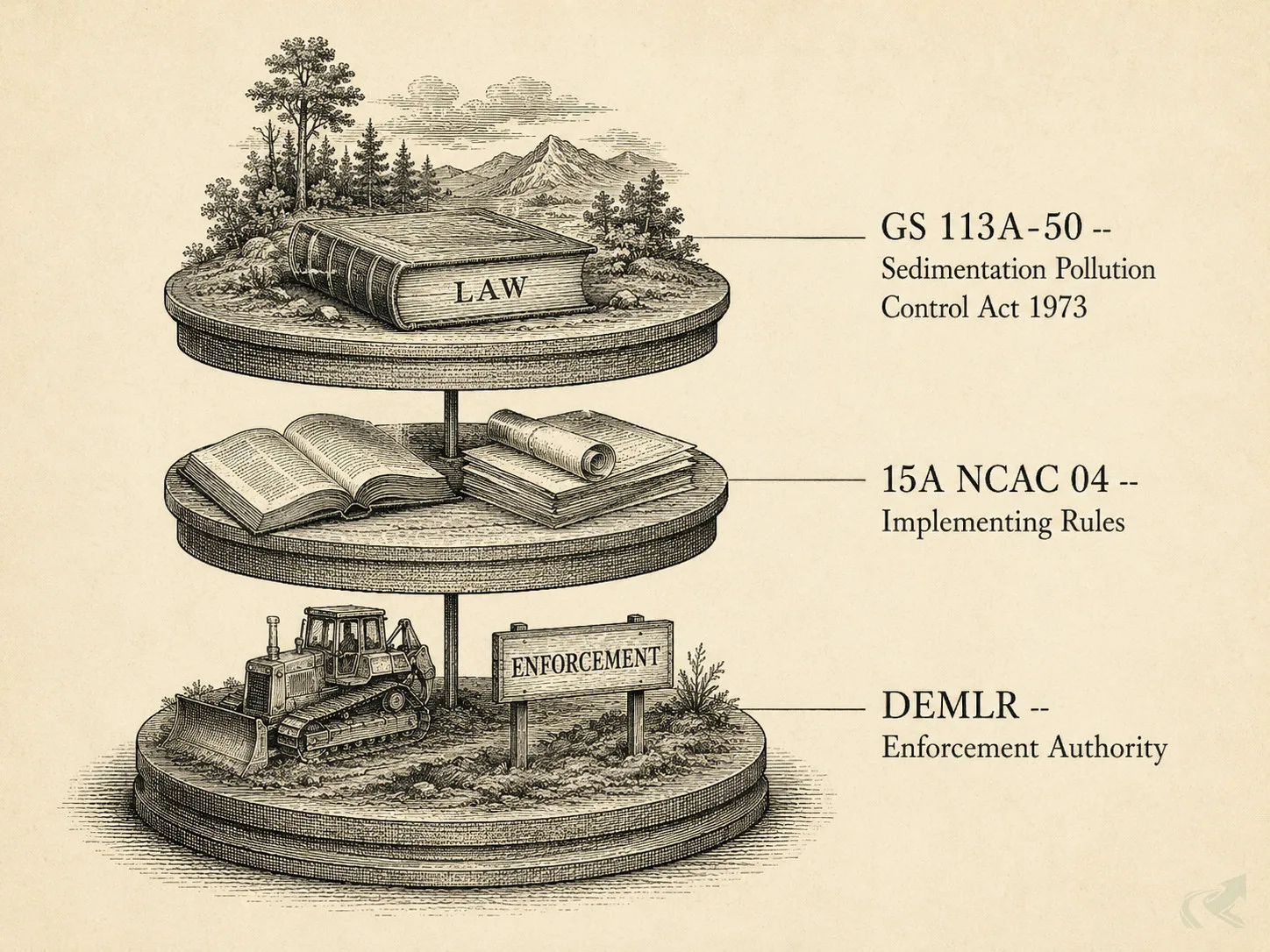
houses DEMLR, which is the division that actually reviews the plans and sends inspectors.
For background on the Act and how it shaped NC’s current regulatory framework, see the NC Sedimentation Pollution Control Act reference page.
15A NCAC 04 — The Implementing Rules
15A NCAC 04 — specifically Subchapter 04B, “Erosion and Sediment Control” — is the administrative rule set that translates the SPCA into specific engineering standards — what an E&S plan must contain, how controls must be designed and maintained.
If the SPCA is the law, 15A NCAC 04 is the instruction manual for how to comply with it.
The rule covers minimum design standards for silt fence, construction entrances, outlet protection, and slope stabilization. It also defines maintenance requirements — controls must stay functional throughout the project, not just be installed on day one.
Engineers and plan reviewers work from the NC Erosion and Sediment Control Planning and Design Manual (2013 edition, the current version published by DEMLR). That manual operationalizes the rule into specific design charts and tables.
The 1-Acre State Trigger
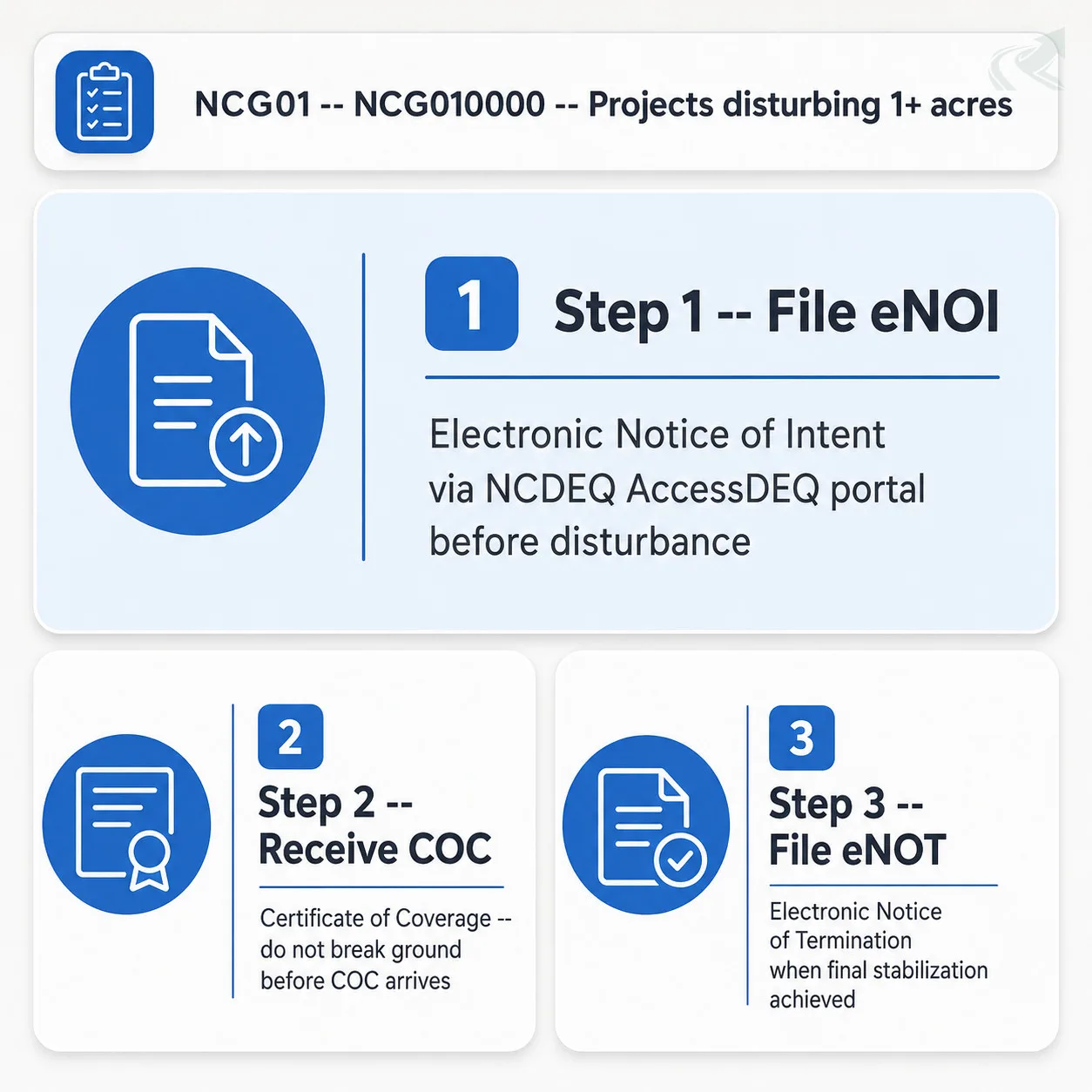
Any project that disturbs 1 or more acres in North Carolina triggers the state E&S plan requirement — you must file with NCDEQ before breaking ground.
“Disturbs” means any grading, clearing, or excavation that removes vegetative cover from soil. A project that clears 0.8 acres of trees and grades 0.25 additional acres is over 1 acre total. The threshold applies to the combined footprint, not each phase separately.
Projects that disturb 1 or more acres also need an Construction General Permit, designated NCG01 (full permit number NCG010000). That permit covers stormwater discharge from the construction site.
For the full breakdown of what triggers state-level compliance, including edge cases for phased projects, see NC land-disturbance thresholds that trigger compliance.
County Ordinances Below 1 Acre
Durham County enforces its erosion ordinance at 12,000 square feet — well below 1 acre. Most other major NC counties use the 1-acre state threshold. The county threshold is where most residential grading projects live.
The county inspector is typically the one who shows up at a residential project, not DEMLR. That inspector enforces local ordinance, which can trigger at a fraction of the state threshold.
Two scenarios matter in practice:
- County-only projects (under 1 acre): county E&S approval required; no state E&S plan needed; no NCG01 permit needed.
- State + county projects (1 acre or more): both apply. State E&S plan through NCDEQ AND county E&S approval through local Soil & Water or stormwater office.
The table below shows the county thresholds for major NC metros. Figures for Wake, Mecklenburg, Durham, and Guilford verified against county portals and ordinances May 2026. Buncombe and New Hanover thresholds confirmed from county ordinance text. Portal URLs for Buncombe and New Hanover remain unverified.
NC County E&S Thresholds -- Major Metros
| County | County Trigger | Enforcing Office | Permit Portal |
|---|---|---|---|
| Wake | 1 acre | Wake Soil & Water Conservation District | wake.gov/departments-government/watershed-management |
| Mecklenburg | 1 acre | Mecklenburg Storm Water Services | stormwaterservices.mecknc.gov |
| Durham | 12,000 sq ft | Durham Stormwater & GIS | dconc.gov/Engineering-and-Environmental-Services |
| Guilford | 1 acre | Guilford Soil & Water Conservation District | guilfordcountync.gov |
| Buncombe | 1 acre | Buncombe Soil & Water Conservation District | [UNRESOLVED] |
| New Hanover | 1 acre | New Hanover County Stormwater | [UNRESOLVED] |
Wake
- County Trigger
- 1 acre
- Enforcing Office
- Wake Soil & Water Conservation District
- Permit Portal
- wake.gov/departments-government/watershed-management
Mecklenburg
- County Trigger
- 1 acre
- Enforcing Office
- Mecklenburg Storm Water Services
- Permit Portal
- stormwaterservices.mecknc.gov
Durham
- County Trigger
- 12,000 sq ft
- Enforcing Office
- Durham Stormwater & GIS
- Permit Portal
- dconc.gov/Engineering-and-Environmental-Services
Guilford
- County Trigger
- 1 acre
- Enforcing Office
- Guilford Soil & Water Conservation District
- Permit Portal
- guilfordcountync.gov
Buncombe
- County Trigger
- 1 acre
- Enforcing Office
- Buncombe Soil & Water Conservation District
- Permit Portal
- [UNRESOLVED]
New Hanover
- County Trigger
- 1 acre
- Enforcing Office
- New Hanover County Stormwater
- Permit Portal
- [UNRESOLVED]
Thresholds for Wake, Mecklenburg, Durham, and Guilford verified against county portals and ordinances May 2026. Buncombe and New Hanover thresholds confirmed from county ordinance text. Portal URLs for Buncombe and New Hanover remain unverified — call the enforcing office to confirm the current application process.
For the county permit process and what to submit, see county erosion control permit requirements in NC.
DEMLR Enforcement — What Actually Happens
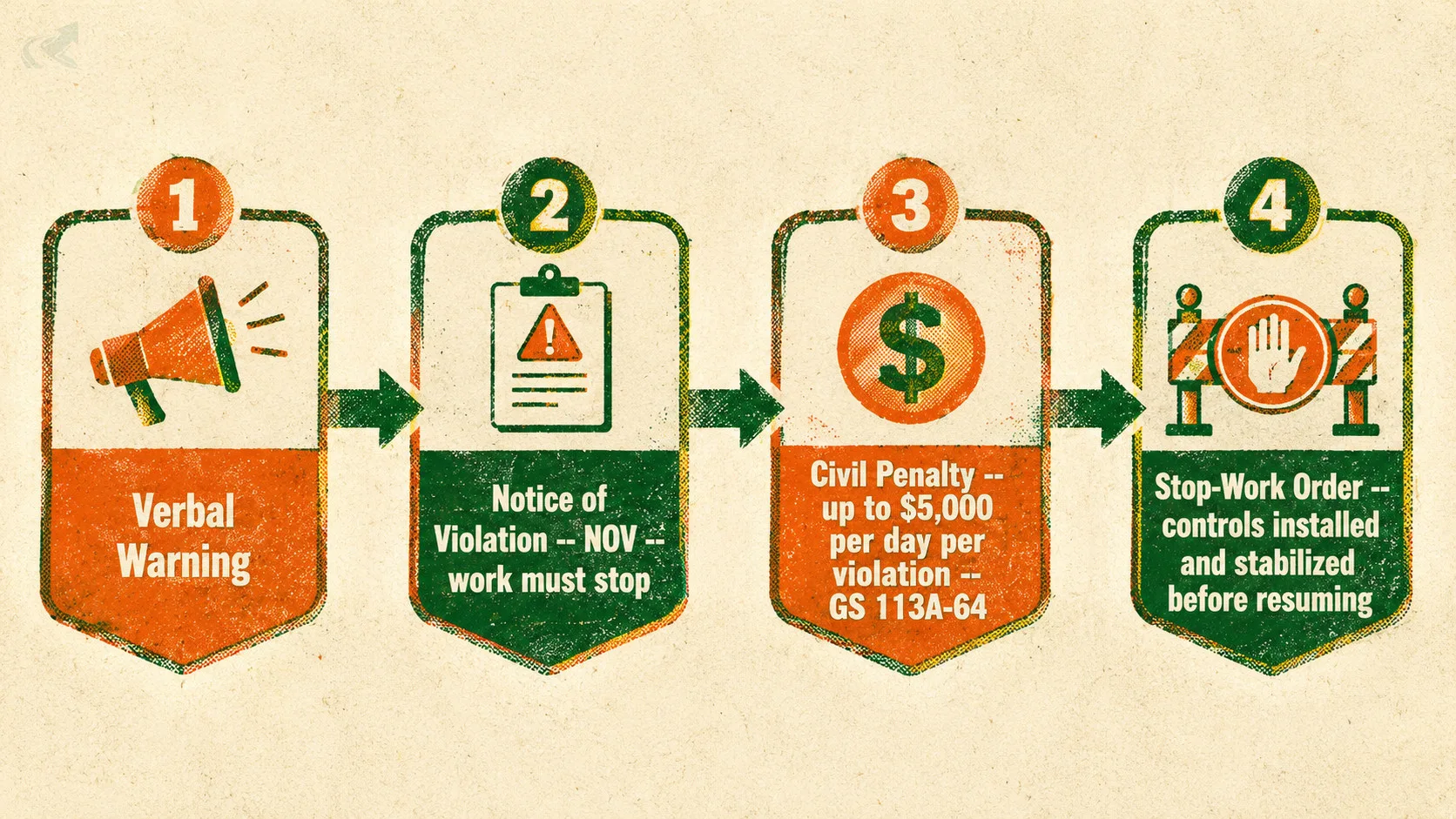
DEMLR enforcement follows a standard progression: verbal warning — Notice of Violation — civil penalty — stop-work order. Civil penalties for E&S violations can reach $5,000 per day per violation — the maximum civil penalty per GS §113A-64, where each day of a continuing violation counts as a separate violation.
What triggers a DEMLR inspection:
- Complaint from a neighboring property owner — the most common trigger on residential jobs
- County referral — a county inspector escalates to DEMLR when a project hits the 1-acre state threshold
- DEMLR’s own stormwater inspection program — targeted inspections along regulated waterways and sensitive watersheds
A is not advisory. Work must stop, controls must be installed, and DEMLR must re-inspect before full work resumes.
The stop-work-order reality: work stops until controls are installed AND stabilized — not just corrected going forward. If sediment left the site and reached a neighbor’s property or a waterway, DEMLR can require restoration of the damaged area. Restoration costs can exceed original project cost.
That’s not a theoretical risk. It’s the actual enforcement mechanism, and it’s the reason experienced grading contractors treat E&S installation as a line item on every quote, not an afterthought.
What This Means for Your Project
If your project is in Durham County and over 12,000 square feet, you need a county land-disturbance permit. In other major NC metros, the county E&S threshold is 1 acre — the same as state law. Check municipal rules, which may apply at lower thresholds. If it’s over 1 acre, add the state NCG01 permit.
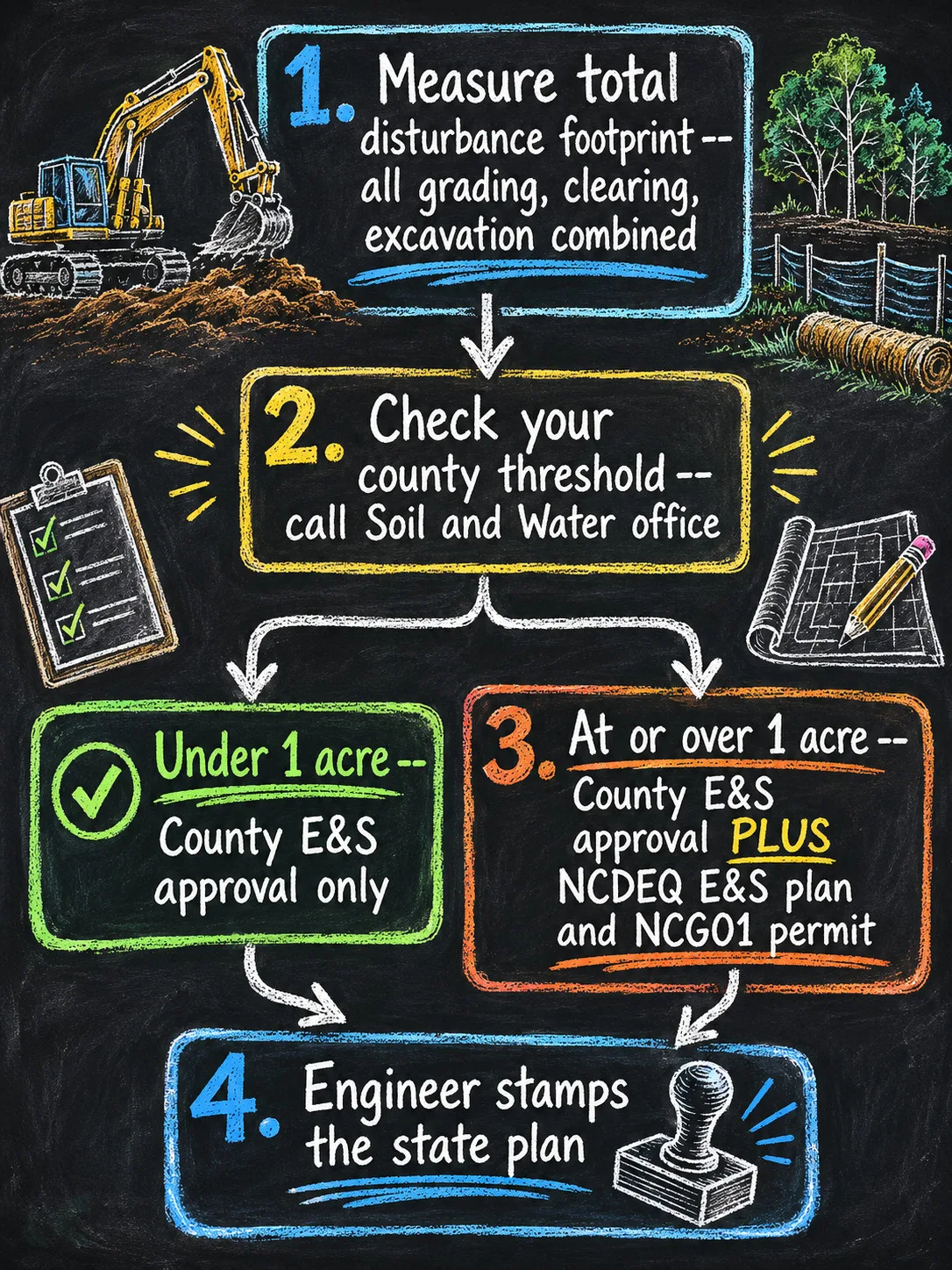
Decision framework — run these in order:
- Measure total disturbance footprint — all grading, clearing, and excavation combined.
- Check your county’s threshold — call the county Soil & Water office or stormwater department. Ask “what’s the disturbance threshold for an E&S plan in [county name]?”
- If under 1 acre: county E&S approval only. Your GC or developer typically files; the grading contractor installs and maintains controls.
- If at or over 1 acre: county E&S approval PLUS NCDEQ E&S plan and NCG01 permit. A licensed engineer typically stamps the state plan.
For background on what clearing and grubbing triggers from a compliance standpoint, see what NC law requires when you start clearing.
Find a Grading Contractor Who Knows the Local Rules
A grading contractor who regularly works in your county will know the local inspector’s expectations — and will include E&S installation as a line item in the quote, not a surprise add-on after the permit review.
Ask for an itemized quote that shows silt fence, construction entrance, and any outlet protection as separate line items. If E&S is bundled into a round-number “site prep” figure, you can’t tell whether it’s priced or assumed.
Find a contractor who works in your county: hire a licensed NC grading contractor.