Two questions NC property owners ask first
What does land clearing actually cover for an NC construction project?
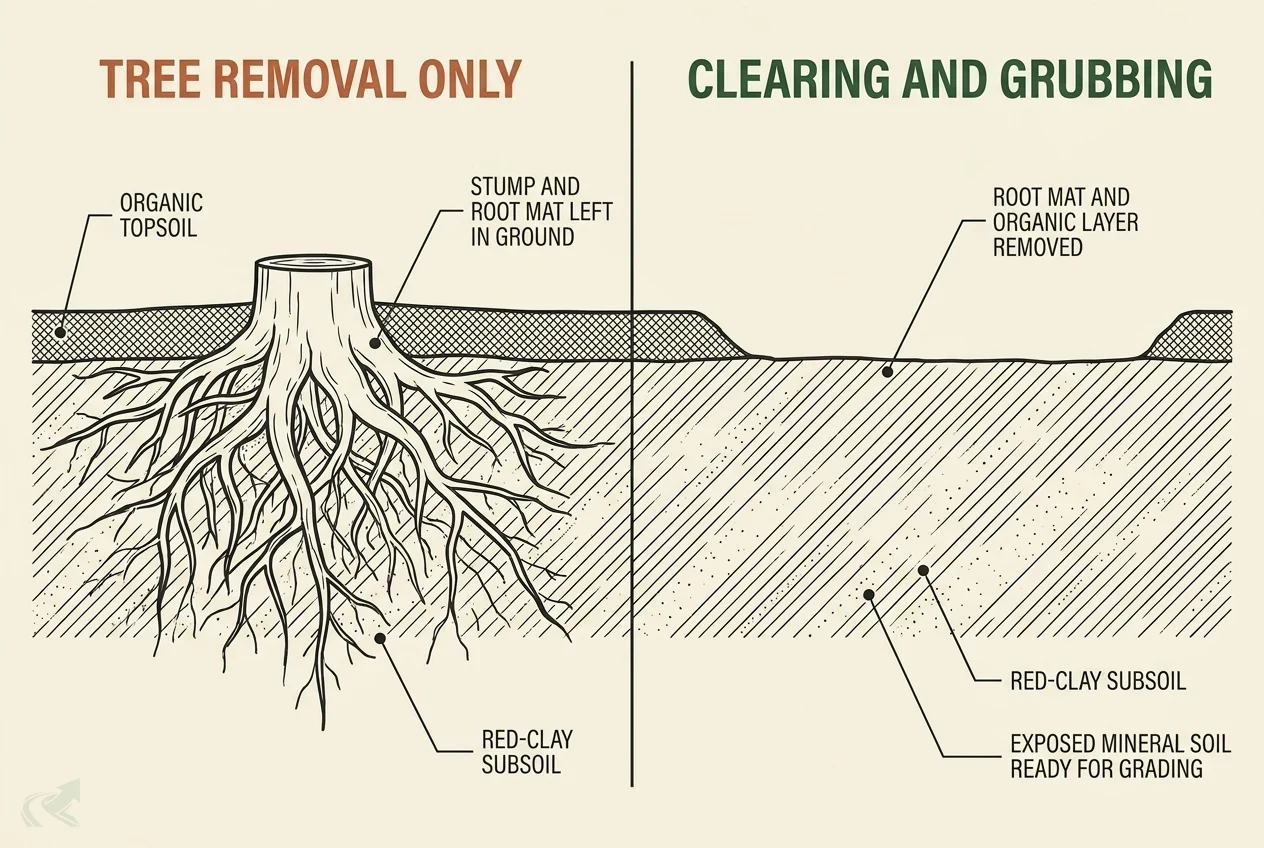
Land clearing covers tree felling, limbing and bucking, brush removal, stump grinding or extraction, grubbing (removing the root mat and organic layer), and debris processing or disposal. A quote that says 'tree removal only' stops above ground -- it does not include stumps or the root layer underneath.
When does NC land clearing trigger an erosion and sediment control permit?
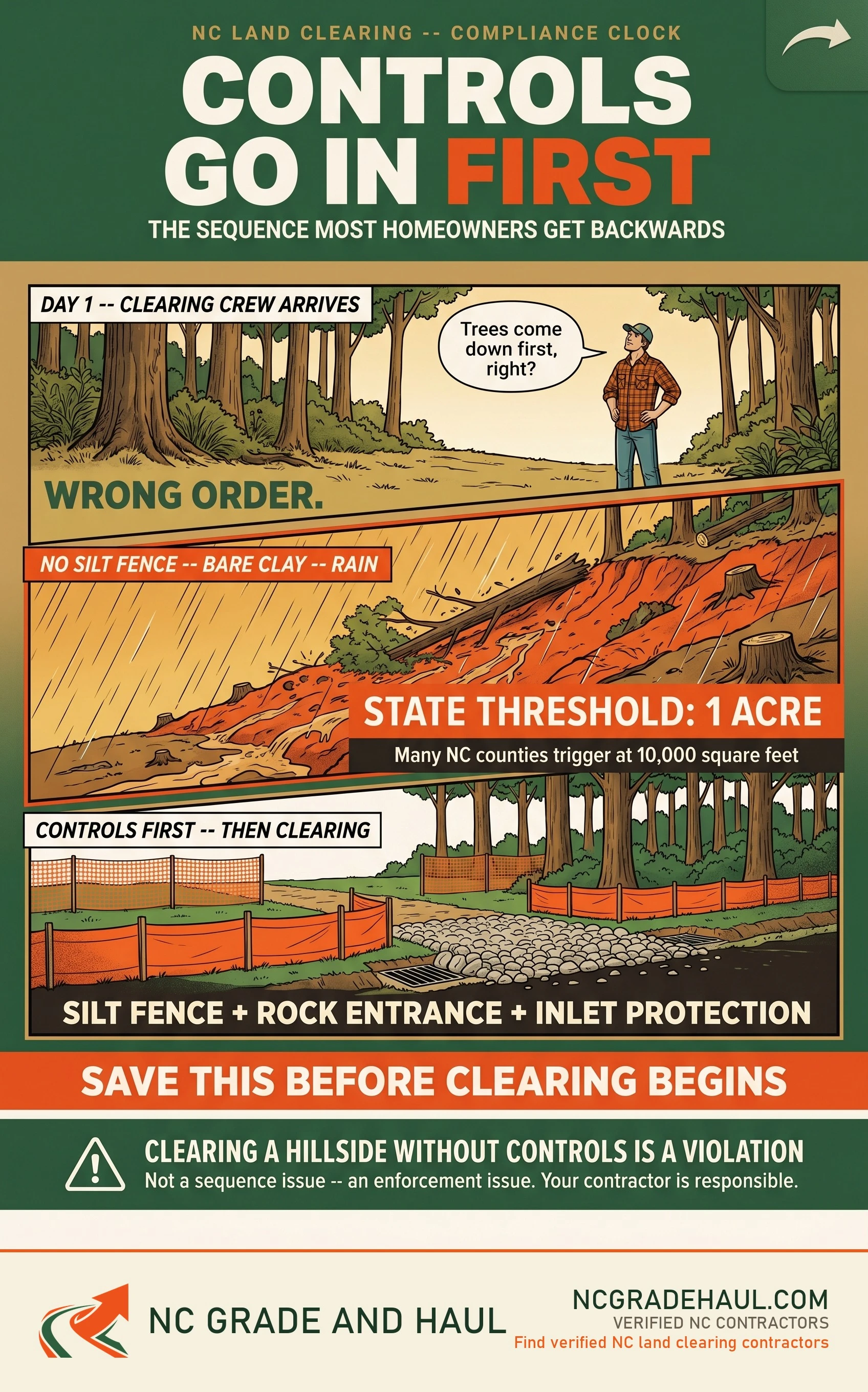
State threshold is 1 acre of land disturbance. Many NC counties set a lower threshold -- often 10,000 square feet. Erosion and sediment controls (silt fence, construction entrance, inlet protection) must be installed BEFORE significant clearing begins, not after. Starting bare-soil clearing without controls in place is a violation.
Ray Pettiford is clearing three acres of mixed hardwood and scrub brush in Guilford County to create a building site. He called three contractors. The first quoted “clearing and grubbing.” The second quoted “tree removal only — stumps extra.” The third quoted “clearing, grubbing, and debris disposal included.”
Same property. Three completely different scopes. Without knowing what each term means, there is no way to compare those quotes or know whether any of them covers what actually needs to happen before a grader can touch the ground.
This page maps the full clearing sequence: what each step covers, what equipment it takes, how debris gets handled, and where the compliance clock starts.
What Land Clearing Actually Covers
Clearing is a sequence — felling, limbing, stump removal, grubbing, and debris — not a single task.
Most scope confusion comes from one word doing too much work. Here is what each step means in practice:
- Felling and limbing — cutting trees at the base, removing branches, bucking the trunk into manageable sections. This is the above-ground work. Any tree-removal quote stops here unless it explicitly says otherwise.
- Brush and scrub removal — cutting and piling or chipping smaller-diameter material, brambles, and undergrowth. Often included in “clearing” but sometimes priced separately on dense sites.
- Stump grinding — a grinder chews the stump to 6-12 inches below grade. Fast, leaves a wood-chip pile, root system stays in the ground. Standard default on most NC residential and light commercial sites.
- Stump extraction — the root ball is dug out and pulled. Slower, heavier equipment, leaves a bigger hole, but removes the entire root mass. Required when grading needs to go deeper than grinding can reach or when the root system would interfere with a foundation.
- Chemical stump treatment — drilling and injecting herbicide to kill the root system in place. Rarely the right call for a construction site — it kills the roots but leaves them to rot underground, which can create voids under a pad or driveway.
- Grubbing — after stumps are handled, the root mat (the dense horizontal root network near grade) and the organic layer (topsoil with embedded organic material) are scraped and removed. This step is mandatory before any structural grading. A grader cannot compact soil over an organic layer and get a stable result.
The “clearing and grubbing” line item is the correct scope for a building-site prep job. “Tree removal only” gets the above-ground material. It does not prepare a site for grading.
Equipment for Different Clearing Scales
The right equipment for the job is driven by acreage, stem density, and what’s being done with the debris.
Matching equipment to scale is not a preference — it is a cost and schedule driver. The wrong equipment on the wrong site size adds days and expense.
- Chainsaw crews — selective clearing, small lots under an acre, or sites with valuable timber to save. Slow per acre, high labor cost, precise. Good for clearing a building envelope without touching the surrounding canopy.
- Skidder and feller-buncher — large-scale clearing (2 acres and up). The feller-buncher cuts and bunches; the skidder drags. Fast per acre, but requires room to maneuver and a place to pile material.
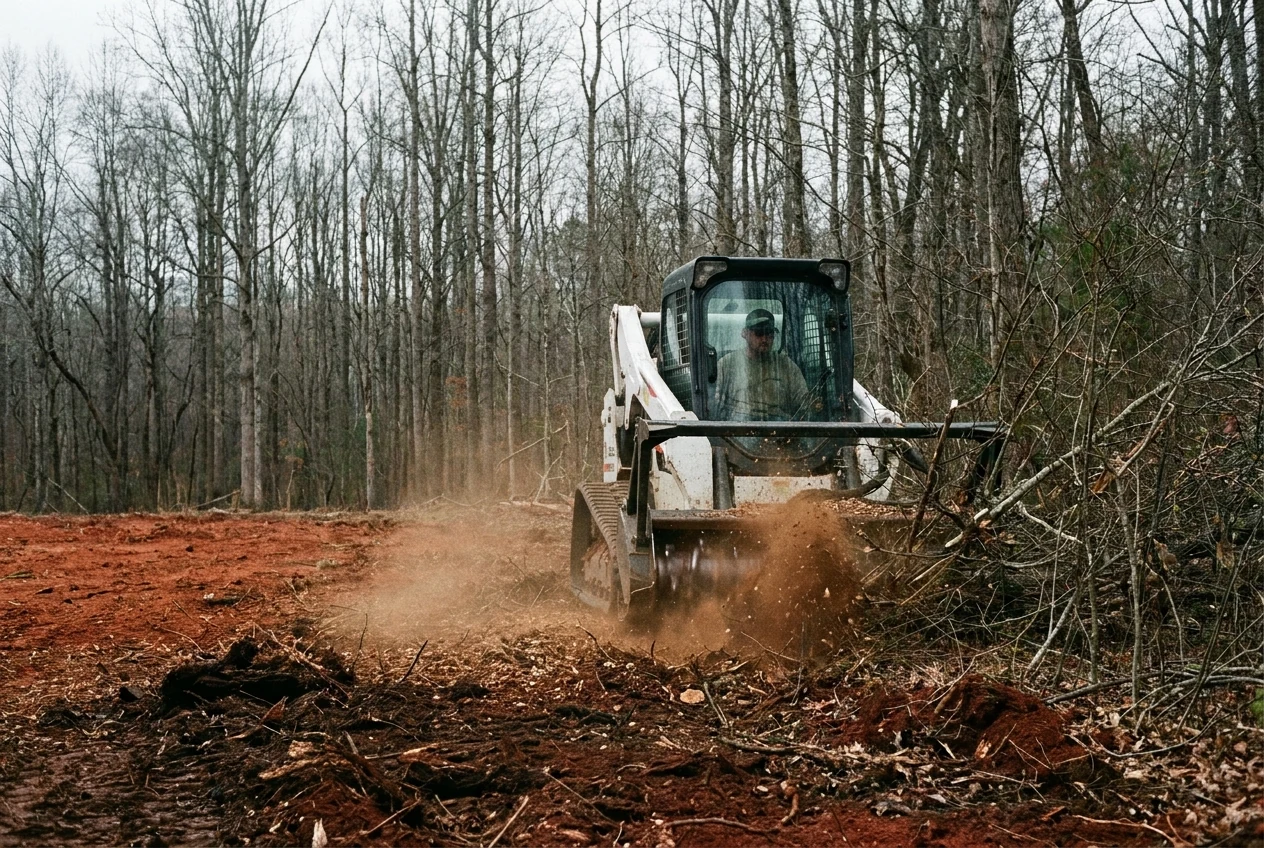
- Forestry mulcher — the most common choice for brush-heavy Piedmont sites. Grinds brush, small trees, and stumps simultaneously into mulch on the ground. No debris to haul off (mulch decomposes in place or gets spread). Efficient for right-of-way clearing, steep slopes, and sites where hauling is expensive.
- Bulldozer with rake or root rake — for grubbing after felling. Strips the root mat and organic layer, pushes it to a pile or windrow for burning or hauling.
Typical NC clearing costs range from roughly $1,500-$3,000 per acre for light brush via mulcher to $3,000-$6,000 per acre for heavy timber with stump extraction — costs vary by Piedmont region market, access, and debris disposal method. Get at least two itemized quotes before accepting any single number.
Debris Disposal Options
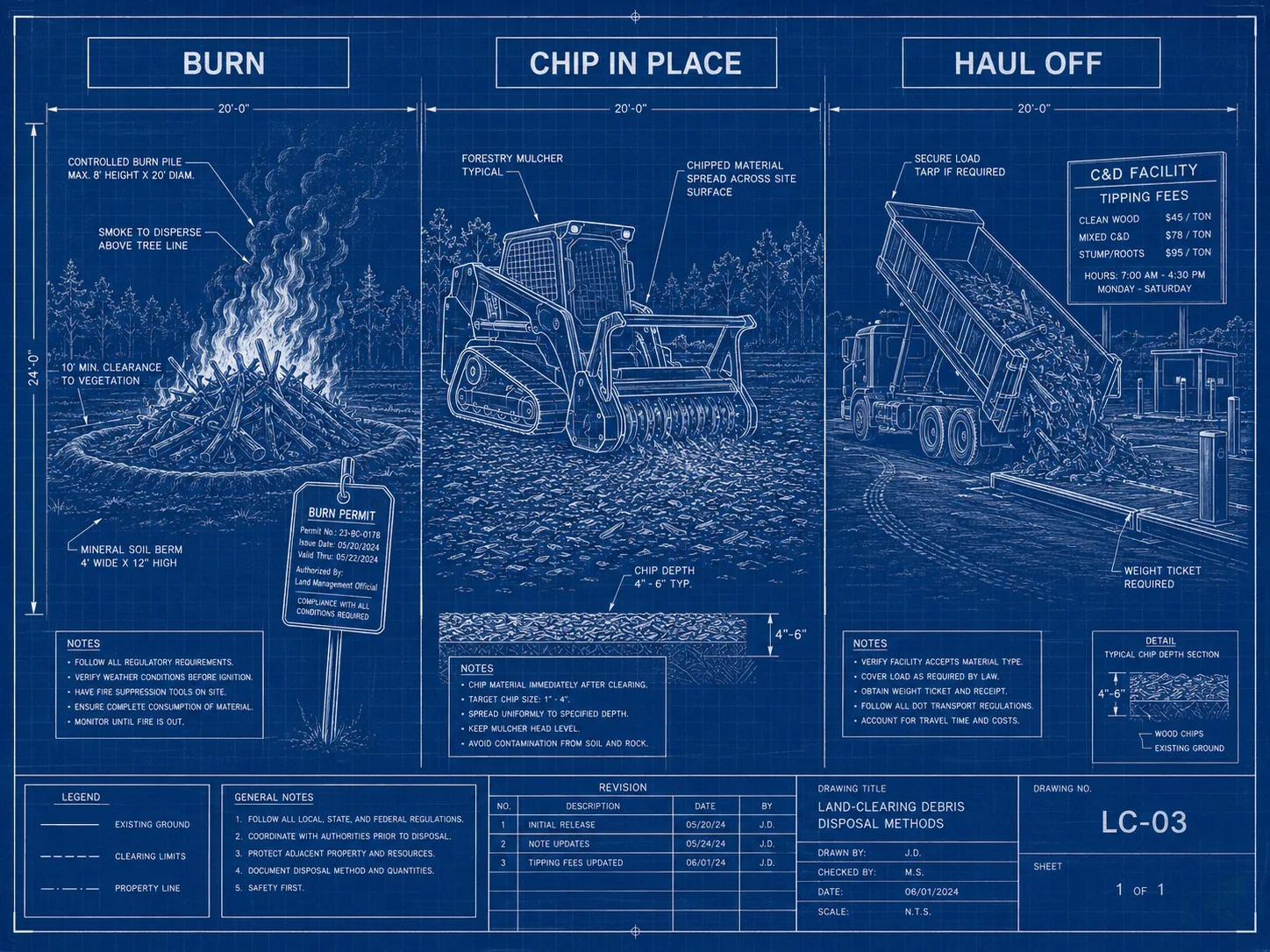
Three options: burn, chip and mulch in place, or haul off. Each has different costs, rules, and site implications.
The debris disposal decision affects schedule, cost, and whether the site stays clean during clearing. It should be named as a line item in any clearing quote.
- Burn (with permit) — North Carolina allows open burning of land-clearing debris under a permit issued by the county or NC Forest Service. Restricted during drought conditions and prohibited within certain distances of occupied structures. The site must be monitored. Fast and lowest-cost for rural properties with enough clearance, but not available everywhere. Verify permit availability before counting on it.
- Chip and mulch on-site — a tub grinder or forestry mulcher processes trees and brush into chips spread across the cleared area. No haul-out required. Works well when the site will be regraded anyway (chips get blended into the soil amendment or stripped off in the grubbing pass). Does not work for root balls and stumps, which need separate handling.
- Haul off to C&D facility or recycler — clean wood debris often goes to a chipping or mulch recycler at low or no cost. Mixed debris (wood with soil, concrete, or other material) goes to a C&D landfill with a per-ton tipping fee. That fee passes through to the quote. Ask whether haul-out fees are included or are estimated and billed actual. See land-clearing debris disposal in NC for the full breakdown.
When Clearing Triggers E&S Compliance
The state threshold is 1 acre. Many NC counties set a lower bar — sometimes as low as 10,000 square feet.
North Carolina’s Construction General Permit applies to any land disturbance of 1 acre or more. The permit requires:
- Filing an eNOI (electronic Notice of Intent) through NCDEQ’s AccessDEQ portal before disturbance begins
- Receiving a Certificate of Coverage confirming the site is covered
- Implementing a Sediment and Erosion Control Plan before clearing starts
- Filing an eNOT (electronic Notice of Termination) after stabilization is complete
Source: NCDEQ Stormwater Program
“Before clearing starts” is load-bearing language. The plan is not filed after the trees come down. Silt fence, rock construction entrances, and inlet protection go in before the clearing crew starts. A site that clears a hillside and then installs erosion controls is already in violation.
County thresholds are often stricter than the state threshold. Many NC counties require a local land-disturbance permit at 10,000 square feet — well under the one-acre state trigger. Some counties require it at any disturbance involving a grading plan. County rules apply in addition to, not instead of, the state permit.
See NC land-disturbance thresholds that trigger compliance for county-by-county specifics, and NC Sedimentation Pollution Control Act for land clearing for the statutory background.
For North Carolina clearing that’s part of a larger grading job, the erosion control hub at erosion control triggered by NC land clearing has the full plan-review and permit-sequence detail.
Common mistake: Starting clearing before E&S controls are installed. Clearing a hillside before silt fence is up is a violation, not just a sequence issue. The grading contractor is responsible for installing controls before the first tree comes down on a permitted site.

Stump Removal — Grind vs Dig
Grinding is the default for most NC sites. Extraction is the right call when grade change or foundation work requires full root mass removal.
Stump grinding leaves the root system in place, which is fine for a yard that will be seeded or landscaped. It is not fine for a structural pad, a driveway base, or any application where roots will continue to decay underground and create voids.
The decision tree for most North Carolina clearing jobs:
- Yard / landscaping use — grinding to 6-10 inches below grade is adequate. Chips decompose, root system stabilizes.
- Graded driveway or gravel pad — grinding to 12 inches minimum, or extraction for stumps larger than 12 inches diameter. Root decay timelines in Piedmont clay are long; voids show up in year two.
- Building foundation area — extraction required. The structural engineer’s spec governs; don’t substitute grinding without sign-off.
For the full grinding-vs-extraction decision and what to ask when getting stump quotes, see stump removal for NC land clearing.
Getting a Quote That Covers the Full Scope
A complete clearing quote names every phase as a line item. If stumps and debris aren’t listed, assume they’re not included.
The scope confusion in the three-quote scenario at the top of this page is predictable. Contractors who quote “clearing” often mean different things — some include grubbing, some don’t; some include stump grinding, some don’t; some include debris disposal, some assume burn permit.
Here is what a complete itemized quote for a building-site clearing job should include:
- Tree felling and limbing — above-ground material removed
- Stump removal method named — grinding (to what depth) or extraction
- Grubbing — root mat and organic layer stripped to mineral soil
- Debris disposal method named — burn (with permit), chip in place, or haul off with tipping fees specified
- E&S controls — who installs, when (before clearing or concurrent), and what’s included (silt fence, construction entrance, inlet protection)
- Exclusions stated — what the quote does NOT include, so there are no surprises
Use this checklist when reviewing quotes:
Clearing Quote Checklist Does this quote include:
- Tree felling and limbing?
- Stump removal (grinding or extraction — which method and to what depth)?
- Grubbing (root mat and organic layer removal)?
- Debris disposal (burn / chip / haul — method named, fees itemized)?
- E&S controls (what controls, installed before clearing begins)?
- What is explicitly excluded?
A contractor who can answer every item without hedging is describing a real scope. A contractor who says “we’ll figure it out when we see it” is writing you a blank check.
Hire a grading operator in North Carolina who can quote the full clearing scope — felling, stump removal, grubbing, and debris — as separate line items.