On a sloped North Carolina construction site, you have two erosion problems — not one. You have sediment moving on the slope, and you have sediment that arrives at the property line. Silt fence handles the second problem. Straw wattles handle the first.
Most homeowners who ask about erosion control have only seen silt fence. It is the orange-staked fabric along the street edge. They assume it handles everything. On a flat site with gentle grades, it mostly does. On a sloped site with NC Piedmont clay, it does not.
This page explains straw wattles in the NC erosion control system, why they outperform silt fence on slopes, how they are installed, and how the two controls work together.
What Straw Wattles Are
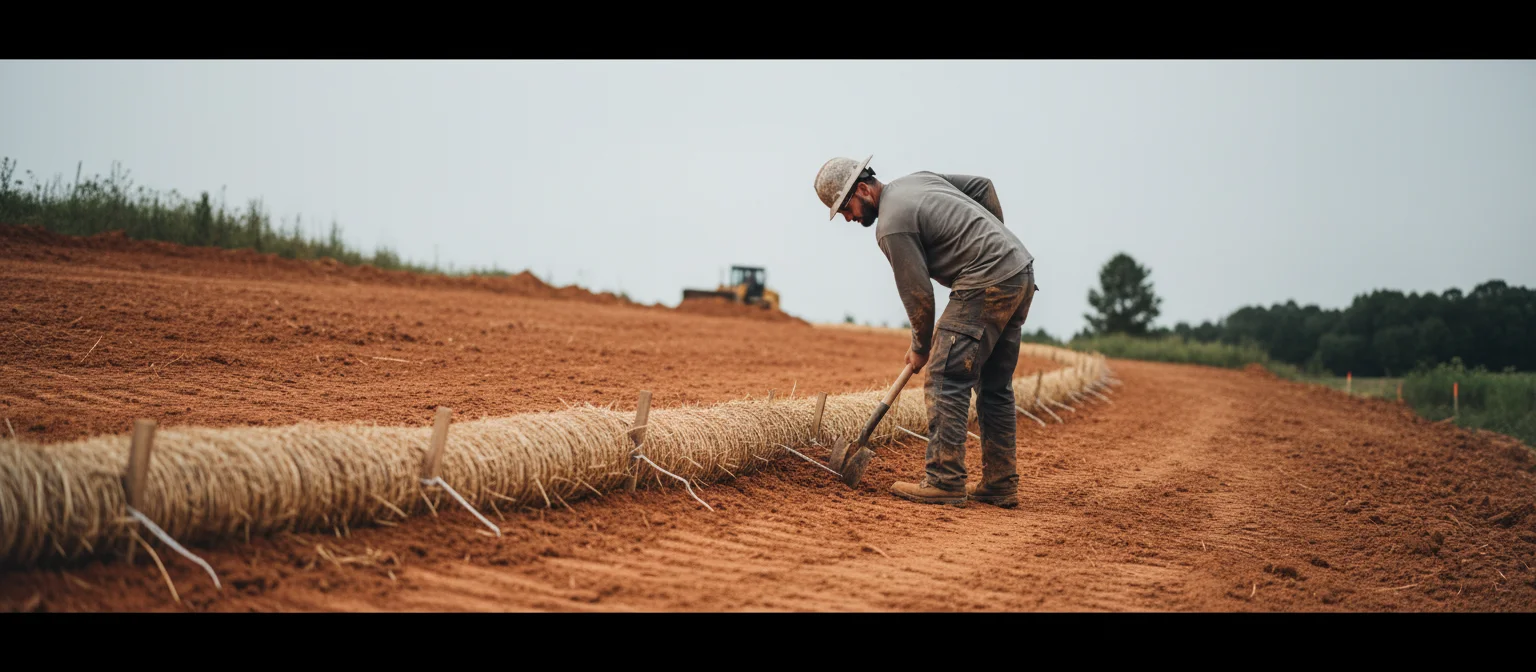
A straw wattle is a straw-filled mesh tube, roughly 9 to 12 inches in diameter, staked horizontally across a slope to intercept sheet flow before it becomes concentrated runoff.
The tube itself is made of biodegradable netting — polypropylene or natural jute — packed with wheat straw or other fibrous material. You install it lying flat on the ground, perpendicular to the direction the slope runs. Water hits the wattle, slows down, and drops the sediment it is carrying before moving on.
That velocity-reduction step is what makes wattles useful on slopes. Without it, sheet flow across Piedmont red clay accelerates until it becomes a concentrated flow channel — the kind that cuts a rut down a slope and delivers a sediment load directly to the downhill drainage system.
A related control is the erosion control blanket — woven fabric or straw matting that gets stapled flat to the slope surface itself. Blankets armor the soil surface against raindrop splash. Wattles intercept water in motion. Both are legitimate E&S controls; they address different parts of the erosion problem and are sometimes used together.
Why Wattles Work Better Than Silt Fence on Slopes
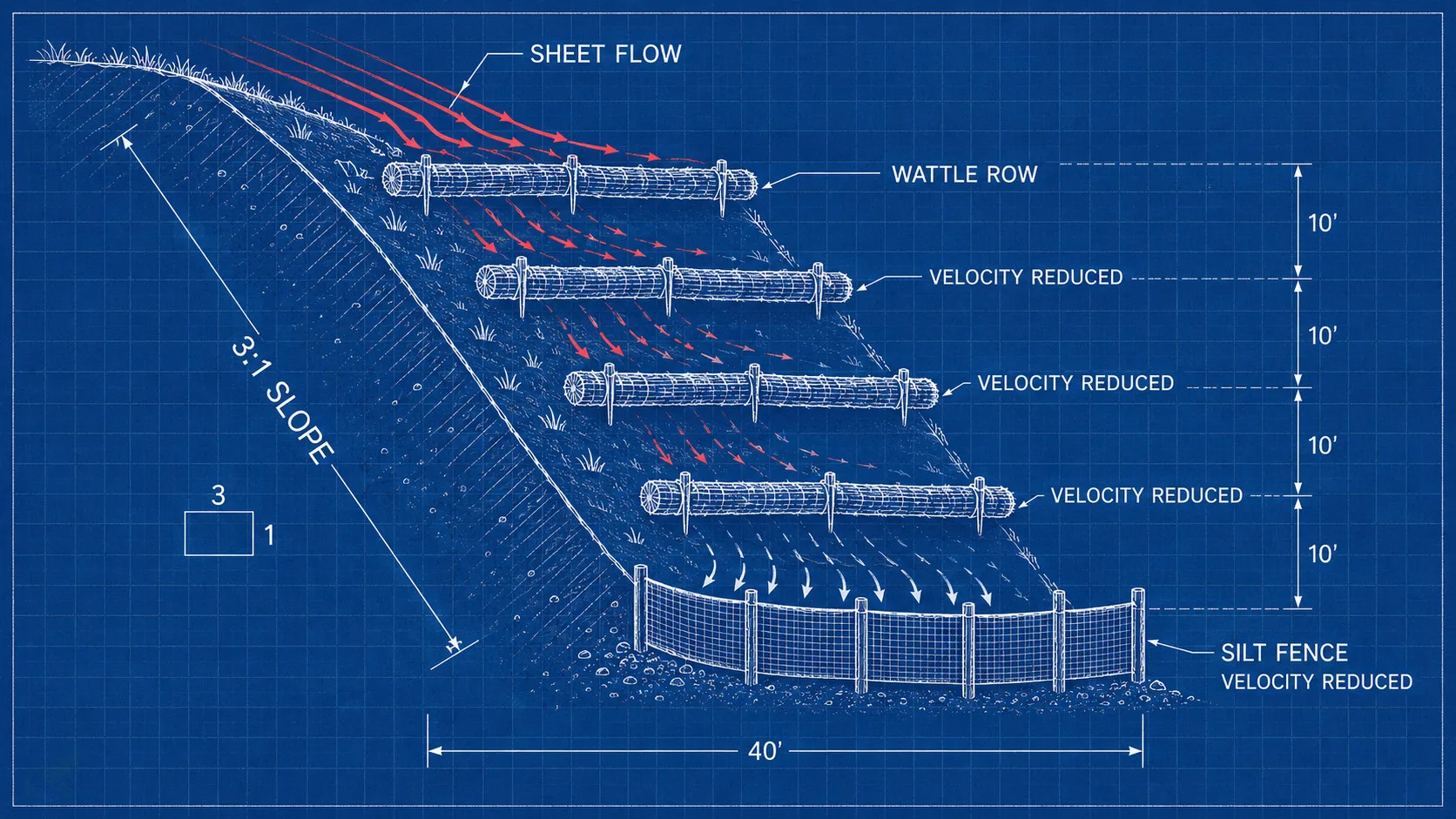
On slopes steeper than 3:1, straw wattles reduce erosion where it starts — on the slope itself — which silt fence cannot do.
Silt fence has a structural limitation on steep slopes. It is designed to work as a sediment basin at a site perimeter: water moves past it, silt drops out, cleaner water passes through. But on a slope, sheet flow does not spread evenly. It concentrates at low points. When concentrated flow hits a silt fence, the velocity is high enough to punch through or undercut the fabric. The silt fence fails precisely where the water is strongest.
Wattles interrupt this process earlier. Installed horizontally across the slope on contour lines, they break up sheet flow before it can concentrate. Water arrives at the wattle with low velocity, drops its sediment load, then moves as thin sheet flow to the next wattle downslope. The slope never lets runoff accelerate to the point where it becomes destructive.
The 3:1 slope ratio is the practical trigger for adding wattles. A 3:1 slope means 1 foot of vertical drop for every 3 feet of horizontal run — roughly 18 degrees. Below that ratio, silt fence alone is generally adequate if installed and maintained correctly. At 3:1 or steeper, the NC Erosion and Sediment Control Planning and Design Manual documents wattle installation as an appropriate supplementary control for slope protection.
For context, most residential sites in the NC Piedmont have some slopes in the 2:1 to 4:1 range. Lot grading and cut slopes from road construction are common 3:1 territory. Straw wattles vs silt fence NC covers the comparison in more depth.
NC Clay Runoff Behavior on Slopes
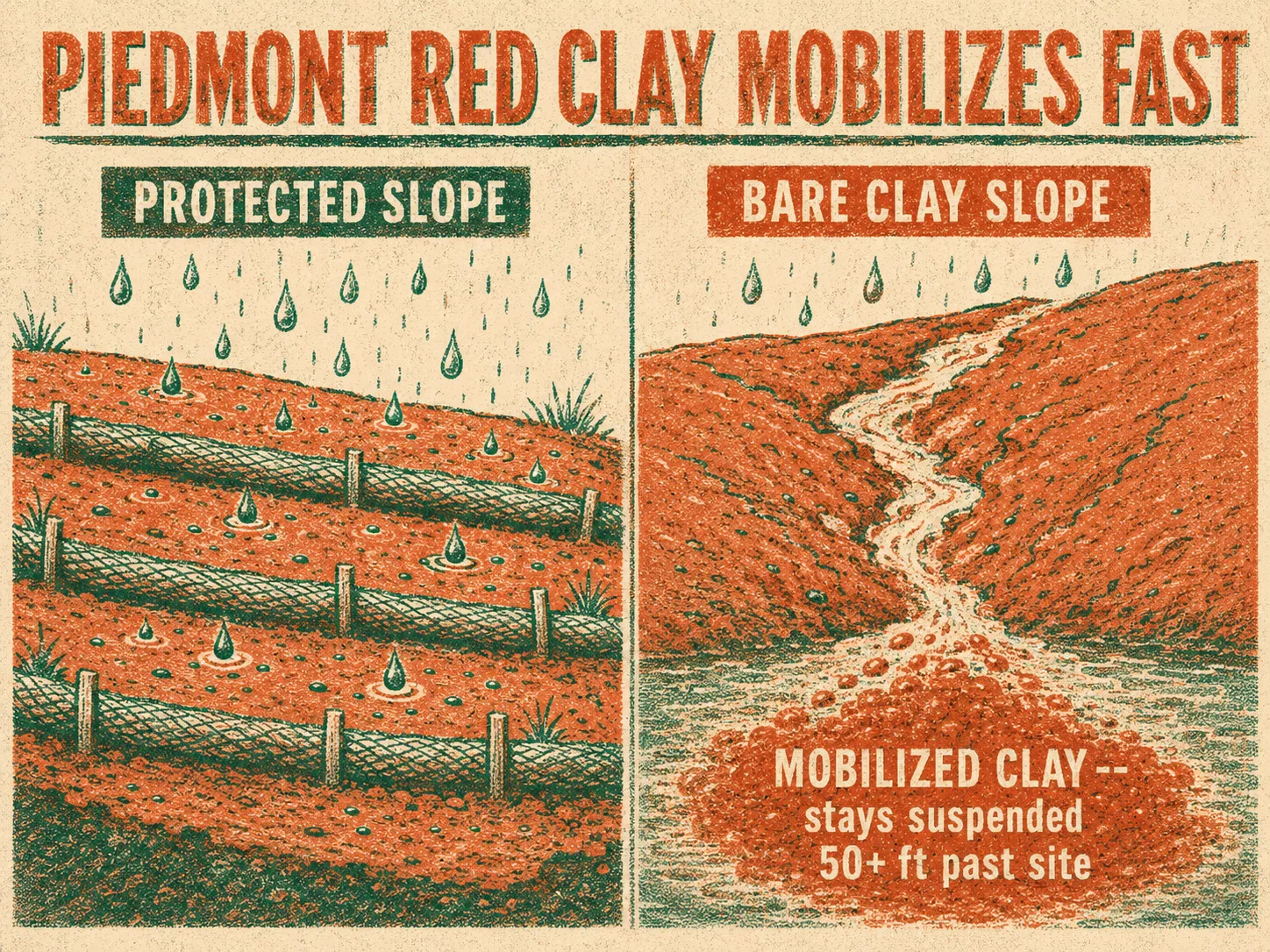
Piedmont red clay mobilizes fast and travels far once it is in motion — which is why stopping it on the slope matters more than catching it at the perimeter.
NC Piedmont clay is a high-plasticity soil. Individual clay particles are fine enough to stay suspended in slow-moving water long after heavier silt particles have settled. Once mobilized, clay-laden runoff can travel well past the site boundary and still look turbid 50 feet from where the slope ended.
The mobilization threshold is low. Even moderate rainfall on a bare, unprotected clay slope in North Carolina generates meaningful sheet flow within the first few minutes. As slope steepness increases, so does runoff velocity and the rate at which particles are lifted off the surface.
This is why the E&S control logic for sloped NC clay sites is not “install better silt fence at the bottom.” It is “don’t let clay particles move in the first place.” Wattles accomplish this by forcing water to slow down and drop its load before it can gain velocity. The slope stays intact. The sediment stays on the site. The silt fence at the toe captures whatever makes it through.
Clay behavior on slopes is also why storm events immediately after grading are the highest-risk window. Freshly disturbed clay on a site after land clearing has no root structure, no organic mat, no surface crust — just bare particles waiting to be mobilized. Wattles installed before the next rain event is the right sequence, not after.
Installation — Horizontal Contour Placement
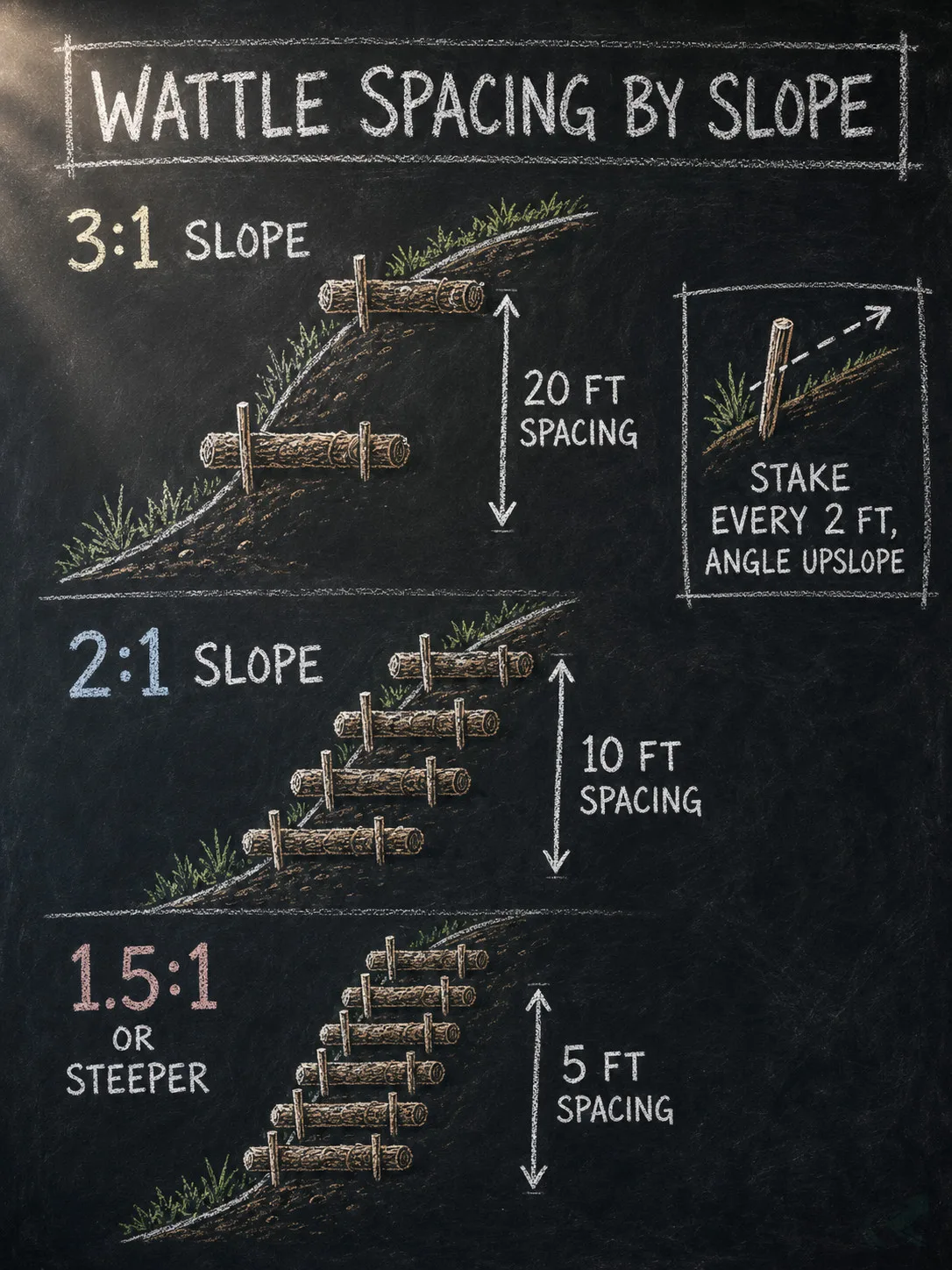
Install straw wattles perpendicular to the slope direction, running along the contour lines, at spacing that matches the slope steepness.
Contour placement is the most critical installation detail. A wattle installed diagonal to the contour will channel water toward its low end rather than slowing it across the full slope width. The wattle must be level along its length — perpendicular to the fall line — so water hits it evenly and cannot route around a low corner.
The table below shows recommended spacing by slope ratio based on NC E&S planning guidance. Tighter slopes need closer spacing because water gains velocity faster:
| Slope ratio | Recommended wattle spacing |
|---|---|
| 3:1 (18 degrees) | 20 feet apart on slope |
| 2:1 (27 degrees) | 10 feet apart on slope |
| 1.5:1 or steeper | 5 feet apart on slope |
Staking procedure: drive wooden stakes through the wattle body into the soil at roughly 2-foot intervals along the wattle length. Stakes should angle slightly upslope (leaning into the slope) to resist the hydraulic load from runoff pressing against the wattle. Minimum 8-inch stake penetration in loose disturbed soils; 6 inches is sufficient in more consolidated subgrade.
At wattle ends, overlap adjacent wattle sections by 6 inches minimum to prevent flow from bypassing the ends. Ends that terminate at a slope edge (rather than another wattle) should be turned upslope 12 to 18 inches to form a hook — this prevents concentrated end-around flow from cutting a channel at the wattle terminus.
Straw wattles are the most common type in North Carolina residential and commercial E&S work. Coir fiber wattles (made from coconut fiber) are a higher-durability alternative. Coir resists decomposition longer, which matters when the slope will remain unvegetated for an extended period — more than one growing season. Coir wattles cost more per linear foot but do not need replacement on longer projects.
Wattles and Silt Fence as a Paired System
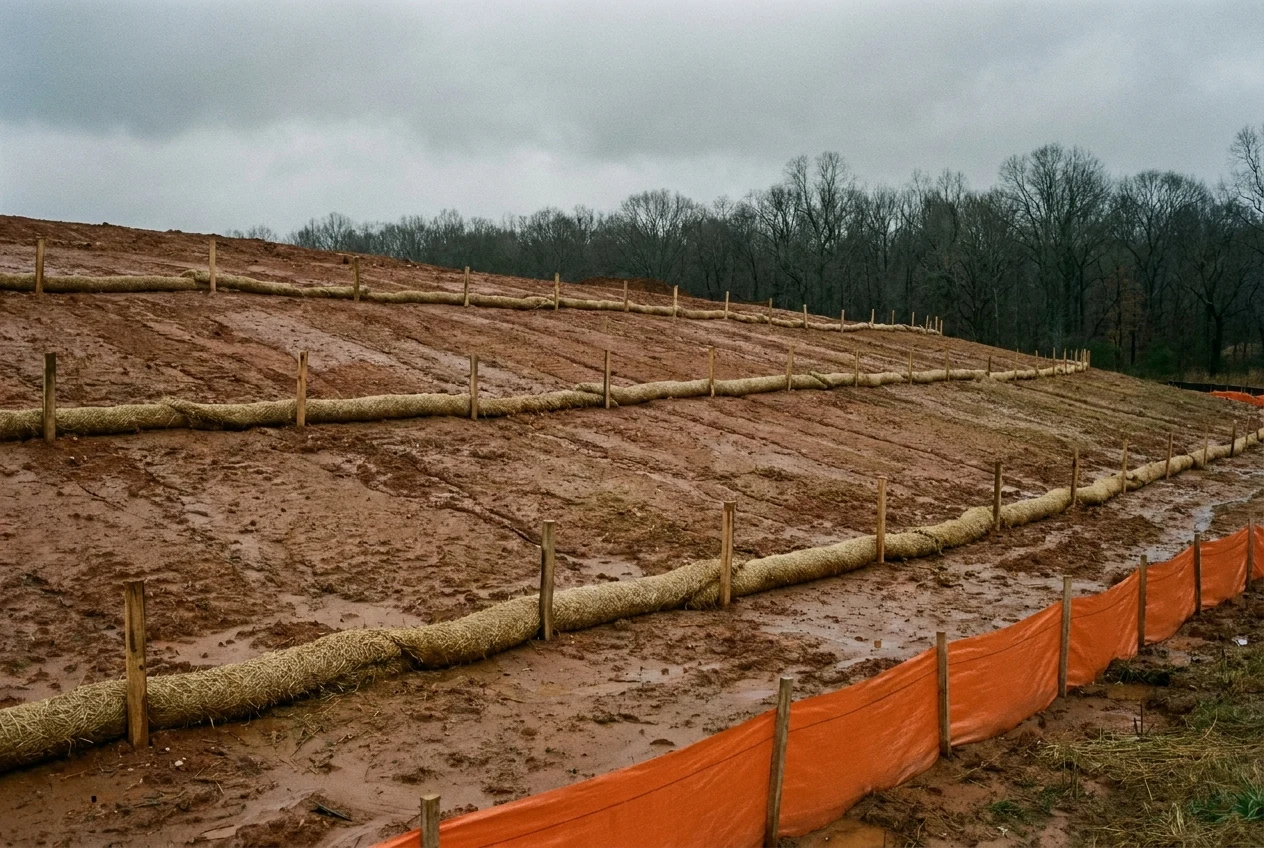
The standard North Carolina approach on sloped sites uses both: wattles on the slope for velocity reduction, silt fence at the slope toe for sediment capture.
These two controls are not alternatives — they are layers. Wattles reduce the sediment load arriving at the silt fence. Silt fence captures the residual sediment that makes it downslope despite the wattles. When one is missing, the other is carrying the full load it was never designed to handle alone.
On a properly controlled sloped site in North Carolina, the E&S plan typically shows both. Wattles at the spacing intervals dictated by slope ratio, running across the disturbed slope area. Silt fence at the perimeter — downslope edge, street edge, drainage inlet protection. The NC erosion law and straw wattle requirements describe the regulatory framework that makes both required controls on sites above the NC land-disturbance threshold.
The combination also makes the silt fence more effective. A silt fence downslope of properly spaced wattles receives cleaner, slower water than one receiving direct concentrated flow from a bare slope. Maintenance intervals are longer. The likelihood of undercutting or blowout is lower.
Site Check Checklist
Copy and use on your next pre-rain site walk:
Straw wattle site check: Slope steeper than 3:1? Install wattles perpendicular to slope on contour lines. Space at 20 ft for 3:1 slopes, 10 ft for 2:1 slopes, 5 ft for slopes steeper than 1.5:1. Stakes at 2-foot intervals through wattle body, angled upslope. Overlap ends 6 inches minimum. Combine with silt fence at slope toe.
Find a Verified NC Contractor for Slope E&S Work
Straw wattles look simple. The installation spacing, contour alignment, and stake angle are not. Misaligned wattles channel flow instead of breaking it up — the same failure mode as a broken silt fence, just further upslope.
If your site has slopes at 3:1 or steeper and you are starting to see rills forming between wattle rows, the spacing is probably wrong. That is not a materials problem — it is a layout problem.
Find a grading contractor in North Carolina who carries E&S experience and can walk your slope, assess what’s installed, and give you an itemized quote for corrective work or a new installation before the next storm event.