
What homeowners are asking
What does 'seed-ready' finish grade mean in NC clay?
Seed-ready in NC clay means: correct final slope for drainage (minimum 2% away from structures), top 4-6 inches loosened to allow root penetration, no clay crust on the surface, and timing that allows seeding before the surface re-compacts from rain. If the finish grade was smoothed with a blade on wet clay and then immediately seeded, it probably was not ready.
Why won't grass grow after my yard was finish graded?
Four causes account for most NC turf failures after grading: a clay crust sealed the surface before germination, the slope was too flat and water pooled, the contractor seeded immediately after grading wet clay before it was workable, or the surface was never loosened below 1-2 inches. The grade can look perfect and still fail all four tests.
The sod was installed. The grade looked flat and smooth. Six weeks later, the grass is patchy, thin, and dying in sheets along the low spots. The contractor says it was installed correctly.
In North Carolina red clay, that story is common. The problem usually isn’t the sod or the seed — it’s what the finish grade actually was, versus what seed-ready actually requires.
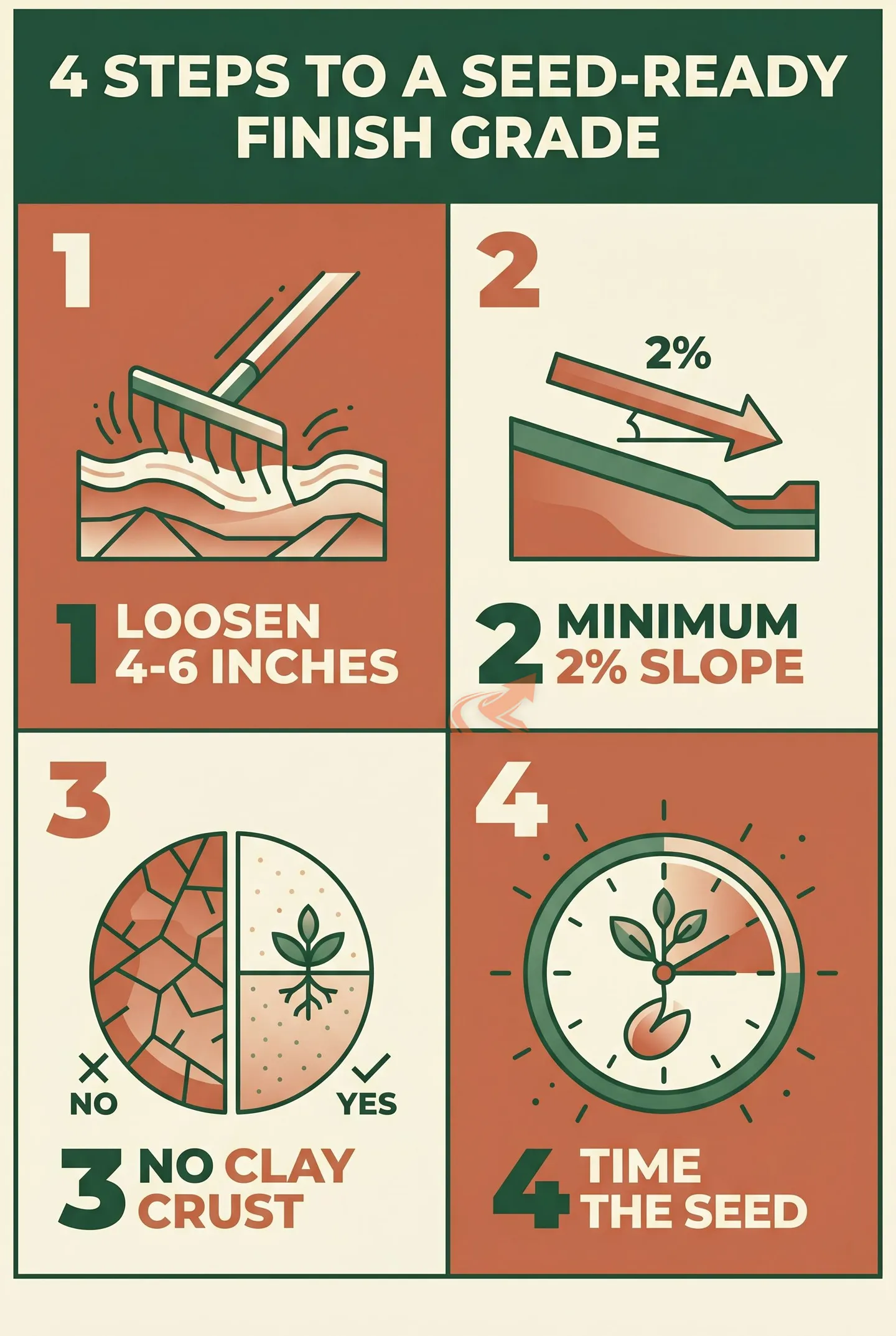
What Finish Grade for Turf Actually Includes
Finish grading for turf is not the same as finish grading for concrete or drainage — the surface preparation requirements are different.
A pad or driveway finish grade — building pad preparation in NC — needs flatness and slope. That’s it. Turf finish grade adds three more requirements: surface loosening to 4-6 inches depth, debris removal (rocks and clods larger than 1 inch interfere with seed-to-soil contact), and an assessment of whether the clay surface needs amendment before seeding.
Slope tolerance for turf is also tighter. Contractor quotes that describe “finish grading” without specifying the turf standard are describing a pad-grade, not a seed-ready grade. They are not the same scope.
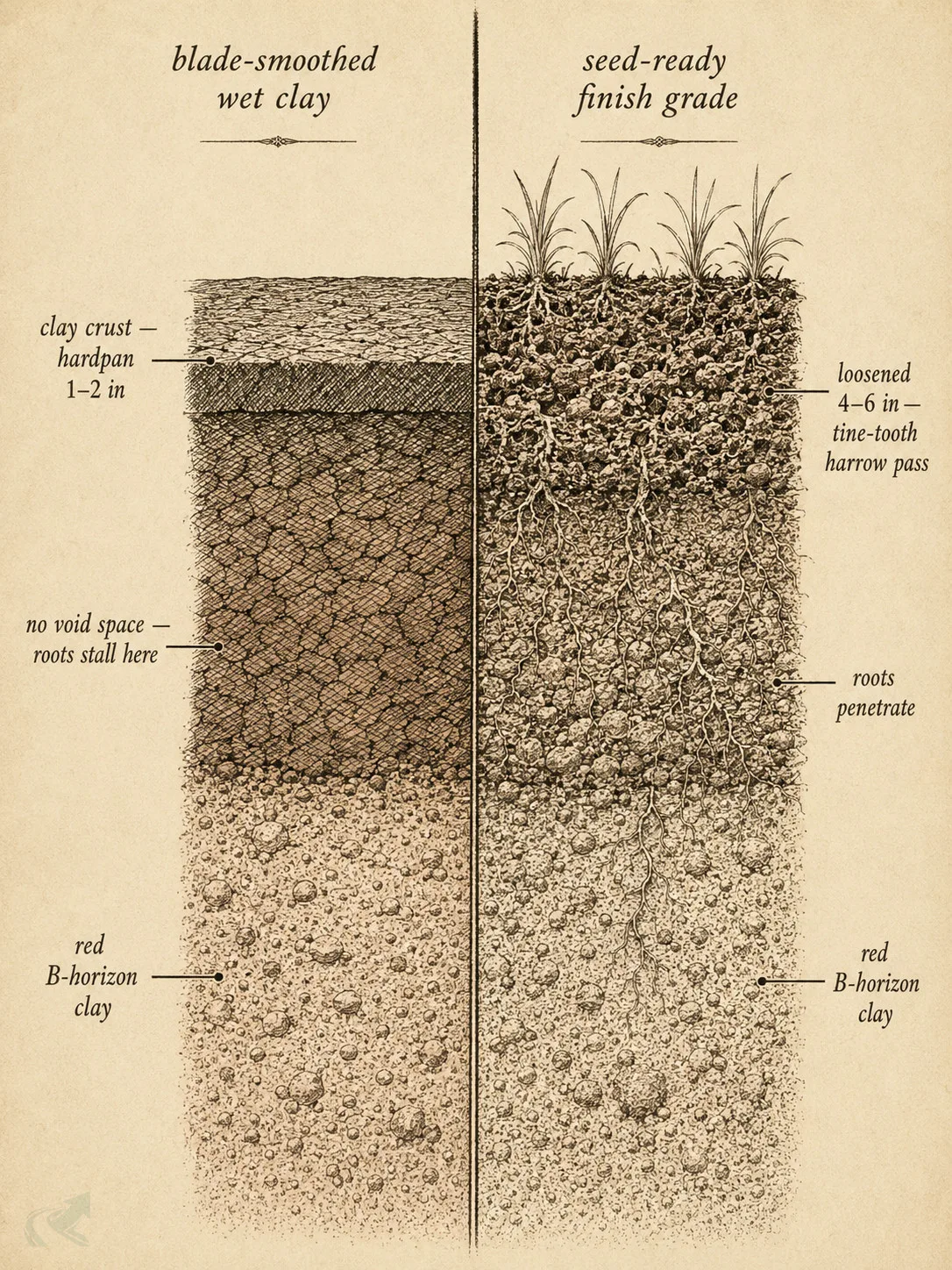
Surface loosening matters because grass roots cannot penetrate compacted clay. A box blade run over wet Piedmont clay seals and compresses the top inch. The surface looks smooth. It is not workable. Roots stall at the surface and the turf fails.
If you had rough grading before seed-ready finish grade — typical after new construction — confirm with the contractor what the finish grade scope included. “Finish graded” on an invoice does not mean seed-ready.
The 2% Slope Rule for Turf Areas
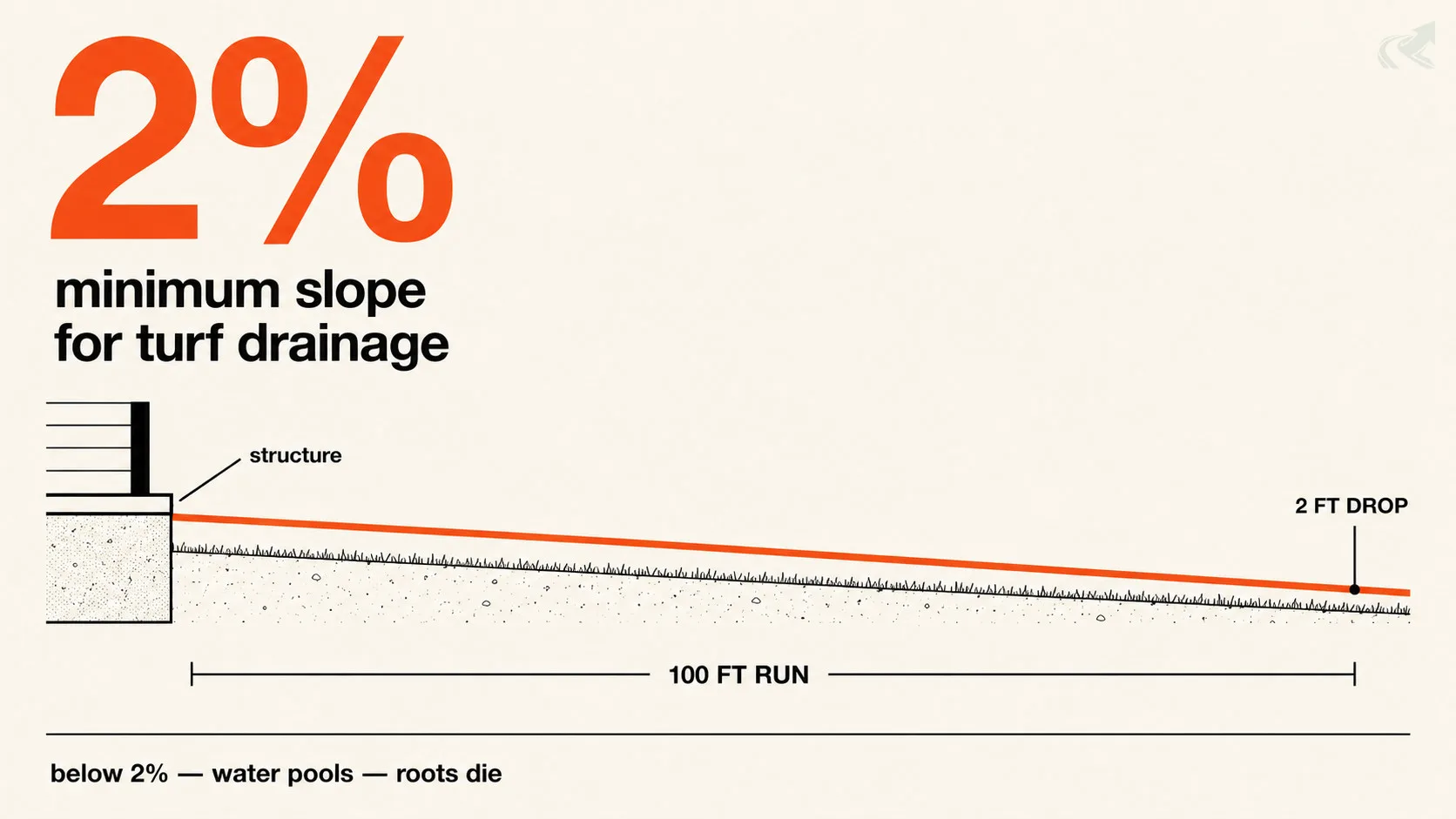
The minimum slope for turf drainage is 2% away from structures — that is 2 feet of drop per 100 feet of run.
Flat is wrong. A yard that looks level to the eye may be at 0.5% to 1% slope — not enough for North Carolina rainfall events to drain. Water that cannot drain pools. Pooling water promotes fungal disease, drowns root systems, and creates the muddy bare patches that look like a turf installation failure.
The 2% minimum applies to finish grade, not rough grade. Rough grade tolerances are wider. Many NC contractors apply rough-grade tolerances to what they call a finish grade — warning signs in a grading bid like this are why the yard drains and the sod fails.
This is also how hardscape grade differs from turf grade. Concrete and pavers can drain at 1% because the surface itself is impermeable — water moves across it. Turf absorbs some rainfall and must shed the rest. At less than 2%, it cannot shed fast enough in a Piedmont summer storm.
A yard that needs slope correction before seeding is a yard regrading to achieve a seed-ready grade job, not just a finish grade.
NC Clay’s Turf Problem
That’s not how it works in NC clay — the Piedmont surface behaves differently from the generic finish grade instructions.
Most finish grading advice describes sandy loam or mixed native soil. In that context, running a blade over the surface and raking it smooth produces a workable seedbed. The soil has enough structure and void space to support germination.
Piedmont red clay is different. When clay-fraction soils are worked at the wrong moisture content — too wet or too dry — the surface fines re-arrange and seal. A contractor who blades a wet clay yard smooth creates what is effectively a hardpan in the top 1-2 inches. The surface looks finished. The seed bed is not there.
The clay crust problem also goes the other direction. NC red clay dries fast in summer sun. A surface that was workable in the morning can be approaching concrete hardness by afternoon. Seed cast on a surface that crusts before germination cannot establish root contact.
The fix is surface loosening — typically a tine-tooth harrow pass or a Harley rake running 3-4 inches deep — after any blade work. This breaks up the sealed surface and creates the loose, slightly rough seedbed that grass needs.
Piedmont red clay challenges for seed-ready grading covers the soil science in more detail. The short version: if the surface is visibly smooth and sealed after finish grading in NC clay, it is not seed-ready.
Timing — When to Seed or Sod After Grading
The window between finish grade and seeding matters — seed too soon after grading wet clay and the surface is not ready; wait too long and it re-seals.
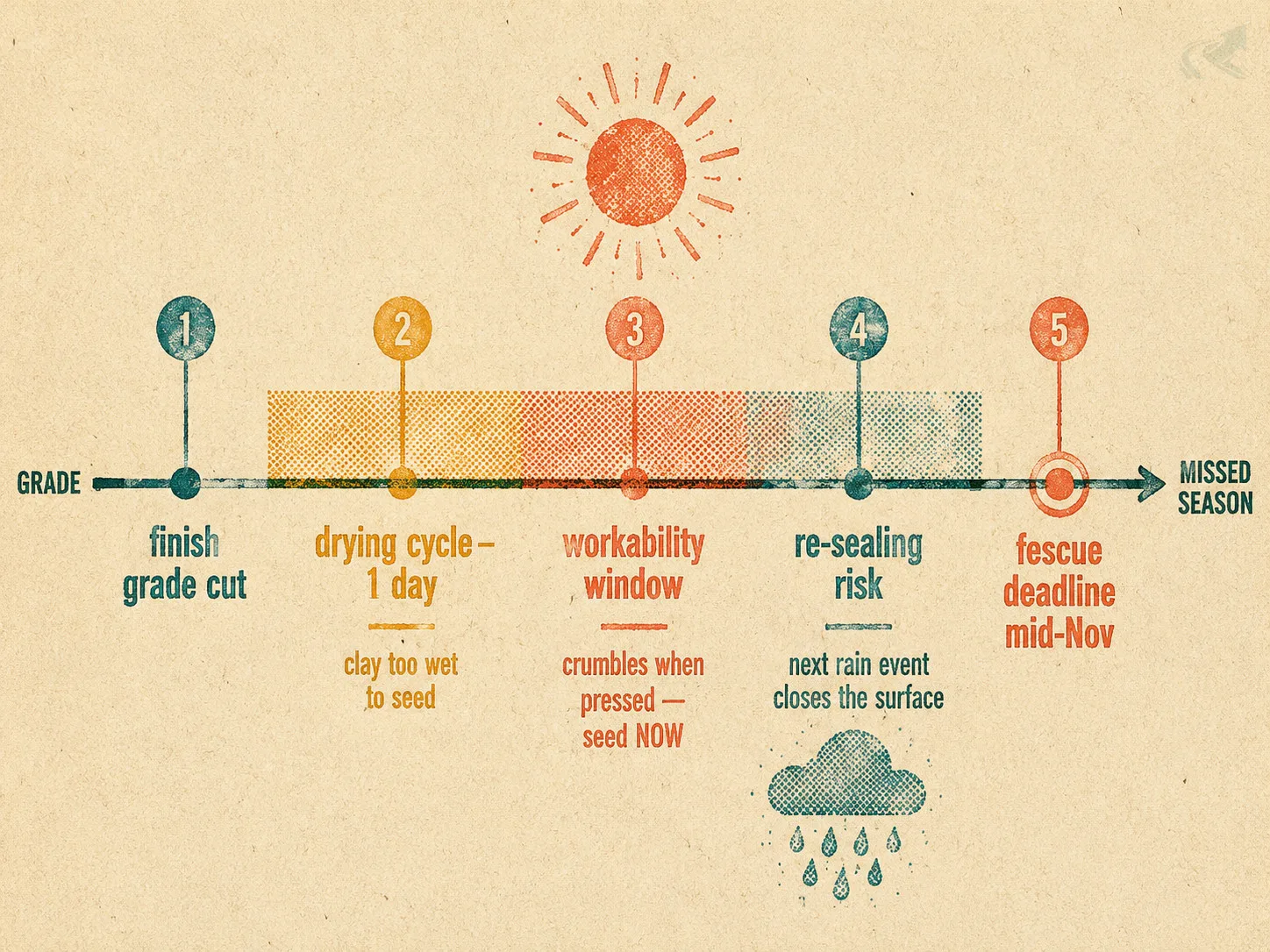
NC red clay goes through a workability window. Right after grading, the surface is loose and workable — but if the grade was cut on wet clay, it needs to dry to the right moisture before seeding. That typically means waiting for one drying cycle, checking that the surface crumbles slightly when pressed, and then seeding before the next significant rain event.
If rain follows immediately after seeding on a freshly blade-smoothed clay surface, the rain impacts seal the surface again before the seed germinates. Germination requires seed-to-soil contact and surface moisture, not a waterproof clay cap.
Sod timing has the same constraint on the surface, but adds a rooting window requirement. Sod needs to root within 10-14 days of installation or it desiccates. Sod installed on a compacted clay surface cannot root through the crust. The sod stays green for two weeks on stored energy, then dies.
For NC fall seedings (fescue, October-November), the timing window also needs to land roots before first frost. A delayed or re-worked finish grade that pushes seeding past mid-November — a risk tied to where grading fits in the NC build sequence — is a missed-season situation in the Piedmont.
Ask the contractor for the timing plan before work starts — not after the seed is down.
Why Grass Fails After Finish Grading That Looked Perfect
Four failure causes account for nearly every NC turf failure after finish grading. The grade looked right every time.
A seed-ready finish grade vs a blade-smoothed clay crust
Comparison. Seed-ready surface: Top 4-6 inches loosened, not sealed; At least a 2% slope away from the structure; No clay crust -- seed gets soil contact; Clay worked at the right moisture window. Looks perfect, kills grass: Wet clay blade-smoothed into a hard surface crust; Near-zero slope -- water ponds after rain; Roots cannot penetrate the sealed top inch; Germination under 20% when rain re-seals it.
- Top 4-6 inches loosened, not sealed
- At least a 2% slope away from the structure
- No clay crust -- seed gets soil contact
- Clay worked at the right moisture window
- Wet clay blade-smoothed into a hard surface crust
- Near-zero slope -- water ponds after rain
- Roots cannot penetrate the sealed top inch
- Germination under 20% when rain re-seals it
A finish grade that looks flawless can still fail turf if the clay surface is crusted and the slope is too flat to drain.
Cause 1: Clay crust. The surface was blade-smoothed on wet clay. The top 1-2 inches sealed. Roots cannot penetrate. Grass germinates, runs out of seedbed, and dies at 2-3 weeks.
Cause 2: Insufficient slope. The yard was graded “flat” or at less than 2% away from the structure. Water ponds after rain. The saturated zone kills root zones within one wet season.
Cause 3: Seeding on wet clay. The contractor seeded immediately after grading while the clay surface was still at high moisture content. Rain within 48 hours re-sealed the surface. Germination rate was under 20%.
Cause 4: No amendment. The finish grade was clean Piedmont clay with no organic matter. Turf establishment in raw clay without amendment is possible but marginal — one drought stress event or one compaction event after install can wipe the stand.
All four of these failures are preventable. None of them require a warranty claim against the sod supplier. All four trace back to the finish grade scope and timing.
What to Ask Before Authorizing Finish Grade
Get these four answers in writing before the blade runs — not after the sod dies.
If a contractor cannot answer these questions at the quote stage, they are not scoping seed-ready finish grade. They are scoping pad-grade with a seed comment.
Use this question card — copy it directly to a text message or email to your contractor:
Is the finish grade surface loosened to 4-6 inches depth for seed penetration? What is the slope away from the structure — minimum 2%? Will you amend the clay surface before seeding? What is the timing plan for seed or sod relative to predicted rain?
An itemized quote for seed-ready finish grade should list surface loosening as a line item, slope specification (percentage, not just “positive drainage”), and seeding timing plan. If the quote shows only “finish grade and seed” with a single price, ask what each of those line items includes.
Find a grading contractor in North Carolina who can provide an itemized quote with the surface prep scope named explicitly.