
The question every grading quote raises
What is the difference between rough grading and finish grading?
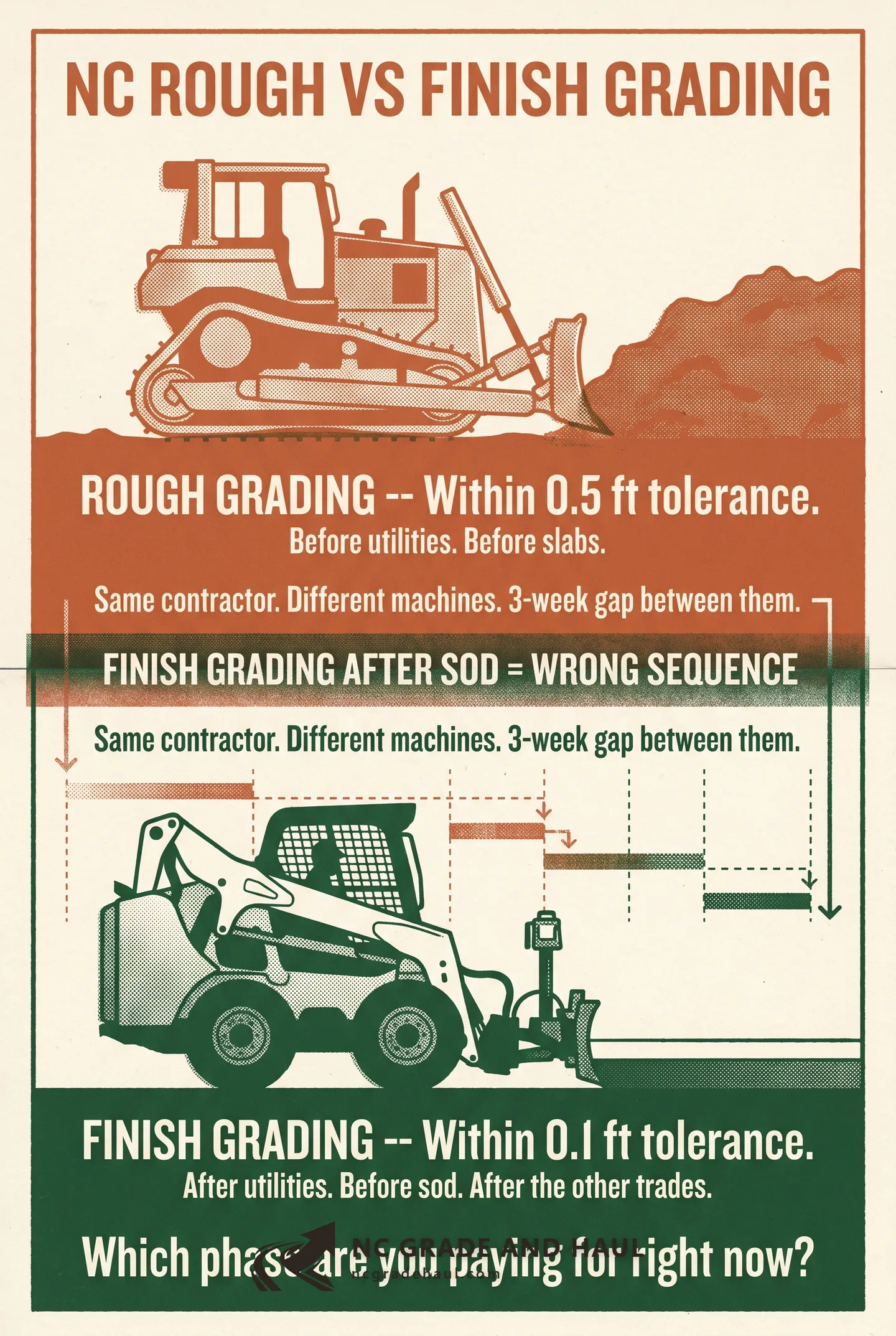
Rough grading is the earthwork -- bulldozer work that establishes grade, cut-and-fill balance, and drainage flow. Finish grading is the final surface pass -- typically after utilities and before landscaping -- that creates a seed-ready or hardscape-ready surface at final elevation. Both are required on most North Carolina construction projects.
If my quote says 'rough grade only,' what am I missing?
You are missing the finish grading phase. Rough grade leaves the lot graded for drainage but not ready for sod, seed, or hardscape. You will need a separate finish grade pass before landscaping -- done by the same contractor at a different stage of the build, or a second crew entirely.
Two contractors quote your lot. One says “rough grade.” One says “rough and finish grade.” The price gap is real — and so is the scope gap. Before you can evaluate which quote is the better deal, you need to know what each phase actually covers.
This page breaks down both phases, when each happens relative to other trades, what tolerances they hit, and the one sequencing mistake that causes visible yard failures 12 months after move-in.
What Rough Grading Is
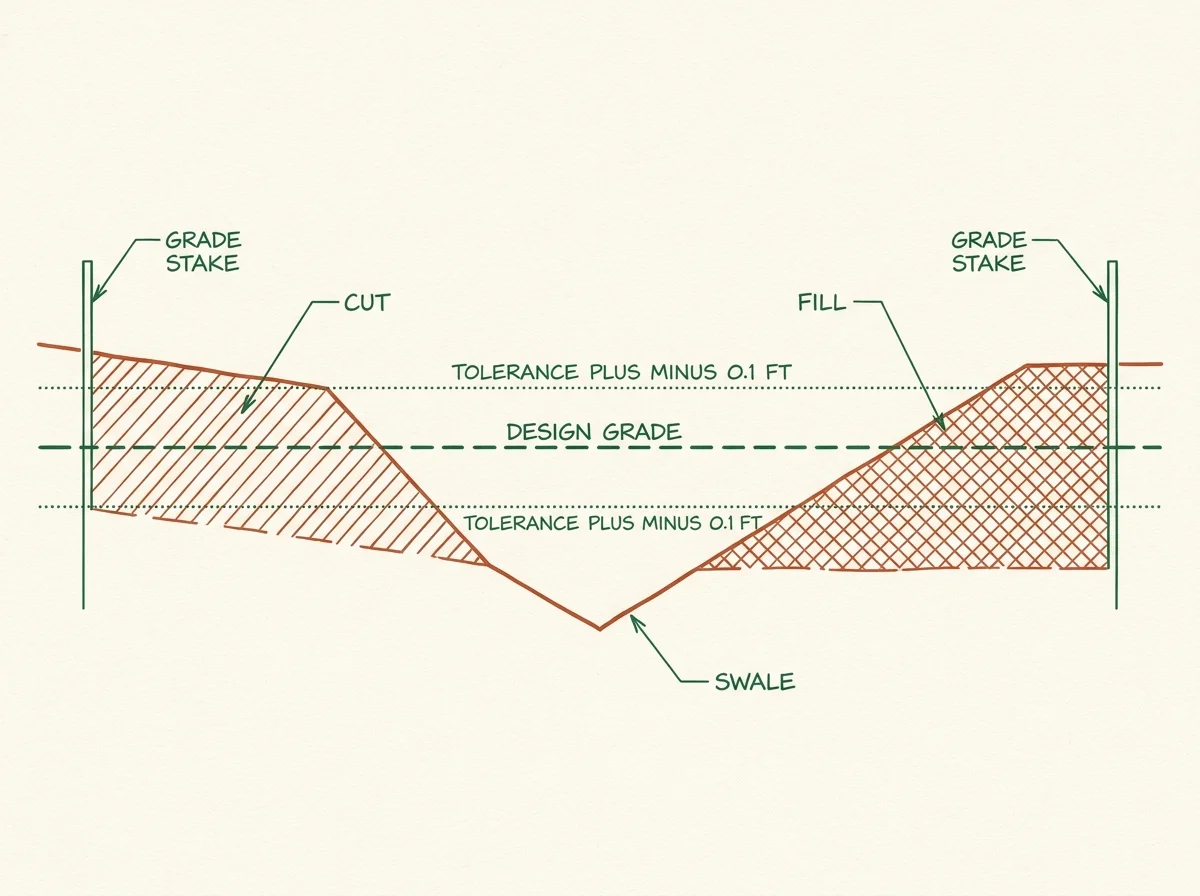
Rough grading is the bulk earthwork — cut, fill, drainage establishment, and pad formation — that shapes the lot to design grade.
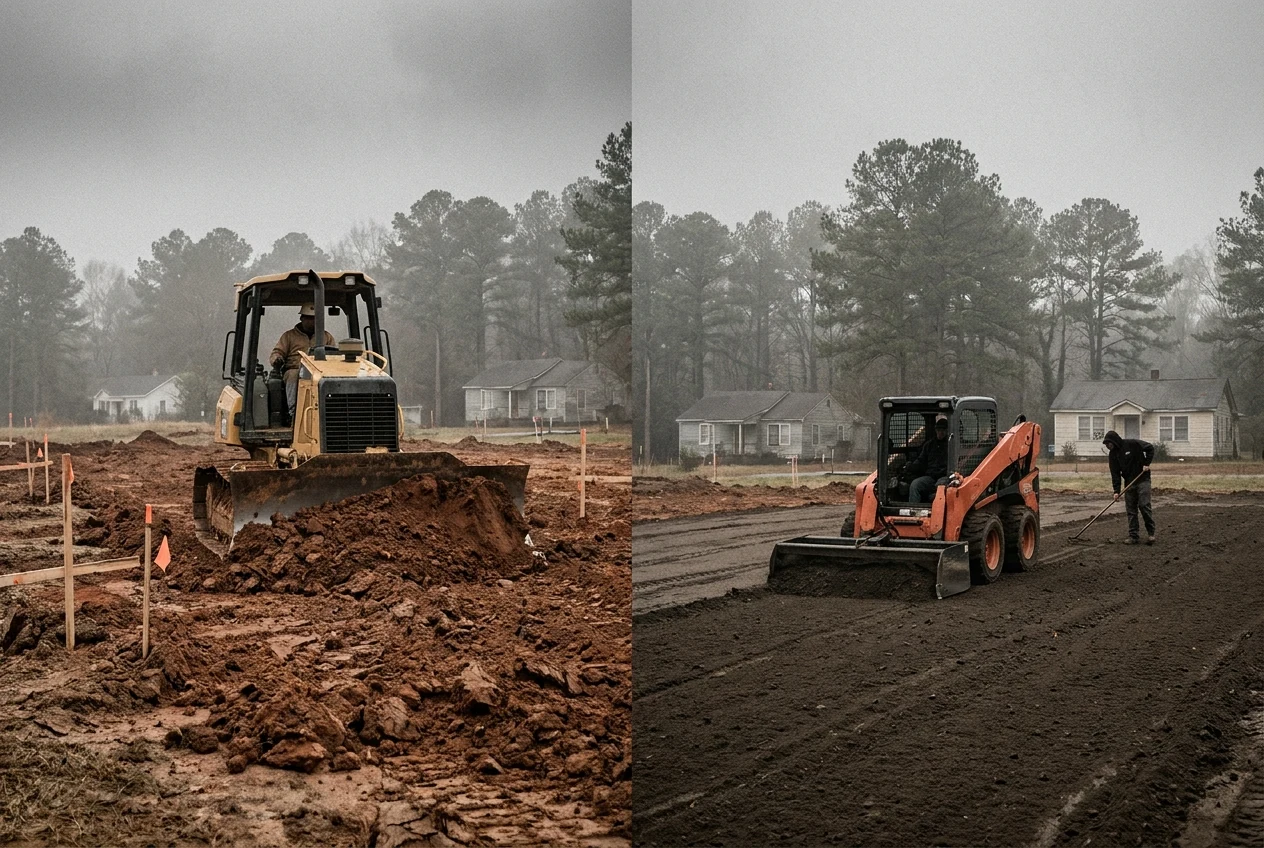
A bulldozer (and sometimes a motor grader on larger lots) does the heavy moving. Soil is cut from high spots and pushed to low spots to balance the site. Swales and positive drainage paths are rough-cut to direct water away from the foundation and off the property.
Rough grade tolerance in residential work is typically within plus-or-minus 0.1 feet of design grade — the same tolerance NCDOT permits in a roadbed after it has been graded to a uniform surface. That is 1.2 inches — close enough for drainage to function, but not close enough for sod or concrete flatwork.
Rough grading happens early — usually right after land clearing in NC for construction and before any utility installation. It is the foundation everything else builds on. Once utilities go in the ground, rough grade is done.
What Finish Grading Is
Finish grading is the final 6-12 inch surface pass that creates a seed-ready and sod-ready, or hardscape-ready, surface at the precise final elevation.
Equipment changes at this stage. A skid steer with a box blade and a hand rake crew takes over from the bulldozer. The goal is a smooth, correctly-sloped surface with no high spots, no low spots, and no undulations that will hold water or cause an uneven seed bed.
Finish grade tolerance is tighter. For concrete flatwork and hardscape, the controlling standard is ACI 117 — the fine grade of soil immediately below a slab-on-ground is held to plus-or-minus 3/4 inch, tightened to plus-or-minus 1/2 inch when the specifier calls for it. For seed and sod, finish grade is typically worked to within roughly half an inch to an inch of design elevation — an industry working estimate, not a published code tolerance. That tolerance is the difference between a flat driveway and one that holds puddles at the edges.
Finish grading also corrects any minor drainage issues that appeared after utility installation. Trenches settle. Compaction isn’t always even. Finish grade is the phase where those problems get fixed before the surface goes down.
The Sequence — When Each Phase Happens in Construction
NC residential construction sequence: where each grading phase falls
1. Land clearing -- Trees, stumps, and brush removed -- site ready for earthwork. 2. Rough grading -- Cut and fill, drainage establishment, pad formation. Tolerance: +/- 0.1 ft. 3. Underground utilities -- Plumbing rough, electrical conduit, drainage lines installed in trenches. 4. Pad and foundation -- Slab pour or crawl space preparation on the rough-graded subgrade. 5. Structure and framing -- Framing, roof -- the building takes shape above the graded lot. 6. Finish grading -- Final surface pass after utilities settle. Tolerance: +/- 1/2 to 3/4 in. Seed-ready or hardscape-ready.
-
Land clearing
Trees, stumps, and brush removed -- site ready for earthwork.
-
Rough grading
Cut and fill, drainage establishment, pad formation. Tolerance: +/- 0.1 ft.
-
Underground utilities
Plumbing rough, electrical conduit, drainage lines installed in trenches.
-
Pad and foundation
Slab pour or crawl space preparation on the rough-graded subgrade.
-
Structure and framing
Framing, roof -- the building takes shape above the graded lot.
-
Finish grading
Final surface pass after utilities settle. Tolerance: +/- 1/2 to 3/4 in. Seed-ready or hardscape-ready.
Rough grade and finish grade are typically 6-12 weeks apart on an NC residential build. Utility trench backfill must settle before the finish grade pass.
Rough grade happens first. Finish grade happens last — after utilities are in the ground and the structure is framed.
Here is the construction sequence on a typical North Carolina residential build:
- Land clearing — trees, stumps, brush removed
- Rough grading — cut and fill, drainage, pad formation
- Underground utilities — plumbing rough, electric conduit, any underground drainage
- Pad and foundation — NC rough grade to pad sequence and slab or crawl space preparation
- Structure — framing, roof
- Finish grading — final surface pass, seed bed or hardscape prep
Finish grade cannot happen after Step 3. Utility trenches — especially plumbing and French drain lines — must be backfilled and settled before any finish surface work. A finish grade over fresh utility backfill will settle unevenly within one growing season.
On most NC residential lots, rough grade and finish grade are 6-12 weeks apart. On smaller lots with tight timelines, that window compresses — but the sequencing constraint does not change. See grading sequencing with other trades in North Carolina for the full dependency map.
Why Finish Grading After Sod Is Wrong
Sod placed on a rough-graded surface that was never finish-graded will develop visible low spots, standing water, and uneven settling within 12 months.
This is the most common builder shortcut in North Carolina residential construction. The lot gets rough-graded, utilities go in, the house gets framed — and then landscaping crews lay sod directly on the rough-graded surface to make the lot look finished for closing.
Here is what that looks like 12 months later: low spots near utility trenches where backfill settled. Water pooling at the foundation perimeter where the rough grade never got corrected. Sod edges lifting at the transition between the builder-laid surface and the neighbor’s lot because the grade was never dialed in.
The fix costs more than the finish grade would have — yard regrading vs finish grading NC is a different mobilization, and lifting sod, resurfacing, and relaying carries a higher unit cost than doing it right in sequence. And by then, the builder has been paid and moved on.
Finish grading also sets the elevation for walkways, patios, and driveways. If sod goes down first, hardscape contractors are forced to match an incorrect surface — which is why slab-on-grade transitions sometimes end up with a 2-3 inch step that was never in the design.
Sod on a finish-graded surface vs sod on rough grade
Comparison. Done in sequence: Rough grade, then utilities, then a finish grade pass; Sod laid on a smooth surface at final elevation; Positive slope away from the foundation holds; Yard still reads true 12 months after move-in. Finish grade skipped: Sod laid straight onto the rough-graded surface; Low spots over utility trenches as backfill settles; Water pools at the foundation perimeter; Sod edges lift; the fix costs more than the skipped phase.
- Rough grade, then utilities, then a finish grade pass
- Sod laid on a smooth surface at final elevation
- Positive slope away from the foundation holds
- Yard still reads true 12 months after move-in
- Sod laid straight onto the rough-graded surface
- Low spots over utility trenches as backfill settles
- Water pools at the foundation perimeter
- Sod edges lift; the fix costs more than the skipped phase
Sod laid before a finish grade pass develops visible low spots and standing water within one growing season.
Rough vs Finish Grading at a Glance
Rough grading vs finish grading -- key differences for North Carolina residential projects
| Factor | Rough grading | Finish grading |
|---|---|---|
| Timing in build | Early -- after clearing, before utilities | Late -- after utilities, before landscaping |
| Primary equipment | Bulldozer, motor grader | Skid steer, box blade, hand rake |
| Grade tolerance | +/- 0.1 ft (NCDOT roadbed standard) | +/- 1/2 to 3/4 in. for slab subgrade (ACI 117); ~1/2-1 in. for seed/sod |
| Surface result | Drainage and grade established, pad formed | Seed-ready or hardscape-ready surface |
| Included in 'site prep' quotes? | Usually yes | Not always -- verify in writing |
| Can it follow utility installation? | Yes -- it precedes utilities | No -- must wait until utilities are in and settled |
Timing in build
- Rough grading
- Early -- after clearing, before utilities
- Finish grading
- Late -- after utilities, before landscaping
Primary equipment
- Rough grading
- Bulldozer, motor grader
- Finish grading
- Skid steer, box blade, hand rake
Grade tolerance
- Rough grading
- +/- 0.1 ft (NCDOT roadbed standard)
- Finish grading
- +/- 1/2 to 3/4 in. for slab subgrade (ACI 117); ~1/2-1 in. for seed/sod
Surface result
- Rough grading
- Drainage and grade established, pad formed
- Finish grading
- Seed-ready or hardscape-ready surface
Included in 'site prep' quotes?
- Rough grading
- Usually yes
- Finish grading
- Not always -- verify in writing
Can it follow utility installation?
- Rough grading
- Yes -- it precedes utilities
- Finish grading
- No -- must wait until utilities are in and settled
Which Phase Does Your Quote Actually Cover?
Read the scope section of every grading quote and look for the word “finish” — if it is not there, assume the quote is rough grade only.
Most residential grading quotes describe scope in one of three ways:
- “Site grading” or “rough grade” — almost always rough grade only. Finish grade is a separate line item or a separate contract.
- “Grade and finish” or “full site grading to final grade” — covers both phases. Ask which construction events trigger the finish phase — it should be post-utility, pre-landscaping.
- “Grade to seed-ready” or “grade to sod-ready” — implies finish grade is included, but get it confirmed in writing. Some contractors use these phrases loosely.
The three questions to ask any NC grading contractor before signing:
Does this quote include rough grade only, or both rough and finish grade? What is the tolerance specification for each phase? What trigger in the construction sequence determines when finish grade happens?
If the answer to the first question is “rough only,” that is not a problem — it just means finish grade is a separate work order. A clear itemized quote with both phases scoped and priced is better than a vague “full site grading” that might mean anything.
Hire a verified NC grading contractor who will put both phases on the quote. Evaluating grading quotes that include both phases covers what to look for in the scope and tolerance language.