
Two questions clearing crews ask
Can I grind stumps before building a pad or pouring a slab?
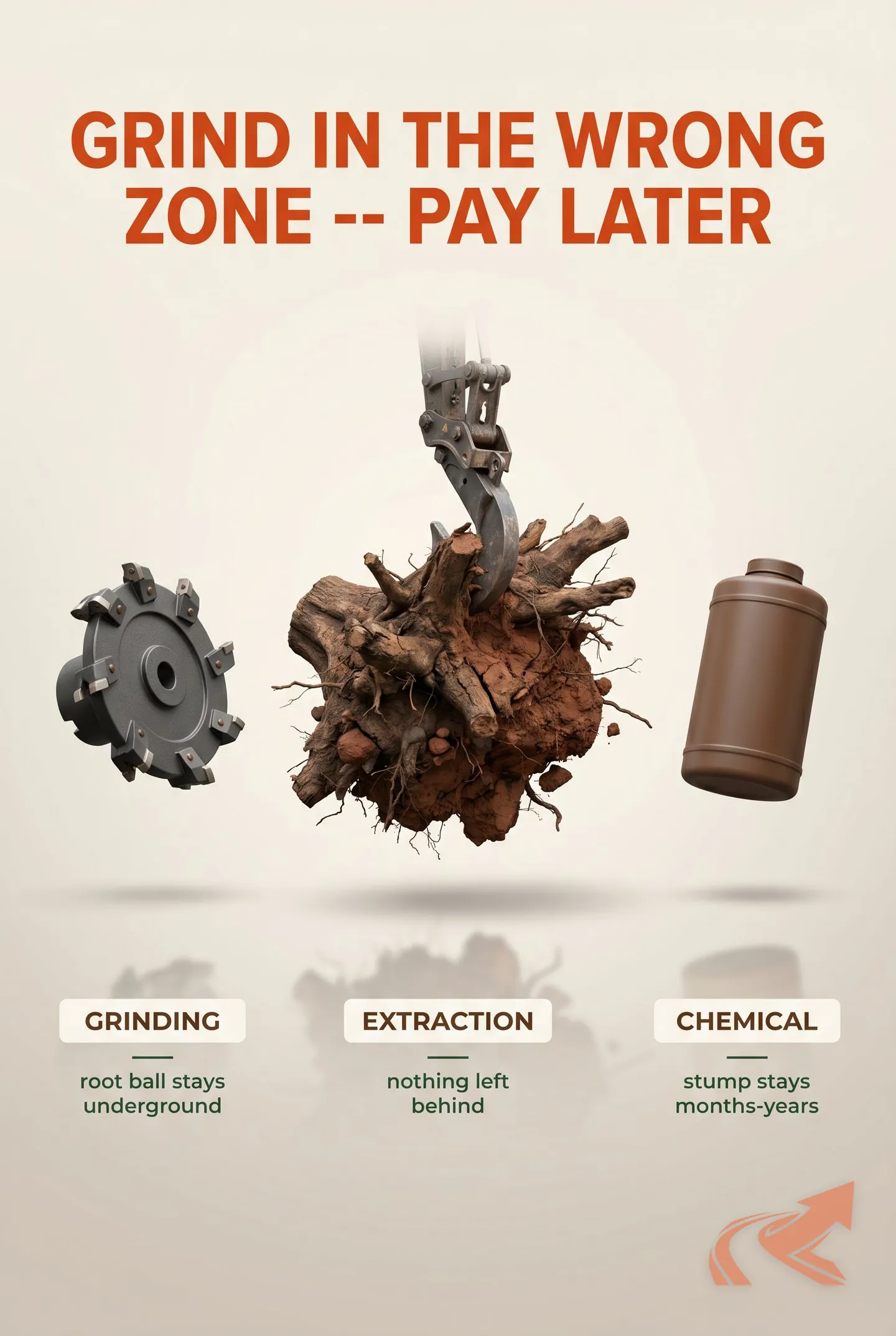
No. Grinding leaves the root ball underground. In NC clay, that organic mass decomposes and creates voids -- sometimes visible as surface settlement 3 to 5 years later. Building pads and structural fill zones require full extraction: the root ball comes out and the pit gets backfilled with compacted structural fill before grading.
What about stumps in areas that won't be built over?
Grinding is fine for yard areas, landscaped zones, and non-structural uses. It's faster and cheaper than extraction. Chemical treatment is for stumps you are leaving in place to decay -- it is not a grading-prep method because the stump stays in the ground for months or years while it breaks down.
Clearing a lot in North Carolina means dealing with stumps before anything else can happen. The wrong method in the wrong zone is not just a timeline problem — it’s a structural one. A stump ground down in a future building pad zone will decompose underground and eventually leave you with a void where compacted fill should be.
This page covers the three methods, when each one applies, and the specific NC clay behavior that makes the choice matter more here than in other soil conditions.
Stump Grinding — When It’s Right
Grinding works for yard and landscaping zones — not for anything structural.
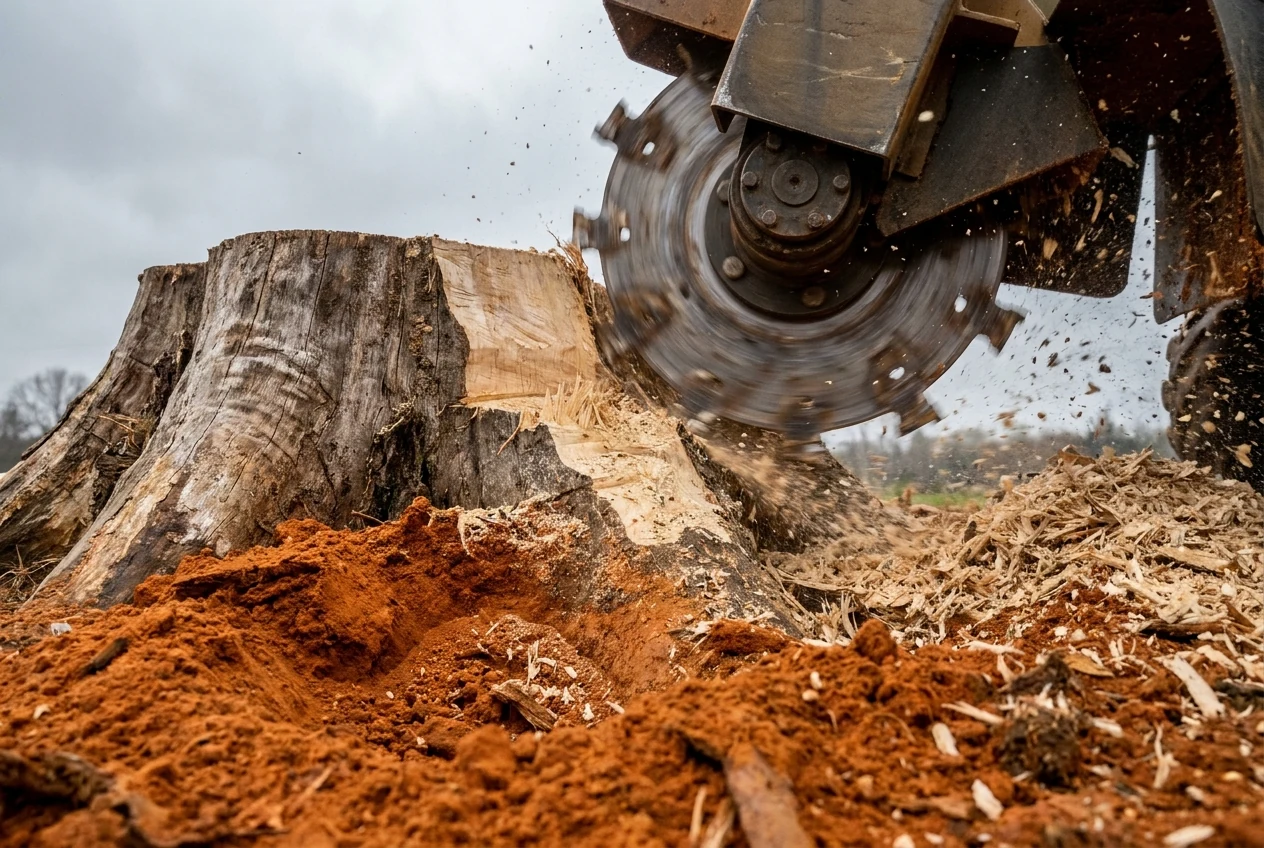
A stump grinder removes the above-ground stump and shreds the visible wood to chips. It does not remove the root ball. The root system — which can extend several feet down and laterally beyond the stump diameter — stays in the ground.
For non-structural areas, that’s acceptable. Grass grows over the chips. Landscaping establishes. The root system slowly decomposes without consequence because nothing is being built on top of it.
Grinding is faster and cheaper than extraction. Same-day service is common for most North Carolina hardwood stumps. For a clearing job with 10 to 20 stumps in mixed zones, grinding the yard-zone stumps and extracting only the pad-zone stumps is a legitimate cost-management approach. Note that clearing a lot also triggers what erosion controls start when clearing begins — silt fence and a gravel construction entrance are typically required before any trees come down.
The error happens when contractors grind everything without asking which stumps are in structural zones. Get that question answered before any stump work starts.
Full Extraction — When the Root Ball Has to Come Out
Any stump in a building pad zone, slab zone, or structural fill area requires full extraction — root ball and all.
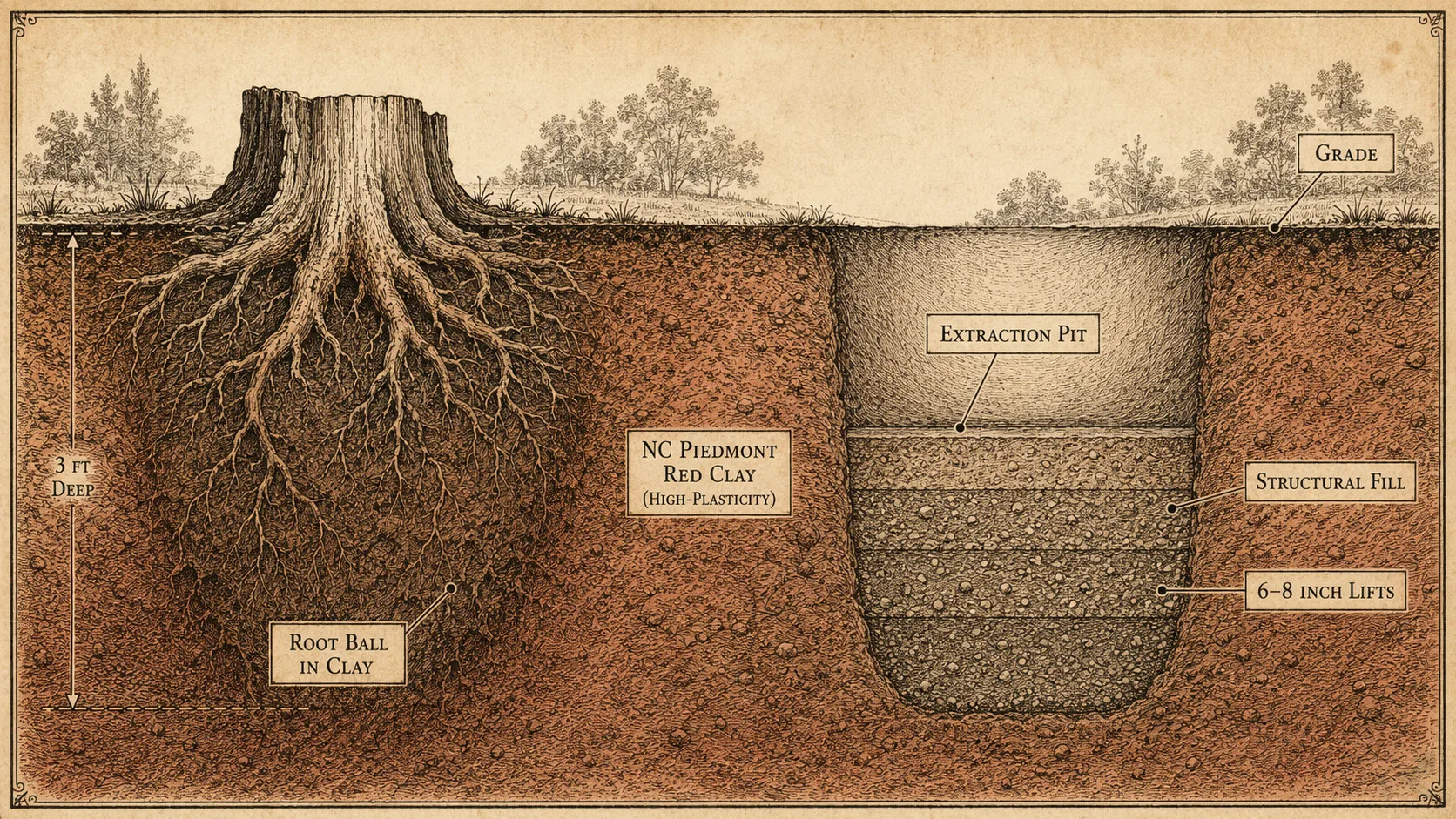
Full extraction is grubbing: the excavator digs down and pulls the entire root system out of the ground. Nothing organic stays buried. The resulting pit is backfilled with structural fill and compacted in lifts before grading can proceed.
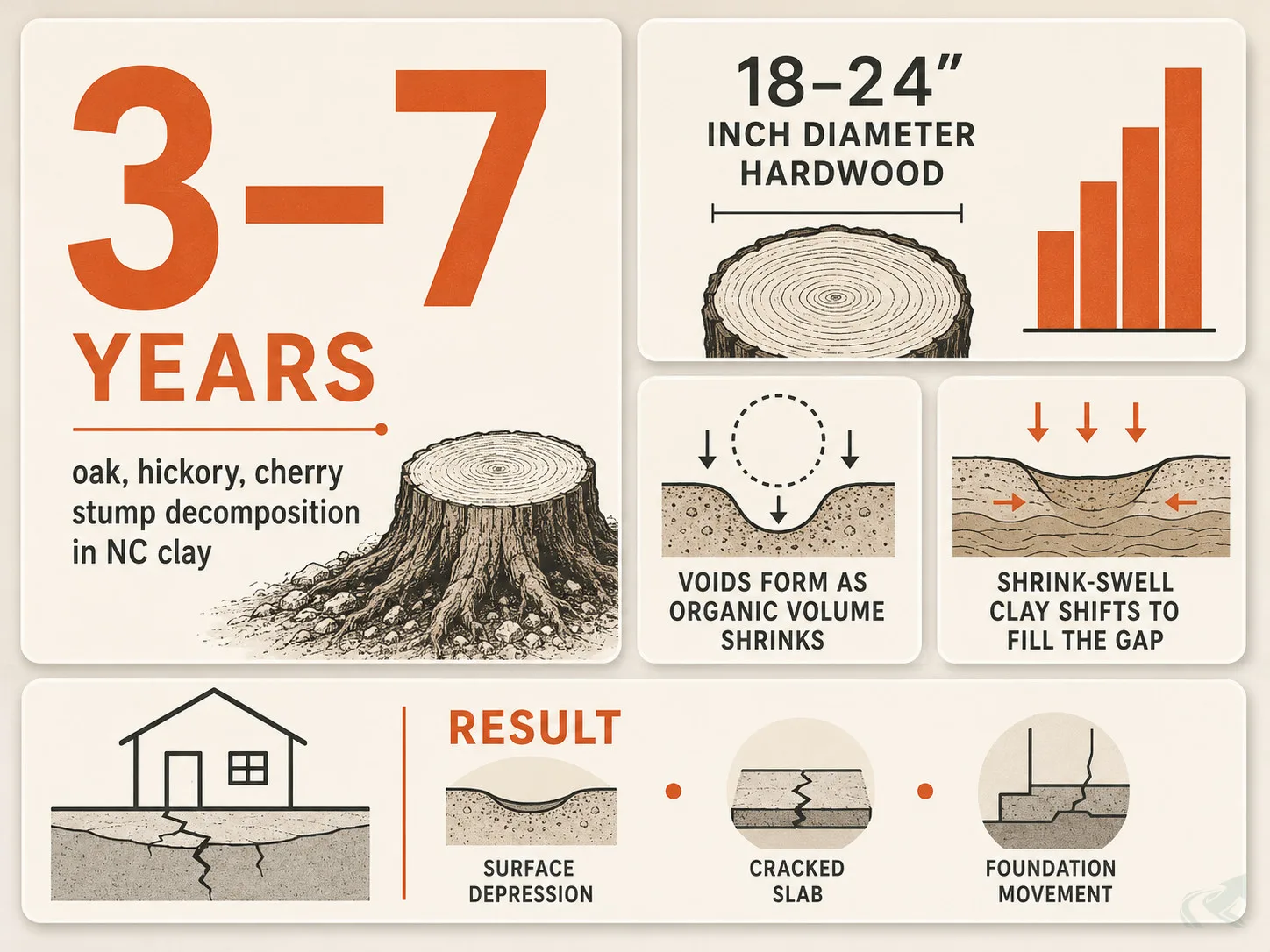
Why does this matter in North Carolina specifically? NC Piedmont clay is a high-plasticity soil. When organic material decomposes underground in that clay environment, the clay around it shifts as the volume shrinks. That settling shows up as depressions, cracking slabs, or foundation movement years after the structure is built.
Geotechnical engineers and building officials across North Carolina treat buried organic material under structural zones as a disqualifying condition. Full extraction is not optional for building pad preparation in NC — it’s the baseline requirement.
The cost is higher than grinding and the job takes longer because of the backfill and compaction sequence. Budget for structural fill and at least one compaction pass after extraction before any grading quote is complete.
A quote that includes stump grinding in a pad zone without noting the extraction requirement is either an oversight or a price-to-win move. Ask directly: extraction or grinding, and for which stumps.
Chemical Treatment — Where It Fits
Chemical treatment is for stumps you are leaving in place to decay. It is not a grading-prep method.
Potassium nitrate and similar stump killers accelerate decomposition by introducing nitrogen into the stump. The stump stays in the ground and breaks down over months to years, depending on species and diameter.
This is appropriate for stumps in low-use areas where decay time is not a problem — a back-corner stump on rural acreage, a tree stump in a future garden bed that won’t be graded for two seasons.
It is not appropriate before any grading work because the stump is still physically present during the treatment window. There is no void to backfill and compact because nothing has been removed yet.
For most North Carolina clearing-before-grading jobs, chemical treatment is not the right answer. It’s included here so the option is understood and set aside, not stumbled over mid-project.
The NC Clay Void Problem
Buried organic material in NC clay creates voids — sometimes years after the initial work.
Here is what happens when a root ball is left underground under a structural zone. The wood decomposes. As it breaks down, the volume decreases. The surrounding Piedmont red clay — which is already susceptible to shrink-swell cycling from seasonal moisture changes — shifts to fill that decreasing volume.
The result is not a clean round hole. It is a diffuse zone of settling, often first visible as a surface depression or a crack in a concrete pad — or as water problems at the foundation perimeter that a NC foundation drainage guide would flag as a settling-related symptom. NC Extension forestry references suggest large hardwood stumps (18 to 24 inches in diameter) can take 3 to 7 years to decompose depending on species, moisture, and soil contact. Hardwood species common to NC Piedmont — oak, hickory, cherry — decompose more slowly than softwoods but are denser when they do fail.
In a yard zone, that settling is a nuisance. In a building pad zone, it is a structural failure. The timeline is long enough that the original contractor is often out of the picture when the problem surfaces.
This is not a rare or theoretical failure mode. It is why North Carolina building inspectors and geotechnical engineers consistently specify full extraction as the minimum standard for any structural zone. The cost difference between grinding and extracting a 20-inch hardwood stump is real. The cost difference between a proper extraction and a slab repair five years later is not comparable.
Method Comparison
The choice depends entirely on what will be built over the stump area.
| Method | Leaves behind | Right for pad prep? | Relative cost | Timeline |
|---|---|---|---|---|
| Grinding | Root ball underground | No | Lower | Same day |
| Full extraction | Nothing -- void backfilled | Yes | Higher | Same day + backfill |
| Chemical treatment | Stump in place, decaying | No | Lowest | Months to years |
Grinding
- Leaves behind
- Root ball underground
- Right for pad prep?
- No
- Relative cost
- Lower
- Timeline
- Same day
Full extraction
- Leaves behind
- Nothing -- void backfilled
- Right for pad prep?
- Yes
- Relative cost
- Higher
- Timeline
- Same day + backfill
Chemical treatment
- Leaves behind
- Stump in place, decaying
- Right for pad prep?
- No
- Relative cost
- Lowest
- Timeline
- Months to years
Ask your contractor which method they are quoting for each stump, and confirm which stumps they classify as structural-zone vs non-structural-zone. That question separates operators who have thought about it from operators who are pricing by default.
Timing Relative to Grading
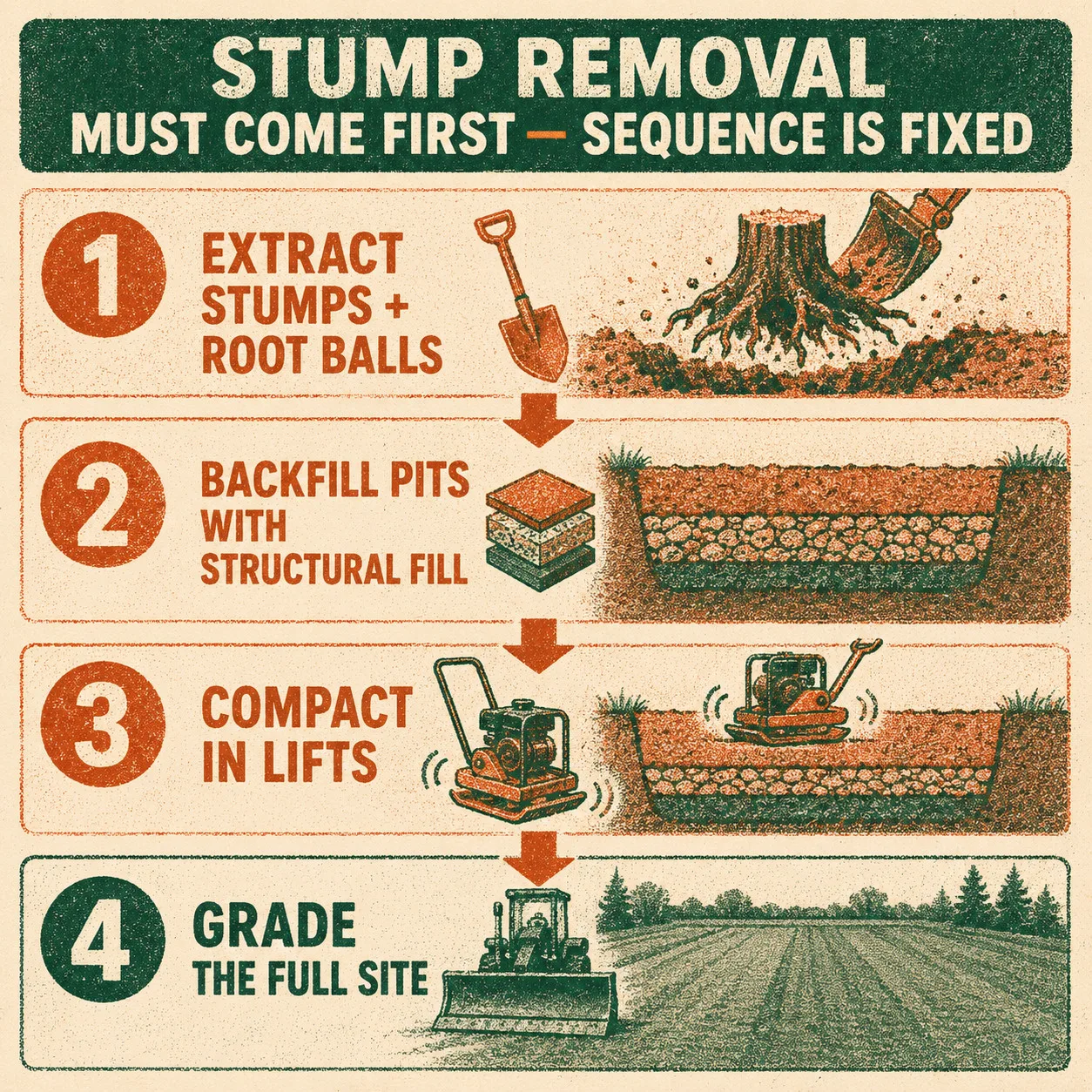
Stump removal — extraction or grinding — must happen before grading starts. The sequence is fixed.
You cannot grade around stumps and come back later. The equipment sequencing doesn’t work that way, and leaving stumps in place during grading creates roots-under-fill conditions that are worse than an ungraded site.
For extraction zones, the sequence is:
- Extract stumps and root balls
- Backfill extraction pits with structural fill
- Compact backfill in lifts
- Grade the full site
Steps 1 through 3 must be complete and the backfill must be adequately settled and compacted before the grader works that zone. Rushing from extraction directly to finish grading without the compaction step puts you back at the void problem through a different mechanism.
For grinding zones, the stump work happens first, the chips can be raked out or incorporated into topsoil depending on depth, and grading proceeds — moving into the rough grading vs finish grading sequence that follows once the site is cleared and compacted.
Get the stump scope confirmed in the clearing contract — method per zone, not just “stump removal included.”
Backfill After Extraction
The extraction pit needs structural fill, not whatever dirt is on site.
Pulling a root ball leaves a pit. That pit cannot be filled with the native clay that surrounded the stump — that material has been disturbed, is often mixed with organic debris, and will not compact to adequate density.
Structural fill for extraction pits in North Carolina typically means:
- Clean fill dirt — screened, no debris, confirmed source. Not topsoil, not mixed demo dirt.
- ABC (Aggregate Base Course) for smaller pits or areas where drainage matters.
- Compacted in lifts — 6 to 8 inch layers, each compacted before the next layer goes in.
The fill requirement is a real cost that should be on the quote before work starts. A quote that shows extraction labor but no fill material and no compaction equipment is incomplete. Ask what goes in the hole and how it gets compacted.
For the fill sourcing and specification detail, see fill dirt for stump-removal backfill in NC.
Shareable Checklist — Questions for Your Clearing Contractor
Copy and paste this before signing any clearing contract that includes stump work:
- For each stump: are we in a building-pad zone or a landscaping zone?
- If pad zone — are you quoting full extraction or grinding?
- If grinding — will any of those areas be structural fill later?
- What fill material goes into the extraction pits and who is doing the compaction?
- Is the fill cost included in this quote or a separate line item?
Find a Verified NC Grading Contractor
The stump question is one of the fastest ways to separate contractors who have done this work from contractors who have bid it. A contractor who knows the extraction-vs-grind answer without being prompted — and who can name the fill spec for the extraction pits — has actually done pad prep in NC clay.
NC Grade and Haul verifies grading contractors against active NCLBGC license status, OSHA violation history, and workers compensation coverage. Every contractor listed has cleared those three checks.
Hire a grading operator in North Carolina and ask them about the extraction sequence before the first tree comes down.
See how stump removal fits into the broader NC land clearing process and what to expect for disposing of stumps and clearing debris in North Carolina.