
Ray Pettiford’s barn floor came out in chunks — some with rebar, most without. The question isn’t whether concrete can be recycled in North Carolina. It can. The question is whether his specific load qualifies, what it costs compared to the nearest C&D landfill, and whether the resulting recycled concrete aggregate (RCA) has any use on his property.
This page answers those three questions for concrete and asphalt demolition debris in North Carolina.
What North Carolina Concrete and Asphalt Recycling Produces
Clean demolition concrete becomes RCA — a graded aggregate with real market value as road base and structural fill substitute.
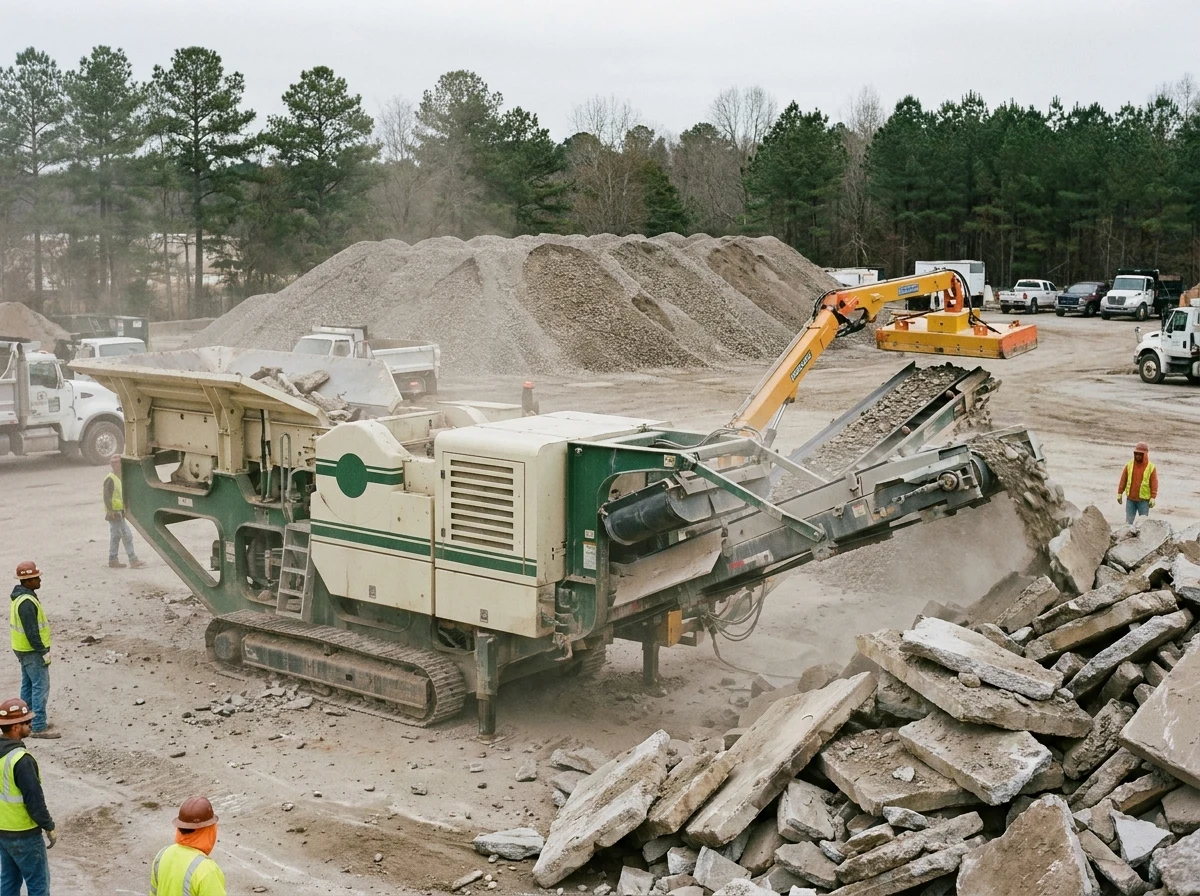
When a concrete recycling facility processes demolition debris, the output is Recycled Concrete Aggregate (RCA). Crushing equipment breaks the concrete, removes ferrous material via magnet, and screens it to spec — typically 3/4-inch or 1.5-inch graded aggregate. RCA is accepted as an aggregate base course substitute for NCDOT applications under Section 1043-2 of the 2018 Standard Specifications for Roads and Structures, and as structural fill sub-base on private sites.
Asphalt demolition debris becomes Recycled Asphalt Material (RAM) — often called asphalt millings. Millings are used as base material for driveway grading in NC, parking area surfacing, and farm road topping. Because millings self-bind in heat (the asphalt binder reactivates slightly), they compact to a harder surface than gravel.
Both outputs have commercial value. That’s why tip fees at recycling facilities run well below C&D landfill rates — the facility is selling the processed output, not just accepting waste.
Where to Recycle in NC
Concrete and asphalt recycling facilities operate across North Carolina’s metro areas — Triangle, Triad, and Charlotte all have options within reasonable haul distance of most demolition sites.
Most facilities that process demolition concrete are asphalt plant operations or aggregate quarries with crushing equipment. They accept load-in concrete in defined volume minimums — often a full truck load (roughly 10 tons) for competitive tip fees. Smaller volumes may still be accepted but at higher per-ton rates, so running the yards vs tons explained for NC hauling math before scheduling pickup saves surprises.
Specific facilities, tip fees, and acceptance criteria change as operators update equipment, adjust capacity, or close. The NC DEQ maintains a permitted solid waste facility list that includes active C&D processors; call facilities directly before routing a job to confirm current acceptance criteria, minimum loads, and pricing.
When calling a facility, ask:
- Minimum load accepted
- Whether rebar-in concrete is accepted (some pull it themselves, others require clean-crushed only)
- Current tip fee per ton
- Whether they accept residential demo volumes or only contractor accounts
- Asphalt millings acceptance policy and tip fee
An itemized quote from the facility before you route trucks prevents surprises at the scale.
Cost Comparison: Recycling vs C&D Landfill
For clean concrete, recycling is almost always cheaper — the cost gap between recycling and C&D landfill tip fees is typically substantial before accounting for haul distance.
Recycling Facility vs. C&D Landfill: Disposal Cost Factors
Comparison. Concrete Recycling Facility: Tip fees well below C&D landfill rates; Asphalt millings often accepted at low or no cost; Facility sells processed RCA output -- offsets acceptance cost; Best for clean, single-material loads; May require minimum load volume (10+ tons). C&D Landfill: $35-$65/ton in NC metro areas (current estimated); Accepts mixed, contaminated, and ACM debris; No minimum-load or material-purity requirement; Higher tip fee is the trade-off for flexibility; Closer proximity may offset tip fee gap via shorter haul.
- Tip fees well below C&D landfill rates
- Asphalt millings often accepted at low or no cost
- Facility sells processed RCA output -- offsets acceptance cost
- Best for clean, single-material loads
- May require minimum load volume (10+ tons)
- $35-$65/ton in NC metro areas (current estimated)
- Accepts mixed, contaminated, and ACM debris
- No minimum-load or material-purity requirement
- Higher tip fee is the trade-off for flexibility
- Closer proximity may offset tip fee gap via shorter haul
Haul distance is the variable most likely to close the cost gap -- always get an itemized quote (tip fee + haul cost) before routing trucks.
The table below uses benchmarks for North Carolina metro areas. Recycling tip fees are market rates that vary by facility and load volume — confirm directly with the receiving facility. C&D landfill rates are sourced from NC DEQ permitted facility data (FY 2019-20, the most recent published statewide dataset); current rates are higher due to inflation.
| Disposal route | Typical tip fee | When to use |
|---|---|---|
| Concrete recycling facility | Well below landfill rates; varies by facility and volume — call for a quote | Clean concrete loads, competitive cost |
| Asphalt millings recycling | Often low or no tip fee at facilities with high millings demand | Asphalt demolition, facility has commercial buyer for output |
| C&D landfill | $35-$65/ton (NC metro area range, current estimated) | Mixed loads, contaminated concrete, ACM debris |
| On-site crushing | Equipment mobilization + operator time — pencils out for large volumes; get a quote | Large demolition volumes where on-site RCA reuse is planned |
The haul-distance factor matters. A recycling facility 35 miles from your site and a C&D landfill 8 miles away may produce comparable total disposal costs — what NC regulations apply to material hauling determines the legal load per truck run, which multiplies directly into haul cost — even if the tip fee gap is substantial. Get an itemized quote that includes both tip fee and haul cost before deciding which route wins.
For Ray’s barn floor, the math likely favors recycling if a Triad facility is within 20-25 miles. If the load is mostly rebar-contaminated or has floor tiles requiring an ACM assessment, the calculus shifts toward the C&D landfill for that portion.
What “Clean” Means for Acceptance
“Clean” at a concrete recycling facility means: no asbestos-containing materials, a single-material load, and rebar within the facility’s stated tolerance.
What Recycling Facilities Accept vs. Reject
Comparison. Accepted: Clean concrete slabs -- no mixed debris; Rebar-in concrete -- call facility first to confirm; Painted concrete -- surface coating at trace concentration; Asphalt millings -- separate load from concrete; Large single-material loads (10+ tons preferred). Rejected: Concrete with asbestos-containing materials (pre-1980 -- assess first); Mixed loads: concrete combined with wood, drywall, or soil; Pre-1980 floor tile or tile adhesive mixed into the load; Concrete and asphalt combined in one load; Loads with visible ACM without prior abatement.
- Clean concrete slabs -- no mixed debris
- Rebar-in concrete -- call facility first to confirm
- Painted concrete -- surface coating at trace concentration
- Asphalt millings -- separate load from concrete
- Large single-material loads (10+ tons preferred)
- Concrete with asbestos-containing materials (pre-1980 -- assess first)
- Mixed loads: concrete combined with wood, drywall, or soil
- Pre-1980 floor tile or tile adhesive mixed into the load
- Concrete and asphalt combined in one load
- Loads with visible ACM without prior abatement
When in doubt: call the facility before routing trucks. Rejection criteria vary by operator -- rebar acceptance and minimum load size are the two most common variables.
This is the most common rejection reason for demolition concrete loads. Concrete recyclers are processing for a saleable aggregate product — contamination degrades or destroys that product.
ACMs (asbestos-containing materials): The hard stop. Concrete poured before 1980, especially in industrial or agricultural settings, may contain ACMs in floor tile adhesive, in the concrete itself if vermiculite insulation was involved, or in adjacent materials mixed into the load. If the demo is pre-1980 construction, an ACM assessment before debris removal is the required step. Contaminated material routes to a licensed hazardous-waste or ACM-permitted C&D facility — not a standard recycler.
Rebar: Facility-specific. Many recycling operations run a magnet on the crusher output and can pull ferrous material — they accept rebar-in concrete. Others require clean-crushed or hand-separated rebar removal before delivery. Call before assuming.
Painted concrete: Generally accepted. The paint layer is a surface coating at trace concentration relative to aggregate volume.
Mixed loads: Rejected. Concrete mixed with wood, drywall, soil, or other C&D debris cannot be processed to spec. Separate loads are required.
Pre-recycling checklist (copy before scheduling pickup):
- Is this pre-1980 concrete with floor tile or tile adhesive visible? — Need an ACM assessment before moving debris.
- Does the load contain rebar? — Call the facility to confirm acceptance and whether they require removal.
- Is this a single-material load (concrete only, or asphalt only)? — Mixed loads are rejected; separate before scheduling.
- Is there any asphalt mixed into the concrete load? — Separate if possible; asphalt and concrete route to different processes.
Using Recycled Aggregate On-Site
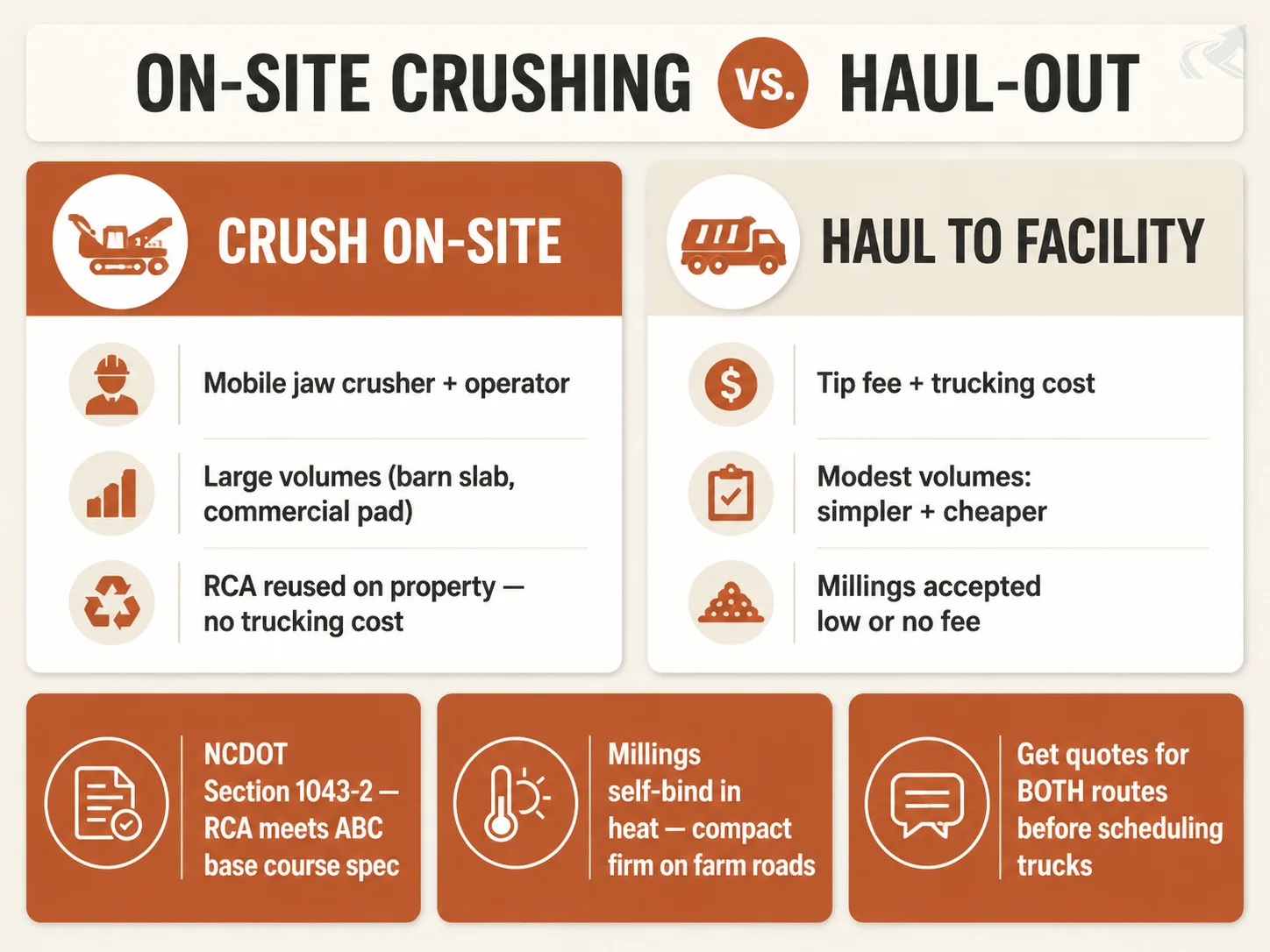
RCA from your own demolition can be crushed on-site and reused as base material — for driveways, parking areas, and farm roads — when the volume justifies equipment mobilization.
For large demolition volumes — barn floors, commercial slabs, parking lots — on-site crushing eliminates the haul-out cost entirely. A crushing contractor brings a mobile jaw crusher, processes the concrete in place, and leaves graded RCA stacked on your property. You pay equipment mobilization and operator time rather than tip fees and trucking.
On-site crushing economics depend on your specific haul distance to the nearest recycling facility, current tip fees, and the mobilization quote from the crushing contractor. For modest-sized demolition jobs, haul-out to a facility is typically the simpler and cheaper path. For large commercial or agricultural slabs where the resulting RCA has a clear on-site use, get a crushing contractor quote alongside facility haul-out quotes and compare.
RCA is accepted as aggregate base course for NCDOT applications under Section 1043-2 of the 2018 NCDOT Standard Specifications (the crushed material must meet ABC gradation requirements and pass source approval per Sections 1005 and 1006). For private driveways and access roads — outside NCDOT jurisdiction — RCA performs comparably to ABC stone when properly compacted.
Asphalt millings from demolished surfaces work well on farm roads and unpaved parking areas. The self-binding characteristic means millings compact and stay put better than gravel — though they soften in high summer heat and can track onto paved surfaces. For more on recycled asphalt millings as a driveway base material, see the guide to recycled asphalt millings from NC demolition.
Finding a Contractor for Demo Debris Hauling in North Carolina
Matching the debris type to the right disposal route — and routing loads to recycling when the cost and contamination criteria allow — is part of what experienced demo haulers in North Carolina do.
Not all hauling contractors have relationships with North Carolina concrete recycling facilities. A contractor who hauls primarily to C&D landfills may quote a job without considering the recycling option — even when recycling would save the property owner money on tip fees.
When getting quotes for demolition debris hauling, ask the contractor to confirm:
- Which facility they plan to route the load to
- Whether they’ve confirmed that facility’s current acceptance criteria for your debris type
- Whether the quote separates tip fee from haul cost so you can compare routes
For demolition debris recycling in North Carolina broadly — including mixed loads, drywall, and wood debris — see the demolition debris hub. For questions on county disposal requirements or whether a permit is needed for debris removal, the county permits guide for North Carolina covers the permit landscape by county.
To connect with a verified NC grading and hauling contractor who handles demo debris, hire a verified NC grading and hauling contractor from the directory.