
Before you call a contractor
Are asphalt millings a good driveway material in NC?
They can be -- on flat, sunny, light-traffic driveways. Millings self-bind in NC summer heat and cost less than ABC. But they behave like loose gravel in winter and fail entirely in shaded or wet locations where heat can't activate the binding. The conditions of your specific driveway determine whether millings are a legitimate choice or a mistake.
What are the main failure risks for millings in North Carolina?
Three: shade (no heat means no binding -- millings stay loose indefinitely), steep slopes (flow risk on the hottest summer days), and continuously wet locations (water prevents the binding temperature from being reached). Some NC counties and municipalities also regulate driveway surfacing in residential zones -- check your county unified development ordinance before ordering.
A contractor quoted you two numbers. ABC gravel at the higher price, asphalt millings at $800 less. He said millings are “just as good.” That’s not quite right — and it’s not a lie either. Millings are a legitimate driveway material under specific conditions. The $800 gap is real. But so is the winter morning when your driveway looks like a gravel parking lot and stays that way until June.
This page tells you exactly when millings work in North Carolina, when they fail, and how to know which situation you’re in before the truck shows up.
What Asphalt Millings Are
Millings are the byproduct of road resurfacing — the old asphalt surface ground into aggregate-sized particles that retain residual asphalt binder.
When NCDOT or a county road crew resurfaces a road, they mill off the old surface layer. That material gets recycled. The resulting product looks like dark grey gravel with a range of particle sizes from 3/4 inch down to fine dust. That gradation is similar to crusher run, but the key difference is the asphalt binder still present in each particle.
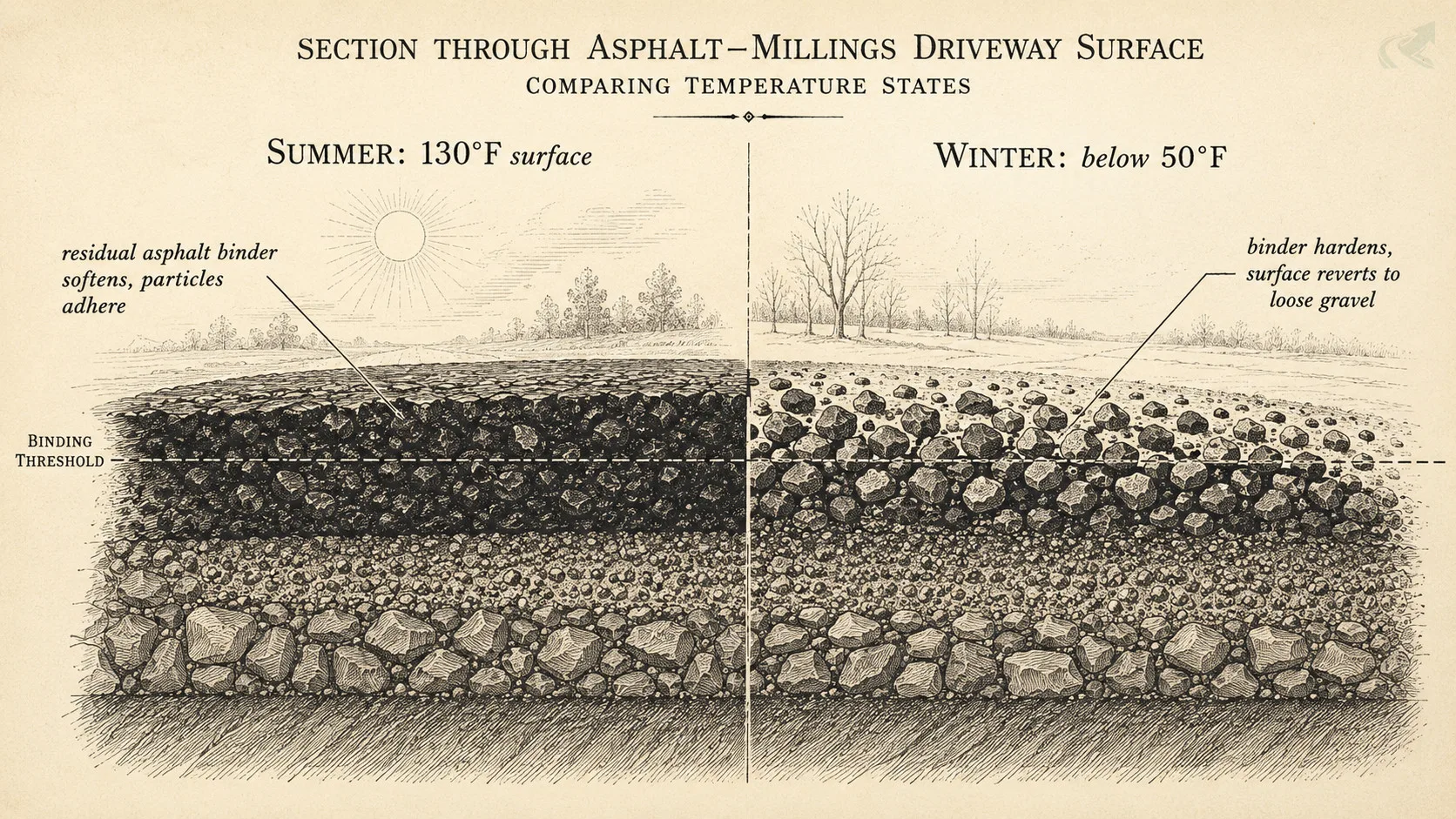
That binder changes behavior based on temperature. On a sunny NC summer day, a dark pavement surface in direct sun can run well above the air temperature — often 40 to 50 degrees hotter. As the surface heats, the residual binder softens. The particles adhere to each other and form a semi-solid surface — firmer than loose gravel, though not as hard as fresh asphalt.
Drop below 50-60 degrees and binding stops. The surface returns to behaving like loose gravel.
Millings are cheaper than virgin aggregate because they’re recycled byproduct. Availability varies seasonally — heavy resurfacing seasons produce more supply. In North Carolina, peak availability typically tracks the NCDOT paving calendar.
When Millings Work Well in NC
Millings work best on North Carolina driveways with significant direct sun exposure, flat to moderate terrain, and light passenger vehicle traffic.
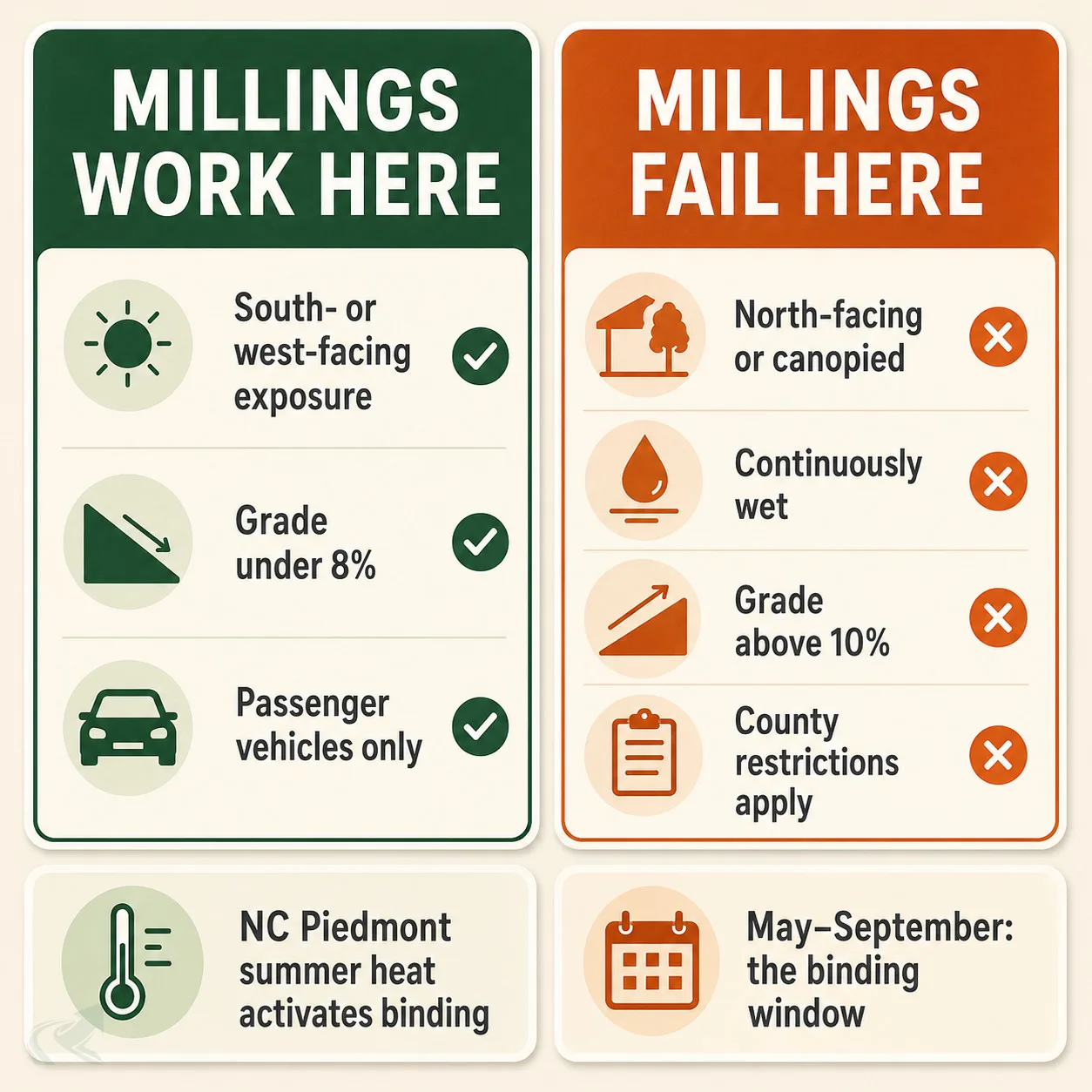
Sun exposure is the non-negotiable. A south-facing driveway in the NC Piedmont gets enough summer heat to activate binding within weeks of installation. The surface firms up. Traction improves. Millings start looking like a legitimate surfacing decision.
Terrain matters almost as much. Grades below 8% are manageable. Steeper grades — past the point where NC driveway grade standards consider millings workable — introduce two problems: vehicle braking digs into partially bound material, and on the hottest days, the top layer of dark millings can absorb enough heat to flow slightly downhill. That risk is real above 10%.
Traffic type is the third factor. Passenger vehicles only. Loaded dump trucks, excavators, or heavy equipment can break apart bound millings — especially in spring and fall when binding is partial and the surface hasn’t fully set for the season.
NC climate is actually a point in millings’ favor relative to northern states. The Piedmont’s hot summers (May through September most years) give millings enough heat-hours to bind meaningfully. Contractors in Ohio or Pennsylvania see less benefit from millings because cooler summers limit the binding window.
Cost-sensitive applications where loose-gravel behavior in winter is acceptable — rural access roads, secondary parking areas, long drives where how driveway grading works in NC determines the base before any surface goes down — are the sweet spot.
When Millings Fail in NC
Millings fail in shaded locations, continuously wet areas, steep slopes in summer heat, and anywhere loose gravel in winter is not acceptable.
Shade is the most common failure. A north-facing driveway under heavy tree canopy won’t reach binding temperatures even in a hot NC summer. The millings stay loose. They migrate to the edges. You chase them back with a shovel every spring and they’re back at the edges by fall. This is not a contractor error — it is a material mismatch for the site conditions.
Wet areas follow the same logic. Water in the substrate and on the surface prevents the pavement from reaching binding temperature. Continuously wet millings don’t bind. If your driveway sits in a wet area — water pooling after rain, soft spots, areas that won’t dry out — the problem calls for yard drainage solutions NC before any surface material is chosen, and millings will perform worse than ABC with a geotextile base.
Steep slopes introduce flow risk that surprises people. On the hottest July days, a dark millings surface on a 12% grade can absorb enough heat to soften the binder and allow the top layer to shift downhill slowly. This is rare but real in North Carolina summers.
County restrictions are a regulatory risk, not a performance risk. Some NC municipalities and counties regulate driveway surfacing in residential zones based on stormwater runoff concerns or appearance standards, and rules vary widely by jurisdiction. Check your county or town unified development ordinance before installing millings. If your local rules restrict millings, the performance conversation is moot.
Asphalt millings on a site that fits vs one that doesn't
Comparison. Flat, sunny, light traffic: South-facing drive gets full NC summer heat; Residual binder softens and the surface binds; Grade under 8% -- no flow risk on hot days; Firms up into a stable passenger-vehicle surface. Shaded or wet site: North-facing canopy never reaches binding temperature; Millings stay loose and behave like gravel; Material migrates to the edges every season; No heat means no binding -- indefinitely.
- South-facing drive gets full NC summer heat
- Residual binder softens and the surface binds
- Grade under 8% -- no flow risk on hot days
- Firms up into a stable passenger-vehicle surface
- North-facing canopy never reaches binding temperature
- Millings stay loose and behave like gravel
- Material migrates to the edges every season
- No heat means no binding -- indefinitely
Millings only bind where the surface gets hot enough -- on a shaded or wet NC driveway the binder never activates and you have loose gravel year-round.
Millings vs ABC — Which Is Better for NC Driveways
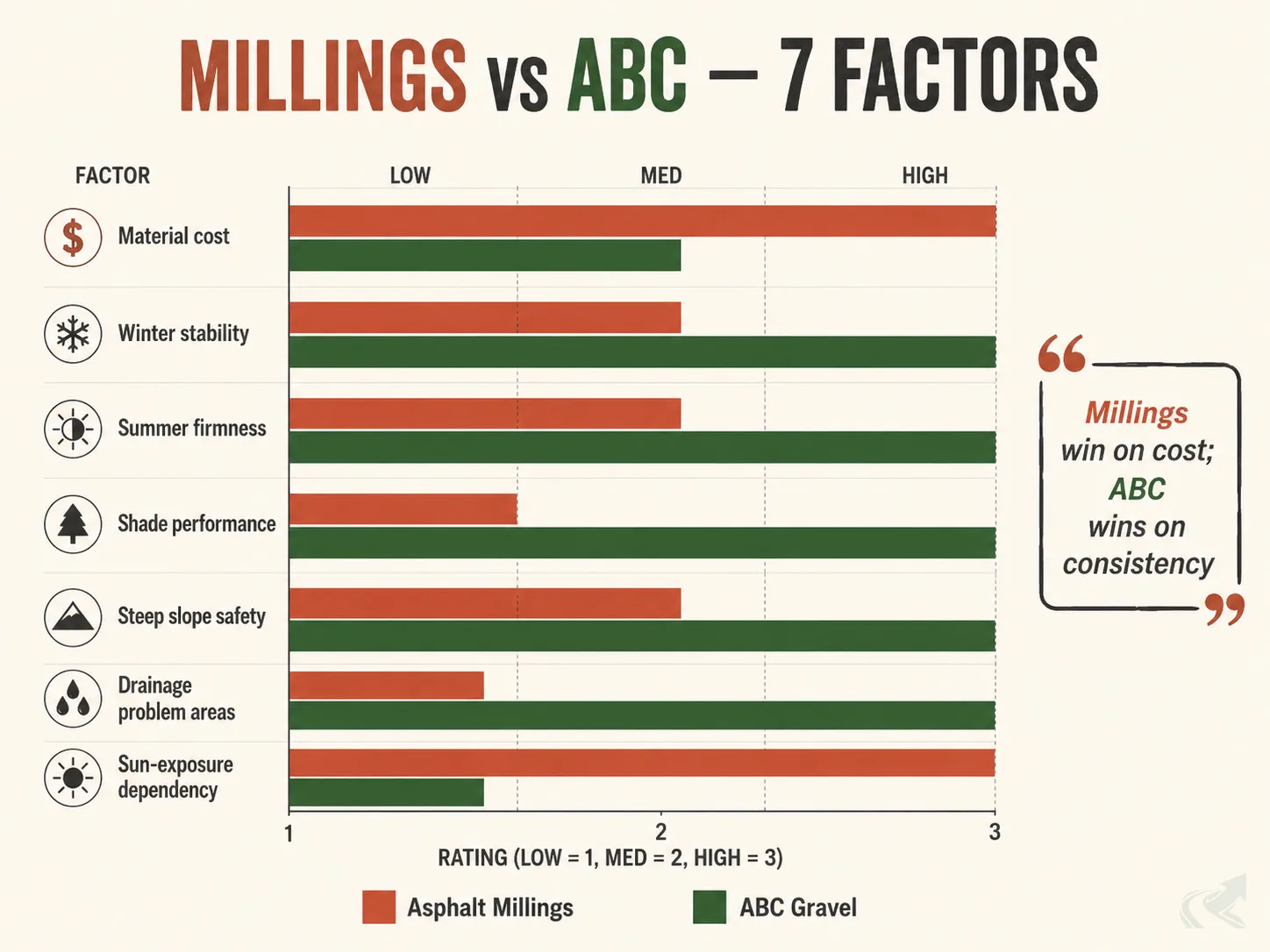
Neither is universally better. ABC is more consistent across all seasons and site conditions; millings are cheaper and bind well where conditions are favorable.
| Factor | Asphalt Millings | ABC Gravel |
|---|---|---|
| Material cost | Lower | Higher |
| Winter performance | Loose gravel behavior | Stable (compacted) |
| Summer performance | Firms up significantly | Unchanged |
| Shade locations | Poor | Acceptable |
| Drainage problem areas | Poor | Better (with geotextile) |
| Sun exposure dependency | High | None |
| County restrictions | Possible — varies by jurisdiction | None known |
| Steep slopes | Risk above 10% | Stable |
| NCDOT permit applications | Not suitable | Suitable |
Millings win when: the site has good sun exposure, flat to moderate grade, passenger traffic only, and cost savings matter more than year-round uniformity.
ABC wins when: consistent performance across all seasons is required, the site is shaded or poorly drained, HOA or county rules apply, or the project involves permit-required driveway culvert installation NC.
For a full look at how millings compare to other North Carolina driveway gravel options, see comparing asphalt millings to other NC driveway gravels.
If your driveway needs regrading before any surface material goes down, gravel driveway grading in NC covers what that work entails and what it costs.
What to Ask Before You Order
Three questions to ask before agreeing to millings:
What is the sun exposure on my driveway? North-facing or heavily canopied — pass on millings. South or west-facing with clear sky — millings can work.
What is the grade? Measure it or ask the contractor to measure it. Above 10% — ask about ABC instead. Below 8% on a sunny site — millings are worth considering.
Does my county restrict millings? Call your county or town planning department or check the unified development ordinance. This takes fifteen minutes and prevents a material rejection after the truck has already dumped.
For material delivery pricing and scheduling, asphalt millings delivery NC covers what to expect from a North Carolina materials haul.
For cost comparison across gravel and asphalt options, asphalt millings vs fresh gravel cost comparison NC breaks down the numbers.
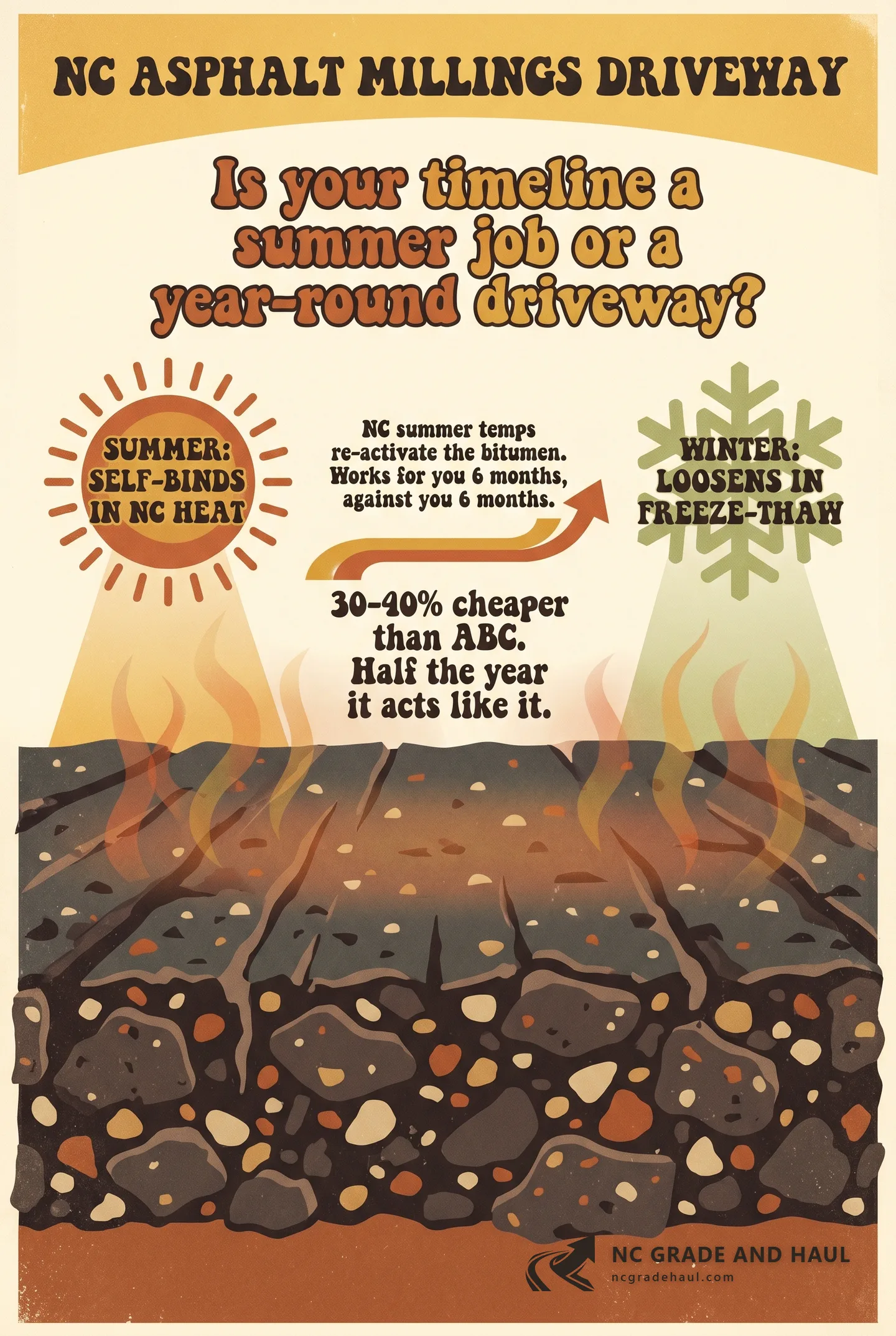
If millings meet your site conditions — flat, sunny, light traffic, no county restrictions — they’re a legitimate surface material at a real cost advantage. If they don’t meet those conditions, the $800 in savings gets paid back the first winter when the driveway turns to loose gravel and stays there until May.
Get an itemized quote that specifies the material by name and includes the depth and compaction method. Know what you’re buying.
Find a grading operator in North Carolina who can confirm whether your site conditions support millings before you commit.
If your plan includes an asphalt overlay or millings-based base for future paving, asphalt driveway grading and millings overlay covers how millings interact with that process.