
Beth called the quarry to order “ABC” and the dispatcher asked: “You mean crusher run?” She didn’t know. She put him on hold and searched. Half the results said they’re the same thing. Half said they’re not.
They are — most of the time, in North Carolina. But the name doesn’t tell you what you need to know. The gradation spec does. This page explains what actually is, why it’s the spec for Piedmont clay driveways, and the one documented condition where it underperforms.
What ABC Is — Gradation and Spec
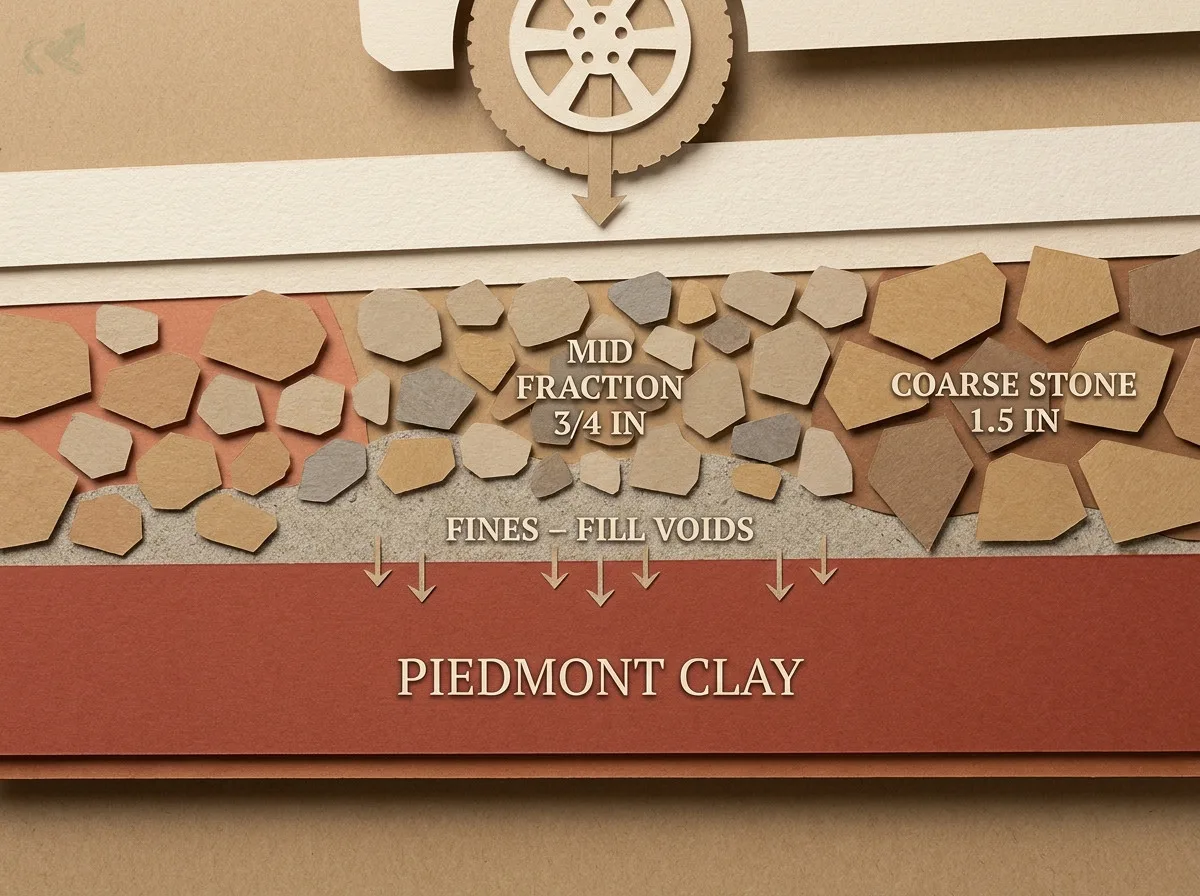
ABC is a continuously graded aggregate from coarse stone (about 1.5 inch) down to fine dust — all in one mix. The fines are the critical component, not the stones.
The mix breaks into three fractions that each do different work:
- Coarse fraction (3/4 inch to 1.5 inch): provides the structural skeleton and surface durability under traffic. This is the stone you can see.
- Mid fraction (3/8 inch to 3/4 inch): fills the space between the coarse stones, reducing void space before compaction.
- Fines (material passing the #200 sieve): fill the remaining voids. Under compaction pressure, these fine particles create the mechanical interlock that makes ABC behave as a semi-rigid matrix rather than a pile of loose stone.
references this material under the aggregate base course specification NC (Section 1010). Residential driveway practice follows the same gradation, though the specification distinction matters more for road construction than for a homeowner’s 200-foot driveway.
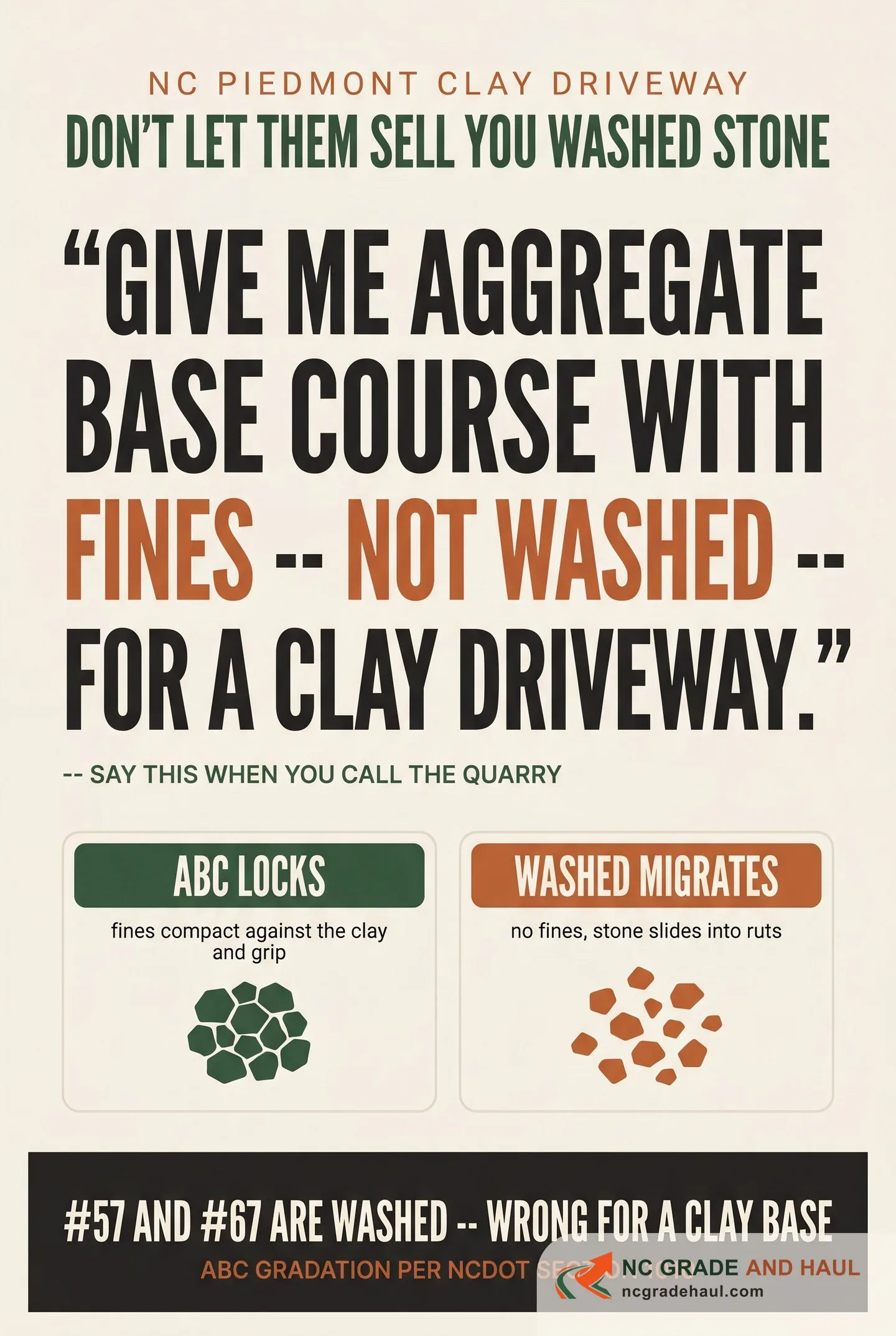
Why the fines matter: without them, aggregate is a pile of stones that rolls and shifts under load. With fines properly compacted, the material behaves as one interlocked unit. This is the critical difference between ABC and #67 stone — #67 is washed (no fines) and cannot interlock. They are not interchangeable.
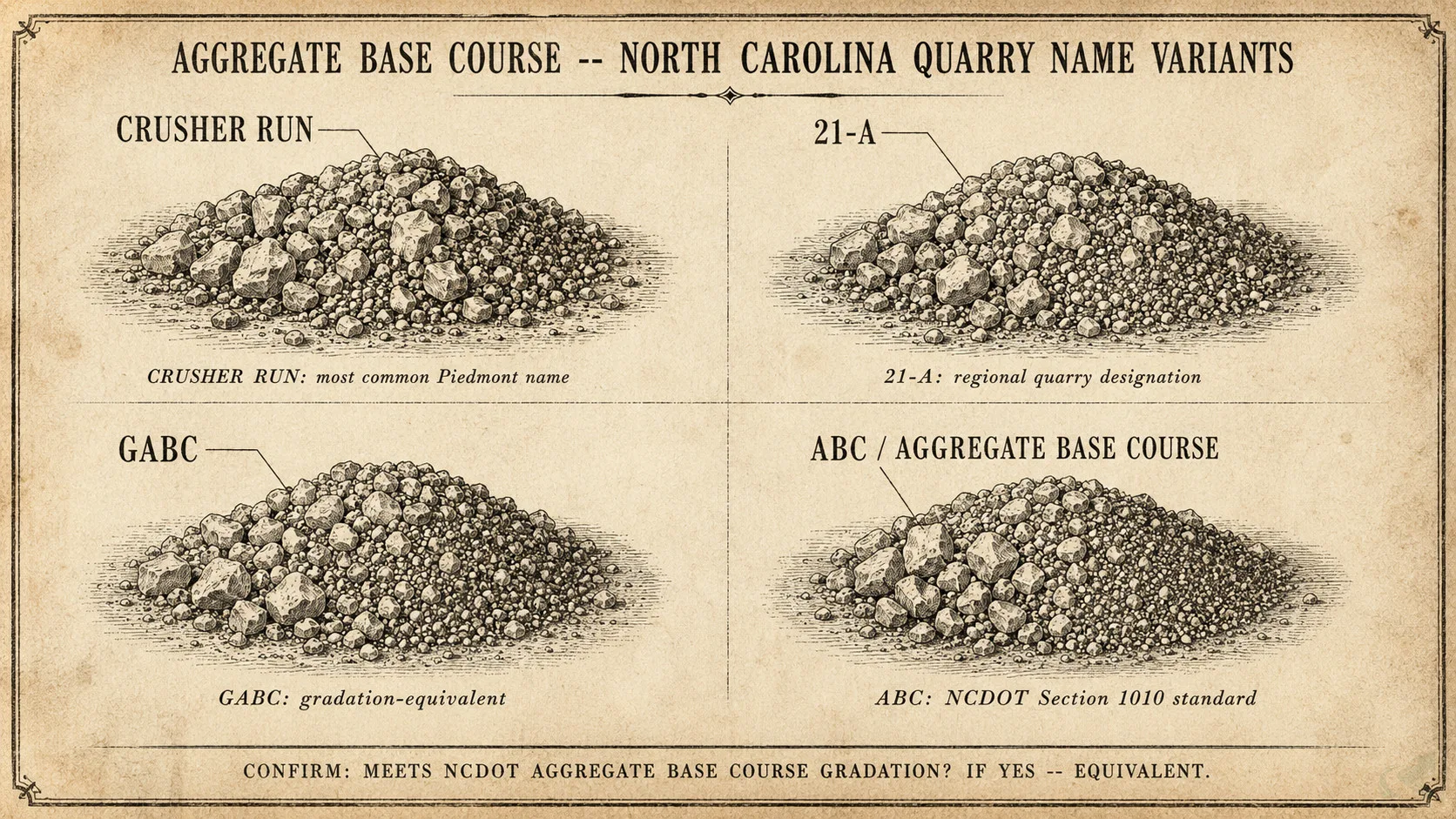
Quarry naming: “crusher run,” “21-A,” “GABC,” and “AB” are common North Carolina quarry names for the same or equivalent material. The names vary by region and supplier. The safe question is not “what do you call it” but “does this material meet NCDOT aggregate base course gradation?” If yes, it’s equivalent. If they hesitate, ask for the gradation spec sheet.
Why ABC Works on NC Clay
ABC compacts on Piedmont clay because its fines interlock with the clay surface directly — it doesn’t need drainage percolation to function, which is critical because Piedmont clay is nearly impermeable.
The subgrade type determines which aggregates actually work — and why washed stone fails in North Carolina.
On sandy subgrade, water drains vertically through the base. Almost any aggregate can function because the load never encounters full saturation at the stone-to-subgrade contact zone. NC’s Piedmont is not sandy subgrade — how red clay affects driveway grading explains why the soil type changes every material decision.
On Piedmont clay, water doesn’t drain vertically. The clay is effectively impermeable. The aggregate must carry load without the benefit of drainage — all bearing capacity comes from mechanical interlock between the aggregate and the clay surface.
ABC on clay: the fines fill against the clay surface and compact into a semi-rigid mat. The clay’s impermeability actually helps here — the firm clay provides a reaction surface against which the fines can compact and lock. The result is a base with real bearing capacity without any drainage requirement.
Washed stone (#57, #67) on clay: no fines means no fill against the clay surface. The stone sits on clay without interlock. Under vehicle load, the stone migrates laterally and creates ruts. Add more washed stone; the same thing happens faster.
What this means for ordering: never substitute washed stone for ABC in a North Carolina Piedmont clay driveway base. They are different products designed for different subgrade conditions.
ABC vs washed stone as a base on Piedmont clay
Comparison. ABC -- locks to the clay: Fines fill against the clay surface and compact; Forms a semi-rigid mat with real bearing capacity; Needs no drainage percolation to function; Holds crown and surface under vehicle load. Washed stone -- migrates: No fines means nothing fills against the clay; Stone sits on the subgrade without interlock; Vehicle load shifts stone laterally into ruts; Adding more washed stone fails the same way faster.
- Fines fill against the clay surface and compact
- Forms a semi-rigid mat with real bearing capacity
- Needs no drainage percolation to function
- Holds crown and surface under vehicle load
- No fines means nothing fills against the clay
- Stone sits on the subgrade without interlock
- Vehicle load shifts stone laterally into ruts
- Adding more washed stone fails the same way faster
Piedmont clay is nearly impermeable -- a base only works if its fines can interlock against the clay, which is exactly what washed stone cannot do.
The Fines Problem — When ABC Underperforms
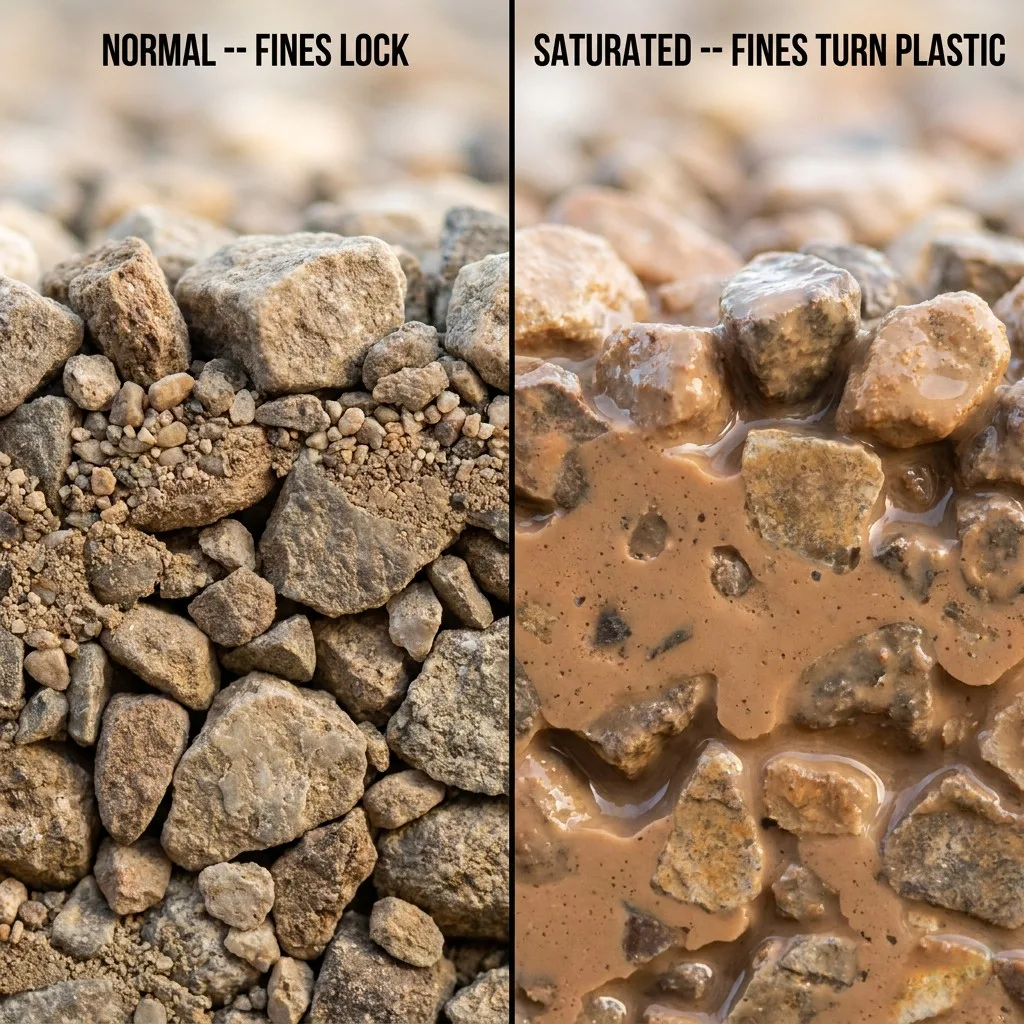
In continuously saturated or ponding areas, ABC’s fines absorb water and turn to mud under vehicle load — the same fines that make it stable in normal conditions become a liability in constant saturation.
This is the only documented failure mode for ABC on NC driveways in normal use. Understanding it tells you whether your site needs drainage correction before gravel work begins.
The failure sequence:
- Normal conditions: fines are slightly moist, providing interlock. ABC performs as specified.
- Continuous saturation: the drainage failure area never dries out. Fines absorb water until they reach plastic state — no longer a solid particle that interlocks, but a paste.
- Under load: the plastic fines squeeze out from between the stones under vehicle weight. The material loses interlock. The visible result: gravel stones sitting in a mud matrix. The stone is still there. The fines lost their binding function.
The visible sign is ABC that is consistently muddy after rain — not just surface-wet, but muddy enough that stones are visible in soft material. That is the fines-saturation failure, not just a wet driveway.
What to do when this is your situation:
- Fix the drainage first. ABC won’t perform in a location that never dries. Redirecting the water source or installing a swale, culvert, or French drain is the prior step — not a competing expense.
- Geotextile separation fabric: a layer of nonwoven geotextile between the clay subgrade and the ABC prevents clay from migrating upward into the base under load. This reduces but does not eliminate the saturation problem. It addresses the upward clay migration, not the downward water source.
- Alternative aggregate: in the worst locations — a low point that collects water from multiple directions — an open-graded aggregate over geotextile may be more appropriate than ABC. Open-graded aggregate allows drainage through the base rather than relying on fines for bearing.
A contractor who specifies ABC for a wet spot without addressing the drainage source is setting you up for the failure mode described above. Site drainage assessment — including driveway crowning in NC to shed surface runoff off the edges rather than letting it pond — comes before gravel specification, not after.
ABC vs Crusher Run — Same or Different in NC?
At most NC Piedmont quarries, crusher run and ABC are functionally equivalent — same gradation, same performance on a driveway. The name difference is quarry-specific, not a spec difference.
The naming split across North Carolina quarries:
- Many quarries use “crusher run” as their standard name for mixed-gradation base aggregate. The material meets the ABC spec — they just don’t call it that.
- Some quarries distinguish “crusher run” (coarser gradation, fewer fines) from “ABC” (matches NCDOT gradation specification). At those quarries, they are not equivalent — the ABC has more fines and compacts better.
- “21-A” is a quarry-specific name used in some NC regions, not an NCDOT specification number. If a quarry uses it, ask for the gradation sheet to confirm fines content.
The safe question at any quarry: “Does this material meet NCDOT aggregate base course specification?” A yes answers the equivalence question. A “it’s like ABC” or “it’s crusher run, similar” is not a confirmation — ask for the gradation spec sheet.
For residential driveways, the practical performance difference between crusher run and ABC is negligible when both include adequate fines and compact correctly. The NCDOT specification distinction matters for road construction and permitted work. For a homeowner driveway, ask about fines content — not the product name.
For a full breakdown of when the distinction matters and when it doesn’t, see crusher run vs ABC explained.
How to Order ABC — Quarry Conversation Guide
Order ABC by the ton, specifying that you need “aggregate base course with fines for a residential driveway — not washed.”
Quantities for planning:
- 1 ton of ABC covers approximately 80—100 square feet at a 2-inch depth (compacted). Variation depends on moisture content and compaction rate at your specific quarry’s product.
- Standard 100-foot driveway at 12-foot width, 2-inch layer: approximately 15—18 tons of material. Add 10—15% for variation in spread and compaction.
- Most NC quarries require a minimum load of 18—22 tons per delivery truck. A single delivery truck covers a standard suburban driveway base layer with material to spare.
The quarry conversation:
- Ask: “I need ABC for a residential driveway base — mixed gradation with fines. What do you call that?”
- Listen for: “crusher run,” “21-A,” “ABC,” “GABC,” “base stone” — any of these from a Piedmont quarry is likely the right material
- If they ask “washed or not?” — say “not washed, I need the fines”
- If they offer multiple products: ask which one has the fines that compact to a firm surface
Copy this when you call:
“I need aggregate base course for a residential driveway on Piedmont clay — mixed gradation with fines, not washed. What do you call that material and what’s your minimum load?”
For ABC gravel delivery NC logistics — minimum loads, spread options, and what to ask a hauler — see the delivery spoke. For all NC driveway gravel types compared, see the gravel hub.
Getting an Itemized Quote
An itemized quote separates material, delivery, spreading, and compaction as distinct line items — not a single per-load number.
Ordering the right gravel is the first step. Getting it spread and compacted correctly is the second. A quote that bundles all of this into “3 loads, spread and grade, $X” gives you no visibility into what you are actually paying for.
Ask for the itemization before you agree to anything:
- Material: ABC by specification, quantity in tons (not “loads”)
- Delivery: per-truck charge separate from material cost
- Spreading: labor and equipment cost to distribute the material
- Compaction: what equipment, how many passes — separate from spreading
These are three distinct services. You need to know which ones the quote includes. A grading contractor near me in NC search on NC Grade and Haul returns contractors with license status and public record references so you can check credentials before you call.
For gravel driveway grading and compaction sequence — the step-by-step of what happens after delivery — see the grading spoke. For how driveway grading works in NC, see the grading hub.