
Ray Pettiford’s farm road in Alamance County is getting thin. Bare clay is starting to show at the edges. After every hard rain the gravel pushes to the low side of the road. He knows a gravel top-up is what it needs — the question is how much to order and what kind to get.
That is what this page answers: the volume formula, how to pick the right stone, and when a top-up alone will not solve the problem.
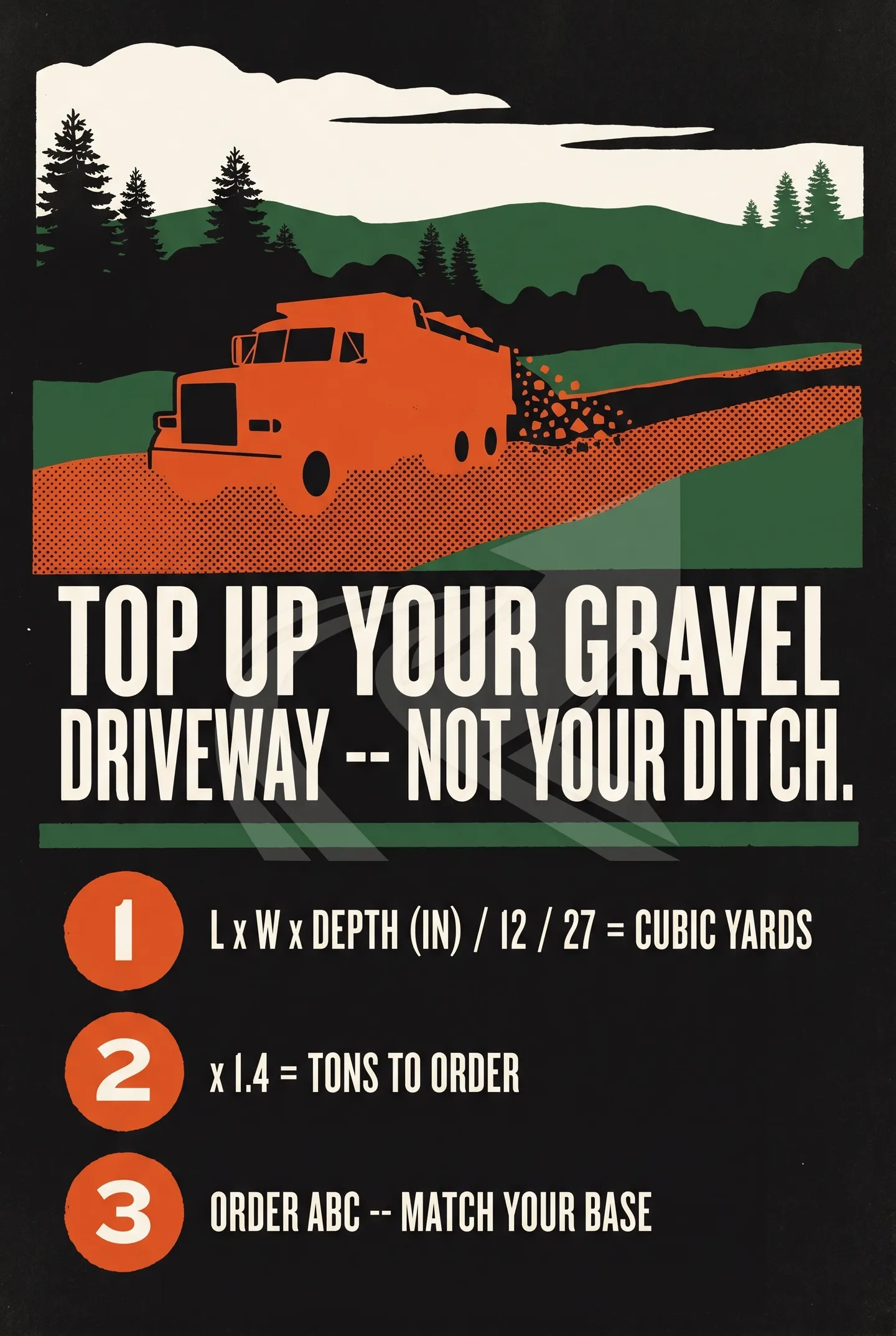
The Top-Up Volume Formula
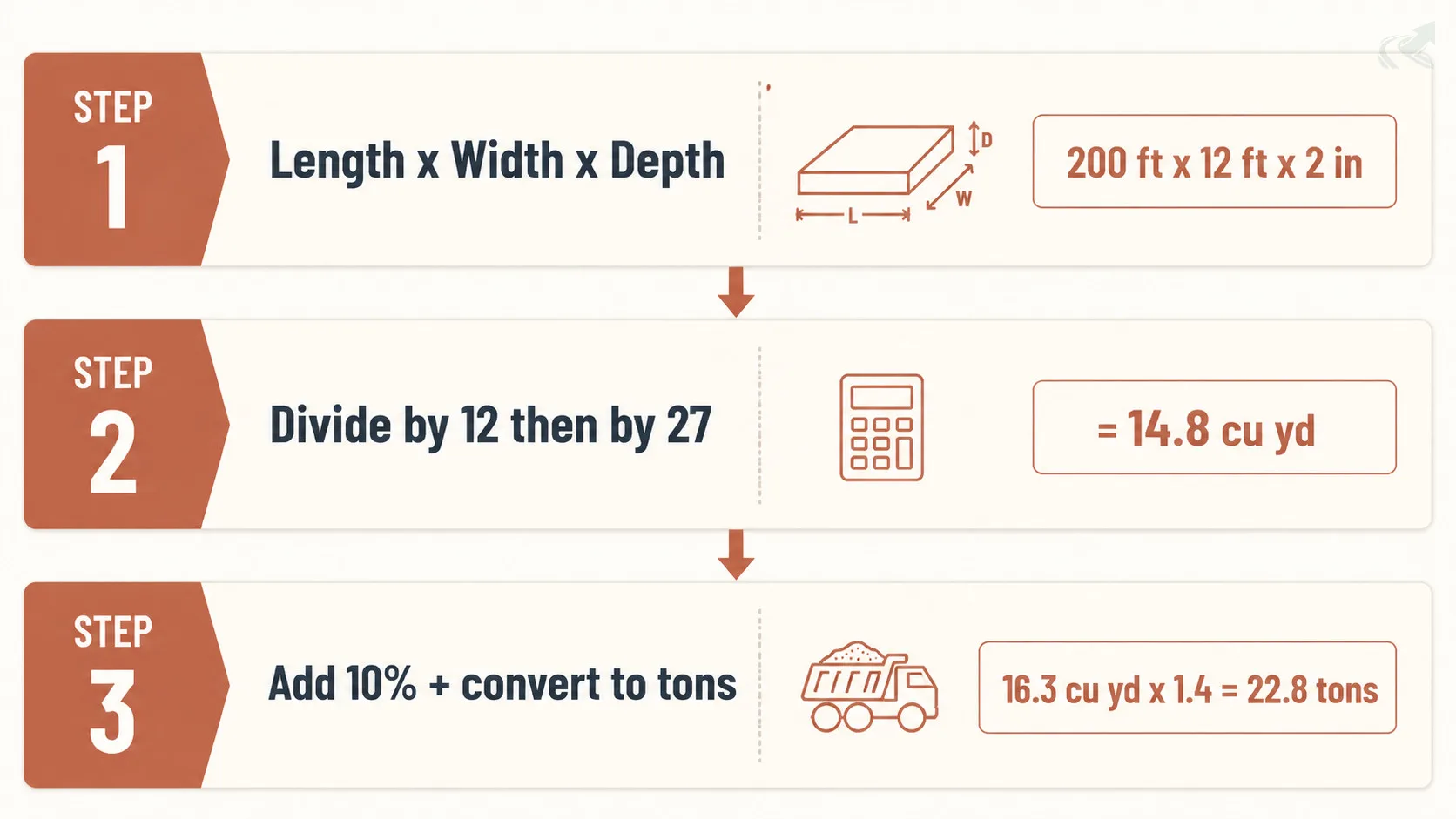
Multiply length by width by depth (converted to feet), then divide by 27 to get cubic yards. That is the number to start with.
The formula in full:
Length (ft) x Width (ft) x Depth (in) / 12 / 27 = cubic yards
Worked example — 200-foot farm road, 12 feet wide, 2-inch top-up:
200 x 12 x (2 / 12) / 27 = 14.8 cubic yards
Add 10% for settling and edge waste: 16.3 cubic yards. Round up to a full delivery load — quarries typically deliver in 10- or 14-yard increments.
Converting to tons for the quarry order: ABC stone weighs roughly 1.4 tons per cubic yard (dry). Multiply your cubic yard figure by 1.4 to get the approximate tons to order.
16.3 yards x 1.4 = 22.8 tons
Quarries sell and ticket by tons off the scale — order by tons, not yards, and verify the delivery ticket when the load arrives.
When to use 3 inches instead of 2: if the existing surface is bare clay in spots or the gravel layer tests thinner than an inch when you probe it, order for 3 inches of new material. A thin top-up over a degraded surface fails quickly.
Stone Type for Top-Up
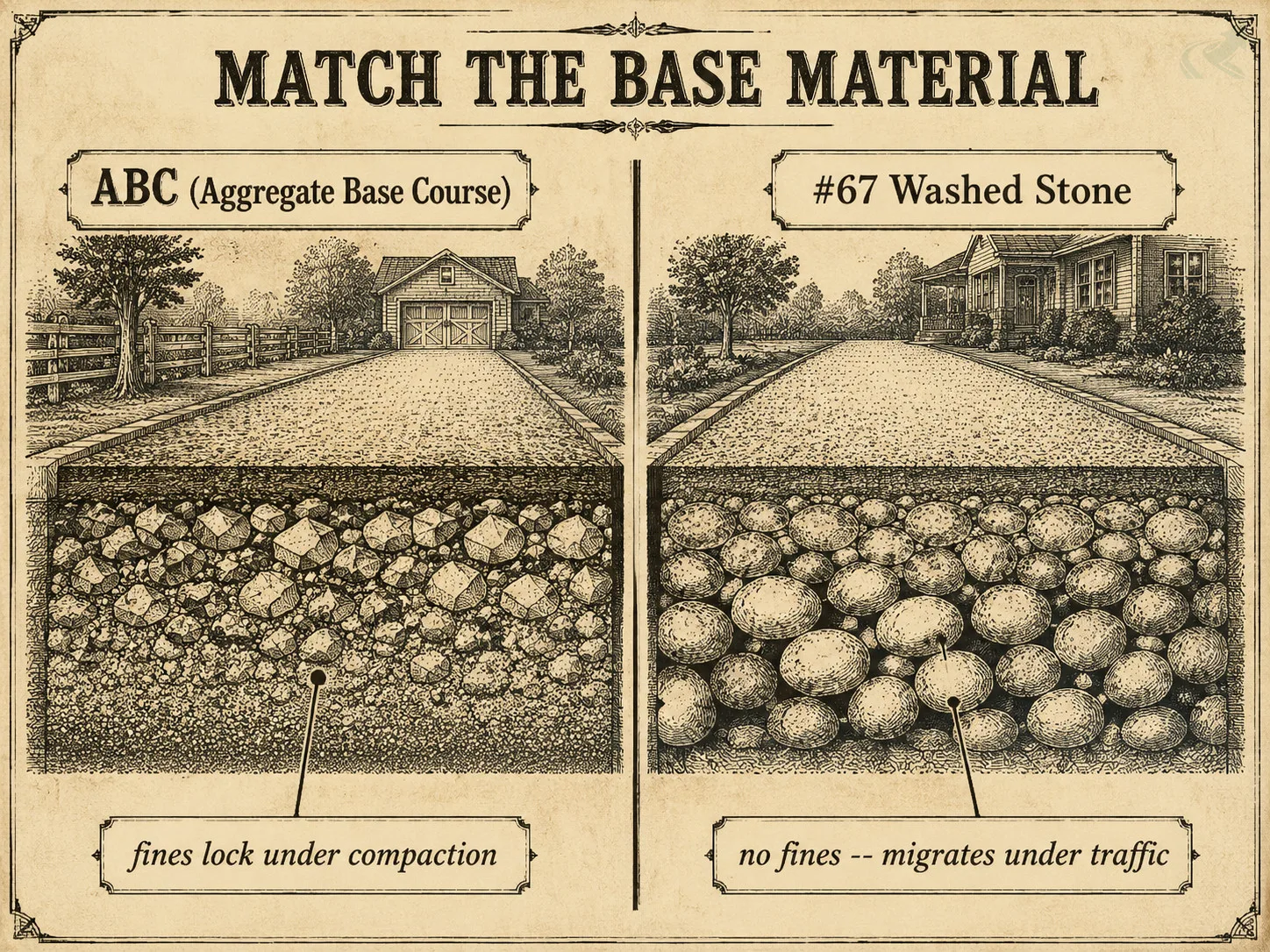
Order the same material that is already on the driveway. For most North Carolina driveways — and virtually all farm roads — that means ABC.
ABC (Aggregate Base Course) is graded from 1.5-inch pieces down to fine material. The fines lock under compaction. That is why it works as a driveway base in NC: it creates bearing capacity on top of Piedmont or Coastal Plain clay.
If you top up an ABC driveway with #67 or #57 washed stone, the new material will not bond to the existing surface. Washed stone has no fines. It sits loose on top of the compacted ABC below, migrates under tire traffic, and ends up in the ditch within a season.
Common mistakes to avoid:
- Ordering #67 over an ABC base. #67 won’t compact — it will roll off the existing base and migrate to the low side. Always match the base material.
- Ordering #57 as a surface layer. Same migration problem. Neither washed stone grade is appropriate over an existing ABC base.
- Not confirming what is down before ordering. Dig a small test pocket at the edge. If the existing material has visible fines and locks when squeezed, it is ABC or crusher run — order the same.
When the base has mixed with subgrade: if the gravel layer has contaminated with clay (it looks gray-brown and sticky), a straight top-up will not hold. The contaminated layer needs to be pulled and replaced — that is a regrading job, not a top-up.
Top-Up vs Regrade — How to Decide
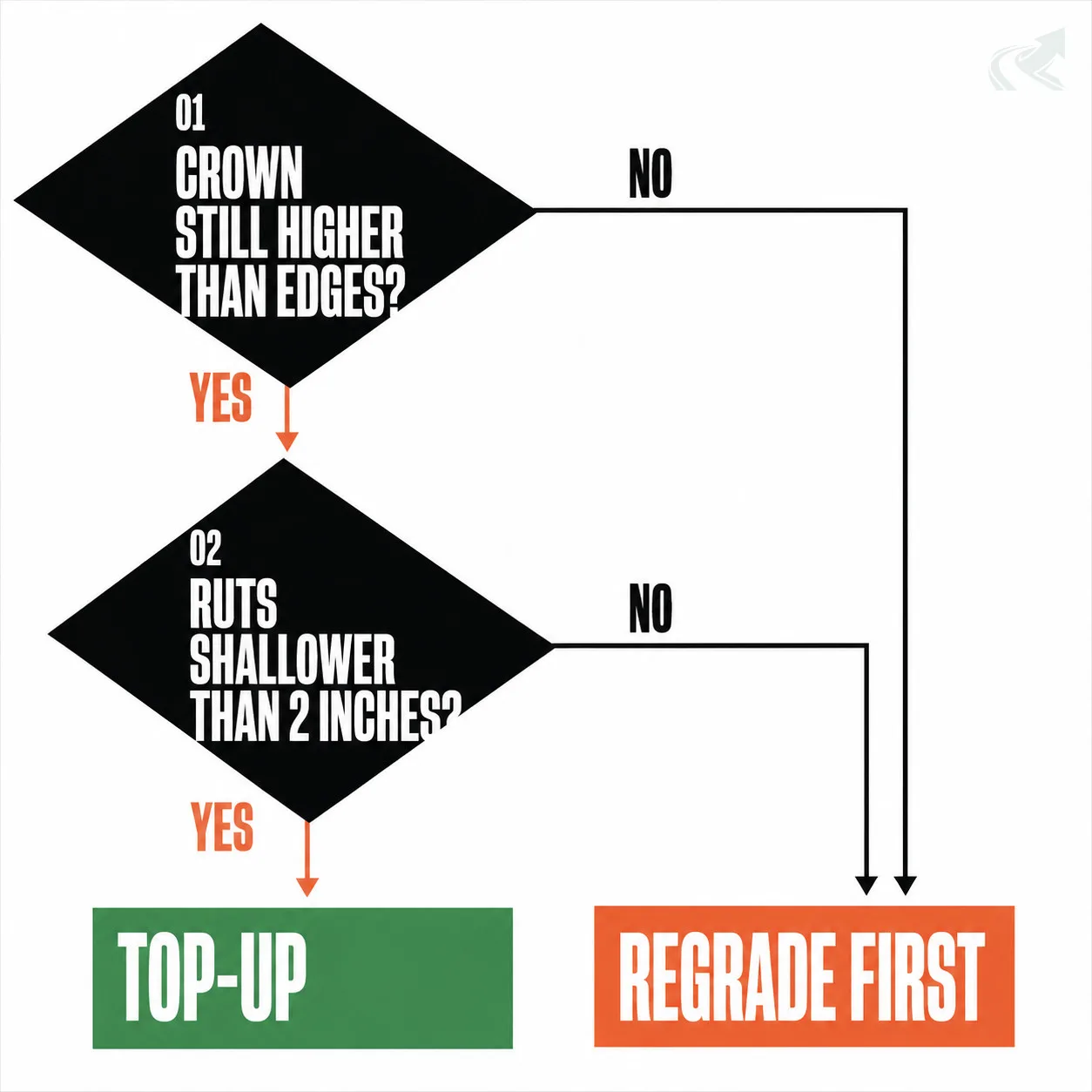
A top-up works when the base geometry is still sound. If the crown is flat, ruts cut through to clay, or drainage has failed, regrading must come before any new material.
This matters to Ray because ordering 22 tons of ABC on a drainage-failed base does not solve the problem — it just adds new material to the same divots the old gravel already found.
Run this quick diagnostic before you order:
- Walk the road after rain. Soft or spongy spots underfoot mean the base is compromised. Regrade required.
- Check the crown. Stand at one end and look down the centerline. Is the center higher than the edges? A flat or reversed crown means water is pooling center-to-edge instead of draining to the sides. Regrading restores the crown; gravel alone cannot.
- Look at where the gravel went. If it piled to one edge or into the ditch, the geometry drove it there. Adding more gravel without fixing the geometry means the same thing happens again.
- Check rut depth. Ruts shallower than 2 inches that do not expose clay — top-up may be enough. Ruts deeper than 2 inches or exposing bare clay — regrade first.
The honest call on most North Carolina farm roads that have been in service for 5+ years: some regrading is usually part of the scope. A pure top-up with no grading works only when the crown is intact, the base is tight, and you are addressing cosmetic thinning.
For a deeper look at gravel driveway grading before or after top-up — including the full regrading sequence — see the gravel grading spoke. For cost of driveway gravel top-up vs full regrading NC, the cost page breaks down both scopes.
How to Prep the Driveway for Delivery
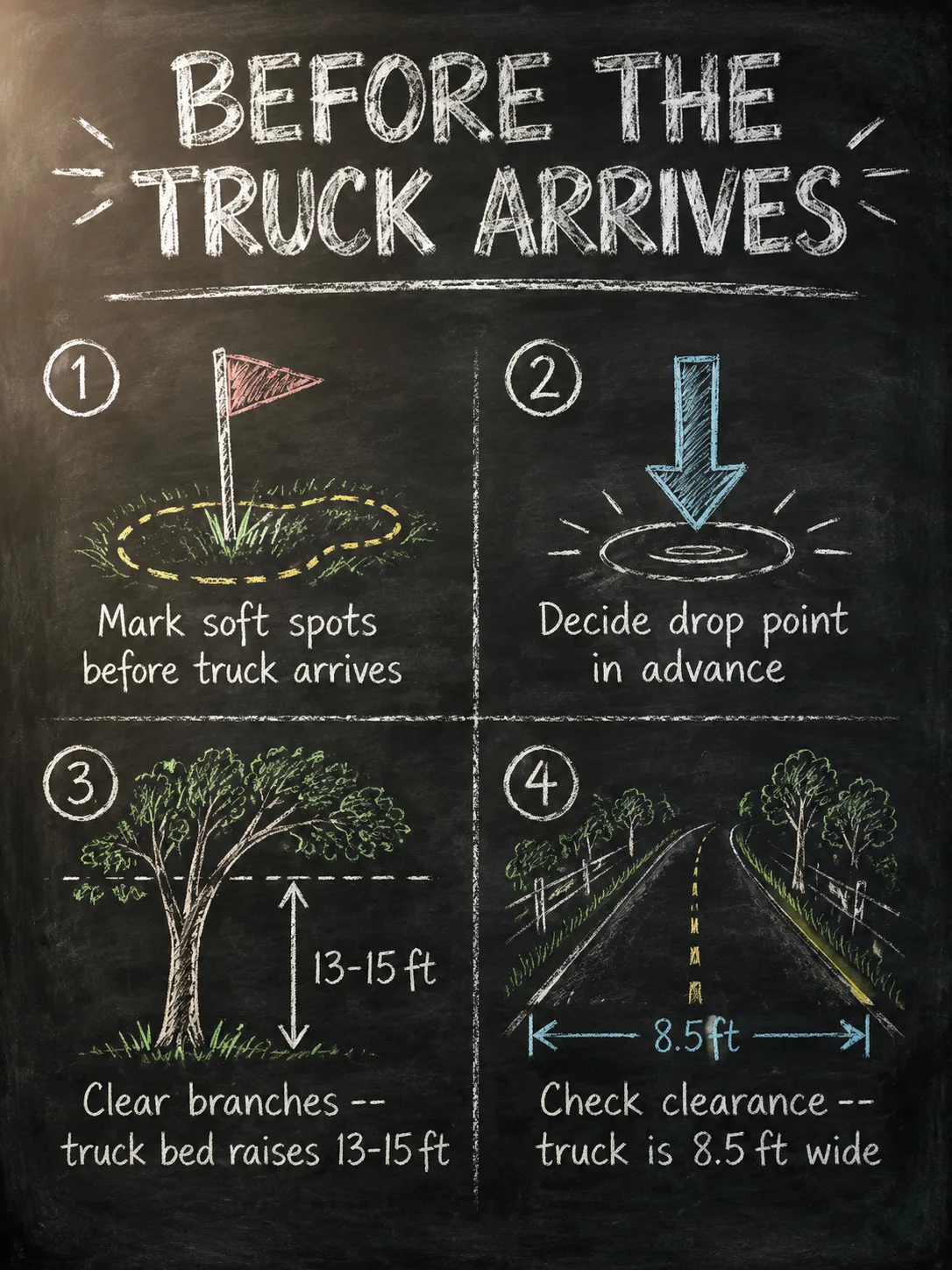
Clear the delivery path, know where you want the material dropped, and identify any soft spots before the truck arrives.
A fully loaded gravel delivery truck runs 60,000-80,000 pounds — NC dump truck weight limits are permissive on state roads, but the truck will break through soft spots near the gate or along the approach, and getting it unstuck is a significant cost.
Steps to take before delivery day:
- Walk the approach and mark soft spots with stakes or flags. Give the driver a clear path that avoids them. If the soft spots are unavoidable, consider a partial delivery from the road edge and spreading from there.
- Decide the drop point in advance. If the contractor is spreading material, the truck can tail-gate — releasing material slowly as it drives forward. If you are spreading yourself, a stockpile at one end works, but you will need equipment to move it.
- Clear the gate and any low-hanging branches. A dump truck with the bed raised is 13-15 feet tall. Branches that are fine for passenger vehicles can stop a delivery.
- Check truck clearance for the whole run. On longer farm roads in North Carolina, note any tight turns, culvert crossings, or narrow sections. Most standard dump trucks are 8.5 feet wide.
Ordering from the Quarry
Call with the tonnage and the material spec. Order by tons, confirm the delivery ticket matches before the truck leaves.
When you call the quarry:
- State the material: “ABC stone” (or “Crusher Run” if that is what your quarry calls it — the name varies across NC quarries, but the gradation is the same). Confirm that it includes fines.
- State the tonnage: give them the number from your formula calculation, rounded up to the next delivery increment.
- Confirm the delivery date and time window. Quarry schedules can be tight; locking the time prevents a missed delivery that leaves you without material for a crew standing by.
- Ask about delivery minimums and surcharges. Some NC quarries have minimums (often 10 tons) and add a fuel surcharge for destinations beyond a certain distance.
At delivery: verify the ticket. The delivery ticket from the scale shows the truck tare weight (empty), gross weight (loaded), and net weight (material). The difference is what you paid for. If the net is substantially short of what you ordered, note it before the truck leaves.
For a full explanation of calculating driveway top-up gravel in yards vs tons and why the conversion matters, the yards-vs-tons spoke has the detail.
Getting the Right Contractor
For NC gravel delivery for driveway top-up, the hub lists what to look for in a delivery and spreading contractor. For the regrading component, hire a verified NC grading and hauling contractor on NC Grade and Haul.
If the diagnostic above confirmed that your road needs regrading before a top-up, that is two scopes: regrading (equipment + operator) and material delivery (truck + quarry). Some North Carolina contractors handle both; others specialize in one.
When getting quotes, ask for the scope to be itemized:
- Material: named by spec (ABC, CABC, #67) and quantity in tons
- Regrading: called out separately from material delivery if both are in scope
- Spreading: tail-gate distribution or stockpile-and-blade, called out separately
- Compaction: whether a compactor pass is included after material is placed
A quote that says “gravel and grade, $X” without those line items is not a complete scope. You need to know which services you are paying for.