
Two questions Triangle homeowners ask after the first flood
Is my DR Horton drainage problem a known pattern or just my lot?
You're almost certainly not alone. Production builders grade to site-plan approval minimums -- a legal standard, not a performance standard. In NC Piedmont clay, minimum grades commonly settle into standing water within 1-3 years. The dynamic is structural to production homebuilding generally, not unique to your lot or your builder.
What can I actually do about it?
Three tools work: the certification letter (forces the builder to put the fix in writing), the county inspector escalation (triggers re-inspection if as-built deviates from the approved site plan), and the NCLBGC complaint pathway if the builder used an unlicensed grading sub. The certification letter is the fastest first step.
Picture a scenario that plays out across Triangle new-construction communities. You close on a new production-builder home in Holly Springs. First significant rain — water pools next to the foundation for 48 hours. You call the warranty line. Someone comes out. Says the grade “looks fine.”
You ask for a second opinion. You’re told drainage is a homeowner responsibility after year one.
You get two quotes from independent contractors. They disagree by 3x. Now you don’t know whether you’re being managed or whether the quotes are real.
What most homeowners in that position don’t know: the forces behind this scenario are structural to production homebuilding — and there’s a specific escalation path that works.
The Grading Pattern — What Production Builders Actually Do
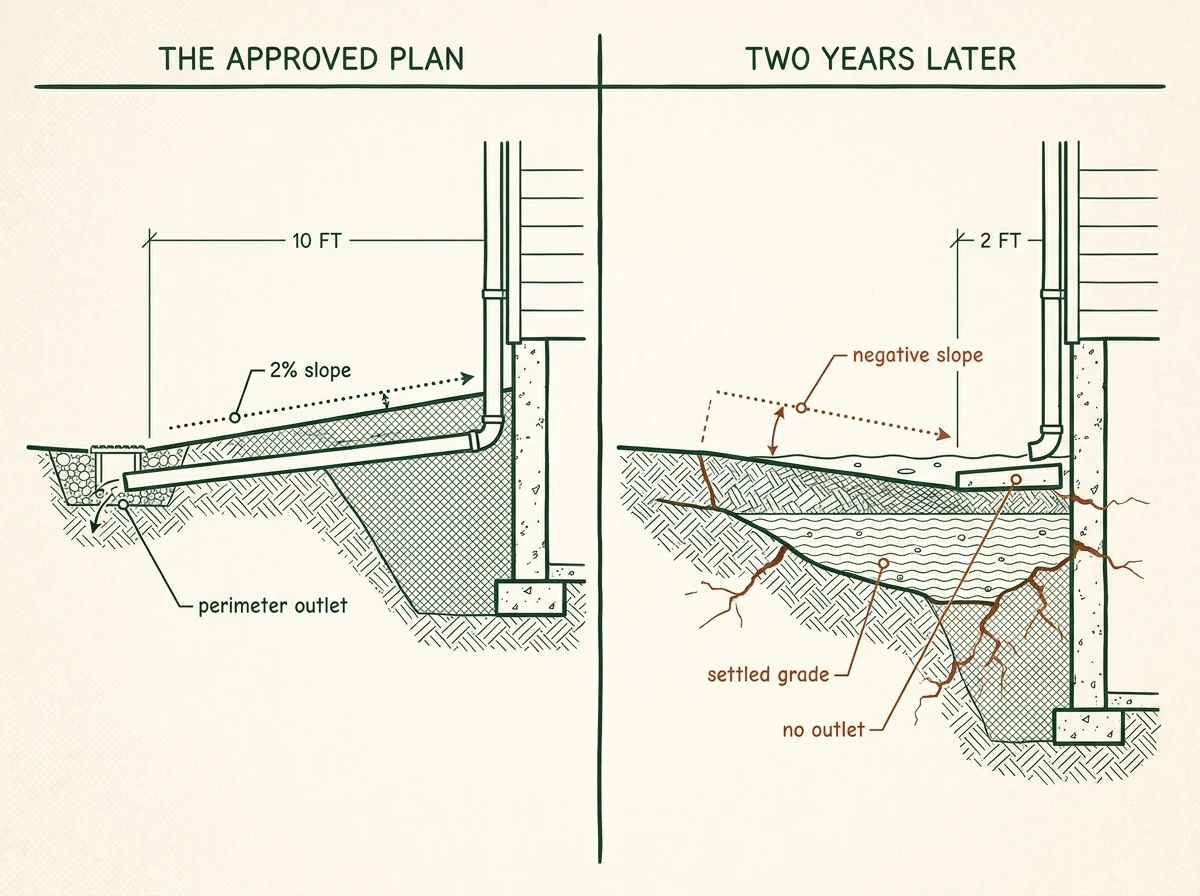
Production builders grade to site-plan approval minimums — which satisfies the county inspector but often fails in NC Piedmont clay within 18-36 months.
Site plans get approved based on grading drawings, not on field verification of actual compaction or slope percentage. The county inspector signs off on a document, not on what the crew finished at 4pm on a Friday.
The industry standard for positive drainage is a 2% slope away from the foundation for the first 10 feet. Production builders hit this on paper. Field variation exists because grading crews are production-paced — they’re measured on how many lots they turn per week, not on whether each lot drains in 5 years.
North Carolina Piedmont clay compacts differently than the national standards used in site-plan calculations. Clay settlement over time shifts the finished grade. A grade that technically met spec on move-in day can read as a negative slope toward the foundation two years later.
Downspout discharge is routed to the lot perimeter on the drawings. Field execution sometimes terminates in surface splash blocks that discharge 2 feet from the foundation wall — with no path to a daylight point.
This isn’t a conspiracy. It’s production math. Speed plus margin pressure plus minimum standards equals the drainage pattern you’re looking at.
The approved site plan vs what the production crew actually built
Comparison. On the approved plan: 2% slope away from the foundation for the first 10 feet; Downspouts routed to the lot perimeter; Grades drawn to satisfy the county inspector's sign-off; A legal standard the plan meets on paper. In the field two years later: Standing water pooling at the foundation; Settled grade now reading as a negative slope; Splash block discharging 2 feet from the wall; No daylight point for the downspout flow.
- 2% slope away from the foundation for the first 10 feet
- Downspouts routed to the lot perimeter
- Grades drawn to satisfy the county inspector's sign-off
- A legal standard the plan meets on paper
- Standing water pooling at the foundation
- Settled grade now reading as a negative slope
- Splash block discharging 2 feet from the wall
- No daylight point for the downspout flow
Site plans get approved on a drawing, not on field verification -- minimum grades in Piedmont clay commonly settle into standing water within 18 to 36 months.
How to Check the NCLBGC Records
license and complaint records are public — any contractor’s license status, class, and complaint history can be searched without a login on the NCLBGC portal.
Grading complaints against production-builder projects typically fall into one of two buckets. The first is against the builder’s grading subcontractor — whose license status, license class, and complaint history can all be looked up independently on the NCLBGC portal. The second is against the builder’s warranty team for denying documented failures.
The grading sub is often the more actionable target. Production builders — DR Horton included — typically subcontract grading work rather than grade lots in-house. The subcontractor holds the grading license and carries the exposure. If that sub’s license is in a class below what the project scope required, that’s a NCLBGC matter.
What you can look up yourself right now: go to the NCLBGC portal and search for the grading subcontractor named on your permit. Their active status, license class, and any complaint history are public records — no login required.
Specific complaint counts and violation rates are not published here. NCLBGC complaint data is public, but it requires a direct portal search on the named contractor to confirm current figures — this page does not state numbers it cannot source to a public record. If a grading-complaint pattern specific to Wake, Durham, or Orange County is later confirmed from direct NCLBGC portal records or county permit violation data, it will be added with the source citation.
Three Escalation Tools — Which One Fits Your Situation
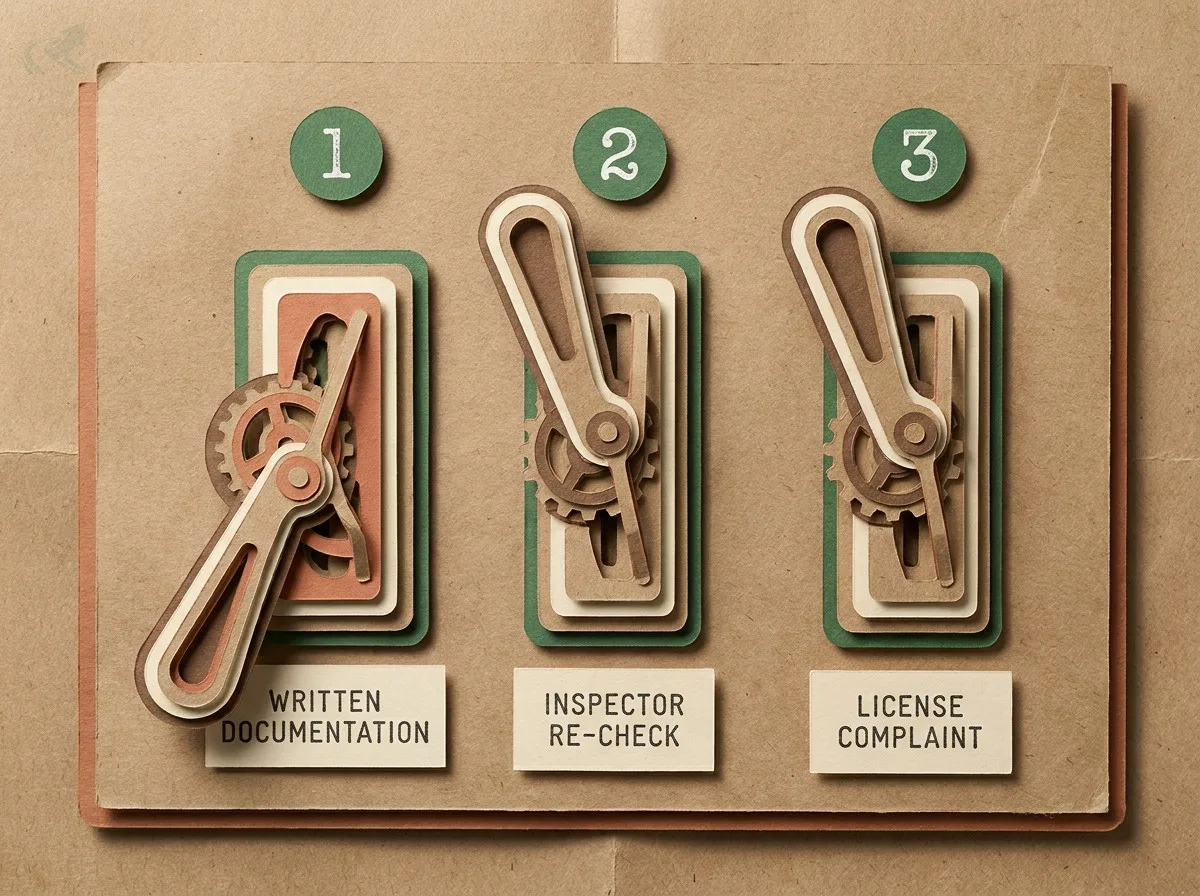
The certification letter, the county inspector route, and the NCLBGC complaint path each work in different situations — most Triangle homeowners should start with the certification letter.
The Certification Letter
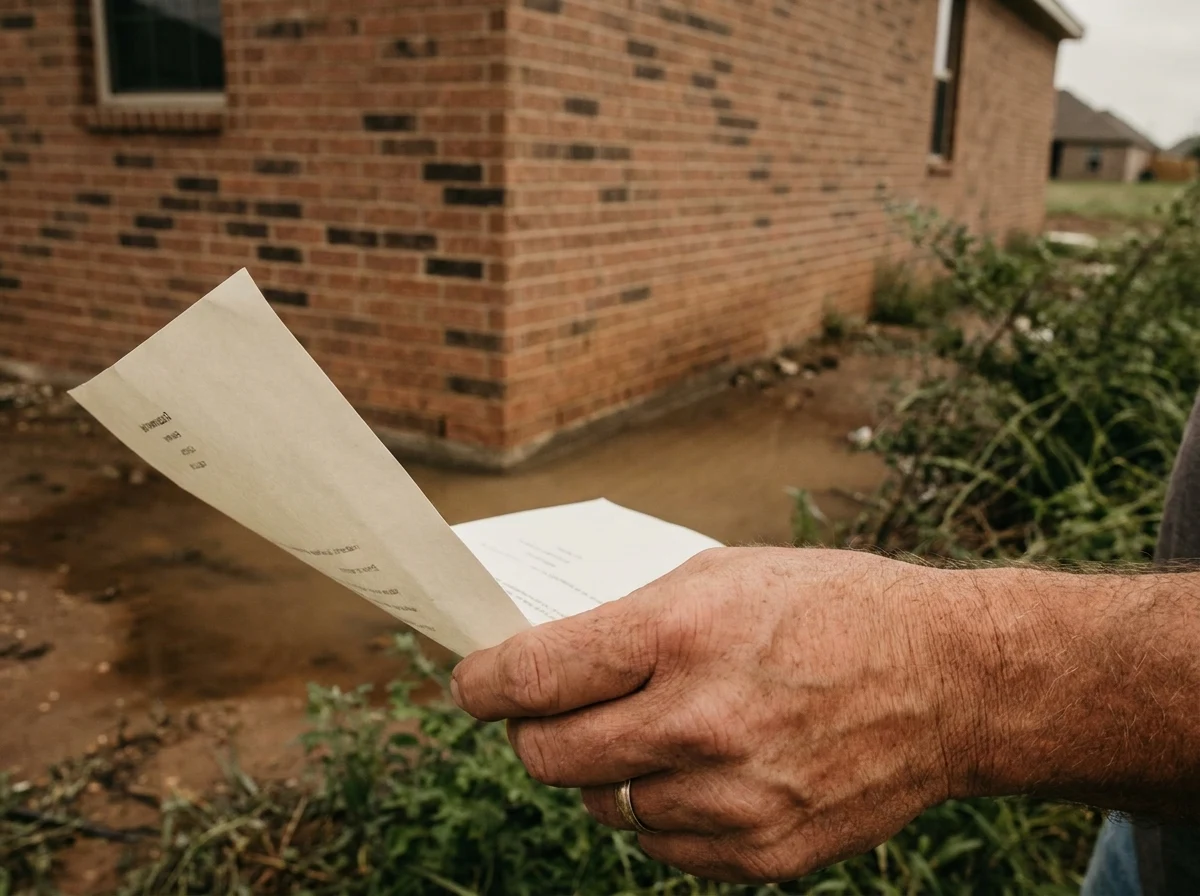
What it is: A written request asking the builder’s warranty team to certify in writing that the as-built grading on your lot matches the approved site plan’s drainage standards.
Why it works: Most warranty teams will not sign a false certification. The liability exposure is immediate and direct. Asking verbally gets verbal reassurance. Asking in writing gets either a written commitment or silence — and silence tells you something.
When to use it: Inside the warranty period. North Carolina has no statutory new-home warranty — builders are not legally required to provide one. Your coverage comes from two places: the express written warranty in your purchase contract (production-builder contracts commonly state a 1-year workmanship period, and many include a separate longer-term structural coverage, but the exact terms are set by your contract, not by statute) and North Carolina’s common-law implied warranty against major structural defects for the original buyer. Both are bounded by a hard outside limit: under North Carolina’s six-year statute of repose (N.C. Gen. Stat. 1-50), once the builder has been off the job for six years a homeowner is generally barred from suing for a construction defect regardless of when it is discovered. Read your purchase agreement for your specific written terms. After the workmanship window closes, the escalation path shifts to county inspectors and the NCLBGC.
Learn how to make your Triangle builder put the fix in writing.
The County Inspector Route
What it is: A request for re-inspection by the county building inspector to compare as-built grading against the approved site plan.
Why it works: If the as-built grade deviates from the approved plan, the inspector has authority to require correction. The approved plan is a legal commitment, not a suggestion.
When to use it: When you have the approved site plan in hand — request it from your county permit office — and have documented evidence (photos, measurements) that the field condition deviates from what was approved.
The NCLBGC Complaint
What it is: A formal complaint against the grading subcontractor for unlicensed work or use of a license class below what the project scope required.
When to use it: If you look up the grading sub named on your permit and find their license is inactive, expired, or in the wrong class for the work scope. An unlicensed grading sub on a production-builder lot is a violation with real regulatory teeth.
Know what you’re dealing with — stop work if your grading sub is unlicensed.
How to Pull the Public Records That Support Your Case
Your county permit office and the NCLBGC portal both hold public records that document your builder’s approved plan and the contractor’s license status — request them before any escalation call.
-
Request the site plan. Go to your county permit office. Wake County’s permit records are searchable at the county permit portal (permitsearch.wake.gov — records after July 1, 2018 are searchable without an account). Request the approved grading plan for your lot. This is a public record — you do not need an attorney to access it.
-
Identify the grading subcontractor. The permit will name the contractor of record. Write down their name and license number exactly as it appears.
-
Look up the license. Search the NCLBGC public verify-license portal (portal.nclbgc.org/Public/Search — no login required) for the contractor named on the permit. Confirm active status and the license class they hold. Class matters — not every license class covers every scope of work.
-
Document the deviation. Photograph standing water from multiple angles. Measure slope at 10 feet from the foundation — a 4-foot level and a tape measure are sufficient. Note every downspout discharge point and whether water reaches a daylight point or pools in the yard.
-
Keep a date log. Every rain event, every warranty call, every response from the builder — documented with date, time, and who you spoke with. Verbal assurances that leave no record are not assurances.
The builder’s documentation is already public. Your documentation just needs to match theirs.
Common Mistakes That Weaken Your Case
Avoiding these keeps your escalation path open. Making them can close it.
Calling the warranty hotline instead of requesting documentation. Phone calls produce verbal assurances. A written documentation request produces either a written commitment or a paper trail showing they refused to give one. Use the script in the section below.
Waiting past the warranty period. The workmanship window is typically 1 year. If you’re past it, the county inspector and NCLBGC paths are still open, but the certification letter loses its direct leverage. Don’t wait.
Accepting “it rained a lot” as an explanation. Standing water for 48 hours after a standard rain event is not a rainfall volume issue. It is a drainage design or execution issue. These are different problems with different fixes.
Letting the builder send their own contractor for the assessment. Get an independent evaluation before agreeing to the builder’s proposed remedy. The builder’s contractor has an incentive to confirm the minimum-cost fix, not to document the actual scope of the failure. Find a grading operator in North Carolina for an independent itemized quote.
Copy This for Your First Warranty Call
Use this exact language — in writing — for your first contact with the builder’s warranty team after you’ve documented the drainage problem.
That language does three things: it names what you want (documentation), it names the specific standard (approved site plan), and it specifies the format (in writing). Most warranty teams that have a legitimate response will provide it. Teams that don’t have one will ask to call you instead.
Does This Work If You’re Not in a DR Horton Build?
Yes — the same escalation tools work for Lennar, Pulte, Smith Douglas, Clayton, and any other production builder in the Triangle.
DR Horton is named here because they are the largest homebuilder in the United States by volume (a position held every year since 2002) and because they operate more than 42 active communities across the Raleigh-Durham market — with that footprint, a large share of Triangle new-construction homeowners live in one of their communities. But the grading standards, the site-plan approval process, and the escalation tools are the same regardless of builder name.
If your builder is Lennar or Pulte or one of the others, you’re dealing with the same permit record system, the same NCLBGC lookup, and the same certification letter pathway.
The general playbook for any North Carolina production builder is at the new-construction grading dispute guide.
If you’ve been dealing with water problems in newly built NC homes and haven’t gotten a straight answer from the builder, the certification letter is the fastest next step for most homeowners.
For foundation-level drainage concerns in any NC build, the NC foundation drainage guide covers the full diagnostic checklist.