
Two questions homeowners ask weekly
Is my new-build drainage failure a one-off, or is this a known problem?
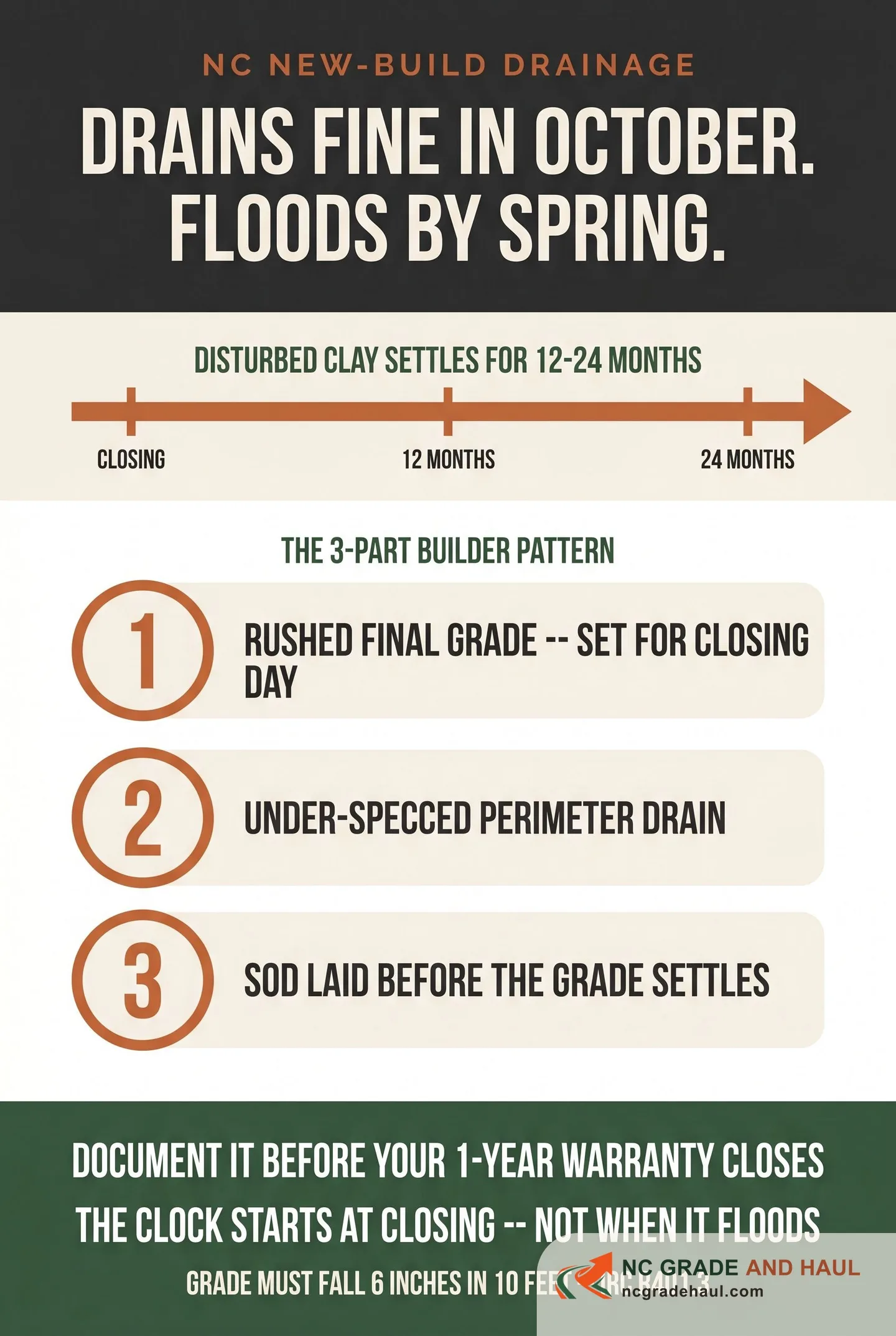
Not a one-off. Triangle NC production builders follow a predictable three-part pattern: rushed final grade, under-specced perimeter drain, and sod installed before grade settles. This page names the pattern and shows you what to document before your 1-year warranty closes.
Why does the flooding start a year or two after closing, not right away?
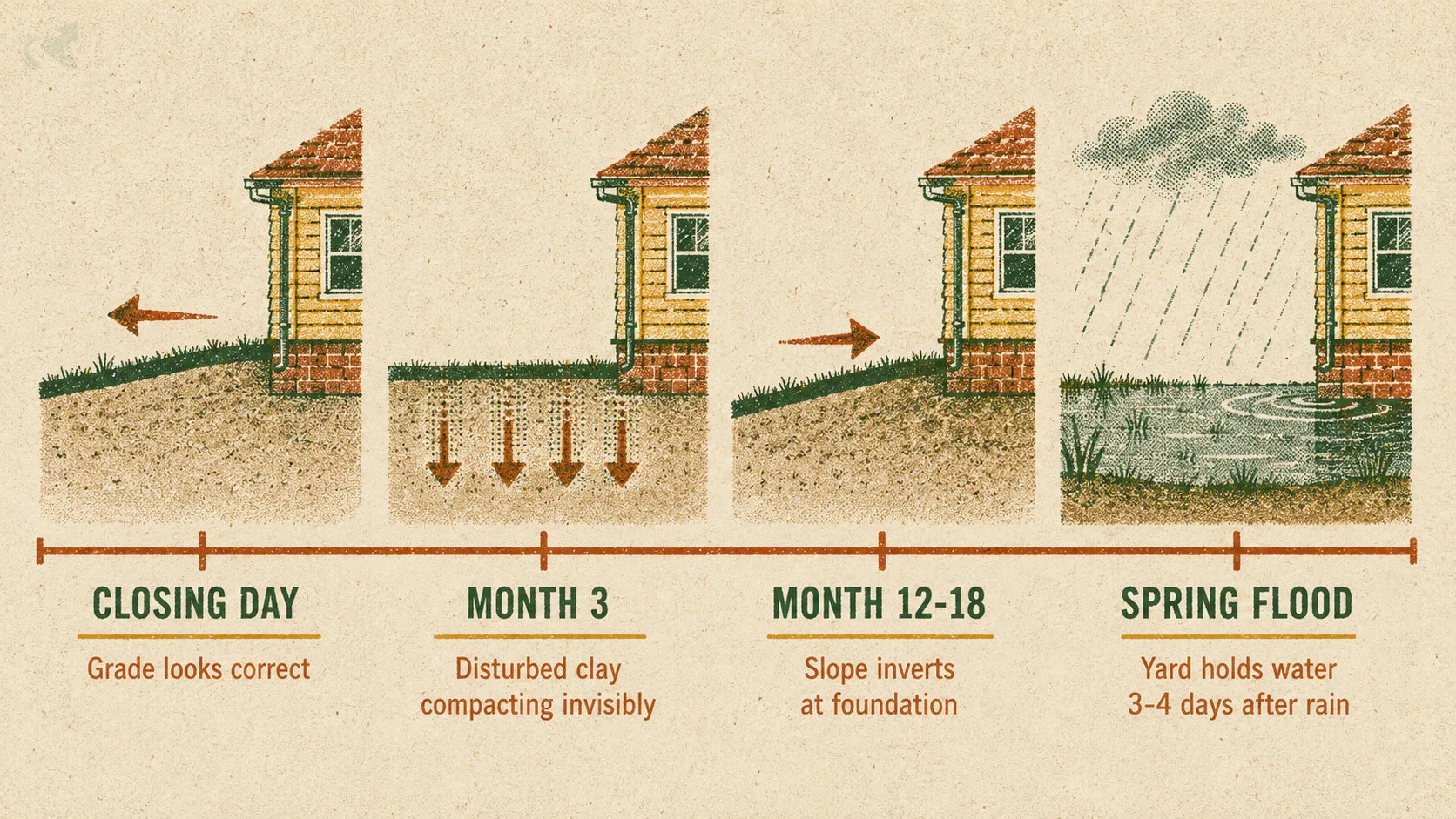
Disturbed soil from construction takes 12-24 months to settle fully. Builders set the final grade at closing -- when it looks right visually -- not after the lot settles. As the soil compacts and drops, a yard that drained fine in October can develop a negative slope by the following spring.
Your backyard holds water three to four days after every rain. Your builder sent someone out. They told you the grading was within spec. The yard was re-graded once already — and it is flooding again in the same spots.
You are not imagining it. You are not being unreasonable. And this is not random.
What you are seeing is a predictable three-part failure pattern that shows up across Triangle NC production subdivisions built between 2018 and 2025. It has a name. Naming it is the first step. The second step is documenting each point before your 1-year warranty window closes.
This is your NC foundation drainage guide for understanding that pattern — what causes it, how to spot it, and what to write down before the clock runs out.
Why Production Builders Skip Proper Final Grade
Production builders operate on closing-day economics — the yard has to look acceptable at closing, not drain correctly at year two.
The build sequence goes: rough grade, foundation, framing, mechanical rough-ins, controls, then final grade and sod. Final grade gets scheduled for maximum visual impact at closing, not after lot settlement.
Soil disturbed by construction equipment — especially after a proof-roll pass that compacts the subgrade for the slab — takes 12 to 24 months to stabilize. The compaction from heavy equipment and the settlement of backfill around the foundation wall both happen below grade, invisibly, long after the sod looks green.
A yard that shows correct positive drainage in October can reverse to negative slope by the following spring. In North Carolina’s Piedmont clay belt, this is especially pronounced. Piedmont red clay settles unevenly after construction traffic compaction. The grade at closing is above final settled grade — and the difference is where yard drainage solutions NC become necessary.
Final grade in NC clay: set right vs set for closing day
Comparison. Graded for year two: Grade set after disturbed soil has had time to settle; Positive slope still drains away 18 months after closing; Backfill compacted so the foundation perimeter holds its line; Survives normal Piedmont clay settlement without reversing. Why it fails: Grade set high at closing for visual impact, not drainage; Disturbed clay settles 12-24 months -- invisibly, after closing; Slope reverses to negative at the foundation perimeter; Water that drained fine in October pools toward the house by spring.
- Grade set after disturbed soil has had time to settle
- Positive slope still drains away 18 months after closing
- Backfill compacted so the foundation perimeter holds its line
- Survives normal Piedmont clay settlement without reversing
- Grade set high at closing for visual impact, not drainage
- Disturbed clay settles 12-24 months -- invisibly, after closing
- Slope reverses to negative at the foundation perimeter
- Water that drained fine in October pools toward the house by spring
Production builders set final grade for how the yard looks at closing -- not for how it drains once the clay finishes settling.
Failure Point 1: Rushed Final Grade
The final grade is set before disturbed soil has settled — it looks right at closing and fails 6 to 18 months later.
Signs to look for: the grade slopes correctly at closing. By year 1 or 2, low spots appear at the same locations relative to the foundation. There is no obvious erosion or visible change in the lot. The soil simply settled.
This is not random erosion. It is a predictable consequence of the build sequence — and it commonly shows up in Triangle NC builds at the 12-to-18-month mark.
What to document:
- Before-and-after photos at the foundation perimeter. Get as close to grade level as you can. Show the slope line — or lack of one — against the foundation wall.
- Date-stamp every photo. Time is everything for a warranty claim.
- A level reading at the foundation. The NC 6-inch-in-10-foot foundation slope rule requires at least 6 inches of drop across the first 10 feet away from the foundation. If the grade is inverted, you can verify it with a 4-foot level and a tape measure before deciding how to fix grading that slopes toward the house.
Failure Point 2: Under-Specced Perimeter Drain
Production builders often install the minimum allowable drain spec — which fails in a North Carolina clay yard that does not absorb runoff.
A functioning perimeter drain requires the right pipe diameter, a proper stone envelope (typically #67 washed stone), and a fall to daylight at a point that can actually handle the flow. Builders cutting costs install smaller-diameter pipe, skip the stone envelope, or daylight the drain into a spot where water pools rather than disperses.
In NC Piedmont clay, there is no soil absorption to fall back on. What the drain doesn’t carry away, the yard holds — and at 48 hours the code answer on standing water duration draws the line between nuisance and warranty defect.
Signs of an under-specced installation:
- Gutter downspouts discharge directly to grade rather than tying into the drain system
- No visible pop-up emitter or daylight outlet anywhere on the lot
- After heavy rain, water sits at the foundation perimeter for hours before it moves — if it moves at all
What to document:
- Photo of each downspout discharge point. Note whether it terminates at grade or connects to buried pipe.
- Photo of any visible drain outlet or pop-up emitter. If there isn’t one, that is documentation in itself.
- Standing water within 6 feet of the foundation, timestamped. Every rain event, every recurrence.
Perimeter drain spec: built to work vs built to minimum
Comparison. Specced correctly: 4-inch pipe sized for the drainage area; Proper #67 washed-stone envelope around the pipe; Fall to a daylight outlet that can handle the flow; Downspouts tied into the buried drain system. Under-specced: Small-diameter pipe with no stone envelope; Downspouts discharge straight to grade at the foundation; No visible pop-up emitter or daylight outlet anywhere on the lot; In NC clay there is no soil absorption to cover the shortfall.
- 4-inch pipe sized for the drainage area
- Proper #67 washed-stone envelope around the pipe
- Fall to a daylight outlet that can handle the flow
- Downspouts tied into the buried drain system
- Small-diameter pipe with no stone envelope
- Downspouts discharge straight to grade at the foundation
- No visible pop-up emitter or daylight outlet anywhere on the lot
- In NC clay there is no soil absorption to cover the shortfall
Minimum-spec drains pass closing but fail in Piedmont clay -- what the pipe doesn't carry away, the yard holds.
Failure Point 3: Sod Before Final Grade Is Confirmed
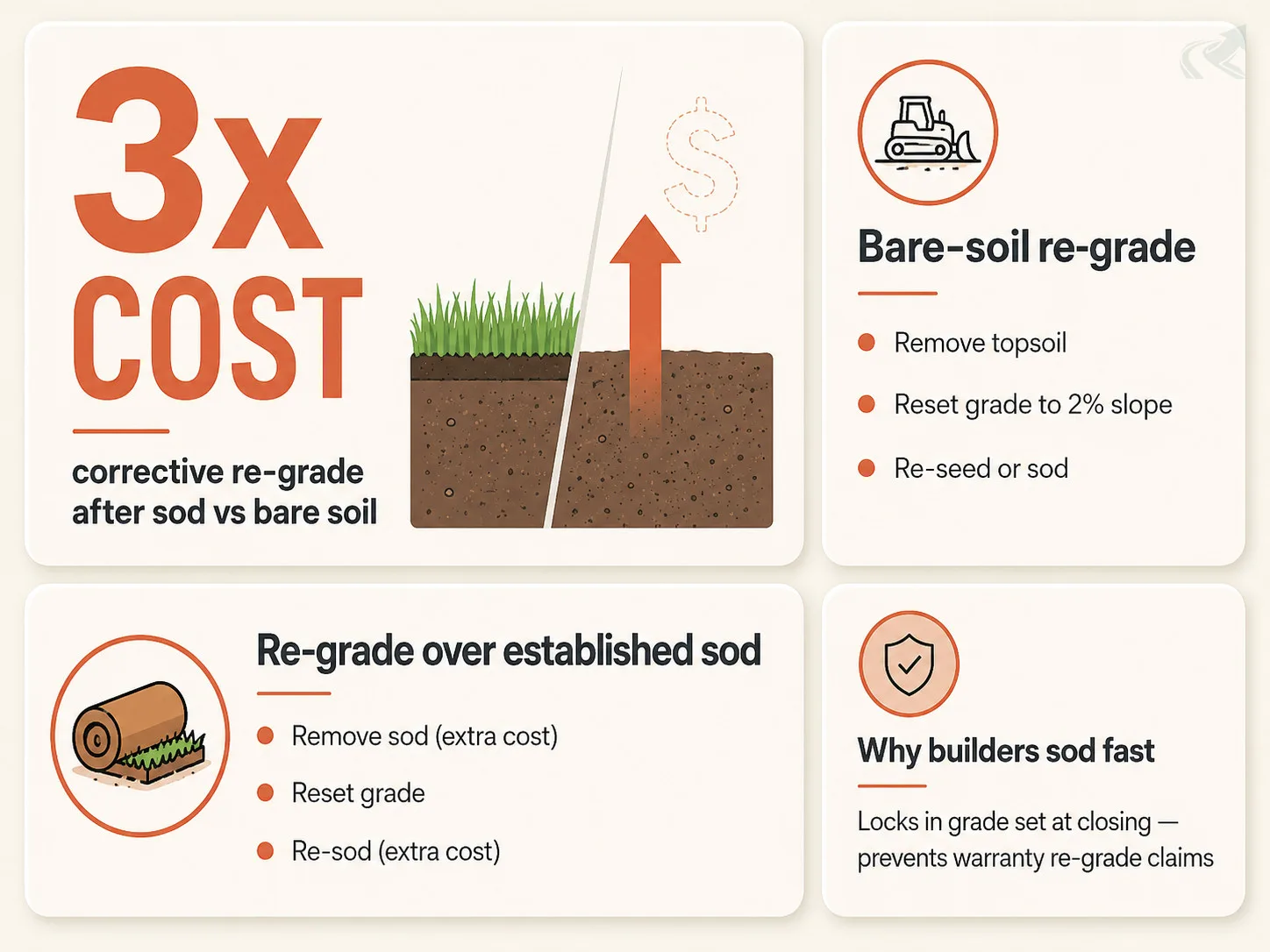
Sod installed over unsettled, incorrectly graded soil locks in the grade failure and makes correction significantly more expensive.
Once sod is established, a NC yard regrading — rough vs finish effort requires removing the sod, re-establishing the grade, and re-sodding. That triples the cost of what would have been a straightforward re-grade on bare soil. Builders know this. Installing sod fast locks in whatever grade they set at closing.
Signs of this pattern:
- The yard was sodded within 60 to 90 days of closing
- Drainage problems showed up within the first year
- The builder’s “fix” involved adding soil on top of existing sod (topdressing) rather than removing sod and re-establishing the grade
If you are still within year 1, document when the sod was installed. The installation date relative to your closing date is relevant to a warranty dispute. Topdressing over sod without removing it is not a corrective re-grade — it is a cosmetic patch that preserves the underlying failure.
What to Document Before Your Warranty Window Closes
In North Carolina, the 1-year workmanship warranty is your primary lever — and it closes faster than the drainage problem becomes obvious.
North Carolina’s implied warranty of workmanship covers defects that appear within one year of the closing date. The clock starts at closing, not when you first noticed the water. If you are reading this in month 10 or 11, the clock is running now.
The documentation checklist:
- Photos of standing water with timestamp — every rain event, every location. Date and time matter.
- Photos of the grade line at the foundation — use a 4-foot level. Show the slope (or the inversion).
- Photos of all downspout discharge points and any drain outlets — or the absence of drain outlets.
- A written warranty claim submitted to the builder via email before the 1-year mark — not a phone call. A phone call produces no record.
- The builder’s written response — save every email thread. If they respond by phone, follow up in writing: “Per our call on [date], you indicated…”
Submit the warranty claim before the 1-year mark even if the flooding isn’t severe yet. The warranty doesn’t track severity — it tracks time. A claim submitted in month 11 is valid. A claim submitted in month 13 is not.
What Homeowners Do That Costs Them the Dispute
Three common mistakes hand the builder the outcome before the conversation starts.
- Calling instead of emailing. Phone calls don’t create a paper trail. Every warranty communication — initial claim, follow-up, response to their response — goes in writing.
- Waiting for the flooding to be “bad enough.” The warranty window doesn’t track severity. It tracks time. A minor drainage problem documented in month 9 is a valid claim. The same problem in month 14 is not.
- Letting the builder topdress over the problem. Adding soil on top of existing sod masks the inverted grade without correcting it. If the builder proposes topdressing as a fix, get in writing exactly what they are committing to. A corrective re-grade removes the sod, re-establishes the grade to the 2% slope rule minimum, and then re-sods. Topdressing is not that.
The 3 Things a Builder Will Tell You (And How to Counter Each)
Builders have three standard responses — none of them are correct, and all of them are designed to run out your warranty clock.
Response 1: “That’s normal settling.” Counter: Settling does not reverse correct grade. If the yard drained properly at closing and now has negative slope at the foundation, the grade was set incorrectly. Correct positive drainage survives settling because it accounts for it. Inverted grade under settling means the grade was wrong from the start.
Response 2: “Your drainage meets code.” Counter: Meeting minimum code is not the same as meeting the implied standard of a functioning yard. The Section R401.3 requires positive drainage away from the structure, but code minimum and functional drainage are not synonymous in Piedmont clay.
Response 3: “We’ll send someone to look at it.” Counter: Get the follow-up in writing with a specific date and a written description of what they will do. “Sending someone to look” is not a repair commitment. If the send-someone-out loop repeats more than once, you are being managed, not serviced. See the builder dispute playbook with email language for the exact script.
The Warranty Email Template (Copy This Exactly)
This is your formal warranty claim. Send it via email. Do not call. Keep a copy.
Copy this email to your builder
Subject: Formal Warranty Claim — Foundation Drainage at [Your Address]
---
I am documenting standing water at the foundation perimeter at [address]. This is the [Nth] documented occurrence in [timeframe].
Per North Carolina’s implied warranty of workmanship, I am formally requesting a corrective re-grade. The issue: [brief description — e.g., “yard pools within 6 feet of the foundation 48+ hours after rain; grade appears inverted at the foundation perimeter.”]
Please confirm receipt of this warranty claim and provide a written response within 10 business days identifying the corrective action you will take and the timeline.
I have photo documentation of each occurrence with timestamps and will provide it on request.
Edit the bracketed fields. Send from a personal email address you control — not a text. Keep the thread.
If you are ready for the next step after documentation, holding your NC builder accountable for foundation drainage covers the escalation path from warranty claim through dispute resolution — including when to request a certification letter from an independent engineer to document the grade failure on the record. To find a contractor who can assess and correct a grade failure independently, hire a licensed NC grading contractor with an itemized quote for the corrective work.
For the code context behind the 2% slope standard referenced above, see the NC 6-inch-in-10-foot foundation slope rule. If the grade failure has also affected your sill plate, see buried sill plate — what it means and how to fix it.
The Triangle NC production builder drainage pattern page covers how this three-part failure pattern shows up in Triangle-market subdivisions.