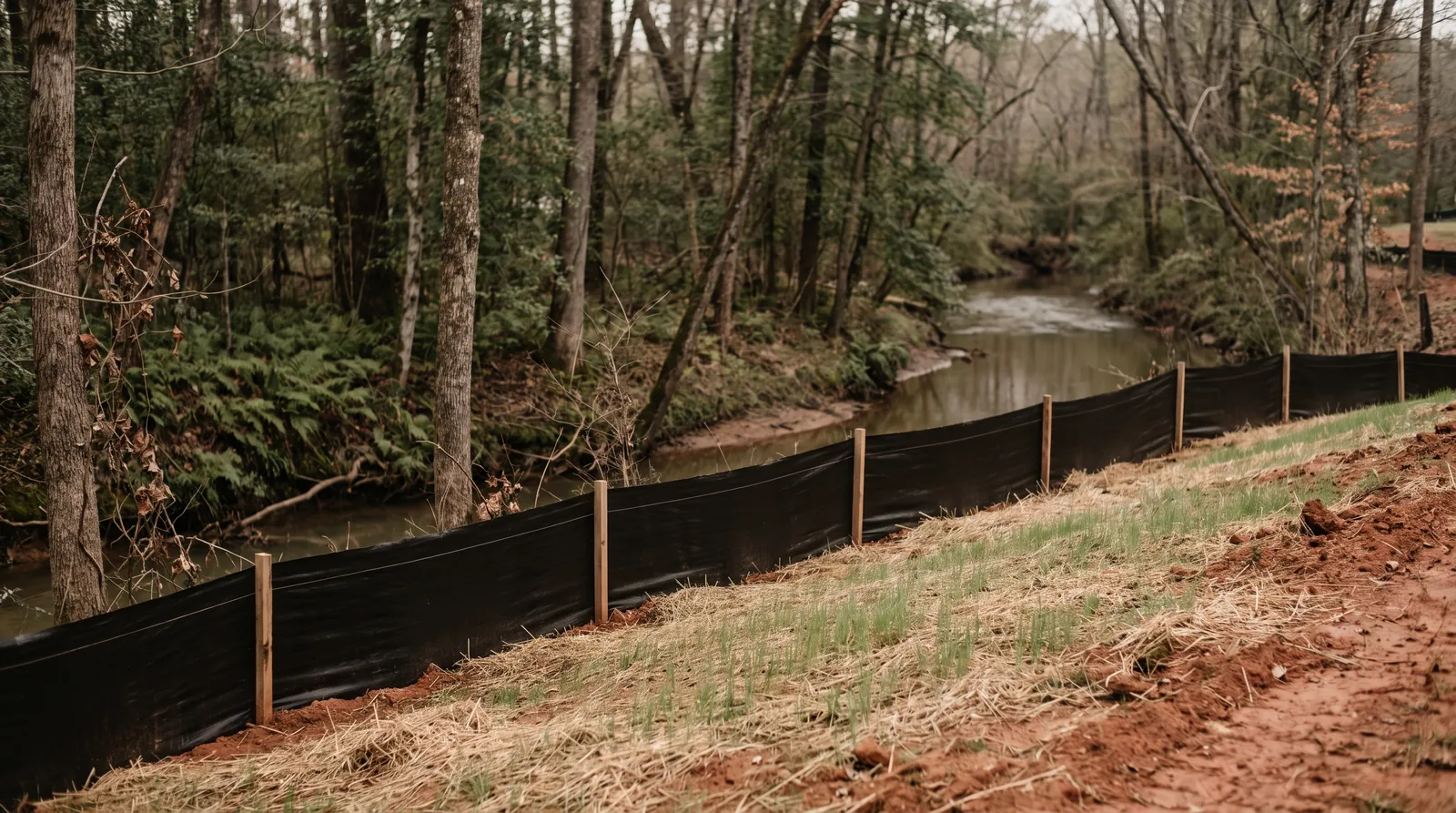
You can move a lot of dirt on your own land in North Carolina without asking anyone. You can also get a stop-work order on a half-acre lot, because of a creek you didn’t know counted. Both are true, because “a permit” for earthwork is not one permit. It is a handful of them, from different offices, and which ones apply depends on how much ground you disturb, where your lot is, and how close it sits to water.
Online, you will find strangers answering the same question both ways. Someone asks what permits a yard drain needs and gets “none”. Someone asks about widening a driveway and gets “you will need one”. Both answers can be right, in different places.
We’re a directory of site-work contractors, checked against public records. We don’t do the work and we don’t issue permits. This page sorts the question “do I need a permit for this?” into the order we’d ask it in.
What Counts as Disturbing Land
North Carolina’s Sedimentation Pollution Control Act defines a land-disturbing activity as any use of land in residential, industrial, educational, institutional or commercial development, or in highway and road construction and maintenance, that changes the natural cover or topography and may cause sedimentation. Clearing, grading, filling and digging all do that. The law’s goal, in the state’s own words, is to prevent visible sedimentation into lakes, streams and natural watercourses, and onto adjoining properties: your neighbor’s yard.
Would you expect to need anyone’s permission to plant a tomato bed? How about to dig a swimming pool?
Land works the same way. The bigger the change to the ground, the more likely somebody has to approve it first. For earthwork, the main yardstick is area:
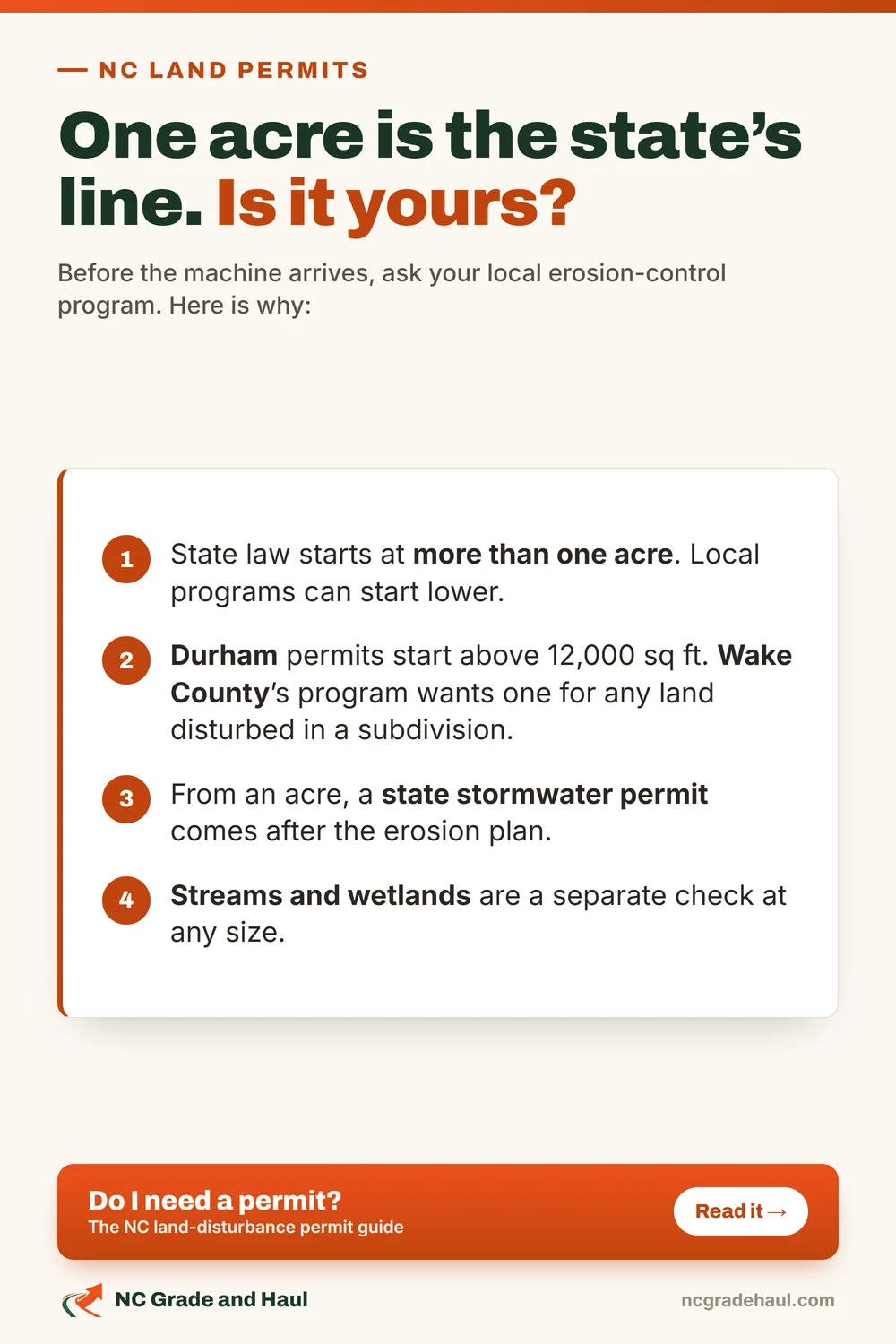
- More than one acre on a tract needs an erosion and sedimentation control plan, filed with the agency that has jurisdiction at least 30 days before the work starts, and approved before it starts. (There is an exception for plans submitted under an approved express permit program.) An acre is 43,560 square feet.
- A tract is all contiguous land being disturbed as a unit, regardless of who owns it. Splitting a job into phases or lots does not make it smaller on paper.
- A larger common plan counts. The state’s construction stormwater permit, covered below, reaches sites under an acre when they are part of a larger plan of that size. Wake County defines a common plan broadly: any announcement, drawing, permit application, sign or survey stake showing that construction may occur on a plot.
- Exposed ground has a clock. Under the state law, slopes left bare must be planted or otherwise covered within 21 calendar days after a phase of grading is finished. DEQ says erosion control is required regardless of the size of the disturbance, so this applies under an acre too. A site under the state stormwater permit (below) has a shorter clock: 7 or 14 days, depending on the slope.
Some work is outside the law entirely. It does not apply to farming on agricultural land, or to timber production done under the state’s Forest Practice Guidelines for water quality, or to sites that hold a Mining Act permit, among a few others. Clearing a lot so a house can go on it is development, which is what the law covers. In one North Carolina thread about clear-cutting, commenters split on whether it counts as agriculture or as land disturbance. The statute’s list is the answer: the exemptions are for farming and for forestry done to the state’s guidelines, not for development.
The Number That Counts Is the Local One
The highway speed limit is 70. Does that mean the streets in your town can go 70 too?
Erosion control works the same way. The state sets the floor, and a city or county can be stricter. North Carolina law lets a local government run its own erosion and sedimentation control program, once the state’s Sedimentation Control Commission approves it, and says the local ordinance “shall at least meet and may exceed” the state’s requirements. In those places, the local staff generally review plans and enforce the law instead of the state.
That is not a rare arrangement. NC DEQ’s contact list for these local programs runs to dozens of cities, counties and towns, and it includes Wake County, Durham City and County, Mecklenburg County, the City of Charlotte, Guilford County, Winston-Salem and Forsyth County, Buncombe County, New Hanover County and the City of Raleigh. The same line, in four places we read at the source:
- Durham: a land-disturbing permit is required on a privately funded, non-agricultural project with a disturbed area greater than 12,000 square feet. A full erosion plan is required above 20,000 square feet, or from 12,000 in certain water-quality areas.
- Wake County (where the county runs the program; Raleigh, Cary and several other Wake towns run their own): any land disturbed in a subdivision needs a Land Disturbance Permit, even under an acre. Outside a subdivision, the permit starts above an acre, and a lot under an acre still needs a stone construction entrance and silt fence where needed to keep sediment out of stream buffers, neighboring lots and roads.
- Guilford County (Greensboro and High Point run their own programs): a grading permit at one acre or more, including non-contiguous disturbance within a larger common plan. A home lot inside a subdivision needs an approved plan, a grading permit and stormwater coverage. A lot under an acre outside a subdivision is told to use a construction entrance and silt fence.
- Charlotte: the city has adopted its own ordinance for privately funded development inside its limits, and DEQ’s listing shows its permit starting at one acre.
Notice that the numbers are not the same, and that none of them is “ask the state”. Boundaries matter too: a lot in a town or an extraterritorial area can answer to a different program than the county next door. DEQ’s own advice is to contact the program directly to confirm whether a site falls in its jurisdiction.
If you want the practice side of this, what goes on the ground to keep soil in place, our erosion control guide covers silt fence, entrances and stabilizing slopes. This page is the permit side.
At an Acre: The Stormwater Permit That Rides on Top
A separate state permit comes with larger jobs. The NPDES construction stormwater program applies to construction that disturbs one acre or more, or less than an acre when it is part of a larger common plan of that size. Its general permit for sites covered by the state sediment program is called NCG01. Sites the state sediment program does not cover, but the federal Clean Water Act does, are covered by a sister permit, NCG25.
It does not replace the erosion plan. It follows it:
The NCG01 construction stormwater permit, step by step
1. Get the erosion plan approved -- By your local program or by DEQ. The permit holder must be the same entity as the financially responsible party named on that approved plan. 2. File the e-NOI in AccessDEQ -- The electronic Notice of Intent. It must be signed by a responsible official inside the permit holder's own organization; DEQ will not accept one filed by an outside consultant. An invoice for the first 12 months is paid before DEQ reviews it. 3. Receive the Certificate of Coverage -- DEQ says it responds within 3 business days after you submit and pay. Approval arrives by email with the Certificate attached. 4. Work, and keep up the annual fee -- Coverage is billed yearly until it is ended. The state permit does not require self-inspections to be done by a certified person, though a local program can: Charlotte's ordinance requires training for site self-inspectors. 5. File the e-NOT when the project is released -- The electronic Notice of Termination, filed after a final inspection releases the project from its erosion plan. Invoices keep coming until coverage is formally ended.
-
Get the erosion plan approved
By your local program or by DEQ. The permit holder must be the same entity as the financially responsible party named on that approved plan.
-
File the e-NOI in AccessDEQ
The electronic Notice of Intent. It must be signed by a responsible official inside the permit holder's own organization; DEQ will not accept one filed by an outside consultant. An invoice for the first 12 months is paid before DEQ reviews it.
-
Receive the Certificate of Coverage
DEQ says it responds within 3 business days after you submit and pay. Approval arrives by email with the Certificate attached.
-
Work, and keep up the annual fee
Coverage is billed yearly until it is ended. The state permit does not require self-inspections to be done by a certified person, though a local program can: Charlotte's ordinance requires training for site self-inspectors.
-
File the e-NOT when the project is released
The electronic Notice of Termination, filed after a final inspection releases the project from its erosion plan. Invoices keep coming until coverage is formally ended.
Plan first, then permit, then work. Ask whoever is doing the job for the Certificate of Coverage number.
If you sell a project partway through, coverage has to be kept up. The new owner either applies to transfer the existing coverage, or gets their own, in which case the previous owner then files a termination. Either way it takes an application; it does not happen by itself.
Streams, Buffers and Wetlands
Everything above is about dirt. These rules are about water, and they do not wait for an acre.
The erosion law has a buffer rule of its own. Construction near a lake or natural watercourse needs a buffer zone wide enough to confine visible siltation within the quarter of the buffer nearest the work. On trout waters the undisturbed buffer is 25 feet wide, or wider if that is what it takes to hold the silt, whichever is greater.
Riparian buffer rules are separate. NC DEQ’s Division of Water Resources protects the vegetated land beside intermittent and perennial streams, lakes, ponds and estuaries. The state’s rules apply only in six areas, and differ between them: the Neuse, Tar-Pamlico, Catawba, Randleman, Jordan Lake and Goose Creek. Outside those, ask your city or county whether it has stream buffers of its own. DEQ has an address lookup that shows whether a property falls in one, and its staff will make a stream determination if you are not sure whether a ditch or channel counts.
Wetlands and streams have a federal layer. Section 404 of the Clean Water Act requires a permit from the Army Corps of Engineers to discharge dredged or fill material into regulated waters. In North Carolina that is the Corps’ Wilmington District, which takes applications and requests for jurisdictional determinations online. DEQ’s 401 and Buffer Permitting Branch handles the state’s water quality certification that goes with it. Whether a particular wet spot or channel counts under federal law is the Corps’ call, and the state’s Division of Water Resources makes its own stream calls. It is not ours and not your contractor’s.
The short version: if there is standing water, a stream or a boggy low spot anywhere near the work, find out what it is before anything is filled, piped or dug. A wet yard is a drainage problem until the day it turns out to be a regulated one.
Where Septic and Driveway Permits Fit
Two other permits come up on nearly every house-site job, and neither replaces the erosion-control permit:
- Septic. A new system goes through its own permits from the county health department, starting with a soil and site evaluation. Our septic guide explains the system, and the septic permit guide walks through the paperwork.
- Driveway. A driveway that joins a public road has its own permit from whoever maintains the road. The driveway permit guide covers it.
Different offices, different forms, different clocks. What they share with your grading job is the ground. The law measures a tract disturbed as a unit, so when you are close to a line, ask your erosion-control program whether to count the septic field and the driveway clearing in your total. Clearing for a house pad, a field and a drive can add up faster than any one of them looks.
What Happens If You Skip It
If you tip a bucket of muddy water and it runs across the fence onto your neighbor’s lawn, whose problem is the mud?
Yours, and the law agrees. The steps, as DEQ and the statute set them out:
- A complaint or an inspection. Inspections happen after a plan is approved or after a complaint to DEQ or the local program. An inspection report alone is not an enforcement action.
- A Notice of Violation. It lists what is wrong, what must be fixed and by when. A first-time violator is offered help developing corrective measures. A continuing notice follows if the deadline passes.
- A civil penalty. The maximum is $5,000 per violation, and each day a violation continues counts as a separate violation. Someone who has never been assessed a penalty before, and who stops the continuing damage within 180 days of the notice, is capped at $25,000 in total for that job. The penalty can be assessed against the financially responsible party, the property owner, or both.
- A stop-work order or a court injunction. Either can be used to enforce the act.
- Criminal charges for knowing or willful violations: a Class 2 misdemeanor, with a fine of up to $5,000.
One kindness in the law: a silt fence that is damaged during construction is not penalized, as long as it is repaired or replaced within the compliance period.
The practical lesson is the one in the headline. Ask before the machine arrives, and keep the paperwork where you can find it.
Does This Need a Permit?
Does this need a permit?
Read the job, guess whether anyone has to approve it first, then tap to check. These are the questions we'd ask; your local program has the final say.
1 You're building a house on a lot inside a subdivision where Wake County runs the erosion program, not Raleigh, Cary or another town with its own. You'll disturb well under an acre.
Yes. Wake County requires a Land Disturbance Permit for any land disturbed in a subdivision, even under an acre.
Then: Outside a subdivision and under an acre, Wake asks for a stone construction entrance and silt fence instead of a permit.
2 You'll clear 1.5 acres of woods on your own land for a house site. No subdivision.
Yes. More than one acre on a tract needs an approved erosion plan, filed at least 30 days ahead with whichever program has jurisdiction.
Then: From an acre, the state stormwater permit (NCG01) comes after the plan is approved.
3 You'll regrade a back yard in Durham: about 10,000 square feet.
Under Durham's 12,000 square foot permit line, so probably not a land-disturbing permit. Count everything you'll strip or grade, not just the finished surface.
Then: Close to the line, call Durham's stormwater and erosion control office and ask them to count it.
4 A farmer wants to regrade a hay field.
If the regrading is for farming, it is exempt: the erosion-control law does not apply to farming on agricultural land.
Then: That does not make a stream or wetland on the field any less regulated. Ask before filling a wet area.
5 You want to fill a low spot where water stands after every rain.
Stop and find out what it is. Filling regulated waters takes a federal Section 404 permit, and the Corps decides what counts.
Then: DEQ's Division of Water Resources can make a stream determination. The Corps takes jurisdictional determination requests.
6 You're adding a 100-foot driveway off the road, with a creek on the far side of the lot.
Check three offices: the erosion-control program, whoever maintains the road, and the stream and buffer rules for that creek.
Then: Start with our driveway permit guide and DEQ's buffer address lookup.
7 A small shed pad, a few hundred square feet, in a back yard.
Probably under your program's line, but programs differ, so a call is cheap. Keep the mud on your own lot either way.
Then: Ask what the lowest line is in your jurisdiction and whether it counts a pad.
8 Your contractor on a 2-acre job says the permit is no big deal and they'll sort it out later.
Ask for the approved erosion plan and the Certificate of Coverage number before any machine rolls.
Then: Ask who is named as the financially responsible party. Penalties can land on that party or on the property owner.
Who to Hire, and What to Ask Them
The checks are the same ones we’d give for any site-work job. Ask whoever is quoting you which erosion-control program covers your address, whether the plan is approved, and who is the financially responsible party on it. A contractor who has worked your county knows its inspector and its portal, and a quote that lists erosion controls as their own line shows they are priced rather than assumed.
Our hire guide walks through how to check a contractor against public records, and our directory lists contractors checked that way. If your job is mostly surface shaping, start with the grading guide; for trenches, footings and ponds, the excavation guide; and for what the work looks like when trees come down first, land clearing.