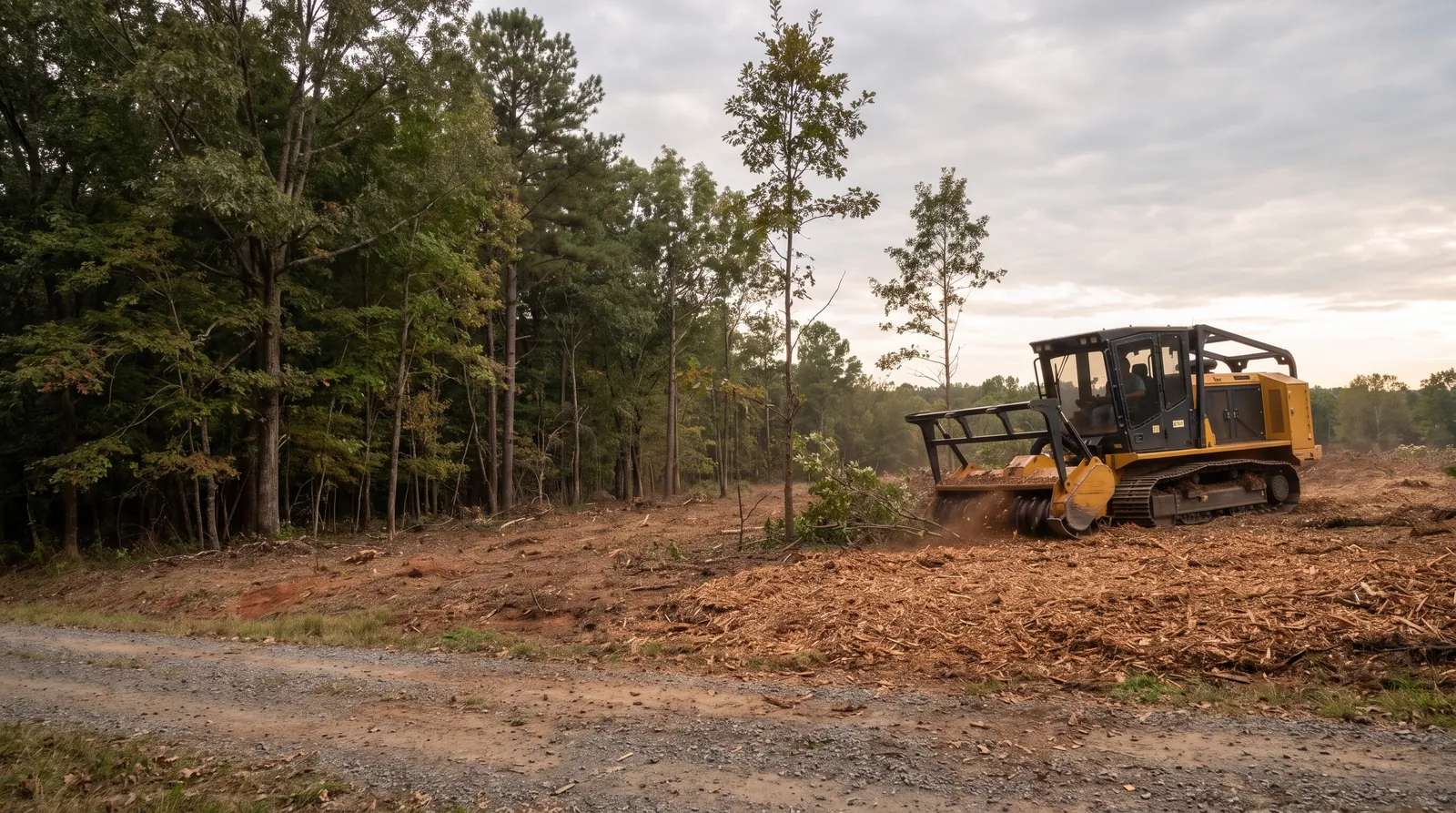
“Clear my land” is what people say when they mean nearly anything. Thirty old trees in a back yard. Ten acres of scrub. A fence line of vines. The stumps left after the builder went home. It is five or six different jobs wearing one name, and the name is how quotes go wrong.
This page sorts the jobs out: the ways to clear land, when each one fits, and the public rules that sit in front of the machine. We’re a directory of site-work contractors, each checked against public records. We don’t clear land ourselves. This is what we’d tell a friend before they hired someone.
What Land Clearing Is
Land clearing means taking vegetation off a piece of ground so it can be used for something else. North Carolina’s own open-burning rule defines it as the uprooting or clearing of vegetation in connection with construction, land development or mining, or the initial clearing of vegetation to enhance property value.
In practice the work comes in layers, and a quote can cover some of them and not others:
- The trees and brush: cutting them down.
- The wood: what happens to it afterward. Hauled, ground up on the spot, or burned.
- The stumps: ground down, or dug out.
- The roots and the top layer of soil: scraped off. Trades call this grubbing.
Stopping after the first layer is tree removal. Going all the way down is clearing and grubbing. Whether you need the whole depth depends on what comes next. What comes next is the question to answer first.
The Four Methods, and When Each Fits
These are the trade’s common names for the approaches. No agency defines them, so treat the pairings below as the usual fit, and confirm with the firm that quotes.
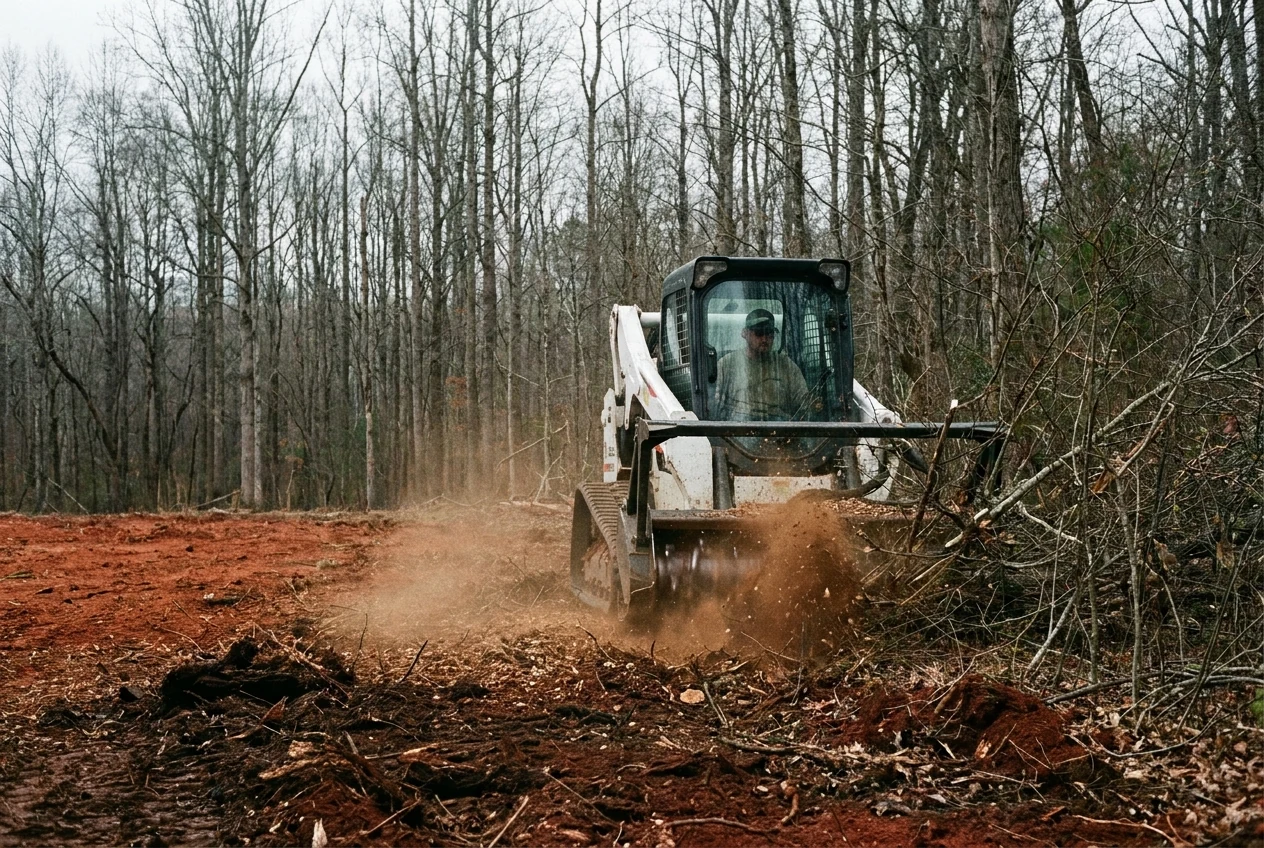
- Cut and haul. Trees are felled, cut up and carried off, to a mill, a chipper or a disposal site. It suits lots with timber worth selling, or where nothing should be left on the ground.
- Forestry mulching. A machine grinds trees, brush and sometimes stumps where they stand and leaves a layer of mulch. Nothing is hauled. See forestry mulching for what it leaves behind.
- Grubbing and stump removal. After the trees are down, stumps are ground or dug out and the roots and top layer scraped off. This is the layer that matters most when a pad, a driveway or a foundation will sit on the spot. See stump removal.
- Burning. Piling and burning the vegetation on site, where state rules allow. The rules are strict enough to get their own section below.
Smaller jobs, like overgrown brush and vines, fall under brush clearing, which is lighter work than a full clearing job.
Which method fits?
Read the job, guess the usual approach, then tap to check.
1 A few acres of brush and small trees that will become pasture.
Forestry mulching or brush clearing is a common fit: the growth is ground where it stands.
Ask the firm: Ask what the ground looks like when they leave, and what happens to anything too big to mulch.
2 Mature hardwoods where a house and driveway will go.
Cut, process the wood, then take out the stumps and scrape the roots.
Ask the firm: The building plans say how deep the stumps and roots must come out. Ask who reads them.
3 A stand of pine and hardwood with real timber in it.
Call the NC Forest Service or a consulting forester before anything is cut.
Ask the firm: Ask about a written contract and who marks the property lines.
4 A rural lot, a pile of cut brush, and the nearest house 600 feet away.
Burning may be allowed, but only on certain days and in certain hours, and a Forest Service permit is needed if the pile is in or within 500 feet of woodland.
Ask the firm: Ask the firm who is checking the air-quality forecast on burn day.
5 Thirty big trees in a yard with houses on every side.
That is tree work, not land clearing. Get an arborist to say which ones actually need to go.
Ask the firm: Check your city's tree rules before anyone cuts.
The Order of Work
On most jobs the order runs: controls first, then cut, then wood, then stumps, then roots. The gap between the first two layers and the last two is where most quote confusion lives.
If you picture the end state first, you know how deep to ask the quote to go.
What would you assume if a friend said “I’ll clean the kitchen for you”? That the oven is included, or not? Most of us would ask. A clearing quote needs the same question: which layers, exactly?
Before the Machine Starts
This is the part most people meet by surprise. A short list of public rules decides what a crew may do, and some of them have lead time.
Checks before clearing, in order
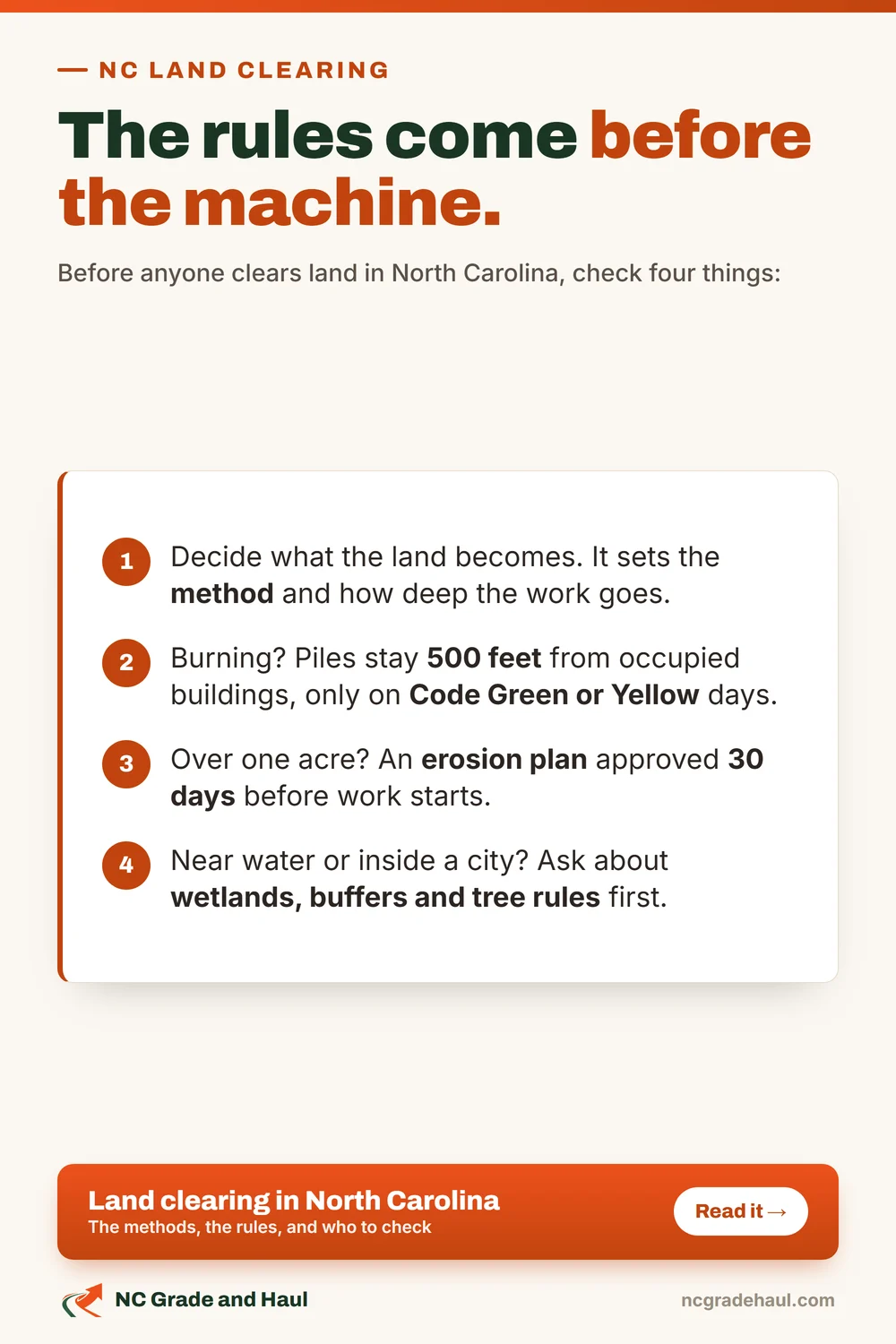
1. Decide the end state -- Pasture, lawn, or a building pad. It sets the method and how deep the work goes. 2. Ask whether the trees are yours to cut -- Check your city's tree rules, and talk to a consulting forester if there is timber. 3. Check water and wetlands -- A stream, a lake or a wetland on the lot brings buffer and federal rules. 4. Over an acre? Get the erosion plan approved -- It has to be filed at least 30 days before the work starts. 5. Burning? Check the rule and the permit -- The state's open-burning rule applies, and the NC Forest Service may require a permit. 6. Before any digging, call NC 811 -- Three working days ahead, so the utilities can mark their lines.
-
Decide the end state
Pasture, lawn, or a building pad. It sets the method and how deep the work goes.
-
Ask whether the trees are yours to cut
Check your city's tree rules, and talk to a consulting forester if there is timber.
-
Check water and wetlands
A stream, a lake or a wetland on the lot brings buffer and federal rules.
-
Over an acre? Get the erosion plan approved
It has to be filed at least 30 days before the work starts.
-
Burning? Check the rule and the permit
The state's open-burning rule applies, and the NC Forest Service may require a permit.
-
Before any digging, call NC 811
Three working days ahead, so the utilities can mark their lines.
The rules come before the machine. Several have lead time, so start them early.
Grubbing and stump digging are digging. NC 811, the state notification center, asks you to call or go online three working days before digging so the utilities can mark their buried lines for free. The excavation guide covers that check in full.
If You Plan to Burn
Open burning is where land clearing meets the state’s air rules. The rule is 15A 2D .1900, enforced by the . First adopted in 1971, it allows burning of plain vegetation under conditions and forbids nearly everything else. The conditions that matter for a clearing job:
- Only what grew there. Logs, stumps, limbs and other natural vegetation from the clearing can be burned. Trash, construction materials, treated wood, tires, plastic and anything man-made cannot. The rule of thumb DAQ gives: if it doesn’t grow, don’t burn it.
- Hours and air days. A land-clearing fire may be started only between 8 a.m. and 6 p.m., and nothing may be added to it between 6 p.m. and 8 a.m. the next day. It may be started only on air-quality Code Green or Code Yellow days. Code Orange, Red and Purple days are off limits, and so is any day the Forest Service or another agency has banned burning in the area.
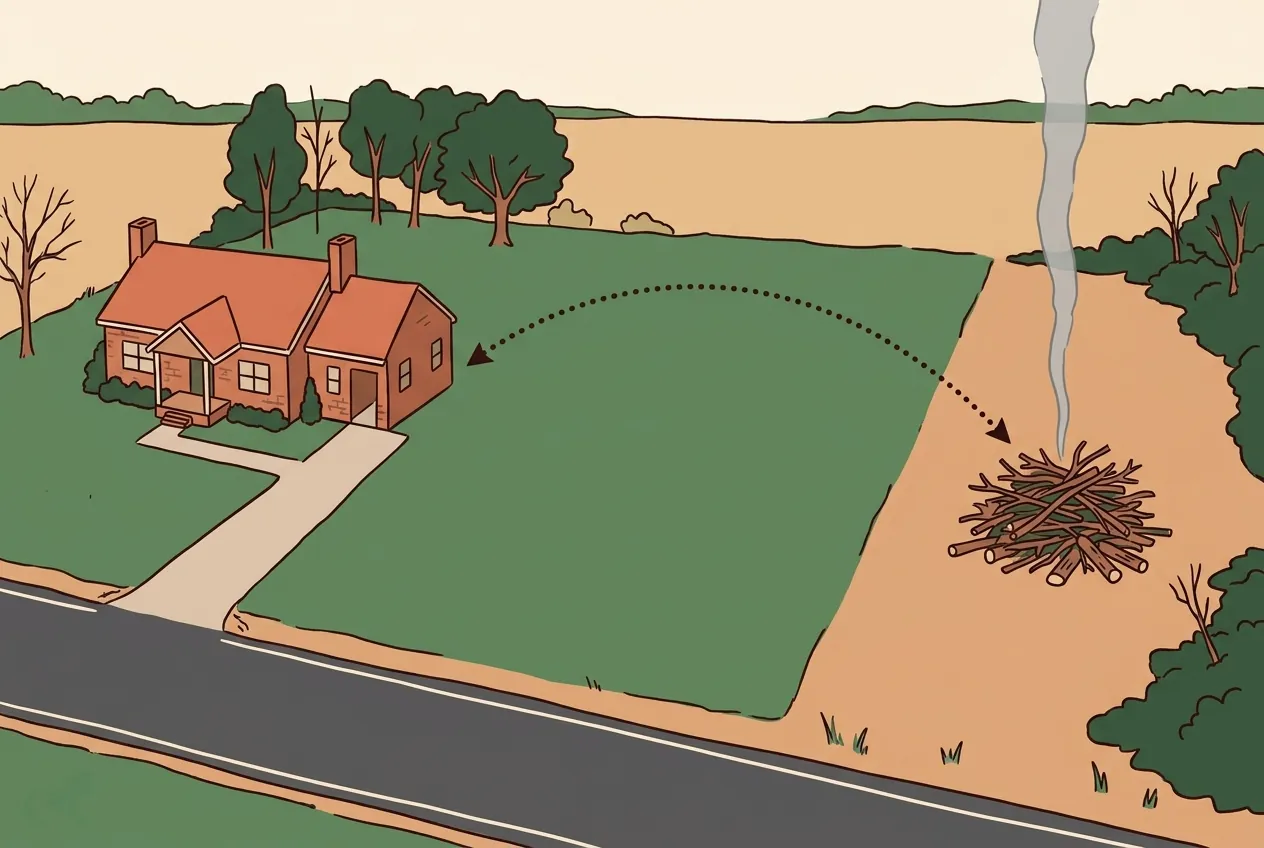
- Distance. Land-clearing piles must be at least 500 feet from homes and other occupied buildings that aren’t on the property being cleared, and at least 250 feet from a public road when the wind is blowing toward the road. Burning closer to a building takes a written waiver from every resident within 500 feet, approved by the DAQ regional office before the fire is lit, and no waiver is granted near an occupied school, day care or hospital.
- Starting the fire. Kerosene or diesel may be used to start a land-clearing fire. No other man-made material can be burned.
- Where the wood came from. The vegetation should come from the site where it is burned. DAQ allows land-clearing material to be moved and burned elsewhere only up to four times a year, and only when set conditions are met.
Break the rule and the penalty can reach $25,000.
Do you light a big bonfire in your yard without first checking the wind and who is downwind? The setback rules are that same instinct, written down.
Then there is the permit. DAQ doesn’t issue burn permits; the NC Forest Service does, free of charge, online or through its county offices. State law (G.S. 106-942 and 106-943) requires one for a fire in or within 500 feet of woodland the Forest Service protects. In most counties that applies to fires lit between midnight and 4 p.m. In 21 coastal and eastern counties it applies at any hour, and burning land-clearing debris piled across more than five contiguous acres takes a special permit wherever it sits, with fires started only between 8 a.m. and 4 p.m. During dangerous fire weather the state can ban all open burning, permit or not. DAQ adds that local ordinances, local burn bans and Forest Service permit requirements can apply on top of the state rule, so following the state rule doesn’t guarantee you’re clear locally. Ask the firm who is pulling the permit and who is watching the forecast on burn day. Our permits and burning guide goes deeper.
The One-Acre Erosion Plan
Bare soil sheds sediment into streams. North Carolina’s Sedimentation Pollution Control Act exists to stop that, and it comes with a clock.
If the land-disturbing activity will disturb more than one acre on a tract, the person doing it must have an erosion and sedimentation control plan filed with the agency in charge and approved at least 30 days before starting. A plan under an approved express-permit program can be filed on shorter notice. The work then has to follow the approved plan, with devices that keep sediment on the tract, and the Act says exposed slopes must be planted or covered within 21 calendar days of finishing a phase of grading. At an acre or more there is also a separate state stormwater permit, NCG01: once the erosion plan is approved, the next step is an application for its Certificate of Coverage. The permits guide walks through it.
Here is a question to ask in your head. If you strip every plant off a steep slope right before a heavy rain, where does the rain go, and what does it take with it? The plan exists so the answer isn’t “into the creek.”
Plans are filed through DEQ’s AccessDEQ portal, unless a delegated local program handles your property, in which case you file with the county or city. Local programs can be stricter than the state, so ask which one covers your lot. Our land-disturbance thresholds guide and the erosion control hub go into the detail.
One thing that confuses people: the Act exempts producing and harvesting timber on forestland when the work follows the state’s Forest Practice Guidelines Related to Water Quality. That reads as being about growing and harvesting timber. Clearing a lot to build on it is not the same thing, so ask your program before assuming the exemption covers you.
Water, Wetlands and Trees
Three more checks that sit in front of the machine.
Streams and lakes. Under the same Act, land-disturbing work near a lake or natural watercourse needs a buffer strip wide enough to keep visible siltation within the part nearest the work. For trout waters the undisturbed buffer is at least 25 feet. Separately, NC DEQ’s Division of Water Resources has riparian buffer rules that protect the vegetated land beside streams, lakes and ponds in six areas: the Neuse, Tar-Pamlico and Catawba basins, Randleman Lake, Jordan Lake and Goose Creek. DEQ has an address map that shows whether a lot falls in one. Check it before clearing near water.
Wetlands. Section 404 of the federal Clean Water Act requires a permit before dredged or fill material is placed in waters of the United States, which includes wetlands. The Army Corps of Engineers runs the permits. Whether a particular clearing job counts is the Corps’ call, not ours. If your lot is low, soggy, or beside a creek, ask before any machine goes in.
Trees inside a city. Online you’ll hear that state law protects clear-cutting from city rules. Part of that is true. Under G.S. 160D-921, a local government can’t regulate forestry activity on forestland taxed at its present-use value, or forestry done under a registered forester’s management plan. But it can still regulate development, and it can deny a building permit or site plan for up to three years after a harvest that removes all or substantially all of the trees its development rules protect. Five years if the violation was willful. The practical rule: if you’re clearing a lot you mean to build on, in a city that protects trees, talk to the planning office before the first cut. A stump is forever.
Selling the Timber First
If the trees have value, the money question comes before the clearing question. The NC Forest Service’s advice is to contact the Forest Service or a consulting forester before agreeing to anything, to get a variety of quotes, and to get a written contract or timber sale agreement before any cutting. It warns about cold calls from buyers offering cash for your timber.
A consulting forester represents you, not the buyer. NC State Extension notes that in North Carolina, registered consultants sign an affidavit that they are not in the timber-buying business. They can inventory the stand, prepare the sale contract and mark the skid trails. Fees can be hourly, per acre, or a share of the sale, so get them in writing too.
Boundaries matter. The Forest Service calls unmarked property lines the leading cause of timber trespass cases, and neither it nor a forester can set a boundary line: that takes a licensed surveyor.
What Clearing Is Not: Grading
Clearing takes things off the land. Grading reshapes it: cutting and filling the surface so it sits at the right level and sheds water. Owners often want both, and small lots often get both from one firm. One Charlotte owner asked online for a single company to do removal and grading in one go, and was told most grading firms could do it. Still, they’re two scopes on a quote, and the clearing has to come first.
Clearing also isn’t demolition. Taking down a building and hauling it away is its own job, covered in the demolition guide. And land-disturbance and building permits are their own subject, in the permits guide. If you’re preparing a lot for a pad, site preparation picks up where clearing stops.
What would you do?
Read the situation, decide your first move, then tap to check.
1 You want to burn a big brush pile this Saturday, and the air-quality forecast says Code Orange.
Don't light it. Burning is prohibited on Code Orange, Red and Purple days.
Then: Check the forecast again. Even on a good day, no fire may be started and nothing added to the pile after 6 p.m.
2 You're about to clear two acres for a house.
Ask your erosion-control program whether the plan is approved, because it must be filed at least 30 days before work starts.
Then: Ask who files it, and who installs the controls before the first tree comes down.
3 A man knocks on your door offering cash for the pines on your back acreage.
Say no for now and call the NC Forest Service or a consulting forester.
Then: Get a written contract and have the boundary lines marked before anything is cut.
4 The lot has a damp low corner and a small creek along one side.
Ask before clearing there. A watercourse buffer applies, and the Corps decides whether wetland rules do.
Then: Ask the firm how they handle work near water.
5 You're in a city and want the lot cleared to build.
Call the planning office before the first cut.
Then: A harvest that strips protected trees can delay a building permit for up to three years.
How to Find and Check a Land-Clearing Contractor
Start with the quote. A real clearing quote names every layer instead of saying “clearing”:
- The trees and brush, and what is cut.
- What happens to the wood: hauled, mulched on site, or burned, and who handles any burn permit.
- The stumps: ground or dug out, and to what depth.
- Grubbing: whether the roots and top layer are scraped off.
- Erosion controls: who installs them, and whether they go in before clearing.
- Who calls 811 before any digging.
- What is not included.
A firm that can answer each line without hedging is describing a real scope. “We’ll figure it out when we see it” is not a quote.
Then check the firm. North Carolina’s general contractor law covers anyone who contracts for grading or other construction where the cost of the undertaking is $40,000 or more (G.S. 87-1). Clearing and grading on one job can reach that. If it does, the firm needs a license in the right classification, and you can look it up on the NC Licensing Board’s free public search. Below that, other checks still matter: insurance sent to you by the insurer, a written quote, and a public record of the business you can look up. Our hire guide walks through all of it.
That’s the work our directory does. We check contractors against the licensing board, the Secretary of State’s registry, OSHA’s inspection records and the Industrial Commission’s workers’ compensation coverage. A contractor marked verified has passed those checks, with a link to the record behind each one. See the land-clearing contractors in our directory. If your job is mostly digging, the excavation guide has the checks for that trade.