Two questions people ask first
What do I have to do before a house can be torn down in North Carolina?
Four things, in this order. Have the building inspected for asbestos by an accredited inspector, which the state recommends for every building, houses included. Send the state's demolition notice at least 10 working days ahead where it applies, even if no asbestos turns up, and ask the state's asbestos unit whether your house needs one. Get the local demolition permit, which is a separate paper from the state notice. And have the utilities shut off and an NC 811 ticket filed at least three full working days before any machine moves.
Where can the debris go?
Demolition waste goes to a landfill permitted for it, or to a recycler for the clean parts such as concrete and metal. Each county landfill sets what it accepts, and asbestos is handled apart from everything else. Ask the landfill before the first truck leaves.
A house can come down fast. Getting it ready to come down takes a good deal longer, and the machine is the one step you can’t take back.
That’s why the order matters more than the machine. This page walks the order a North Carolina owner faces when a house, garage, outbuilding or slab has to go: what the state asks for first, what your city or county asks for, what has to be shut off, where the debris may go, and what the ground should look like when the crew leaves. We’re a directory of site-work contractors, checked against public records. We don’t do demolition ourselves.
In one North Carolina thread, a commenter described a teardown on their block. The builder had started tearing down a house, and almost at once a gas company vehicle showed up. The gas main was still connected, the utility’s system had flagged instability in the line, and its employee flagged down the bulldozer driver to say that carrying on risked a gas explosion. Then a city inspector turned up. The commenter doesn’t say how it ended. It is a fair picture of what a line left connected can bring.
What Demolition Involves
Demolition here means taking down a whole structure, a house, a garage, a shed, a slab, and clearing the lot. It sits next to excavation (the same machines, and often the same firms), and next to land clearing, which is about trees, stumps and brush rather than buildings.
A job runs in five stages: inspect for hazardous materials, notify and permit, shut off the utilities, take the structure down and sort the debris, then clear the footprint and grade the ground. This page covers each in that order.
The order, before and after the machine
1. Asbestos inspection -- An NC-accredited inspector checks the building before any demolition begins. 2. State notice, and a state permit if asbestos must come out -- Where the notice applies, it goes to NCDHHS at least 10 working days ahead, even when nothing is found. Ask whether a house needs one. 3. Local demolition permit -- Issued by your city or county inspections office. It does not replace the state notice. 4. Utilities off and an NC 811 ticket -- Service disconnected, and the 811 notice filed at least three full working days before work starts. 5. Demolition and sorting -- The structure comes down, and the debris is separated for the right destination. 6. Clear and grade -- Foundation and footings out where the permit requires it, then graded so water drains.
-
Asbestos inspection
An NC-accredited inspector checks the building before any demolition begins.
-
State notice, and a state permit if asbestos must come out
Where the notice applies, it goes to NCDHHS at least 10 working days ahead, even when nothing is found. Ask whether a house needs one.
-
Local demolition permit
Issued by your city or county inspections office. It does not replace the state notice.
-
Utilities off and an NC 811 ticket
Service disconnected, and the 811 notice filed at least three full working days before work starts.
-
Demolition and sorting
The structure comes down, and the debris is separated for the right destination.
-
Clear and grade
Foundation and footings out where the permit requires it, then graded so water drains.
Everything before step five is paperwork and phone calls, and all of it comes before the machine.
Asbestos Comes First
Asbestos was used in more than 3,000 building materials. The state’s examples include vinyl flooring, joint compound, plaster, ceiling tiles, and cement siding or roofing. The risk comes from disturbing it, and a demolition machine disturbs everything.
Before you sand and repaint a chair you inherited, would you want to know what the old finish is made of?
A building works the same way, with far more at stake. North Carolina’s Health Hazards Control Unit, part of NCDHHS, handles this. Its step-by-step guide says that an accredited asbestos professional must inspect buildings before any demolition or renovation begins. The inspection finds out what asbestos is there, where, and how much.
The legal wording is a little narrower, and it’s worth knowing. The federal rule the state administers writes its inspection duty for commercial, industrial and larger residential buildings, more than four dwelling units. For a single-family house, the state’s own letter says it recommends an inspection always, houses included. Our advice is to treat the inspection as part of the job. Call the unit at 919-707-5950 first. The staff answer questions about your particular project.
Two more rules matter to an owner:
- The notice, and when it applies. The state’s guide says to notify the unit of building demolition even if no asbestos is present, at least 10 working days before work begins. The rule behind that notice is the federal one, which North Carolina’s rule adopts as written, and the federal rule leaves out residential buildings of four or fewer dwelling units. Durham’s permit form adds that it still covers houses demolished for commercial, institutional or industrial purposes. Whether your house needs the notice is a question to put to the unit before you schedule anything.
- Some removal needs a state permit. That applies when more than 35 cubic feet, 160 square feet or 260 linear feet of regulated asbestos-containing material will come out. Regulated material means material that crumbles easily, plus material that demolition will cut, grind or break up.
Anything that has to come out comes out before the demolition touches it, and the state’s guide says only NC-accredited asbestos professionals can do that work. State law exempts a person doing it in their own home, not a crew hired to do it. The crew keeps the material wet, with no visible dust. Ask to see the person’s accreditation card, or look the name up on the state’s Find Asbestos Professionals tool. In Mecklenburg, Buncombe and Forsyth counties, local air programs have their own asbestos rules on top of the state’s, so check with them too. If the house was built before 1978, lead paint rules may also apply.
The Local Permit, and What Your City or County Asks For
Your city or county inspections office issues the demolition permit. The state’s guide is blunt that a local permit alone does not meet the state notification or permit requirements. Two papers, two offices.
Local rules differ, so ask. Durham’s whole-structure demolition application is one example we read in full. It asks for a plot plan showing every existing utility on the property, with the structure to be demolished labeled. It says projects over $40,000 need a licensed general contractor to get the permit and do the work. The applicant must also acknowledge in writing that the site will be cleared of all debris, including the foundation and footings, and graded to drain. And the applicant must acknowledge that the building permit does not relieve them of any required state asbestos inspections.
A second Durham form covers what is in the street. The applicant marks the water meter and has it removed, locates the sewer cleanout and caps it if it’s in the way, requests an inspection 48 hours before and after the demolition, and owns any damage to the meter, curb or pavement. Your town may ask for none of this, or for different things. The way to find out is to ask the inspections office before you hire anyone.
Utilities: Shut Off, Then Call 811
Would you let someone start cutting into the wires inside a wall before the power to that wall has been shut off?
A house is full of live lines, and the lines outside it are the dangerous ones: gas, electric, water, sewer. Two different things have to happen, and neither replaces the other.
The service gets disconnected. Call each utility, electric, gas, water and sewer, about ending service. Durham’s form, for example, has the owner ask the city to remove the water meter. Ask your inspections office what proof of disconnection it wants.
The 811 notice gets filed. North Carolina’s Underground Utility Safety and Damage Prevention Act covers demolition by name. It defines demolition as wrecking, razing or removing a structure by any means. The person responsible for the demolition must notify the NC 811 center at least three full working days before it starts. A working day excludes weekends and state holidays. There is a narrow exemption: an owner demolishing on their own single-family property doesn’t have to give notice, as long as the work doesn’t encroach on any utility’s right-of-way, easement or permitted use. When you hire a crew, ask who files the ticket. When a building is coming down, the law also requires the person demolishing it to give each utility a reasonable time to remove or protect its facilities before the work begins.
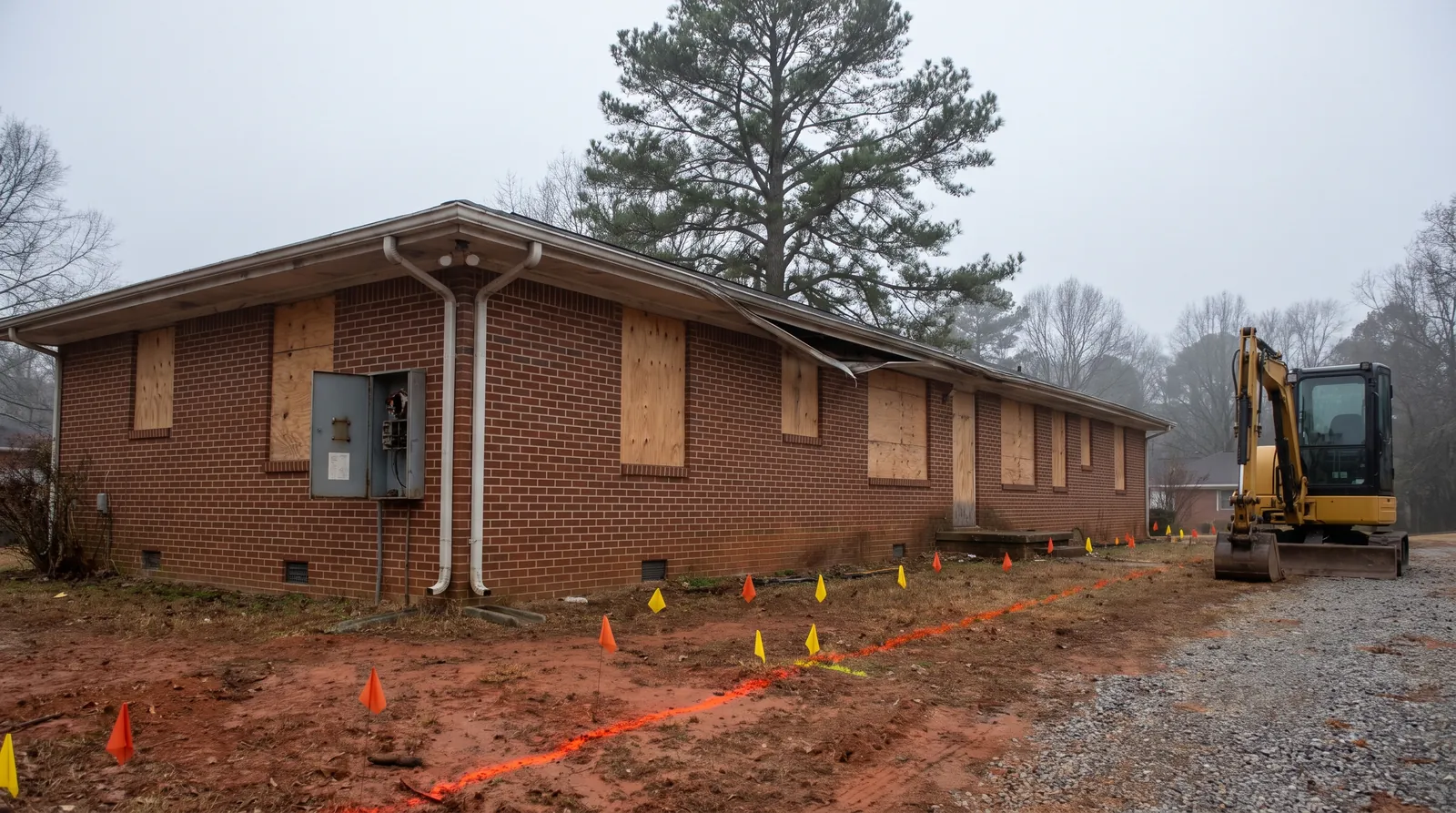
The gas call at the top of this page shows what a line left connected can bring. Ask for the 811 ticket number and look for the paint and flags on the ground. The excavation guide covers the 811 ticket in more detail.
The Demolition Itself, and Where the Debris Goes
With the paper done, the structure comes down. How the crew does it is their call. Two things are yours to ask about: whether anything was left that the inspection flagged, and what they plan to do with the waste.
When you clear out a garage, do you put the paint cans, the old tires and the clean cardboard in the same bin?
You don’t, and demolition waste is the same story at scale. State law has its own category. Construction or demolition waste is solid waste resulting solely from construction, remodeling, repair or demolition of buildings, pavement or other structures. It does not include inert debris, land-clearing debris or yard debris. So the load from a house, the load of clean concrete from its slab, and the stumps from the lot can each have a different destination.
- A permitted landfill. North Carolina has dozens of landfills built to take demolition waste. DEQ’s 2026 recycling assessment counted 49 permitted C&D landfills among the 190 permitted solid waste facilities it reviewed. Each one sets what it will take. Nash County’s C&D landfill, for example, says it can’t accept asbestos or hazardous waste, and Orange County says special rules apply to asbestos disposal and points owners to the state unit.
- A recycler. DEQ’s assessment lists carpet, cardboard, metals, drywall, shingles, brick, block, concrete and asphalt among the materials recovered in North Carolina. Sorting on the site is what lets the clean material go to a recycler.
- Asbestos is separate. The state’s permit form asks who will haul the asbestos waste and which disposal site takes it, and some landfills, like Nash County’s, won’t take it at all. It doesn’t go in with the ordinary loads.
Ask your contractor in writing where each kind of waste is going, and ask for the receipts. Our guide to demolition debris hauling goes deeper on the loads, and debris removal covers the hauling side.
After the Machine: Clearing and Grading
A demolition isn’t done when the walls are down. Durham’s form asks the owner to acknowledge that the site will be cleared of all debris, foundation and footings included, and graded so water can drain. Read your own permit for what it requires.
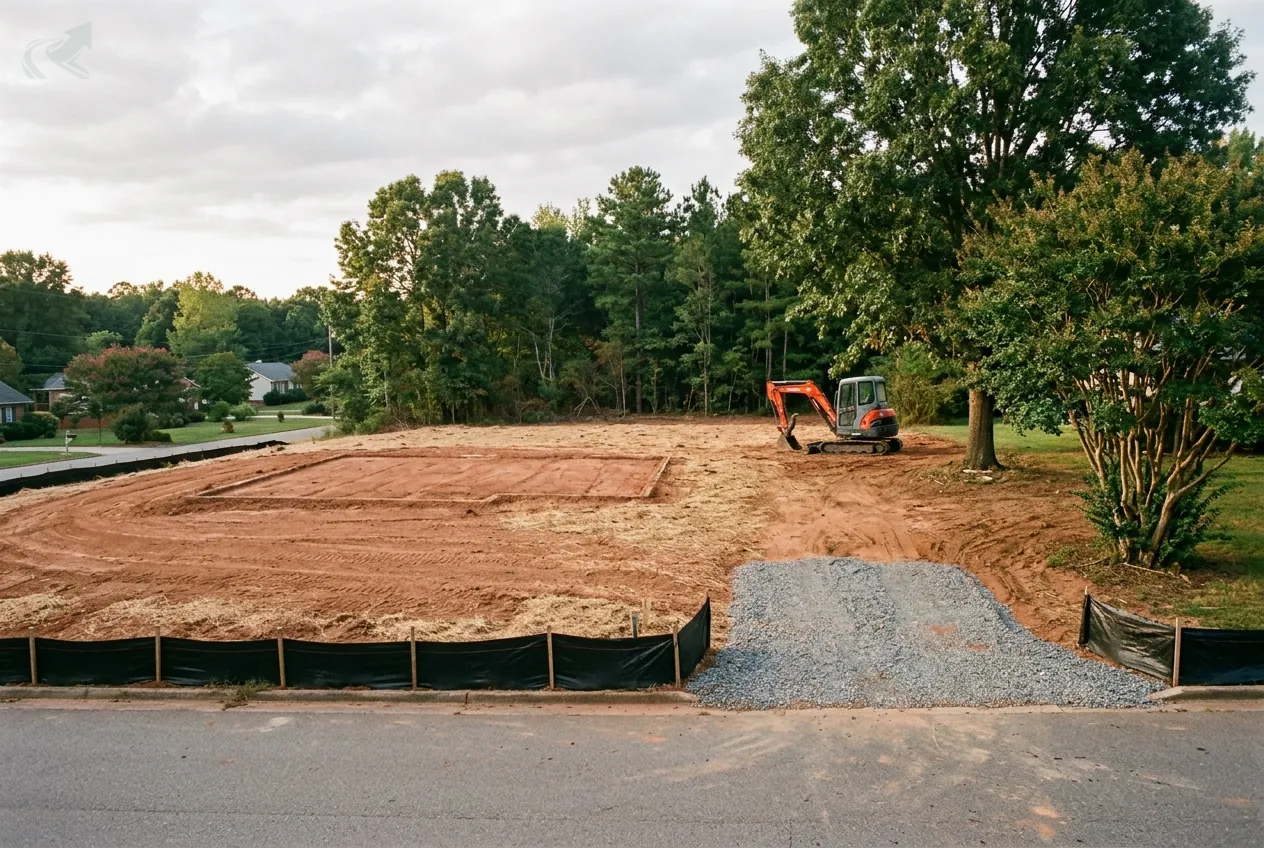
Bare red clay can wash into the street in a hard rain, which is why a cleared lot often gets silt fence and straw. Whether your lot falls under North Carolina’s land-disturbance rules depends on how much ground is disturbed, so read our erosion control guide. If the next step is a new house, the work moves to site preparation and pad preparation.
A pool or a slab is a smaller version of the same job. For a pool, see pool removal. Whatever is coming out, the first questions are the same: what is under it, what is connected to it, and where does it go.
Who Does Demolition in North Carolina
Demolition is done by demolition contractors, and by many excavation and grading firms. The checks are the same ones we describe for any site-work contractor:
- The license. North Carolina requires a general contractor license when the total project is worth $40,000 or more. Look the contractor up with the licensing board. Our page on the general contractor license shows how.
- Who files what. Ask who submits the state notice and who pulls the local permit. Ask to see both.
- The asbestos plan. Ask for the inspection result, and the accreditation card of anyone removing asbestos.
- The 811 ticket number, and proof of the disconnects.
- Where the waste goes, in writing, with receipts afterward.
- Insurance sent to you by the insurer, and a written quote that names each part of the job.
Our hire guide walks through comparing quotes, and our directory lists contractors checked against public records. You can also read how to check any contractor and find an excavation contractor.
What would you do?
Read the situation, decide your first move, then tap to check.
1 You've inherited a worn-out 1980s house and want it gone.
Call the state's asbestos unit and your inspections office before you call a demolition crew.
Then: Ask the inspections office what it needs for a permit, and whether the state notice is yours to file or the contractor's.
2 The inspection found no asbestos at all.
If your project needs the state notice, it is still due, at least 10 working days ahead.
Then: The state's guide asks for notice of building demolition even if no asbestos is present. Ask the unit whether yours needs one.
3 A contractor says the city permit is all you need.
Not necessarily. The state says a local permit alone does not meet its notification or permit requirements.
Then: Ask whether the state notice applies, and if it does, ask to see it.
4 The crew wants to start Monday, and you filed the 811 ticket Friday afternoon.
That is too soon. The law asks for at least three full working days.
Then: Count the working days. Weekends and state holidays don't count.
5 The contractor says the debris is all going to the same landfill.
Ask the landfill what it accepts, and ask where any asbestos goes.
Then: Each landfill sets its own rules, and asbestos is handled separately.
6 The crew leaves the footprint rough, with the old footings still in the ground.
Check your permit. Durham's, for one, requires foundation and footings removed and the site graded to drain.
Then: Settle this in the quote, before the work starts.