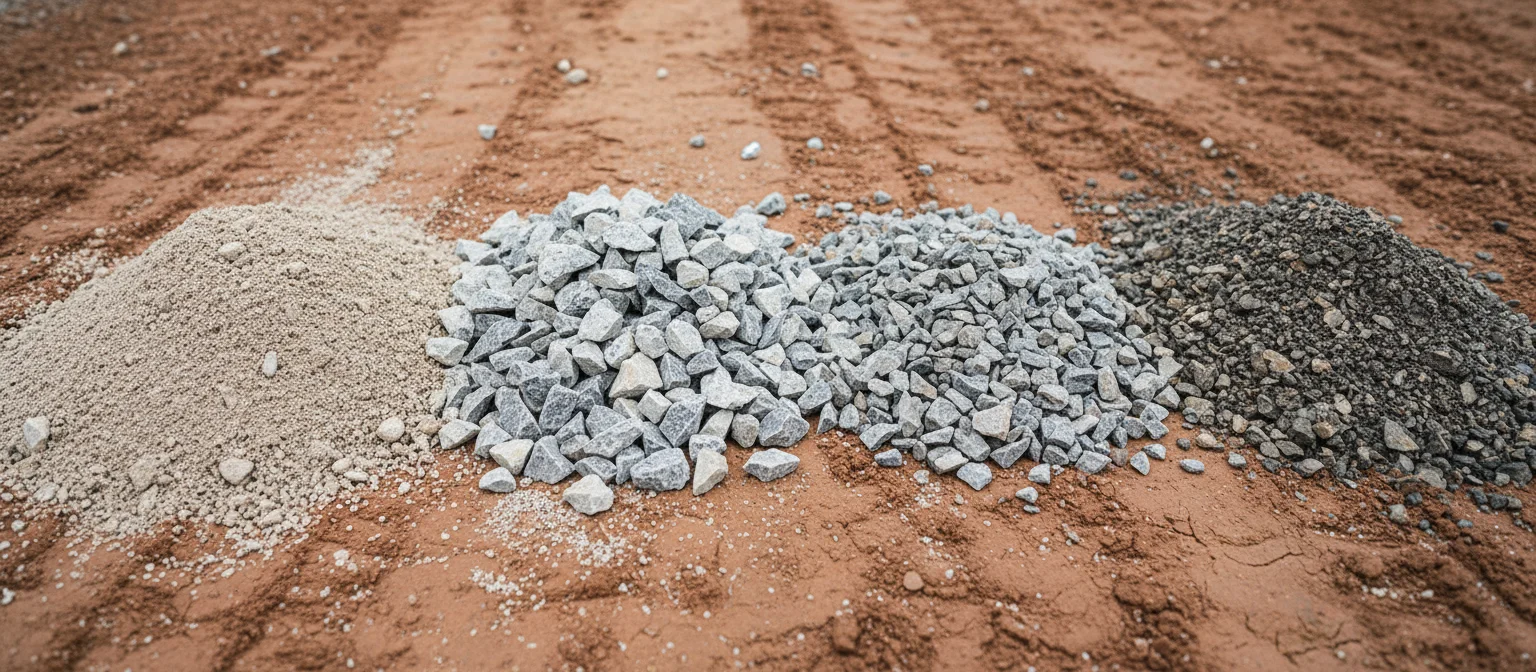
Before you call a contractor
What is ABC gravel?
ABC (Aggregate Base Course) is a crushed stone mix with fine particles that compact together into a stable base. Used for driveway and road bases. NOT appropriate for French drain beds -- the fines clog drainage applications within a few seasons in NC clay.
What is #57 stone?
#57 stone is a uniformly graded crushed stone (approximately 3/4 to 1 inch). The uniform particle size creates void space for water to move through. The standard spec for French drain beds and drainage applications in North Carolina.
What is CABC?
CABC (Crusher-Run Aggregate Base Course) is a denser, more tightly graded version of ABC used for sub-base layers under heavier loads. Not a drainage material -- even more prone to clogging than standard ABC due to higher fines content.
Your French drain quote says “backfill with .” You’ve read that French drains need permeable stone. You looked up ABC and found it described as a base material for driveways and roads. That’s correct — and that’s not what goes in a French drain.
Something feels off about that specification. You’re right.
This page explains the four aggregate types that show up on NC grading and drainage quotes: , #57 stone, #67 stone, and . Each one does a specific job. Mixing them up — especially putting ABC where drainage stone belongs — costs homeowners money and time they won’t get back.
North Carolina’s Piedmont clay makes the stakes higher than they are in other states. Here’s what you need to know before a contractor shows up with a load of the wrong material.
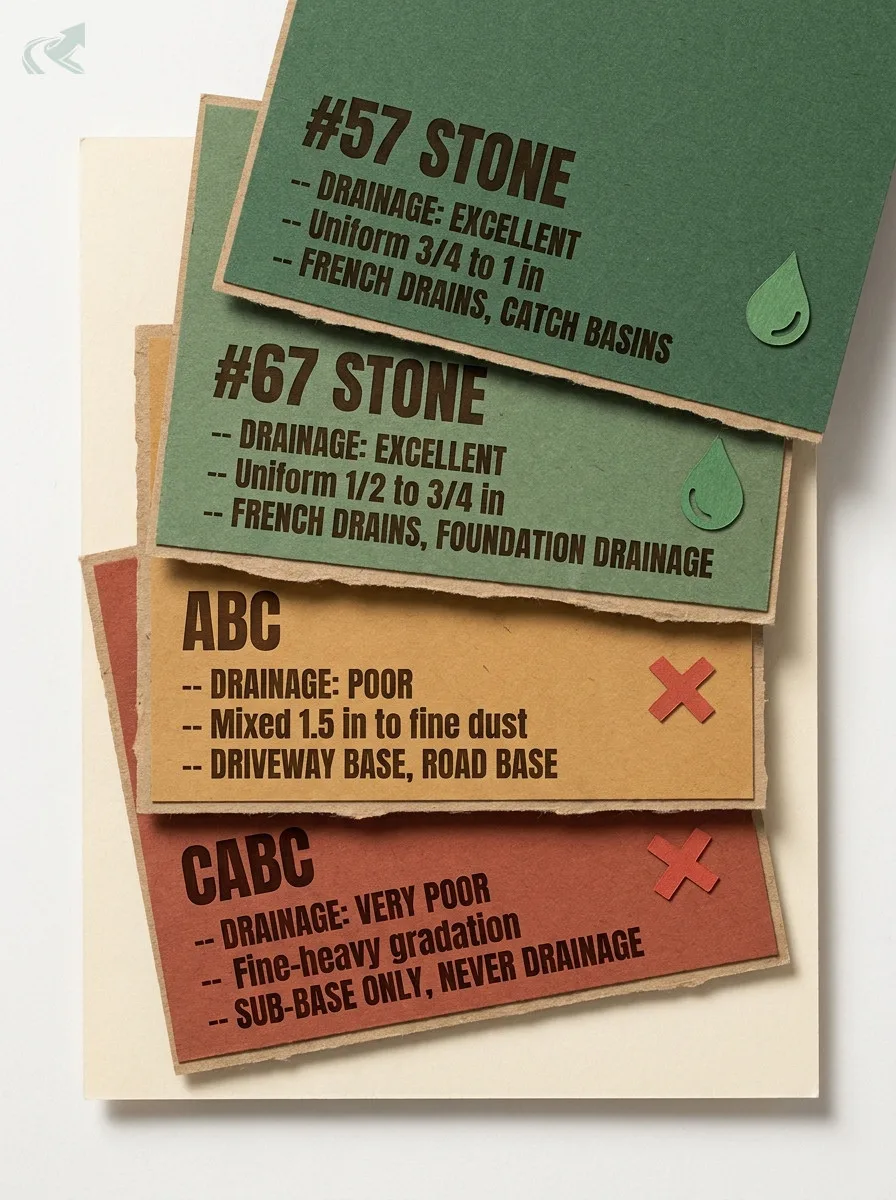
What ABC Is and What It’s For
ABC is a compacted base material — the fine particles are the feature. Those same fines are the problem in drainage applications.
ABC is a blend of particle sizes ranging from about 1.5 inches down to fine dust. When a contractor spreads it and runs a compactor over it, those fine particles fill the void space between larger pieces and bind everything together. The result is a near-solid surface.
That’s what you want under a driveway. It’s what NCDOT specs for road base throughout North Carolina. It’s widely available from NC quarries in every major metro.
The problem appears when ABC goes somewhere it doesn’t belong. In drainage applications — French drain beds, catch basin rings, perimeter drain systems — the fine particles don’t compact into a stable surface. They migrate. Under rain and hydraulic pressure, fines move through the void space, toward perforated pipe perforations, and eventually into the pipe itself.
An ABC-filled French drain in NC clay will be partially or fully blocked within 2—3 seasons. That’s not a theory — it’s the consistent pattern NC operators report in the field.
What #57 Stone Is and What It’s For
#57 is the drainage workhorse in NC — uniform particle size, high void ratio, water moves through it freely.
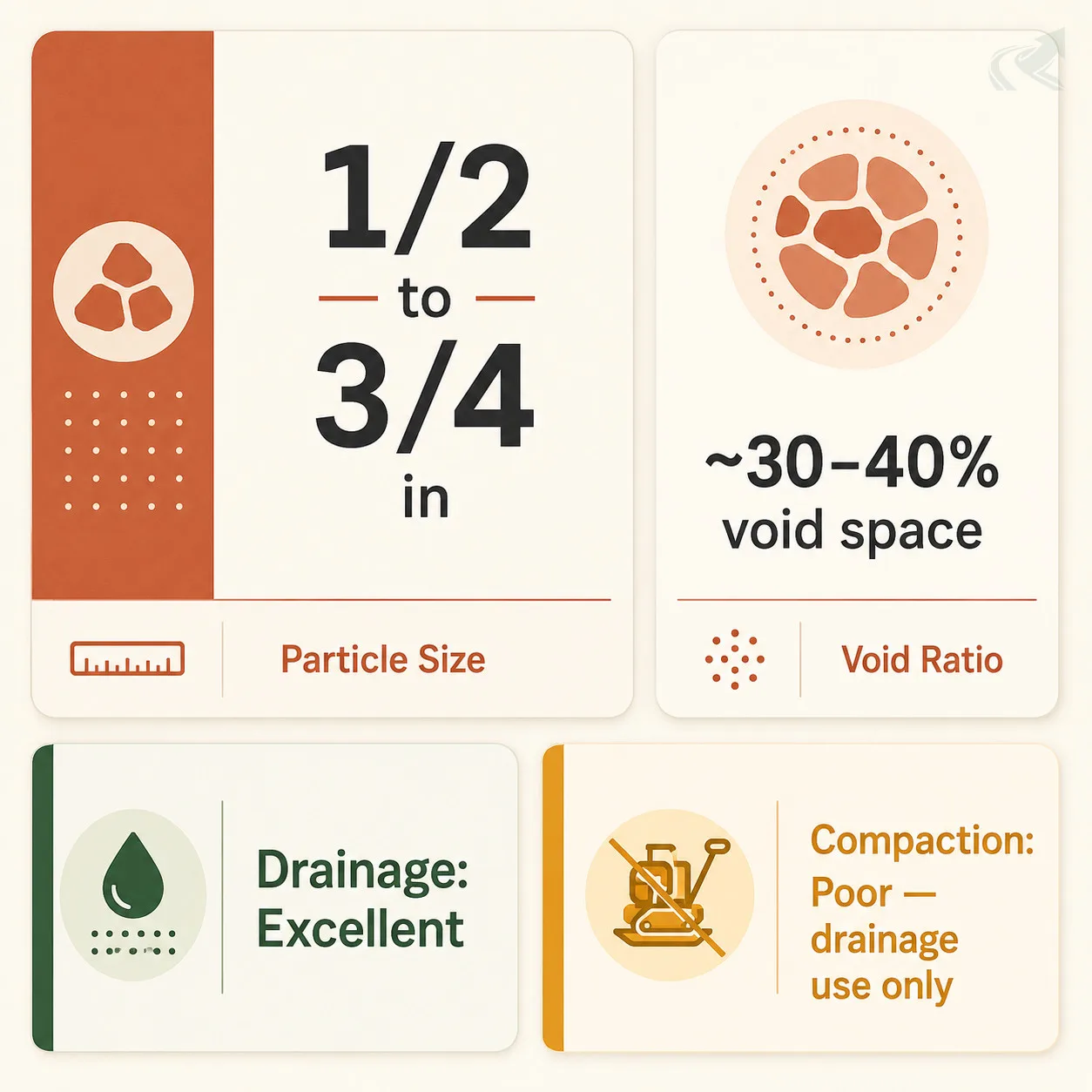
ASTM No. 57 is a gradation specification for crushed stone, approximately 3/4 to 1 inch in diameter. The key word is “uniform.” Because all the particles are close to the same size, they can’t pack together tightly. The void space — roughly 30—40% of the total volume — stays open. Water flows through it without resistance.
That void ratio is what makes #57 the right material for NC French drain installation beds, catch basin drainage rings, curtain drains, and outlet protection zones across North Carolina. Water enters at the perforated pipe and moves quickly through the surrounding stone bed.
#57 does not compact into a stable driving surface. You can’t park on it; you can’t build a driveway base from it. It is a drainage material, not a base material. Keep those two jobs separate on any itemized quote and you’ll catch most aggregate spec errors before they become installed mistakes.
What #67 Stone Is
#67 is slightly smaller than #57 — approximately 1/2 to 3/4 inch — and performs similarly in drainage applications across NC.
ASTM No. 67 is a slightly finer gradation than No. 57. The particle size difference is modest, and the drainage performance is comparable. Both maintain high void ratios. Both are widely available from NC quarries.
Some contractors prefer #67 around perforated pipe because the slightly smaller stone makes tighter contact with the pipe wall while still maintaining drainage capacity. Whether that preference has a strong engineering basis or is primarily convention varies by contractor — either specification is acceptable for standard residential drainage work.
When your contractor specifies one versus the other for a French drain or foundation drainage system, either is appropriate. The more important question is whether they’re specifying crushed stone at all — versus ABC or some other fill material that doesn’t belong in a drainage bed.
What CABC Is
is a denser version of ABC used in sub-base applications with higher load requirements — not a drainage material.
CABC carries a higher fines content than standard ABC. It compacts to a denser, more stable surface and is used for sub-base layers under roads and high-load parking areas where standard ABC compaction isn’t sufficient.
For residential French drains or drainage beds, CABC is the wrong material by a wider margin than standard ABC. The elevated fines content makes it even more prone to clogging. If your quote specifies CABC for any drainage application, that’s a red flag worth asking about directly with a verified NC grading contractor.
CABC is a legitimate material. It’s just not a drainage material, and it should never appear in a drainage bed spec.
The Fines-in-ABC Problem in NC Clay — The Detail Most Homeowners Miss
NC Piedmont clay’s fine particles migrate aggressively into aggregate. ABC’s own fines make this problem worse. A French drain backfilled with ABC in NC clay will clog significantly faster than a #57-filled drain.
Here’s the mechanism. North Carolina Piedmont clay has fine particles that move under hydraulic pressure and rain infiltration. That’s a baseline reality for most residential drainage work in the Triangle, Triad, and Charlotte metro areas.
ABC’s fine particles are already present in the drain bed before any clay migration starts. So the combination — clay fines moving in from outside, ABC fines already present — produces a concentrated accumulation at the pipe perforations. Over 1—3 seasons, that accumulation forms a seal. The drain stops draining — and standing water in your yard is the result.
A properly specified French drain uses #57 or #67 stone wrapped in geotextile fabric. The fabric separates the stone bed from the surrounding clay, slowing fine particle migration into the drainage zone. The stone itself has no fines to contribute. The drain stays clear longer.
This is why the question “what stone are you backfilling the drain with?” matters before any work starts. The right answer is #57 or #67 with geotextile fabric. ABC is the wrong answer, and CABC is a worse wrong answer.
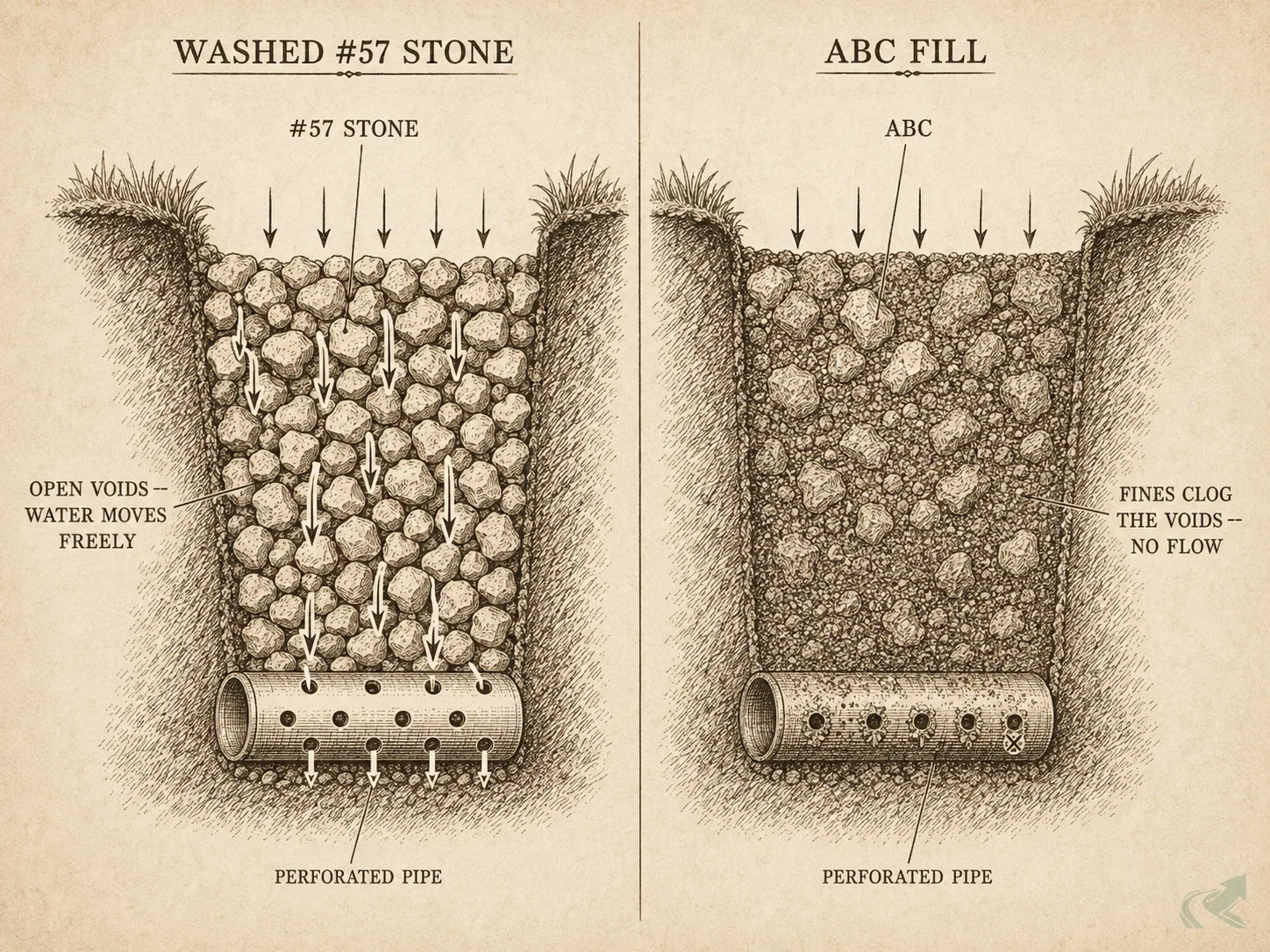
Drain bed stone: washed #57 vs ABC
Comparison. Washed #57 bed: Open voids hold water and let it move; No fines to migrate into pipe perforations; Geotextile wraps the stone and blocks soil; Drain keeps flowing for years. ABC in the trench: Crushed fines pack tight around the pipe; Fines migrate into the perforations; Void space disappears -- water can't move; Clogged drain, no flow.
- Open voids hold water and let it move
- No fines to migrate into pipe perforations
- Geotextile wraps the stone and blocks soil
- Drain keeps flowing for years
- Crushed fines pack tight around the pipe
- Fines migrate into the perforations
- Void space disappears -- water can't move
- Clogged drain, no flow
ABC is engineered to lock up and compact -- the exact opposite of what a French drain bed needs.
Aggregate Comparison: ABC vs. #57 vs. #67 vs. CABC
NC aggregate types: correct application determines whether your project works or fails.
| Factor | ABC | #57 Stone | #67 Stone | CABC |
|---|---|---|---|---|
| Particle size | Mixed -- 1.5 in down to fine dust | 3/4 to 1 in, uniform | 1/2 to 3/4 in, uniform | Mixed -- fine-heavy gradation |
| Fines content | High | Very low | Very low | Very high |
| Primary use | Driveway base, road base, parking lot base | French drain beds, drainage applications | French drains, foundation drainage | Sub-base under heavy-load roads and parking |
| Drainage rating | Poor -- do not use in French drains | Excellent | Excellent | Very poor -- worse than ABC |
| Compaction rating | Excellent | Poor -- not a base material | Poor | Excellent |
| NC quarry availability | Widely available statewide | Widely available statewide | Widely available -- confirm with your quarry | Widely available statewide |
Particle size
- ABC
- Mixed -- 1.5 in down to fine dust
- #57 Stone
- 3/4 to 1 in, uniform
- #67 Stone
- 1/2 to 3/4 in, uniform
- CABC
- Mixed -- fine-heavy gradation
Fines content
- ABC
- High
- #57 Stone
- Very low
- #67 Stone
- Very low
- CABC
- Very high
Primary use
- ABC
- Driveway base, road base, parking lot base
- #57 Stone
- French drain beds, drainage applications
- #67 Stone
- French drains, foundation drainage
- CABC
- Sub-base under heavy-load roads and parking
Drainage rating
- ABC
- Poor -- do not use in French drains
- #57 Stone
- Excellent
- #67 Stone
- Excellent
- CABC
- Very poor -- worse than ABC
Compaction rating
- ABC
- Excellent
- #57 Stone
- Poor -- not a base material
- #67 Stone
- Poor
- CABC
- Excellent
NC quarry availability
- ABC
- Widely available statewide
- #57 Stone
- Widely available statewide
- #67 Stone
- Widely available -- confirm with your quarry
- CABC
- Widely available statewide
How to Read an Aggregate Spec on a Quote
Two items on a quote line tell you whether the contractor is using the right material for the application.
Look at each line item and ask: is this a drainage application or a base application? French drain beds, catch basins, and perimeter drains need #57 or #67. Driveways, road bases, and parking areas need ABC or CABC. The materials are not interchangeable — not in North Carolina, and especially not in Piedmont clay.
The geotextile fabric question is the second part. For any drainage stone installation, the spec should include geotextile fabric wrapping to separate the stone bed from surrounding clay. If it’s not on the quote, ask.
A contractor who answers both questions directly is speccing for the actual conditions on your site. One who defaults to ABC for everything is not.
The same principle applies whether you’re reading an itemized quote for a French drain in Guilford County or reviewing materials for a gravel delivery order. If the quote bundles drainage stone and base material under a single “gravel” line item without specifying gradation, that’s the question to ask first. The right contractor will have an immediate, specific answer.
More aggregate type definitions are at the NC grading glossary. To hire a grading operator in North Carolina who can speak to the right spec for your specific drainage or driveway project, start there.