
NC driveway gravel quick reference
I was told to order 'ABC' but the quarry asked if I meant crusher run or CABC. What do I actually order?
ABC (Aggregate Base Course) is the standard NC driveway base material -- mixed gradation from 1.5 inch down to fines that compact into a locked surface on Piedmont clay. Crusher run is often the same material under a different quarry name. CABC is the compacted surface form of the same base material. The diagnostic question to ask the quarry: 'Does this have fines in a continuous gradation?' A yes means it is suitable for driveway base.
Do I need one type of gravel or two different types for a gravel driveway?
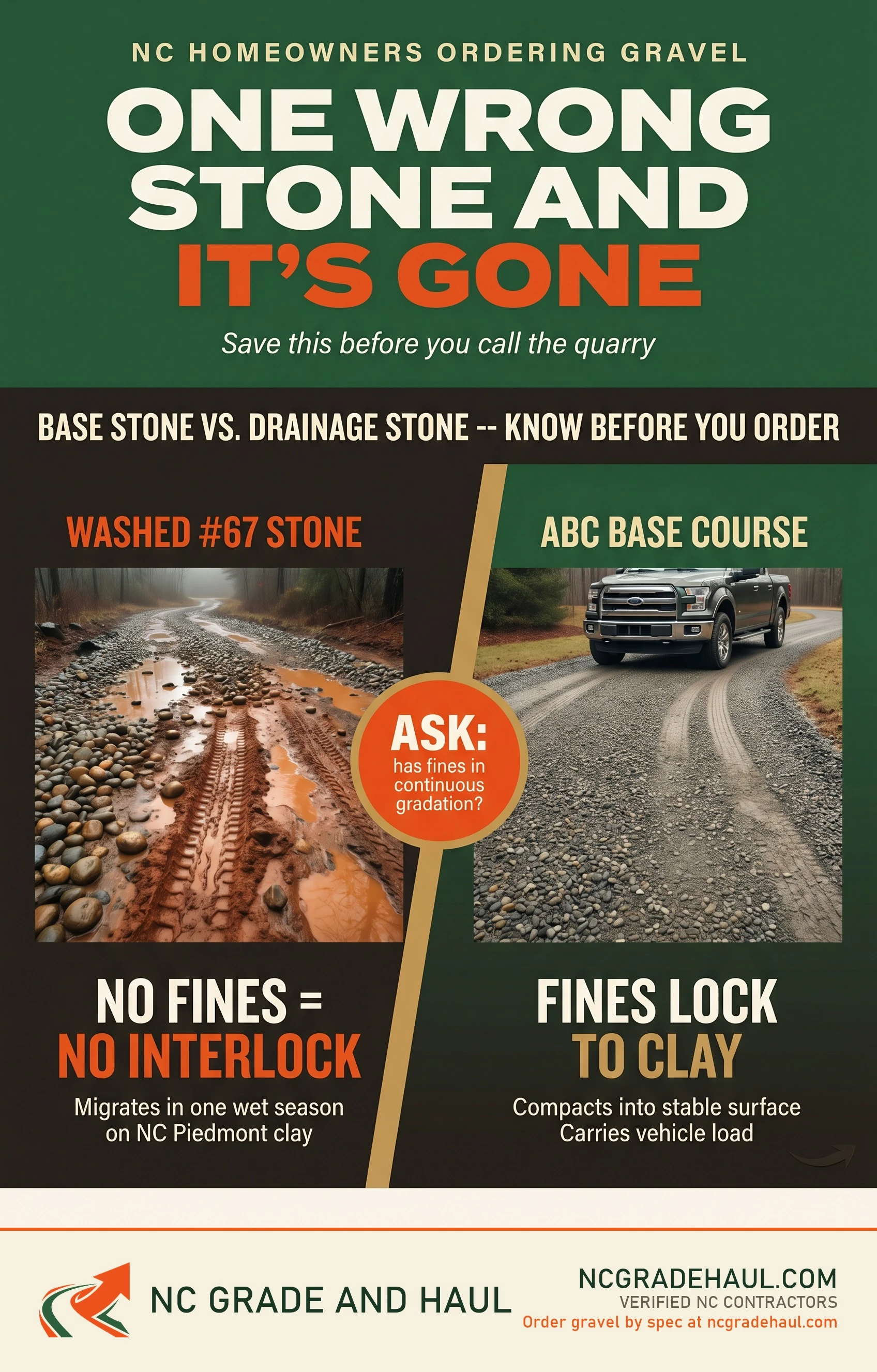
Two layers for a driveway that holds up. The base layer is ABC or crusher run -- compacted first, this is the structural layer. The surface or wearing layer is CABC or sometimes #67 in specific wet-area applications. Dumping #67 washed stone directly on NC clay with no base is not a driveway -- it is temporary surfacing that migrates and disappears within one season.
Brenda Ferrell called the quarry last week to order gravel for her driveway. Her contractor had said “order ABC.” The dispatcher asked: “Crusher run or CABC? And what size — 21-A or B borrow?”
She said “whatever goes on driveways.” The dispatcher said “okay, I’ll put you down for 5 tons of 21-A.” She still does not know what she ordered.
This page is the vocabulary briefing before that call. ABC, crusher run, #67, CABC, 3/4 minus, asphalt millings — North Carolina quarries use all of these terms, and some of them mean the same thing under different names. This hub explains what each material actually is, which one goes where in a gravel driveway, and routes to the individual material pages for anyone who needs to go deeper.
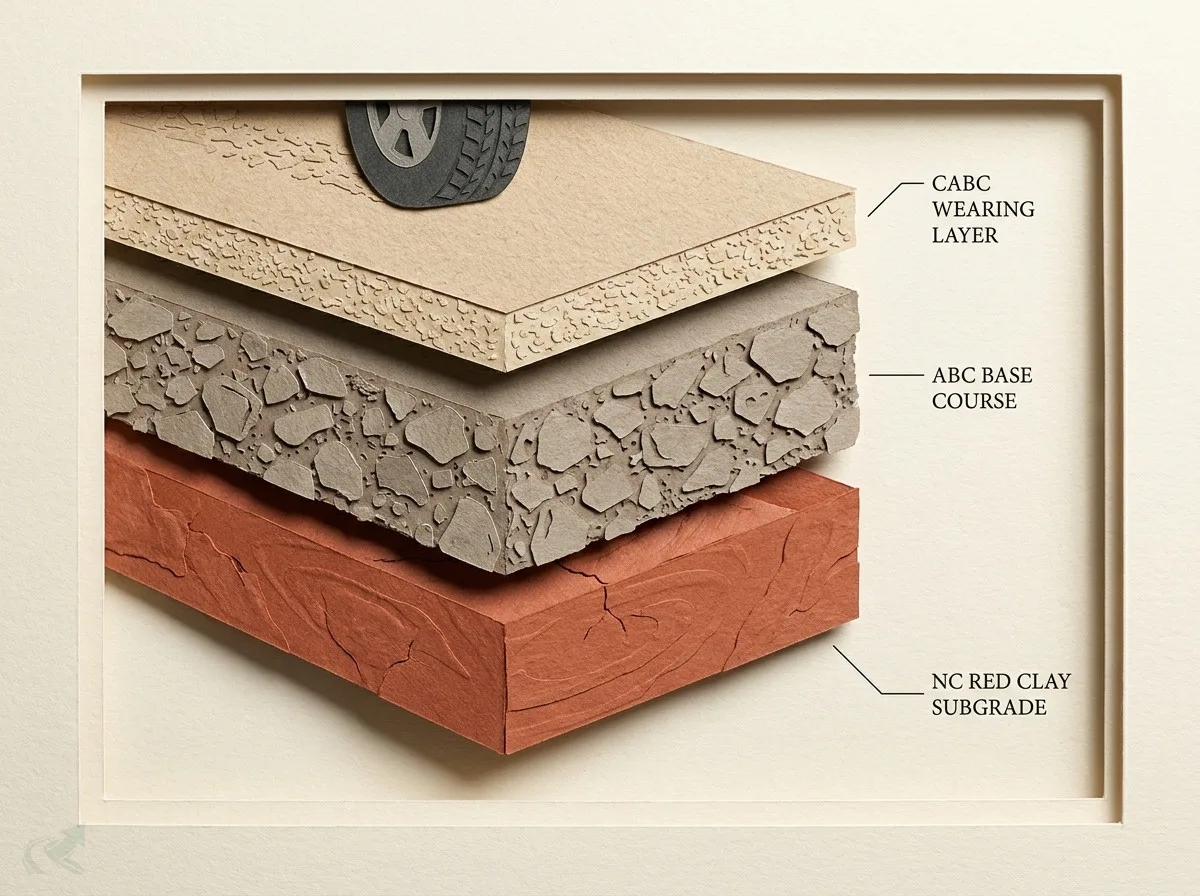
The Two-Layer System — Base vs Surface
An NC gravel driveway has two material layers: the base layer, which provides structural bearing capacity, and the wearing layer, which is the driving surface.
Getting the order wrong costs money twice — once for the wrong material, once to fix it.
Base layer
is the standard base material. The gradation runs from 1.5-inch stone down to fine dust, all in a continuous mix. Under compaction, the fines fill the void space between larger stones and create mechanical interlock. That locked matrix is what carries vehicle load down through the base and into the native subgrade.
This is the structural layer. Skipping it means the wearing surface has nothing stable to sit on.
Wearing layer
The surface or wearing layer sits on top of the compacted base. Common choices in North Carolina: (the same material as ABC, applied and compacted as the final surface course) or #67 stone in specific wet-area applications where drainage matters more than firmness.
Some homeowners call this “top dressing” when they are adding a thin layer over an existing compacted base.
What does not work on NC clay
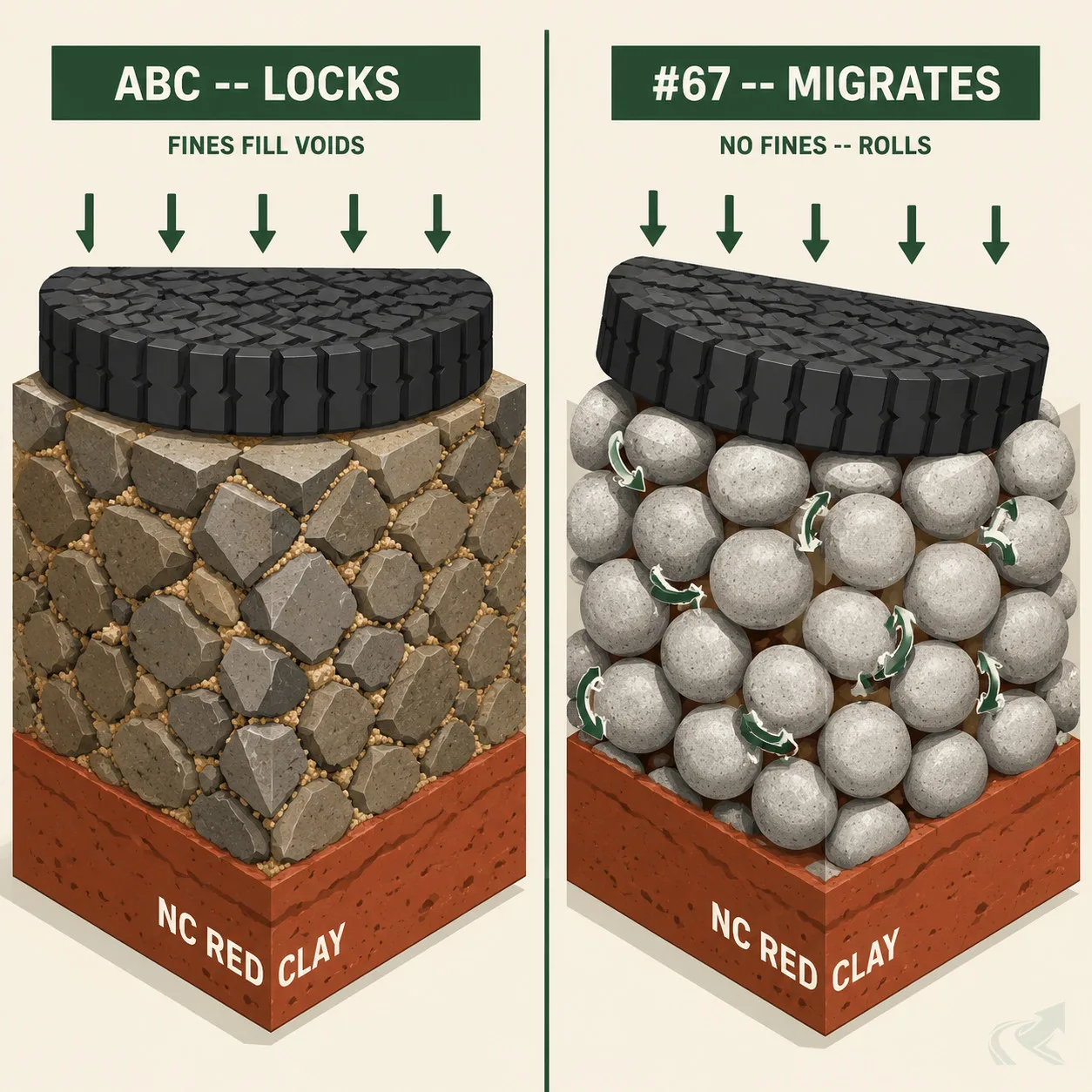
A thin layer of #57 or #67 washed stone on bare clay is not a driveway. It is temporary surfacing. Washed stone has no fines — without fines, there is no interlock, and stone migrates under vehicle tires within one wet season. North Carolina Piedmont clay needs the fines in ABC to bond the base material to the clay surface.
Base down first, compacted. Surface last. Adding surface stone to an uncompacted or failed base buries the problem instead of fixing it.
ABC Gravel — The NC Driveway Standard
is the standard base material for North Carolina gravel driveways because its mixed gradation compacts into a stable, locked surface on Piedmont clay.
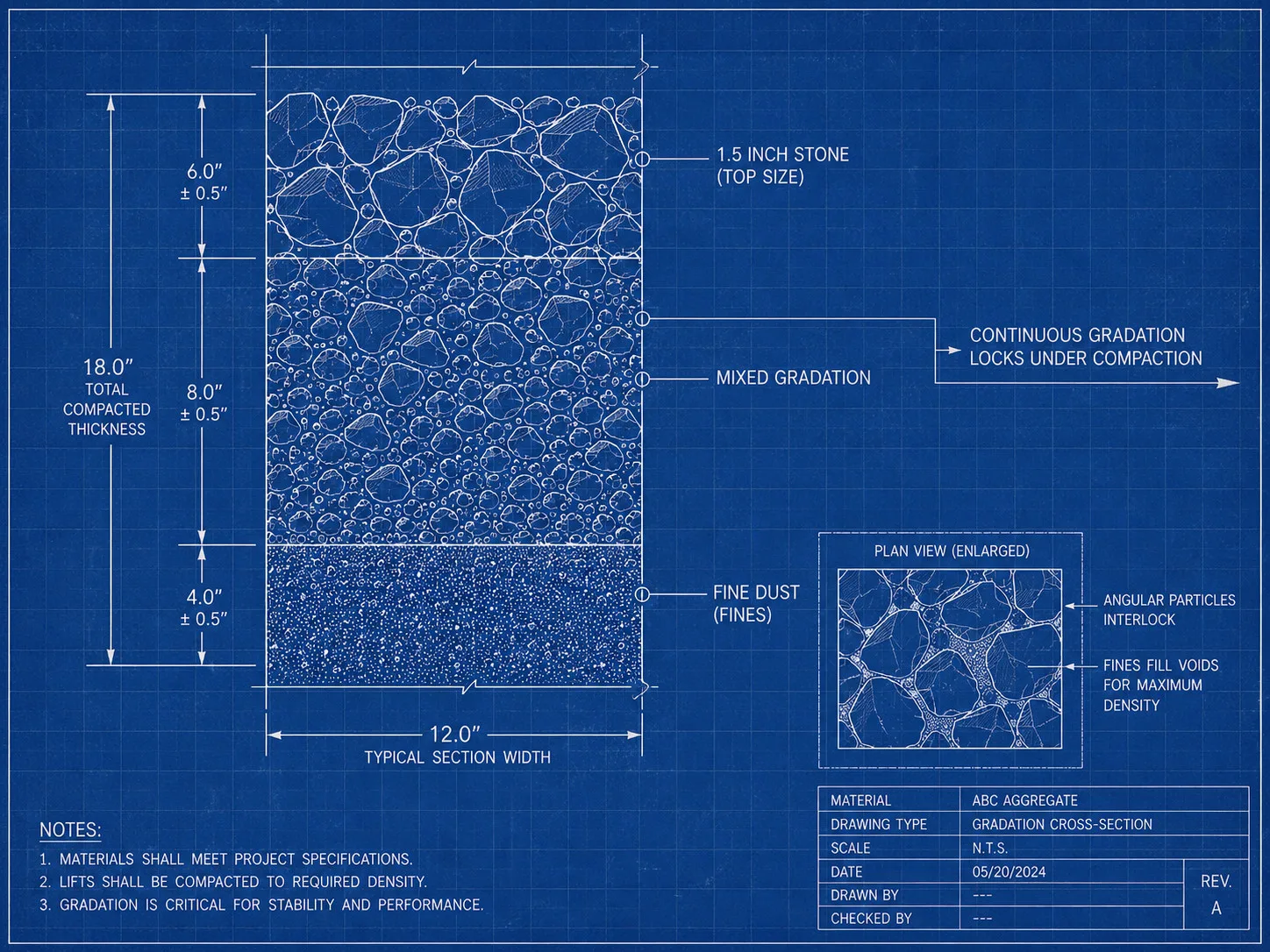
What ABC is
ABC is a continuously graded crushed-stone mix. The gradation runs from 1.5-inch stone (some quarries use 1.25-inch as the top size) all the way down to fine dust. The full range is intentional: when a compactor runs over it, the fines pack into the void space between larger pieces and lock everything together.
The result is a bound surface that does not migrate under vehicle tires — unlike washed stone, which rolls because there is nothing locking the particles in place.
Quarry naming confusion
The same material has different names depending on the quarry and the region. Across North Carolina Piedmont quarries, “crusher run,” “21-A,” “GABC,” and “AB” can all refer to functionally equivalent material. The names vary; the material does not.
The diagnostic question to cut through the naming: “Does this material have fines in a continuous gradation?” If yes, it will compact and perform like ABC. If the answer is “no, it’s washed,” you are looking at a drainage aggregate, not a base material.
See ABC gravel for NC driveways for the full gradation spec, base thickness guidance, and compaction verification.
Crusher Run — Same as ABC or Different?
Crusher run and ABC are often the same material — both are crushed stone with fines in a continuous gradation. The name difference is quarry-specific, not a material difference.
At most NC Piedmont quarries, “crusher run” refers to crushed stone that includes the fine material (the “run” of the crusher, before any screening or washing). That matches the ABC gradation closely enough that the two terms are interchangeable at most local quarries.
When it might differ
Some quarries use “crusher run” for a specific coarser gradation with more large stone and fewer fines than standard ABC. The only way to know is to ask for the gradation spec.
The safe check: “Does this material have a gradation spec that includes fines all the way down?” A yes means it is suitable for driveway base. “No, it’s washed” means it is not.
Why this matters for ordering
If you call and ask for “crusher run” at two different quarries in the same county, you may get different materials. Confirm the gradation includes fines before scheduling delivery.
See crusher run vs ABC gravel for NC driveways for a side-by-side spec comparison and quarry ordering script.
#67 Stone — What It Is Actually For
#67 stone is a washed aggregate used for drainage applications — French drain aggregate, culvert bedding, and drainage layers. It is not suitable as a driveway base material on NC clay.
#67 is 3/4-inch crushed stone that has been washed to remove fines. The absence of fines is the specification, not a deficiency. Open void space between the uniform particles creates the continuous drainage column that makes a French drain work.
Why #67 does not work as a driveway base
Without fines, there is no interlock. Vehicle tires push the loose stone around. The material migrates to low spots and concentrates at the edges. After one wet NC winter, the driveway looks like a gravel pile at each end with bare clay in the middle.
The one exception
In some very wet applications — a driveway section that sits over a high-water-table area, or a surface course in a spot where standing water is the persistent problem — #67 is sometimes specified as the wearing layer over an existing compacted ABC base. The open gradation sheds standing water quickly. But this is a specific design decision, not the general recommendation.
See #67 stone for NC driveways for drainage-specific applications and where #67 belongs in a driveway spec.
Asphalt Millings — The Budget Alternative
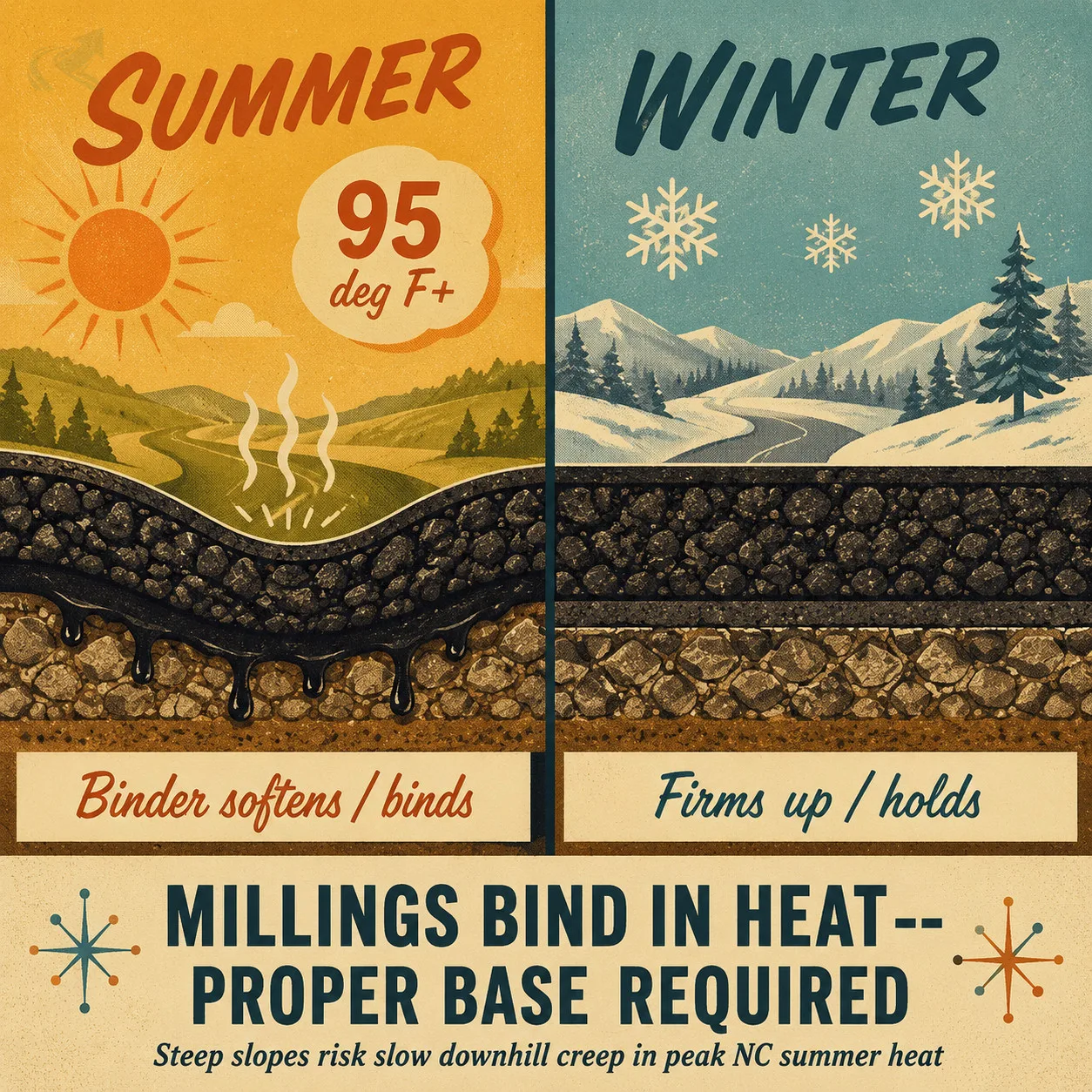
Asphalt millings are recycled asphalt ground to aggregate size. They function as a surface layer that binds slightly in summer heat, producing a semi-solid driving surface at lower material cost than fresh gravel.
Millings are the ground-up asphalt from repaved roads and parking lots. The material contains residual asphalt binder that softens in heat and firms up in cooler temperatures, which gives millings a slightly bound character that loose gravel does not have.
When millings work
- Budget driveway surfacing on a properly compacted base
- Rural driveways with low aesthetic requirements
- Temporary access roads for construction sites
When millings do not work
Millings on an uncompacted clay base with no proper ABC underneath behave like loose aggregate — the binding happens in the surface layer, not at the base. The binder cannot compensate for a failed base.
On steep slopes, millings can soften enough in peak North Carolina summer heat to flow slowly downhill. This is rare but documented in high-sun exposures.
County-level restrictions on millings vary across North Carolina. Some counties limit millings on residential driveways that discharge to state-maintained roads. Verify with your county planning office before ordering.
See asphalt millings for NC driveways for sourcing, pricing, and the compaction requirements that determine whether millings will hold up.
3/4 Minus Gravel — When to Specify It
3/4 minus is a filtered aggregate that includes fines — it compacts better than washed 3/4 stone but may not meet the full ABC gradation spec. Ask for the gradation before ordering for a base application.
The “minus” means the aggregate has been screened so everything passing through a 3/4-inch screen is included — including the fines. This is different from washed 3/4 stone, where the fines have been removed.
How it compares to ABC
3/4 minus includes fines and will compact. The fines content may be lower than in standard ABC because the screening process does not guarantee the same full gradation. On Piedmont clay, 3/4 minus performs better than washed stone but may not achieve the same base stability as true ABC over time.
Some contractors prefer 3/4 minus as a surface topdress over an existing ABC base, particularly on driveways with heavy truck traffic. The larger stone is more resistant to tire displacement than the finer-surfaced CABC.
See 3/4 minus gravel for NC driveways for performance comparisons and when to specify it over standard ABC.
Gravel Type Comparison
The single diagnostic question for any NC driveway material: “Does this have fines in a continuous gradation?” Base layer applications require a yes. Drainage applications require a no.
NC driveway gravel types: fines content, use case, performance on Piedmont clay, and NC verdict. Use this table before calling the quarry.
| Material | Fines content | Primary use | Performance on NC clay | NC driveway verdict |
|---|---|---|---|---|
| ABC | Yes -- full gradation to dust | Driveway base layer | Excellent -- fines lock to clay surface | Standard base choice |
| Crusher run | Usually yes -- confirm gradation | Driveway base layer (same as ABC at most quarries) | Excellent if fines confirmed | Equivalent to ABC if spec matches |
| CABC | Yes -- same as ABC | Surface/wearing layer over base | Excellent as compacted top course | Standard surface choice |
| #67 stone | No -- washed aggregate | Drainage: French drains, culvert bedding | Migrates on clay without base | Drainage only -- not a base material |
| Asphalt millings | Yes -- plus asphalt binder | Budget surface layer over base | Acceptable on proper base; binds in heat | Budget surface option; requires real base underneath |
| 3/4 minus | Yes -- screened, lower fines than ABC | Surface topdress, secondary base | Better than washed; may not match ABC | Confirm gradation; heavier surface dressing use case |
ABC
- Fines content
- Yes -- full gradation to dust
- Primary use
- Driveway base layer
- Performance on NC clay
- Excellent -- fines lock to clay surface
- NC driveway verdict
- Standard base choice
Crusher run
- Fines content
- Usually yes -- confirm gradation
- Primary use
- Driveway base layer (same as ABC at most quarries)
- Performance on NC clay
- Excellent if fines confirmed
- NC driveway verdict
- Equivalent to ABC if spec matches
CABC
- Fines content
- Yes -- same as ABC
- Primary use
- Surface/wearing layer over base
- Performance on NC clay
- Excellent as compacted top course
- NC driveway verdict
- Standard surface choice
#67 stone
- Fines content
- No -- washed aggregate
- Primary use
- Drainage: French drains, culvert bedding
- Performance on NC clay
- Migrates on clay without base
- NC driveway verdict
- Drainage only -- not a base material
Asphalt millings
- Fines content
- Yes -- plus asphalt binder
- Primary use
- Budget surface layer over base
- Performance on NC clay
- Acceptable on proper base; binds in heat
- NC driveway verdict
- Budget surface option; requires real base underneath
3/4 minus
- Fines content
- Yes -- screened, lower fines than ABC
- Primary use
- Surface topdress, secondary base
- Performance on NC clay
- Better than washed; may not match ABC
- NC driveway verdict
- Confirm gradation; heavier surface dressing use case
What’s in This Guide
This hub orients the gravel selection decision. Each spoke page goes deeper on a single material — gradation spec, thickness guidance, ordering questions, and what to ask the quarry before the truck rolls.
- ABC gravel for NC driveways — the full NC standard: gradation, base depth, compaction verification
- Crusher run vs ABC for NC driveways — when they are the same material and when they differ
- #67 stone for NC driveways — drainage applications and why it migrates as a base
- 3/4 minus gravel for NC driveways — filtered aggregate: where it fits and where it does not
- Asphalt millings for NC driveways — sourcing, binder behavior, and county restrictions
Related pages outside this cluster:
- Gravel delivery for NC driveways — ordering by tons vs yards, minimum load guidance, delivery ticket verification
- Driveway gravel quantity in yards vs tons — conversion math and field estimates by material type
- ABC, #67, and CABC glossary — NCDOT spec numbers and formal definitions
- Gravel driveway grading in NC — the grading, crown, and compaction side of the same project
- Hire a verified NC grading contractor — for projects that need a compactor, a grader, and a correct base spec
Order Gravel with a Spec, Not a Name
When you call the quarry, the material name is not enough. Two quarries in the same county can call different materials “crusher run.” One question cuts through all the naming variation:
“Does this material have fines in a continuous gradation from coarse to fine?”
A yes means it is suitable for a base layer. A “no, it’s washed” means it is a drainage aggregate.
An itemized gravel quote should list: material type by gradation spec (or NCDOT spec number if available), tons per load, and price per ton. Get that itemized list before any delivery is scheduled. A quote that says “5 tons of gravel — $280” does not tell you what material arrived or whether it was the right one.
If the project involves more than a surface refresh — if the base is failing, the crown is gone, or you are building from bare clay — an itemized quote from a verified NC grading contractor should name the base spec, the surface spec, the tonnage by layer, and the compaction method. That is a real scope of work. “We’ll regrade it and add some gravel” is not.