
Two questions people often ask
What is the difference between a swale and a ditch?
A swale is a vegetated, shallow-sided channel designed for sheet flow -- slow water movement spread across a wide cross-section. A ditch is deeper, has steeper sides, and moves more water faster. Swales are the more common drainage feature in residential NC grading because they don't require pipe and they manage sheet flow from yards and roadways.
What is a drainage arc?
Drainage arc is sometimes used to describe a curved swale that follows the natural contour of a slope. In practice, swale and drainage arc are often used interchangeably by NC contractors -- the distinction is shape, not function.
A contractor tells Hannah he’ll “run a swale from the low corner of the yard to daylight at the property line.” She pictures a ditch — a trench dug straight across the lot, water rushing through it.
What he’s actually proposing is a shallow, grass-lined channel that slows water down and moves it away without scouring the surface. That difference matters. It affects how the yard looks, how it’s maintained, and what happens during the first heavy rain after grading.
Understanding what a swale is — and what NC clay does to it — gives you enough vocabulary to evaluate whether the plan on paper will hold up in the field.
Swale vs. Ditch — The Functional Difference
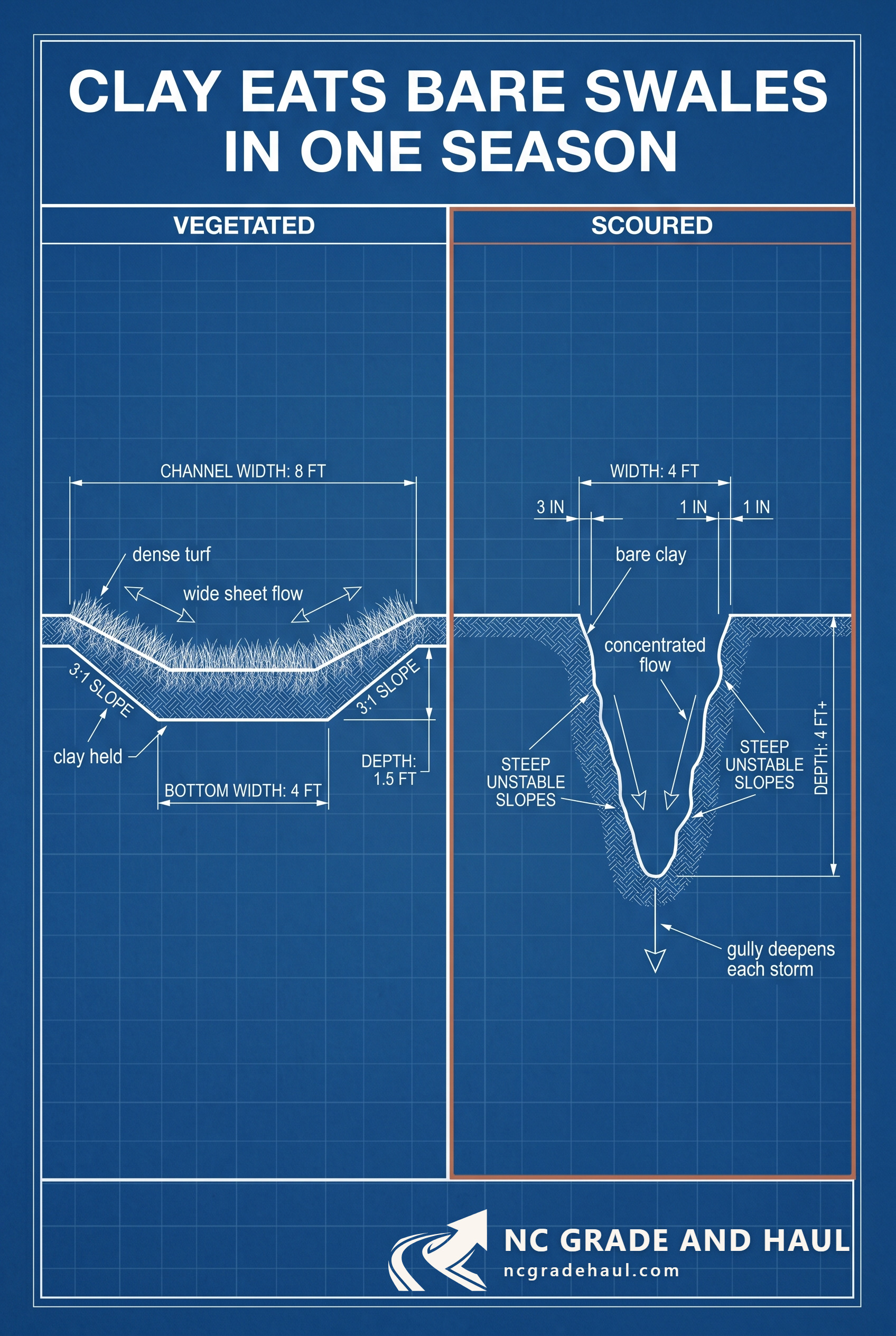
A swale slows water. A ditch moves water. Both route it, but at different velocities and with very different erosion risks.
The distinction isn’t just terminology. A ditch moves concentrated flow fast. A swale spreads that same flow across a wide, shallow cross-section and lets vegetation absorb the energy before the water reaches the outlet. That’s why swales are the standard residential drainage feature across North Carolina — they work without pipe, and they manage the sheet flow that comes off yards, rooftops, and roadways.
| Feature | Swale | Ditch |
|---|---|---|
| Cross-section | Wide, shallow V or trapezoidal | Narrow, deep V or trapezoidal |
| Typical water velocity | Low — sheet flow slowed by vegetation | Higher — concentrated flow |
| Vegetation | Required — slows flow, prevents erosion | Optional; often bare |
| Maintenance | Annual mowing, occasional re-grading | Periodic cleaning; more erosion-prone |
| Residential NC use | Common — yard drainage, lot-edge routing | Common near roads; less in yards |
One more term worth knowing: drainage arc. NC contractors sometimes use it to mean a curved swale that follows the natural contour of a slope rather than running straight to the property line. In most conversations, swale and drainage arc mean the same thing. If a contractor uses one term or the other, it’s worth confirming — but don’t assume they’re proposing two different structures.
How to Read a Site for Swale Routing
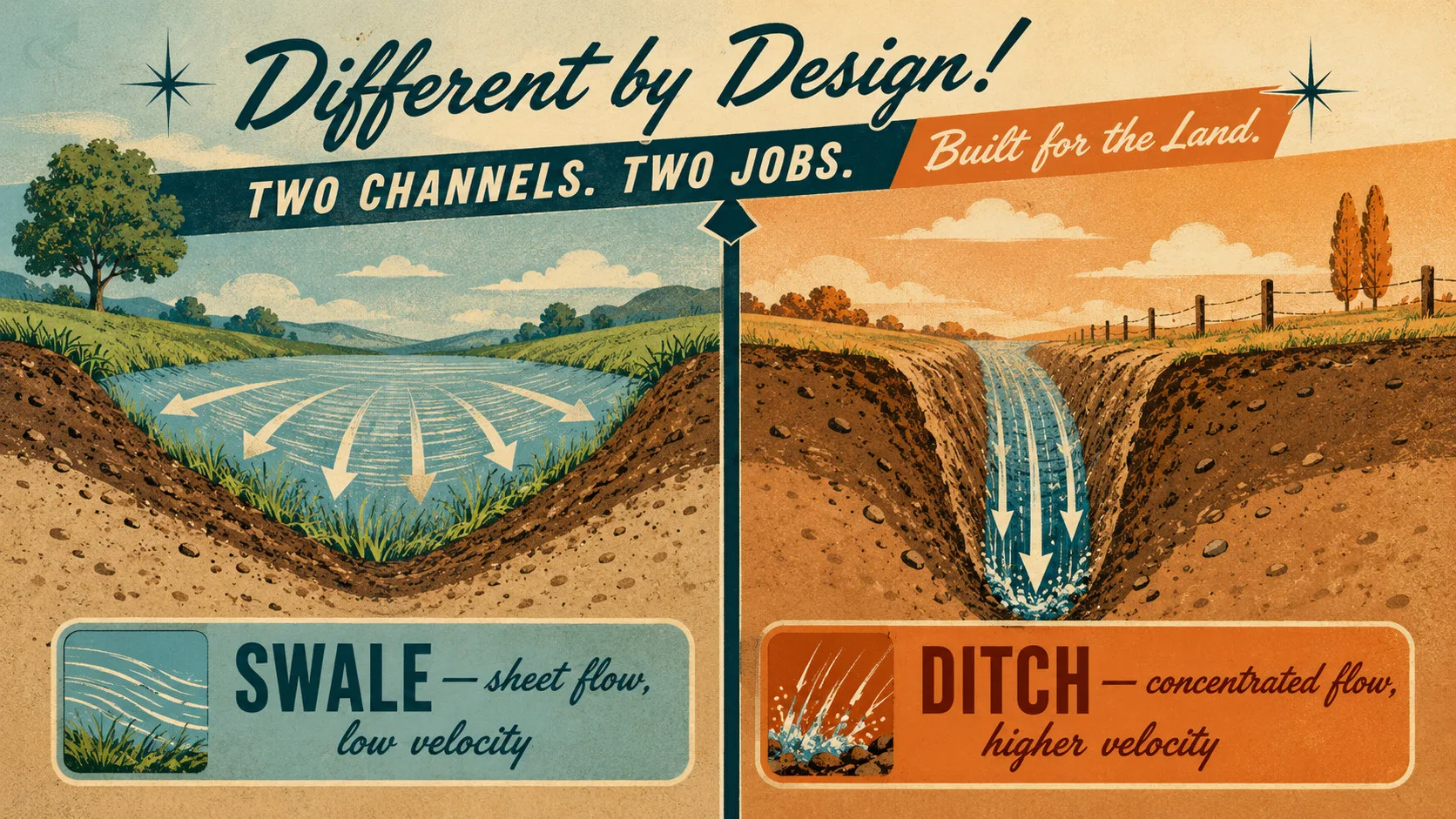
Water follows grade. Swale routing starts by identifying where water naturally concentrates on a site and designing a graded channel that takes it somewhere better.
Four things to identify before a swale route is drawn:
- Find the low corners — water concentrates at low areas on the lot. These are either where a swale should start (capturing and routing the flow) or where yard drainage solutions NC are already overdue.
- Identify the fall direction — which direction does the lot slope? A swale routes water in the direction of least resistance, not always straight to the property line.
- Find the daylight point — where can the swale outlet to discharge water off the lot? Swales need a clean daylight point: typically a road ditch, a natural drainage way, or a collection point that can accept the flow.
- Check slope — swales need enough slope to move water (minimum 0.5-1% grade along the swale bottom per NC guidance) but not so much that velocity erodes the channel. Most residential swales target 1-3% gradient. Above 3-5%, outlet protection becomes mandatory.
A contractor who can walk the site and explain each of these four points is reading the land, not just quoting off a template. Ask which direction they’re routing the swale and why — and where the daylight point is.
What NC Clay Does to Swale Bottoms
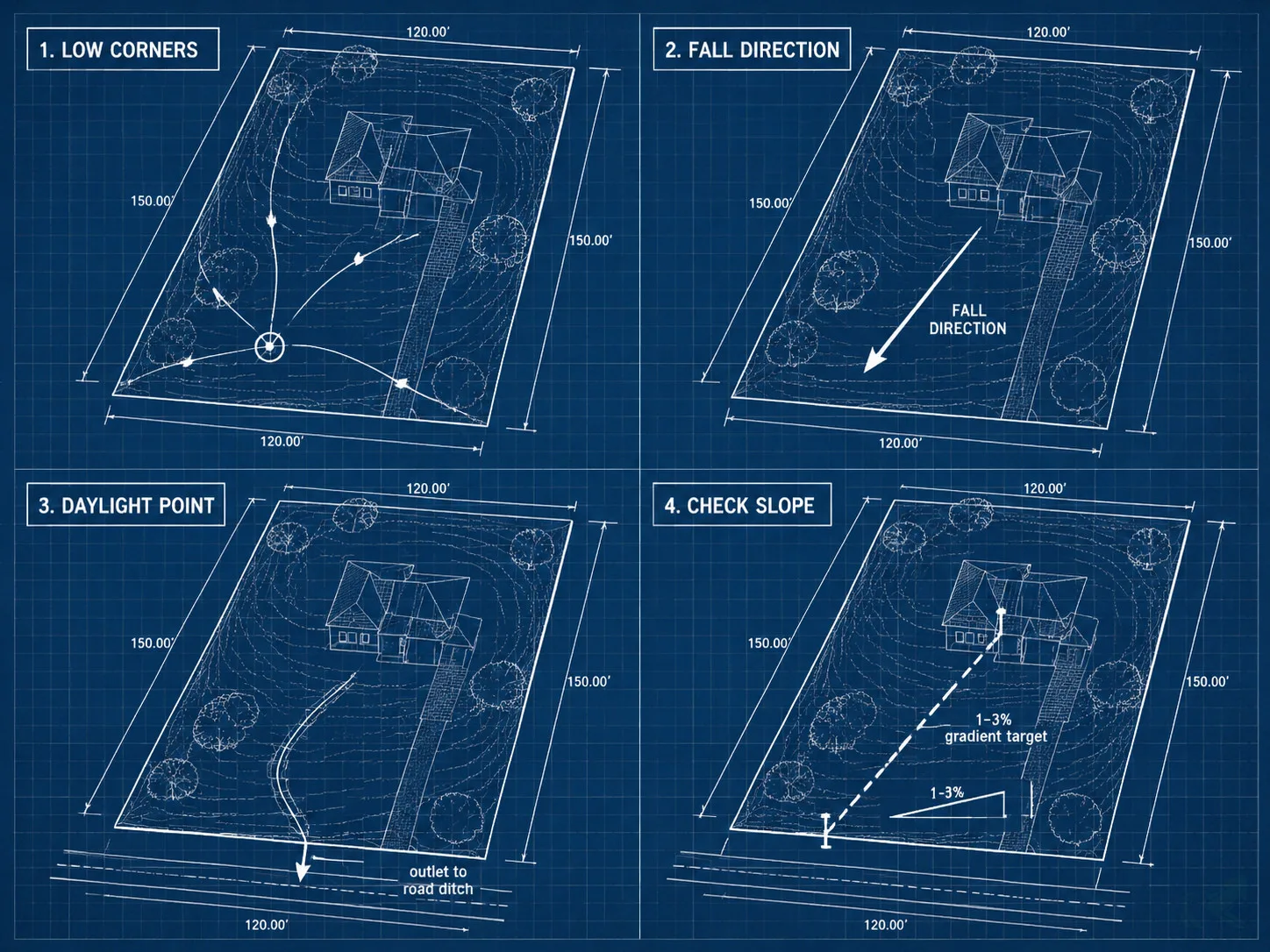
NC clay erodes faster than sandy soils at the swale bottom where water velocity is highest — and bare clay left exposed after grading will scour in the first significant rain.
Here’s the problem: Piedmont red clay looks solid. It’s dense, sticky, and hard to move with a shovel. But under repeated concentrated flow at a swale bottom, the engineering behavior of NC red clay means it erodes more aggressively than sandy soils at the same velocity. The flow-path center deepens first, creating a small channel. Once the channel forms, velocity increases and erosion accelerates. What started as a designed swale becomes a self-deepening ditch.
Two solutions exist. Neither is optional on bare clay.
Vegetation (sod or seeding): Dense turf grass slows flow and binds the soil surface. The grass must be established quickly after the swale is graded — per NC erosion control law and permit thresholds and bare-soil seeding requirements, bare disturbed soil must be seeded within 7-14 days of grading completion (calendar-dependent). Temporary seeding with annual ryegrass buys time for permanent establishment. Bare clay left uncovered will scour in the first significant storm event.
Rip-rap: Angular rock placed at the swale bottom where velocity is highest — typically at the outlet end and at any point where the grade changes abruptly or the swale changes direction. Rip-rap absorbs flow energy and prevents clay scour where vegetation alone can’t keep up with velocity.
When to use each: vegetation is sufficient for swales on gentle slopes under 3-5% with grass that has time to establish. Rip-rap is the correct call at steeper slopes, at any swale outlet, and wherever flow transitions abruptly through a grade change or turn. On NC clay, undersizing the outlet protection is one of the most common reasons a new swale fails within a season.
Swale in NC clay: vegetated vs scoured bare
Comparison. Vegetated swale: Dense turf covers the bottom and side slopes; Water spreads and sheet-flows across the width; Roots hold the clay against moving water; Shallow, slow flow that does not erode. Scoured clay swale: Bare clay bottom with no vegetation; Flow concentrates into a narrow path; A V-shaped channel cuts in and deepens; Exposed clay scours faster every storm.
- Dense turf covers the bottom and side slopes
- Water spreads and sheet-flows across the width
- Roots hold the clay against moving water
- Shallow, slow flow that does not erode
- Bare clay bottom with no vegetation
- Flow concentrates into a narrow path
- A V-shaped channel cuts in and deepens
- Exposed clay scours faster every storm
A swale only works as a grassed channel -- bare NC clay concentrates flow and cuts a deepening gully.
What to Ask About a Swale Proposal
Two questions tell you whether the swale is designed for NC clay conditions and whether it will hold without immediate erosion.
Most contractors will give you a swale length and a rough grade. That’s not enough to evaluate the proposal. The questions below are about outlet protection and timing — the two things most likely to determine whether the swale holds or fails in its first season.
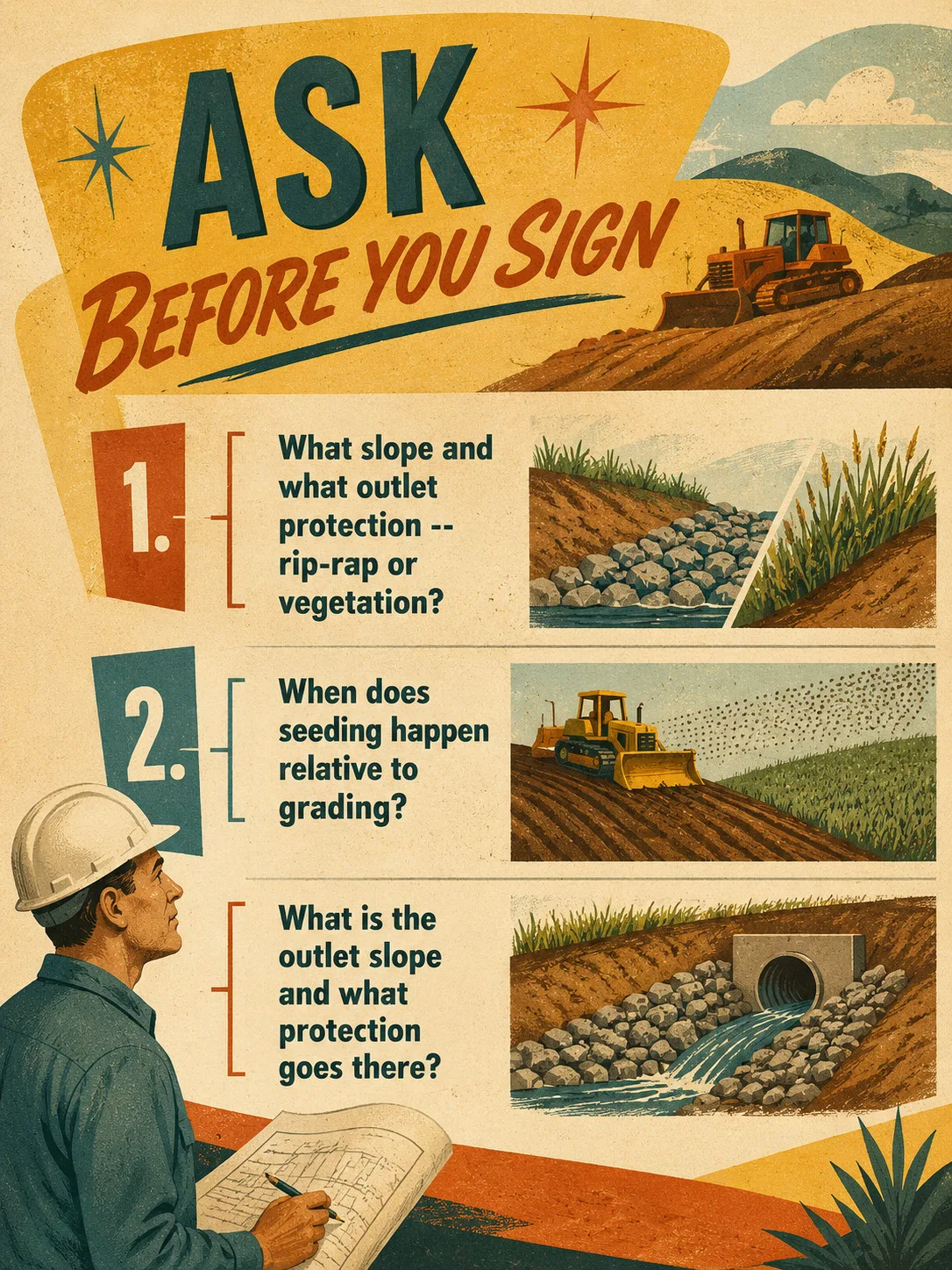
A contractor who answers all three without hesitation is designing for North Carolina clay conditions, not just grading a channel and hoping the grass catches up. Those same clay conditions shape the rules for foundation drainage in NC soil zones — a contractor who understands swale outlet protection usually applies the same rigor to grading away from the foundation. One who says “we’ll seed it when we’re done” without specifying timing relative to the E&S permit window is probably leaving the clay exposed longer than local ordinance allows.
The question also tells you something about how the contractor approaches itemized quotes. An operator who knows the outlet slope and protection type before you ask has thought through the installation. One who hasn’t thought about it yet usually hasn’t thought through the site at all.
Find a grading contractor in North Carolina who can walk your site and specify outlet protection before the bid is written — not after the first rain shows you where it was missing.
For more on how swales fit into a broader NC drainage plan, see the NC drainage swale hub. Definitions for swale, ditch, daylight, rip-rap, and related terms are in the NC drainage glossary.