
Two questions people often ask
Can I rent a mini skid steer and grade my yard myself in NC?
For rough work -- moving material, basic cuts and fills -- yes. For finish grading in NC clay, you need the float-the-bucket technique that takes experience to execute cleanly. Plan for a learning curve.
How much can I move in a rental day?
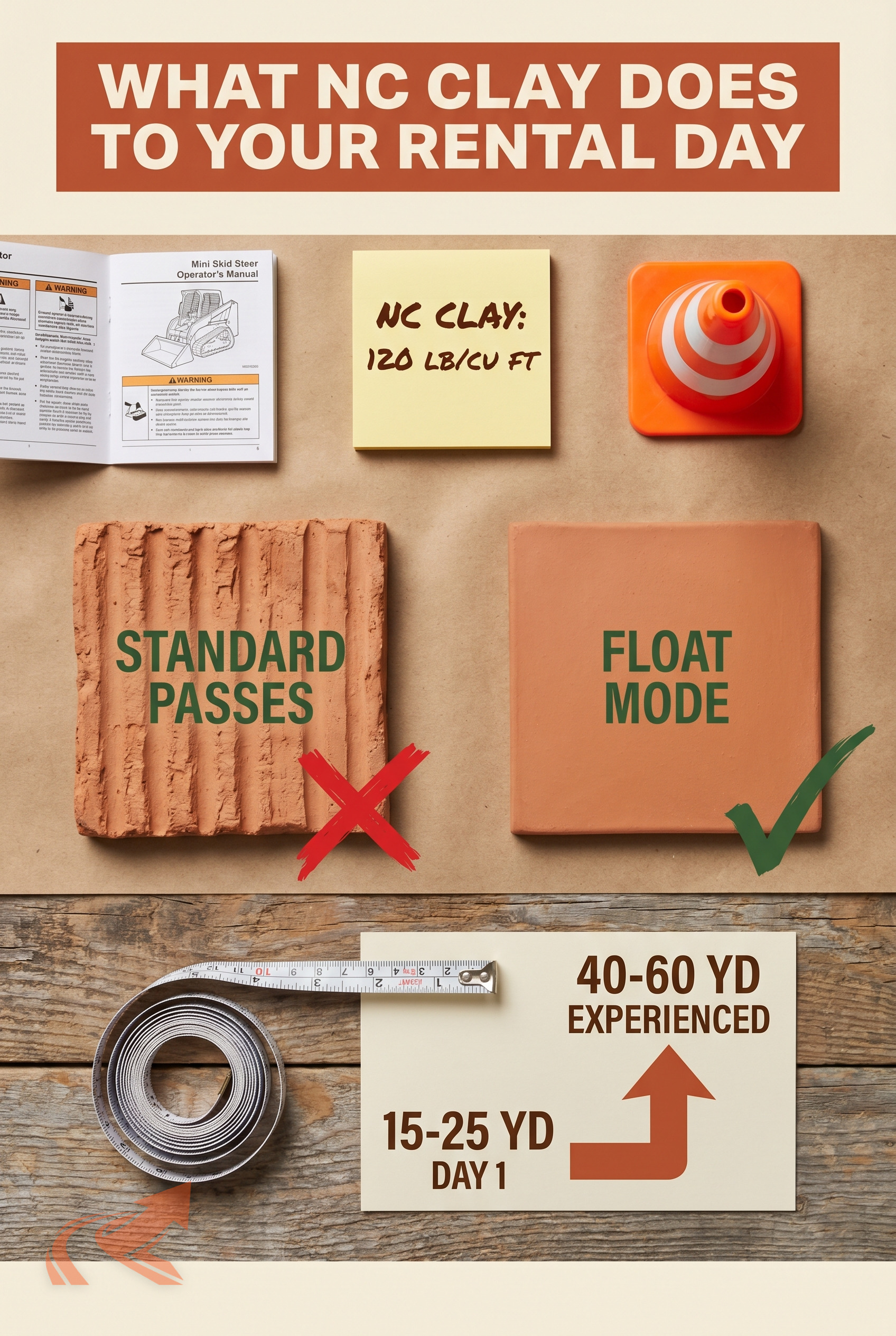
In NC Piedmont clay, a first-time operator in a mini skid steer (Dingo TX-1000 size class) can expect to move roughly 15--25 cubic yards of material in an 8-hour day. An experienced operator moves 40--60. Plan your scope accordingly.
There is a 12-minute video on YouTube of someone leveling a 2,000 square foot area with a mini skid steer. It looks straightforward. The operator makes clean passes, the soil moves, the grade emerges.
That video was almost certainly filmed in sandy soil. Maybe California. Maybe a construction yard with pre-graded fill. It was not filmed in NC Piedmont red clay.
The machine works the same way. The soil does not. North Carolina clay is heavier when dry, stickier when wet, and slower to cut than anything in those videos. A first-time operator renting a compact machine in the NC Triangle or Triad can accomplish real work — but the scope looks different from what the video suggested, and the timeline will too.
This page tells you what is actually achievable, what commonly goes wrong, and what three questions at the rental counter will tell you if you have the right machine.
What Size Machine to Rent
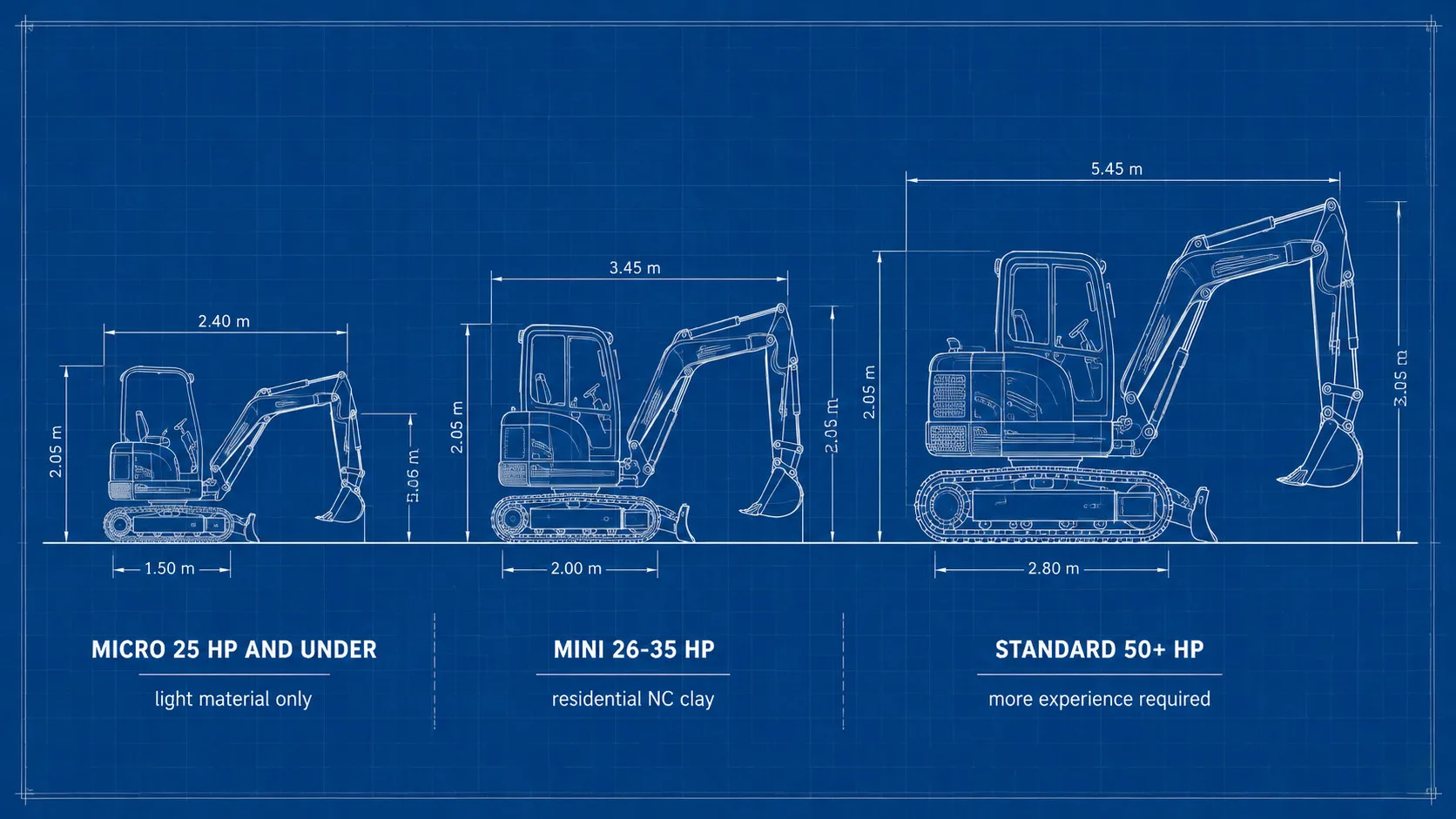
For most residential NC homeowner projects, a 26—35 HP mini skid steer — Dingo TX-1000 or Bobcat MT100 class — is the right size: small enough to navigate tight sites, powerful enough to move Piedmont clay.
Machine classes available at most NC rental yards:
- Micro skid steer (25 HP and under): Adequate for very light material moving and landscape prep. Struggles in wet NC clay. Limited bucket capacity means more passes per cubic yard, and saturated red clay tests the hydraulics harder than the weight rating suggests.
- Mini skid steer (26—35 HP): The workable choice for most NC homeowner projects. Appropriate for residential rough grading, material moving, and light trenching. These machines are common at equipment rental locations in the Triangle and Triad.
- Standard skid steer (50+ HP): Not the right rental choice for a first-time homeowner. Heavier ground pressure leaves deeper ruts in NC clay — and the larger machines require more operator experience to run safely. The skid steer vs compact track loader for NC homeowner rentals comparison covers when moving up in class actually helps vs. when it creates more problems on a tight residential site.
One weight note: NC clay is heavier than sandy soils. Saturated Piedmont clay can weigh 120 pounds or more per cubic foot. Material that looks like a manageable bucket-load may push close to the machine’s rated capacity when the clay has been soaked by recent rain. Check your site conditions before the rental starts.
What NC Clay Does to Your Timeline
NC Piedmont red clay is sticky when wet, hard when dry, and either way it is slower to cut and move than the soil in most online tutorials.
Three clay operating challenges that every first-time NC homeowner renter runs into:
- Wet clay sticks to buckets and tracks. Cleaning the bucket between passes, managing clay pack on the tracks, and keeping your lines of sight clear in wet conditions all eat time. Plan 20—30% more time per task than the video suggested.
- Dry clay requires more force to cut. In a NC summer, baked Piedmont clay can approach hard-pan. A mini skid steer can still cut it, but you will feel the difference in how the machine works on each pass. The bucket digs slower and you take shallower bites.
- Clay does not self-level. After a rough grade pass, the clay surface has ridges and bucket marks. Getting a clean finish in NC clay requires the float the bucket technique for rented skid steers — not just more passes with the standard bucket angle.
Rental skid steer finish on NC clay: float technique vs not
Comparison. Float the bucket: Smooth, consistent surface across the area; A water-shedding crown holds its line; Bucket rides level instead of digging in; Ready for gravel without a re-grade. Standard bucket passes: Deep ridges left every 18 inches or so; Water pools in the troughs between ridges; Uneven surface no amount of extra passes fixes; Clay won't self-level the marks back out.
- Smooth, consistent surface across the area
- A water-shedding crown holds its line
- Bucket rides level instead of digging in
- Ready for gravel without a re-grade
- Deep ridges left every 18 inches or so
- Water pools in the troughs between ridges
- Uneven surface no amount of extra passes fixes
- Clay won't self-level the marks back out
NC clay does not self-level -- a clean finish grade comes from the float technique, not from more passes with a fixed bucket angle.
The float-the-bucket technique and the box blade for mini skid steer driveway grading are the two methods that produce clean finish grade in NC clay. Both take practice to execute correctly on a first rental.
What You Can Realistically Accomplish in a Rental Day
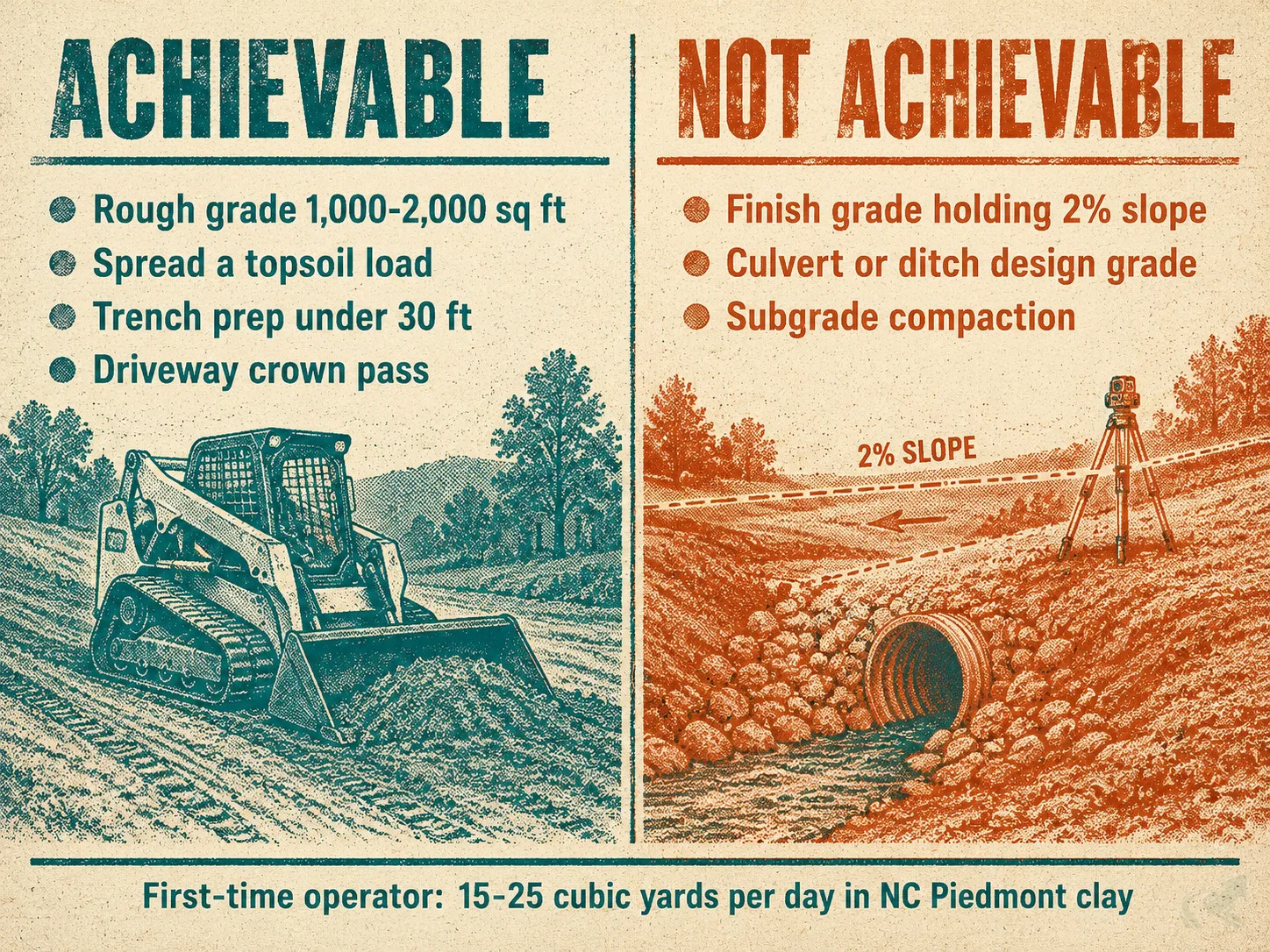
Rough cut, fill distribution, and material moving are achievable for a first-time operator. Finish grading in NC clay is not.
Realistic scope for a first-time rental in North Carolina Piedmont clay:
- Rough grading a 1,000—2,000 sq ft area (initial cut and fill, not finish grade) — achievable in 4—6 hours for most sites
- Moving a delivered load of topsoil or gravel to spread across a prepared area — achievable, with time budgeted for the spread passes
- Basic trench prep for a French drain installation run (under 30 linear feet) — achievable with a trencher attachment, if the rental yard has one and the clay is not fully saturated
- Driveway surface regrading (not subgrade work) — achievable for a simple crown pass if the subgrade is already stable
Not achievable for a first-time rental operator in NC clay:
- Finish grading that holds a consistent 2% slope across the site
- Culvert work or ditch reshaping at a specific design grade
- Subgrade compaction — the skid steer is not a compaction tool without the right attachment, and proof-roll results need to be evaluated by someone who knows what they are looking at
A rough guide to production: a first-time operator in a TX-1000 class machine can move approximately 15—25 cubic yards in an 8-hour rental day in Piedmont clay. An experienced operator moves 40—60. Plan your scope on the lower number. If the project requires moving more than 30 yards, run the math on rental days vs. a contractor quote.
The NC DIY grading triage page walks through how to decide before you rent.
What to Ask at the Rental Counter
Three questions tell you if the rental yard has what you actually need for NC clay work.
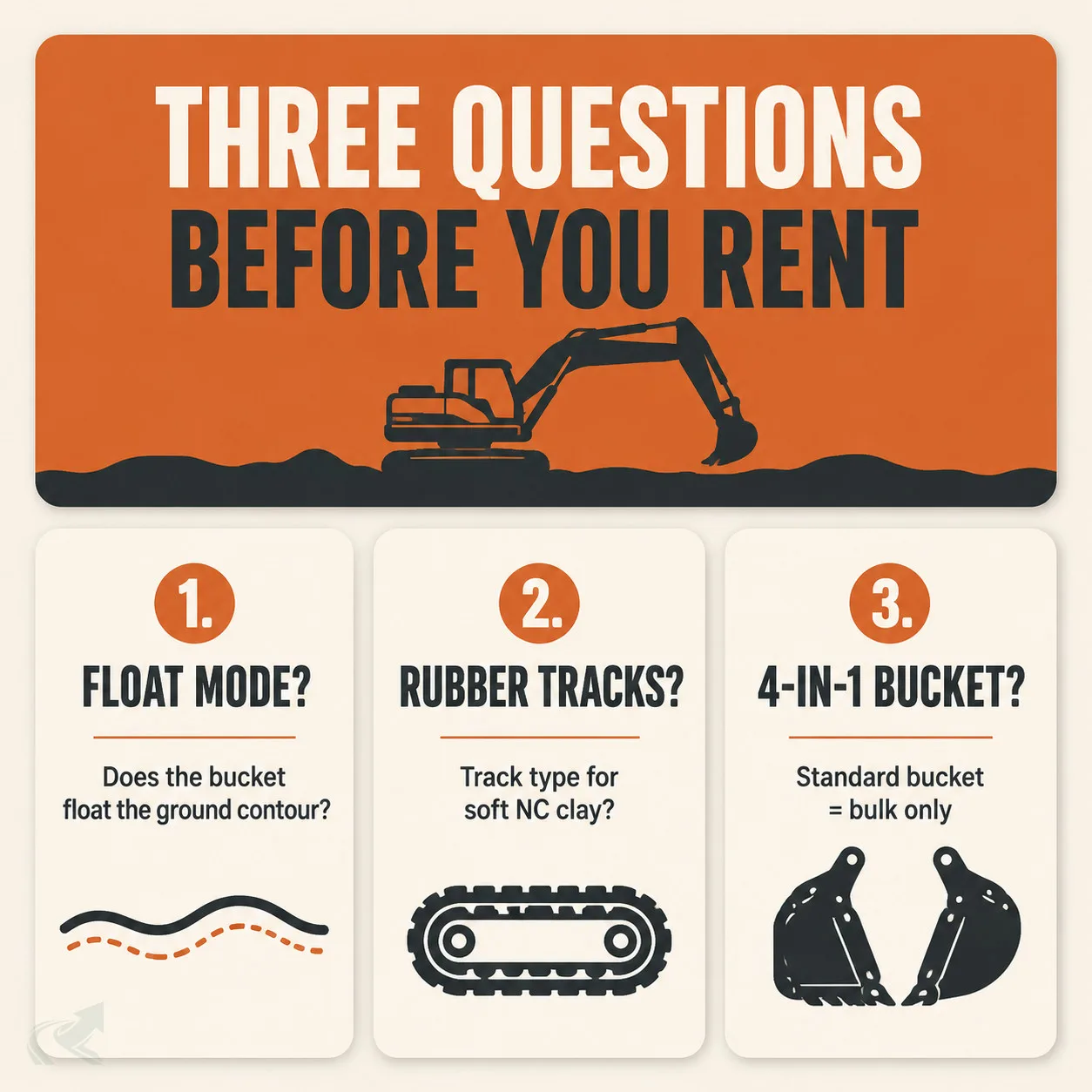
Here is what each question is actually checking:
- Float mode is what makes the float-the-bucket technique work. The bucket follows the ground contour rather than holding a fixed hydraulic angle. Without float mode, you are trying to grade by feel and by eye — which is how bucket ridges form and why the surface looks rough after what felt like a clean pass.
- Rubber tracks vs. wheels — rubber tracks distribute the machine’s weight over more ground contact and cause less surface rutting in soft NC clay. Wheeled machines work on firmer ground but dig ruts in anything wet.
- 4-in-1 bucket opens at the bottom for fine grading and back-dragging. A standard bucket is for bulk material moving only. If you are trying to get any kind of finish grade, you want the 4-in-1. If the rental yard only has standard buckets, your finish grade will show it.
A rental counter that can answer all three questions without hesitation stocks equipment for real grading work. One that pauses on “float mode” likely rents mostly to landscapers moving mulch — still useful, but you now know what you have.
When to Hire Instead of Rent
If your project requires a specific finished elevation — foundation drainage, culvert grade, drainage outlet — hire a contractor. Rental equipment plus no operator experience cannot hold those specs in NC clay.
Hire triggers for North Carolina residential grading work:
- Any project requiring a specific finished elevation within half an inch
- Any drainage work that routes to a specific daylight point, where the slope must be consistent end-to-end
- Any project within 10 feet of a foundation or a utility easement
- Any project larger than 2,000 sq ft of rough grade — rental days add up fast, and the project quote from a local operator often beats the accumulated rental cost once you factor in time
Find a grading operator in North Carolina who works in your county and can give you an itemized quote before you commit to rental days.