
One of the most common questions under grading and equipment operation videos is some version of: “Is there anywhere I could actually get hands-on time in the seat?”
The answer exists. It is just scattered across community colleges, rental yards, and industry credential programs that don’t advertise in the same places. This page consolidates them.
It also covers what Maria needs to know when a crew shows up on her property and she is trying to assess whether the operator is qualified — without being able to evaluate technique directly. You can’t watch someone proof-roll a subgrade and know immediately whether they know what they’re doing. You can verify the floor requirements in about two minutes.
Both questions are addressed here, in separate sections.
Where to Get Formal Operator Training in North Carolina
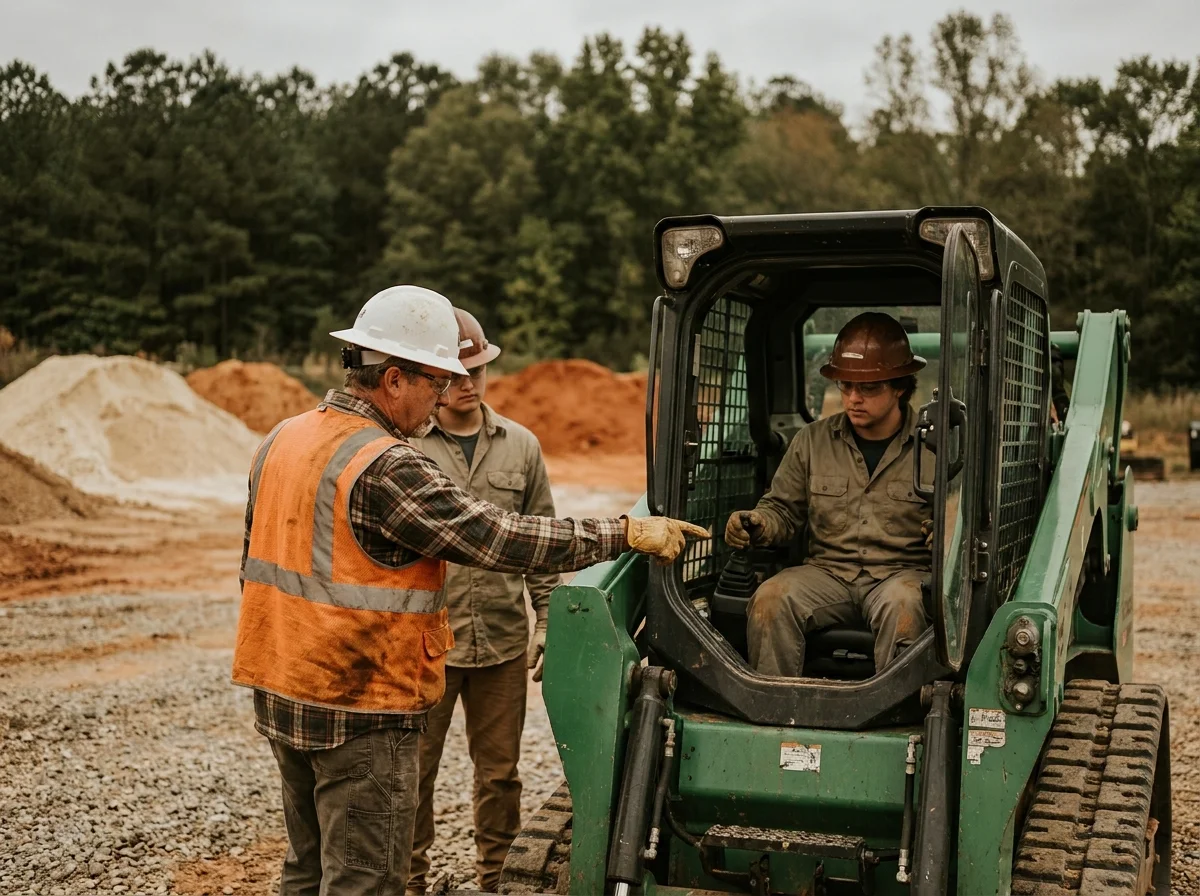
NC community colleges are the most reliable source for structured equipment operator training — look for construction technology or heavy equipment programs.
The NC Community College System (NCCCS) lists active course offerings in its statewide catalog. Programs to look for: heavy equipment operation, construction technology certificates, and OSHA safety certifications. Schools with documented construction-related program tracks include Central Piedmont Community College (Charlotte), Wake Technical Community College (Raleigh), Guilford Technical Community College (Greensboro), and Forsyth Tech (Winston-Salem). Confirm current enrollment and seat availability directly with each campus — program offerings change by semester and seats fill fast.
Cost for certificate programs through NCCCS: in-state tuition is $76 per credit hour (2024-25 rate), with a per-semester cap of $1,216 at 16 credit hours. A 12-credit heavy equipment certificate typically runs around $912 in tuition before fees. Check individual school catalogs for current pricing and financial aid options — the Next NC Scholarship can offset all tuition and fees for qualifying students.
Equipment rental yard orientation is a separate category. Sunbelt Rentals, United Rentals, and some NC independents offer equipment orientation before you take a machine off the lot. Coverage and depth vary by location — call ahead to confirm what the orientation includes before your pickup. A rental yard orientation is typically one to two hours covering safety basics and machine controls. It is not a substitute for formal training — it covers enough to operate the machine without injuring yourself or the equipment, not enough to grade a site correctly.
NCCER ( ) credentials are recognized industry-wide and offer a portable certification path. NC is covered through the Carolinas AGC network; use the Find a Center tool at nccer.org to locate an accredited training sponsor near you. Online courses through NCCERconnect cover Heavy Equipment Operations Levels 1-3. If you want a reference for the machines covered in those courses, the NC grading equipment hub breaks down skid steers, CTLs, and excavators by residential use case. SkillsUSA and similar vocational programs through NC high schools and community colleges are another avenue, particularly for younger operators entering the trade.
For homeowners planning a significant DIY project, the float-the-bucket technique and related operating basics are worth understanding before committing to rental time.
What OSHA Requires for Equipment Operators
requires that any equipment operator be trained and authorized before operating a specific machine — the specific requirements vary by machine type and how the machine is classified.
The structure of OSHA training in construction:
- OSHA 10: A 10-hour general safety course covering hazard recognition and avoidance on construction sites. Widely recognized as a baseline indicator for site workers. It is not machine-type specific, and OSHA explicitly states it is a voluntary program that does not fulfill an employer’s requirement to provide training under specific OSHA standards.
- OSHA 30: A 30-hour course typically aimed at foremen and supervisors. Covers site safety management and worker oversight.
- Machine-specific authorization: Under 29 CFR 1926.21(b)(2), employers must train operators to recognize and avoid unsafe conditions, and that training must be comprehensive enough to ensure the operator can safely handle the specific equipment in the conditions they will encounter on site. OSHA 10 alone does not satisfy this machine-specific training obligation.
- training: The coverage of 29 CFR 1910.178(l) — the PIT standard — depends on how the machine is classified. OSHA has confirmed that skid steers used primarily for earthmoving are generally not covered by the PIT standard; when in doubt, the employer’s obligation defaults to the general training duty under 1926.21(b)(2). Confirm which standard applies based on machine type and project classification with your equipment manufacturer or OSHA compliance officer.
requirements are a separate layer. Dump trucks over 26,000 lbs require a Class B CDL in North Carolina (Class A if pulling a trailer over 10,000 lbs) — see the single vs tri-axle dump trucks for NC material hauling reference for how that weight threshold maps to common axle configurations. Mini skid steers typically do not require a CDL. Standard skid steers operate on-site without a CDL because they are not driven on public roads.
North Carolina does not maintain state-specific equipment operator certification requirements beyond the federal OSHA standards adopted through the NC State Plan.
What Homeowners Should Verify About a Crew’s Training
You can’t verify operator skill without watching them work — but you can verify the floor requirements in under two minutes.
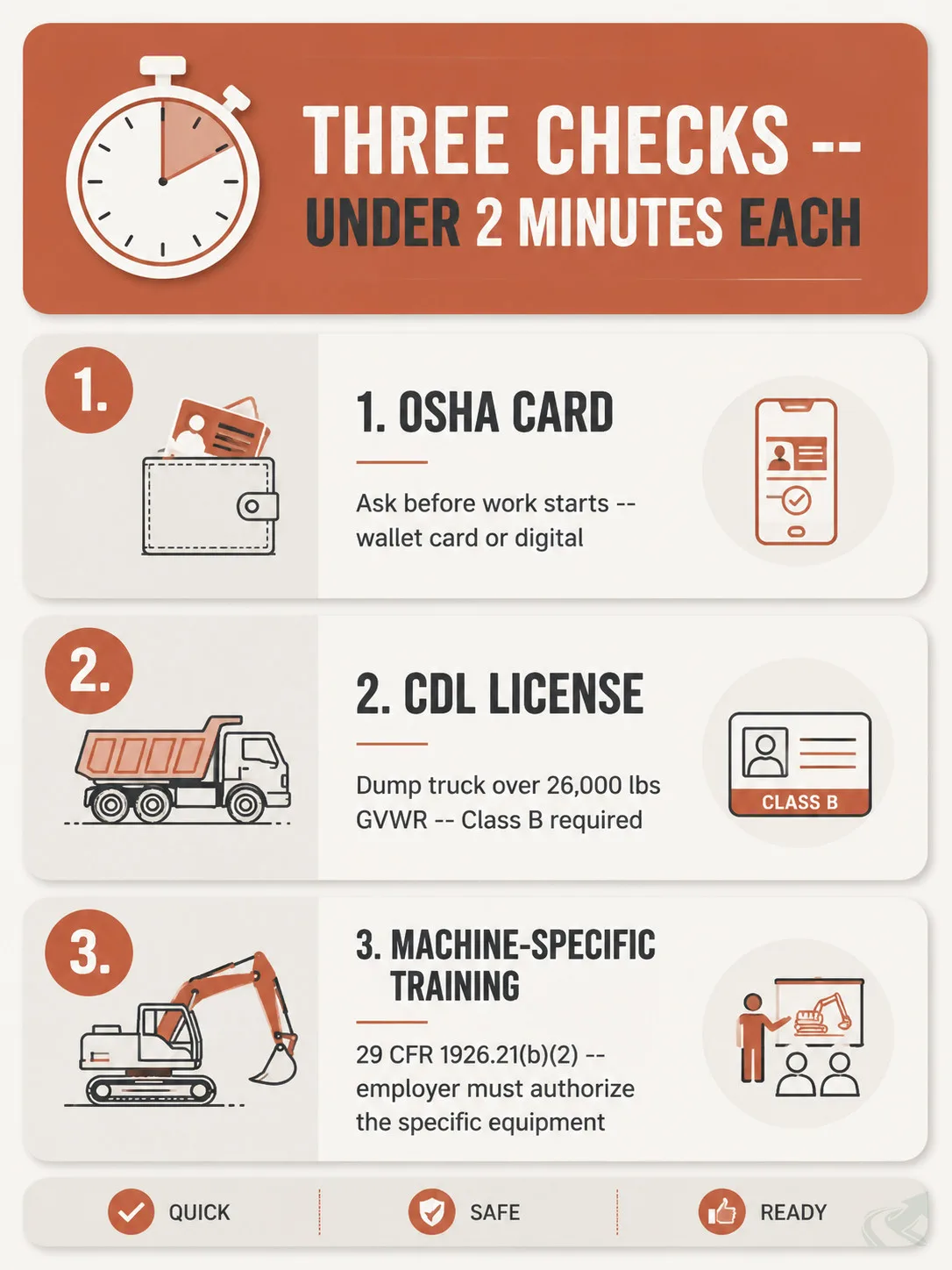
Three checks. Each one takes about 30 seconds.
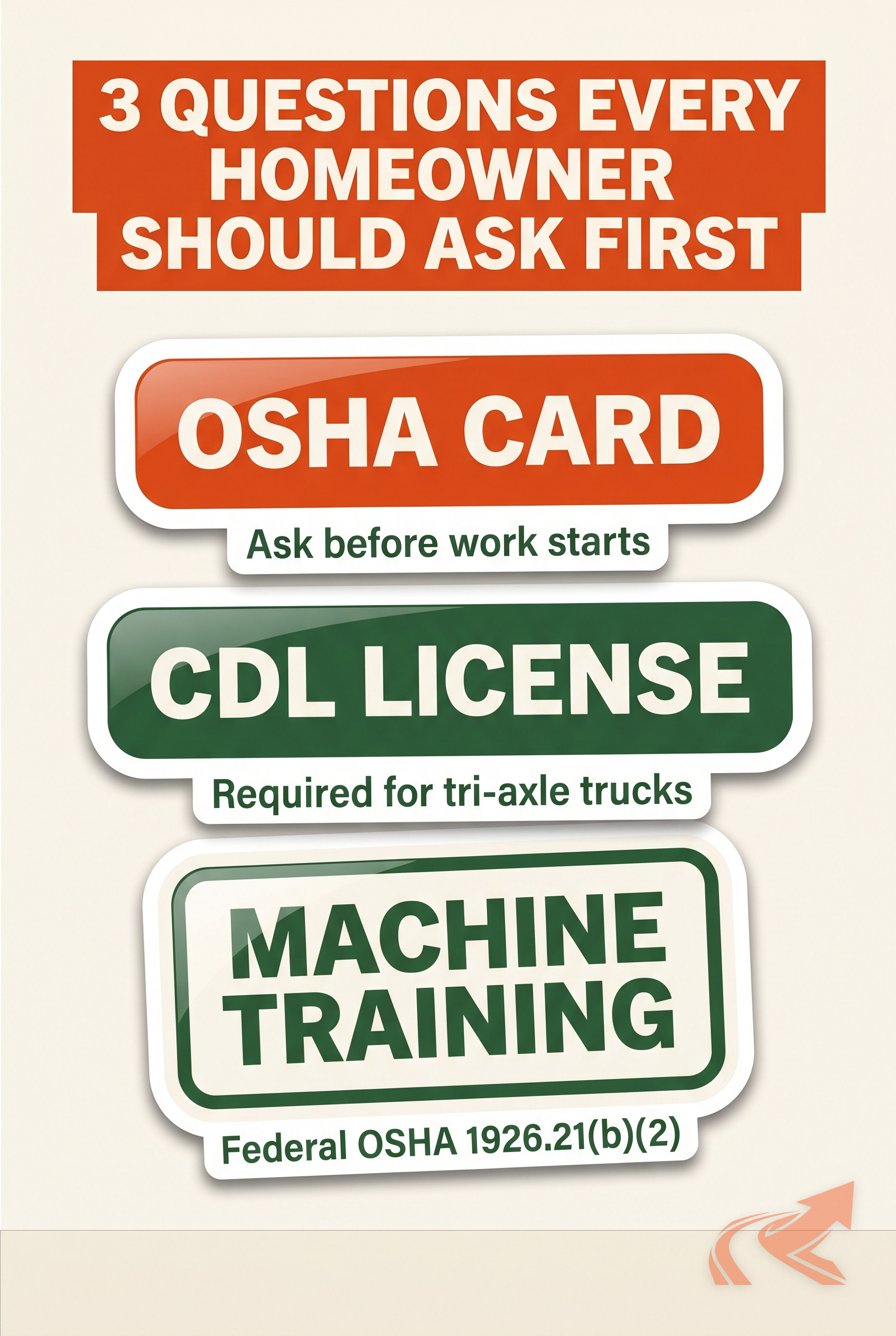
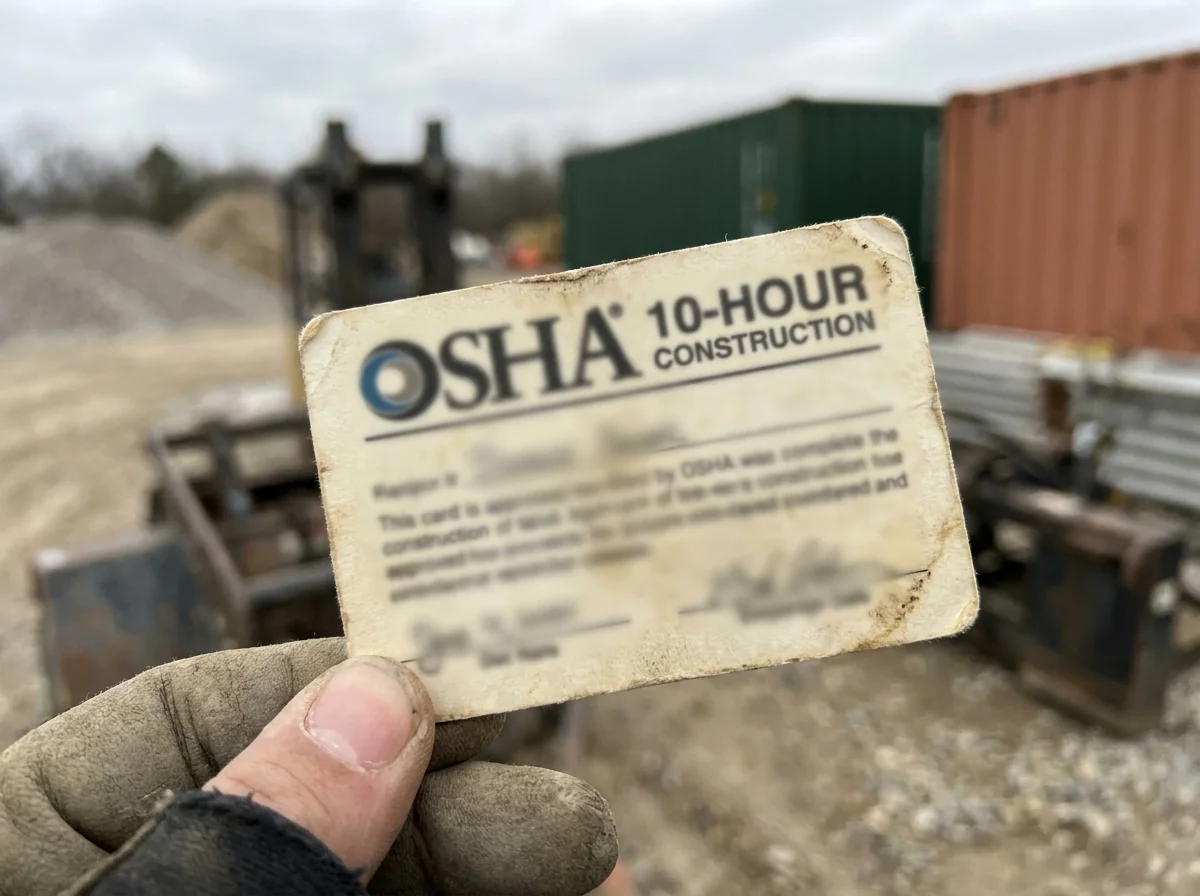
1. OSHA card. Ask to see it before work starts. A legitimate operator who has completed OSHA 10 or 30 has a wallet card or a digital version. This is a baseline indicator, not a guarantee of skill — OSHA 10 is voluntary and does not by itself satisfy machine-specific training requirements, but an operator without one can’t confirm they’ve even met the industry baseline. No card is a flag worth noting before signing anything — and it belongs on the same contractor red-flag checklist as a lump-sum-only quote or a missing COI.
2. CDL for dump trucks or large equipment. If the project involves a tri-axle dump truck or large excavator, ask: “Is your equipment operator CDL-licensed for this truck?” A legitimate contractor answers without hesitation. The right answer is yes. An evasive answer warrants a follow-up.
3. Machine-specific authorization. Federal OSHA requires employers to train operators specifically for the equipment they will operate — comprehensive enough for safe handling in the conditions they will encounter on site (29 CFR 1926.21(b)(2)). You can ask: “Has your operator been through machine-specific training for the skid steer?” or “for the excavator?” It’s a more nuanced question than asking for a card, but it’s a legitimate one. A contractor who has run compliant jobs will have an answer.
Copy this question card and use it before any crew starts machine work on your property:
“Can I see your operator’s OSHA certification card? Is the equipment operator CDL-licensed for the truck you’re bringing to this job? Has the machine operator been through machine-specific training for the equipment they’ll be operating?”
These three questions take under two minutes. They will not insult a legitimate contractor. A crew that reacts poorly to them is answering the question you actually needed answered.
For a broader vetting framework, see the NC DIY grading triage for trained homeowners.
DIY Training vs. Professional Certification
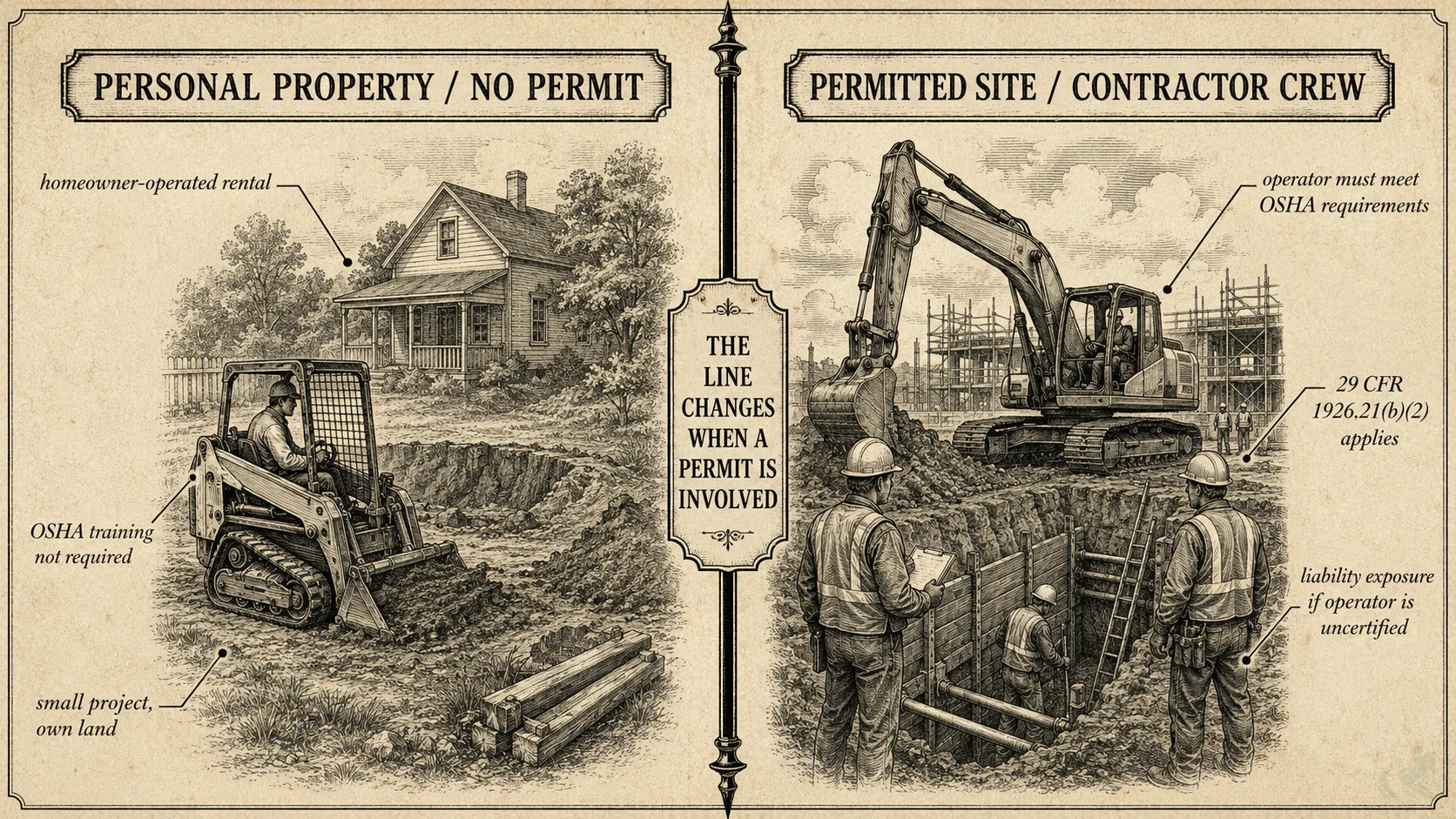
Weekend orientation is enough to operate safely on your own property for small projects — anything involving a permitted site or a contractor-operated machine requires professionally certified operators.
In North Carolina, operating equipment on your own property for personal use does not require OSHA certification. OSHA training requirements apply to workers in employment contexts, not homeowners operating their own equipment or rental equipment for personal projects.
The line changes when a permit is involved or when a contractor’s crew is operating the machine. On a permitted site, any operator should meet OSHA requirements. If you hire a contractor whose operator is not OSHA-certified and that operator is injured on your property, your liability exposure is a question worth raising with your homeowner’s insurance carrier before the job starts.
If you want to try a small grading or leveling project yourself, read the mini skid steer rental after NC operator training page first — it covers what the rental orientation does and doesn’t prepare you for, and what size project is realistic for a first-time operator.
What This Means for Contractor Vetting
If you’re evaluating a grading contractor and their crew is operating equipment on your property, the verification steps above protect you and take under two minutes to run. Ask for the itemized quote that breaks out equipment type, operator count, and certifications as a line item — a contractor who tracks COI (Certificate of Insurance) and OSHA compliance for their crew will have this information ready.
If you’d rather skip the vetting process and book a crew with verified credentials, the NC contractor vetting checklist directory is the next step. Listings include license status verified against the NC Licensing Board of General Contractors.