Before you call a contractor
What is a proof roll?
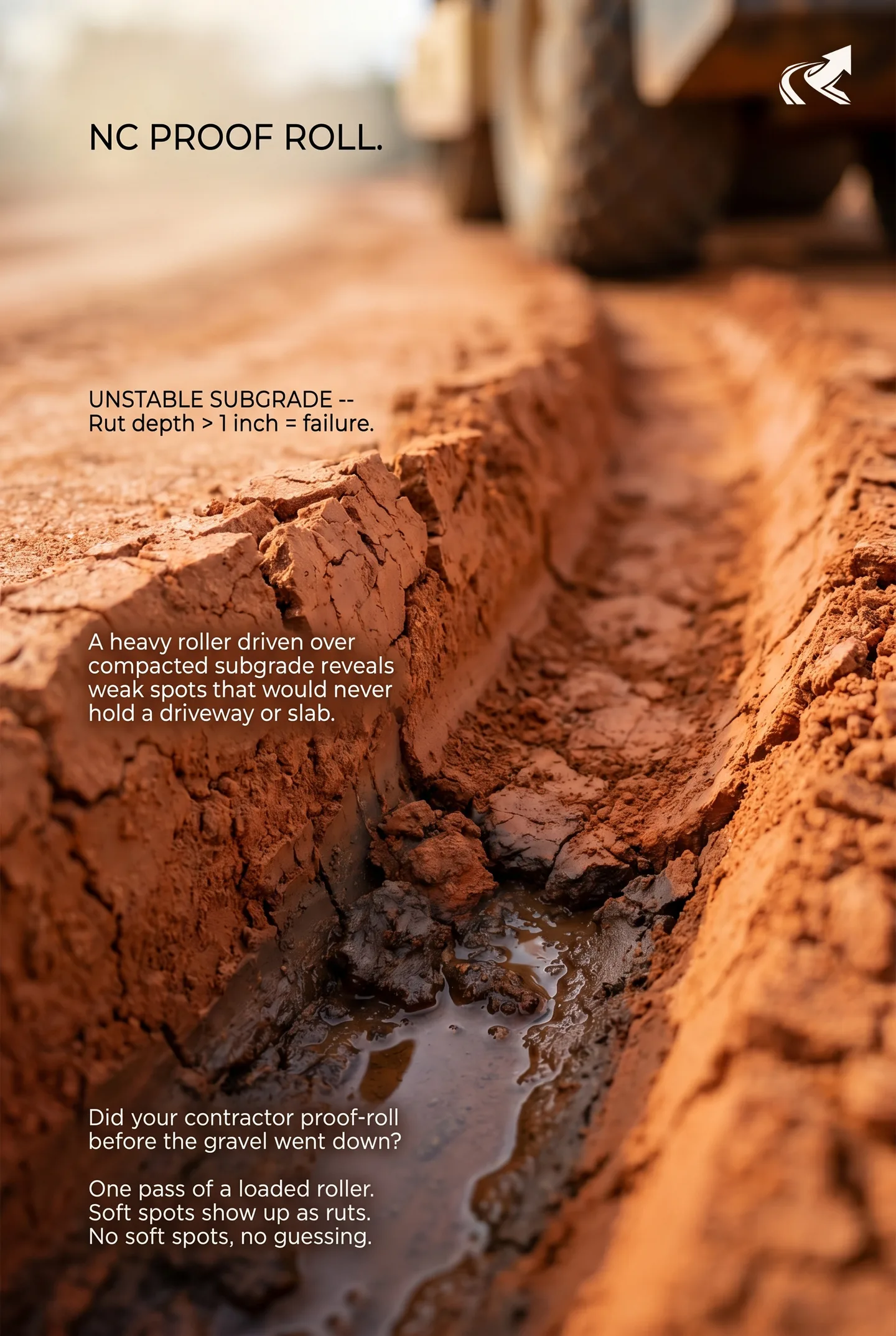
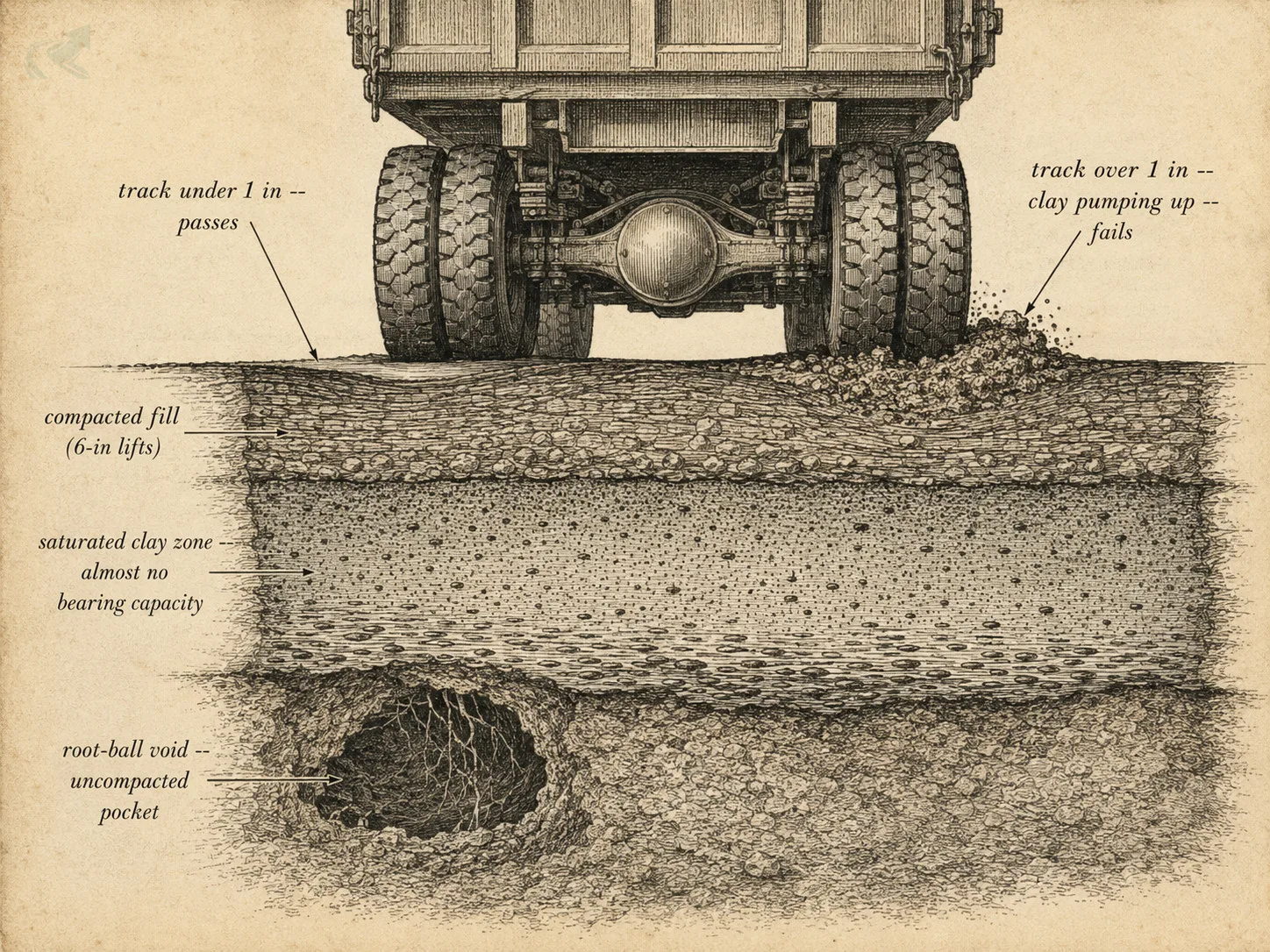
A proof roll is when a loaded dump truck makes passes over the finished subgrade before surface material goes down. Soft spots deflect visibly under the load -- you can see them as tire impressions deeper than about an inch, or as clay pumping up alongside the tracks. A spot that looks solid but fails the proof roll would fail under repeated vehicle loads once gravel or pavement covers it.
Should I ask my contractor to proof-roll before they gravel or pave?
Yes, for any driveway or pad with recent fill placement, NC clay subgrade, soft site history, or a high water table. It adds minimal time and reveals problems that would otherwise be covered and hidden. A contractor who proof-rolls is checking their own work before it becomes your problem.
A homeowner in Guilford County had a new gravel driveway installed in September. By February, two wheel-rut depressions had formed at the same spot — about 15 feet in from the road. Wet winter, nothing unusual. But the problem wasn’t the winter.
The subgrade under those spots was never properly compacted. It looked fine when the gravel went down. The contractor moved on, the gravel covered it, and the weak zone stayed hidden until vehicle loads and rain had their way with it.
A proof roll would have found it in 20 minutes.
This page explains what a proof roll is, what it reveals in North Carolina clay, when to ask for one, and how to read a contractor’s answer when you do.
What a Proof Roll Is
A proof roll uses vehicle weight to test the subgrade’s load-bearing capacity before the surface material goes on — any soft spot deflects visibly under the load.
The mechanics are straightforward. A loaded dump truck — typically 20,000 lbs or more at the rear axle — makes slow passes across the prepared subgrade. An experienced operator or inspector walks alongside and watches for deflection.
Two visible signals mean a problem:
- Deep tire impressions — tracks deeper than roughly an inch in a freshly compacted subgrade indicate the material is moving under load, not holding.
- Pumping — Piedmont clay moisture behavior means saturated clay has almost no bearing capacity. Under load it moves sideways rather than compressing. You’ll see the clay bulging up alongside the tire tracks.
A properly compacted NC clay subgrade shows minimal deflection. It leaves a faint track, not a rut.
For commercial sites, a pneumatic roller can achieve a similar diagnostic result. For residential driveways and pads, a loaded dump truck making passes is the standard approach — low cost, no special equipment, immediate visual feedback.
Proof roll on NC clay subgrade: passing vs failing
Comparison. Subgrade holds: Loaded dump truck leaves only a faint track; Tire impression under roughly one inch; No clay bulging alongside the tires; Properly compacted -- cleared for gravel. Soft spot found: Tire impressions rut deeper than an inch; Saturated clay pumps up alongside the tracks; Crew flags the location for correction; A spot that looked solid would have failed under load.
- Loaded dump truck leaves only a faint track
- Tire impression under roughly one inch
- No clay bulging alongside the tires
- Properly compacted -- cleared for gravel
- Tire impressions rut deeper than an inch
- Saturated clay pumps up alongside the tracks
- Crew flags the location for correction
- A spot that looked solid would have failed under load
A proof roll finds in 20 minutes the weak zone that would otherwise stay hidden under gravel until winter exposes it.
What a Proof Roll Reveals in NC Clay
NC clay has two failure modes that a proof roll catches — uncompacted fill and saturated zones that will pump and settle under load.
North Carolina’s NC Piedmont red clay is dense and stable when it’s dry and properly compacted. It becomes a liability when it holds water — which it does readily, especially after fill placement or extended rain. Three specific failure patterns show up on residential sites:
- Uncompacted fill — fill placed in lifts that were too thick, or not compacted between lifts, compresses under the truck. The surface looks fine. It isn’t.
- Saturated zones — a localized pocket of NC clay holding water from a drainage low point or a high water table. Saturated Piedmont clay has almost no bearing capacity. It looks identical to dry clay from above; the truck finds it immediately.
- Root ball voids — where stumps or root balls were removed but the void wasn’t fully filled and compacted. This is a classic failure point on residential lots cleared for driveways or home additions.
What the homeowner sees during a proof roll: the inspector walks alongside the truck and watches for tracks deeper than approximately one inch, or for soil pushing up alongside the tracks. Any visible movement identifies a location that needs correction before surface material goes on.
Proof-rolling is related to, but distinct from, compaction testing. A compaction test (measured with a nuclear densometer or Proctor cylinder) gives you a percentage relative to a standard — typically 95% standard Proctor for residential subgrade in North Carolina. A proof roll is a visual, load-based check that catches failures a compaction test might miss if testing was done at the wrong locations. They complement each other; proof-rolling is faster and covers the full surface area.
When to Ask for a Proof Roll
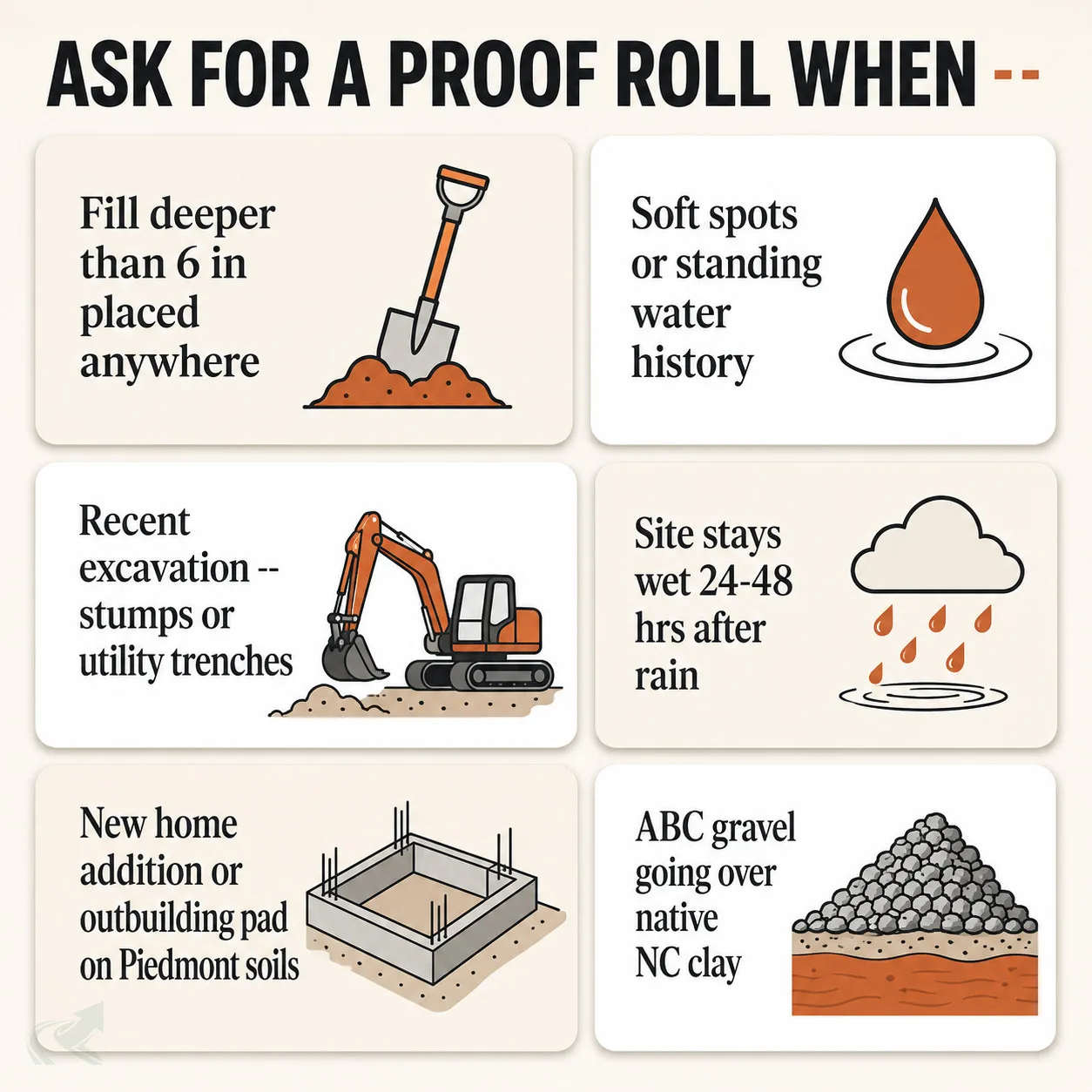
Any driveway or pad project that involves fill placement, soft site conditions, or NC clay subgrade warrants a proof roll before surface material goes down.
Ask for it when any of these conditions apply:
- Fill has been placed deeper than 6 inches anywhere on the site
- The site has a history of soft spots, standing water between rain events, or poor drainage
- Recent excavation disturbed the subgrade (stump removal, utility trenching)
- The site stays wet for more than 24—48 hours after a normal rain event
- You’re building a new home addition pad or outbuilding pad on Piedmont soils
- The quote involves ABC gravel going over native clay — the clay needs verification first
When a proof roll is less critical: re-grading an existing gravel driveway where the subgrade is established, firm, and has a known compaction history. If the contractor has worked the same site before and can speak to the subgrade condition with confidence, the calculus shifts.
When in doubt, ask for it anyway. The cost is the time for the truck passes — which the contractor’s equipment is likely already on site to do. It is not a significant add.
What Happens If a Soft Spot Is Found
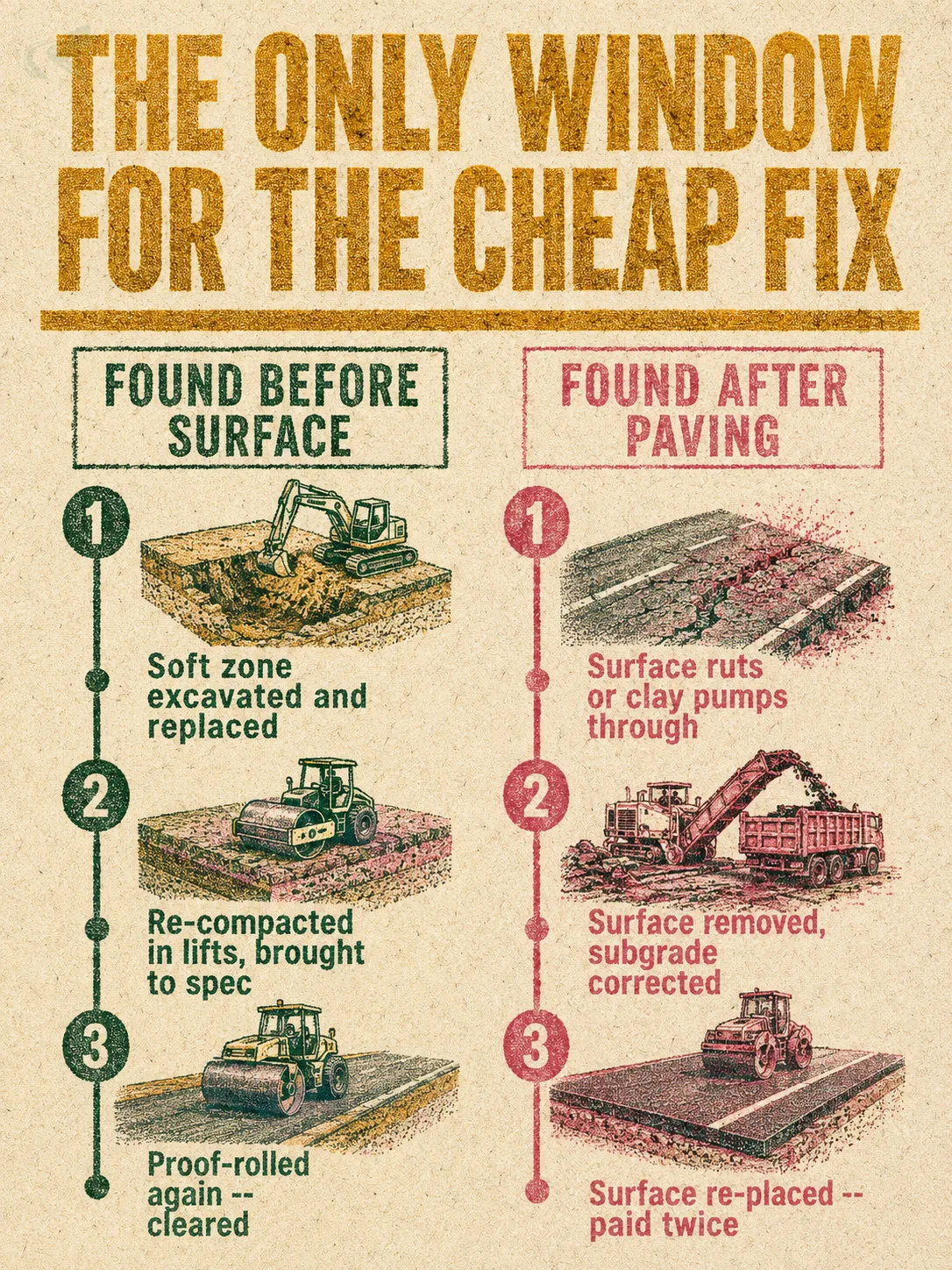
Found before surface material is placed: fixable at low cost. Found after: expensive.
That’s the whole calculus. When a proof roll reveals a soft spot before the gravel or ABC stone base goes down:
- The soft zone is excavated and replaced with compacted fill or aggregate
- The area is re-compacted in lifts, brought to spec
- The corrected zone is proof-rolled again before surface material goes on
This is the contractor correcting their own work before it’s covered. It is not a failure of the project. A contractor who finds a problem, fixes it, and verifies the fix is doing the job right.
If the soft spot is found after gravel or paving is placed — via settlement, rutting, or clay pumping up through the surface after rain — the repair is far more disruptive. The surface has to come off, the subgrade corrected, and the surface re-placed. You’re paying for the same work twice, plus the damage that accumulated in between.
The window for the cheap fix is before the surface goes down. The proof roll is how you keep that window open.
How to Ask About Proof Rolling
One question tells you whether the contractor plans to verify subgrade quality before surface placement.
Use this when you’re getting quotes or reviewing a scope of work:
An operator who proof-rolls, compacts in lifts, and has a defined response to finding soft spots is running a professional operation. The answer should come quickly and specifically — something like “loaded truck makes two passes, we watch for pumping or impressions, any soft spot gets excavated and replaced before we re-compact and recheck.”
An operator who hasn’t thought about it will either say they don’t do it, or will agree to it without being able to explain what they’re looking for. The question reveals both competence and whether the spec is built around your site or around moving to the next job.
The three-part question also tests compaction practice. Filling in thick lifts without compacting between them produces subgrade that proof-rolls badly — it moves under load because the compactive effort never reached the bottom of the fill. A contractor who compacts in 6-inch lifts to 95% standard Proctor and then proof-rolls is doing the full sequence.
This connects directly to proof-rolling on a new-home pad grading NC — pad prep for a home addition or accessory structure follows the same verification sequence, and the stakes are higher because concrete footings or slab depend on what’s underneath.
If you want more of the vocabulary behind these techniques, the NC grading glossary including proof-roll covers related terms — subgrade, compaction, lift, bearing capacity, ABC gravel — in the same plain-English format.
When you’re ready to find someone who actually does this work correctly, hire a verified NC grading contractor who can speak to their compaction and verification process before they write the quote.