Two questions people ask before hiring a grading contractor
Does a grading contractor in NC need a general contractor license?
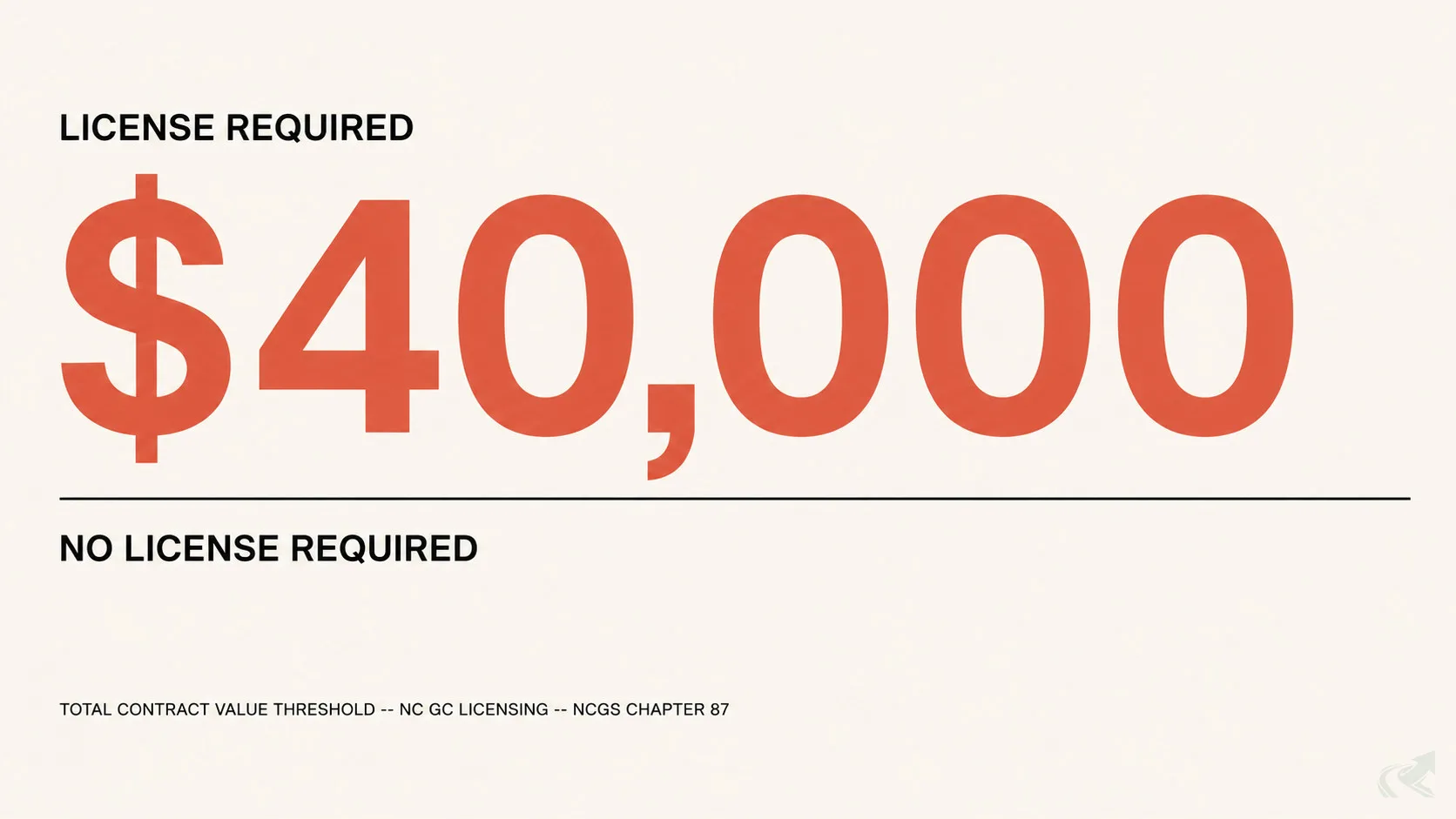
It depends on project value. Jobs of $40,000 or more require a licensed general contractor in North Carolina. Below $40k, an unlicensed operator can legally perform the work -- but they still must comply with permit, erosion control, and insurance requirements for the project type.
What are the three NC GC license classes, and which one applies to grading?
Limited (up to $750,000 per project), Intermediate (up to $1,500,000), and Unlimited (no cap). The class matters when you're vetting a contractor's credentials against the scope of work they're proposing.
Ask grading contractors whether a job needs a licensed general contractor and the answers can differ: yes, no, or “it depends on the job size” with no number attached.
The number is $40,000. That’s the dividing line under Chapter 87, Article 1. Below it, an unlicensed operator can legally do the work. At or above it, a licensed general contractor is required. The license class — Limited, Intermediate, or Unlimited — determines how large a project the contractor is authorized to take on.
Here is how each class works and how to tell which one your project requires.

The $40,000 Threshold — What It Covers and What It Doesn’t
Any construction project in North Carolina where the cost of the undertaking is $40,000 or more requires a licensed general contractor (G.S. 87-1).
“Total contract value” means the full contract: materials plus labor. A French drain that costs $8,000 in materials but $15,000 total doesn’t cross the threshold. A drainage system installed alongside foundation correction and regrading that totals $55,000 does.
The $40k line isn’t about the size of the machine — it’s about the total contract. A contractor can move a lot of Piedmont clay on a $38,000 job and technically stay below the threshold. What changes at $40,000 is the legal requirement to hold a license.
Grading projects that can cross $40k:
- Full lot regrading on larger residential parcels
- Grading plus French drain system plus detention basin as a combined scope
- Land-clearing operations on multi-acre parcels with significant earthwork
Grading projects that are usually smaller:
- Driveway grading NC and resurfacing
- Single French drain on a residential lot
- Yard regrading with minor drainage correction
The threshold applies to each contract, not to the total work done over time. If a contractor bundles all the work into one contract, the full amount counts. More on that in the scenario section below.
Limited vs Intermediate vs Unlimited — The Three License Classes
License class determines the maximum project value a contractor is licensed to handle — verify that the class matches the scope of work you’re awarding.
The issues three tiers. Each has a project-value cap set by statute (G.S. 87-10), not counting the cost of the land and ancillary improvements to it:
- Limited: a single project valued up to $750,000.
- Intermediate: a single project valued up to $1,500,000.
- Unlimited: no cap on a single project.
A contractor with a Limited license cannot legally bid a $1,000,000 site-prep job. The license is active — the tier is wrong for the scope.
A problem arises when a contractor misrepresents their class — claiming Unlimited when the NCLBGC portal shows Limited. That’s not a technicality; it’s a disqualifying credential mismatch — and grounds for NC stop-work order escalation if the work has already started.
The NCLBGC portal shows the license limitation alongside the license number. Two minutes of lookup before signing a contract.

The Owner-Occupant Exemption — Who It Covers
NC law exempts an owner who builds on land they own, solely for their own occupancy, from the GC license (G.S. 87-1(b)) — but this exemption does NOT cover hired contractors, only the owner running the work themselves.
Here is what the exemption means in practice:
The exemption covers an owner who builds or alters a building on their own land for their own occupancy. If the building isn’t occupied that way for at least 12 months after it’s finished, the law presumes the owner didn’t intend it that way.
The exemption does NOT extend to any contractor he hires. The hired contractor’s licensing requirement is based on the contract value — not on the owner’s status.
The exemption also does NOT remove permit requirements. The owner still needs the applicable land-disturbance permits regardless of who does the work.
Contractors sometimes use the exemption to confuse homeowners: “It’s your property, you can do what you want.” That’s partially true for the homeowner’s own work. It is not true for the contractor.
The owner-occupant exemption is real. It just doesn’t mean your contractor gets to skip licensing or references, insurance, and itemized quotes because you own the land.
When Does a French Drain or Drainage Job Require a Licensed GC?
A standalone French drain installation can stay under the $40,000 line. Combined drainage, grading, and structural correction projects can cross it.
Three scenarios that play out differently:
Scenario 1: Single French drain, residential lot
If the contract is under $40,000, a GC license is not legally required. The contractor still needs current and must comply with rules for the project. No license requirement doesn’t mean no requirements.
Scenario 2: Yard regrading plus French drain plus downspout extension
License required: check the total. If the contractor bundles it into one contract, the full amount counts toward the $40k threshold.
If a contractor offers to split a $45,000 scope into two contracts — say, one for “drainage” and one for “grading” — specifically to stay under the threshold, that’s a red flag. Ask the licensing board how it counts the job.
Scenario 3: Foundation drainage NC correction, new build, multiple systems
Combined scope can reach $40k. If it does, a licensed GC is required. And the license limit matters — verify the class is appropriate for the project size, not just that a license exists.
Does your drainage job cross the $40,000 license threshold?
1. Single French drain, residential lot -- Under $40,000, no GC license is legally required. COI and E&S compliance still apply. 2. Regrade plus French drain plus downspout work -- Check the total -- if it is bundled into one contract, the full amount counts. 3. Foundation drainage correction, multiple systems -- Combined scope can reach $40,000. If it does, a licensed GC is required -- and the license limit must match the project size.
-
Single French drain, residential lot
Under $40,000, no GC license is legally required. COI and E&S compliance still apply.
-
Regrade plus French drain plus downspout work
Check the total -- if it is bundled into one contract, the full amount counts.
-
Foundation drainage correction, multiple systems
Combined scope can reach $40,000. If it does, a licensed GC is required -- and the license limit must match the project size.
The $40k line is about total contract value, not machine size -- splitting one scope into two contracts to dodge it is a red flag.
Common Mistakes Homeowners Make on GC Licensing
Knowing the threshold doesn’t help if you misapply it — here are the four mistakes that show up repeatedly.
-
Assuming unlicensed means illegal. Below the $40k licensing threshold, an unlicensed operator is legal. The issue is the other vetting steps — COI, E&S compliance, permits — that still apply regardless of licensing.
-
Not verifying the license class matches the project. A Limited contractor is not licensed to handle a project over $750,000, even if they have an active license. Check the limit, not just the status.
-
Accepting verbal license confirmation. Always look it up yourself on the NCLBGC portal. It takes two minutes. A legitimate contractor provides their license number in writing without being asked.
-
Misunderstanding the owner-occupant exemption. It applies to the homeowner’s own labor on their own primary residence. It does not apply to any contractor they hire, regardless of who owns the property.

How to Verify a Contractor’s License Class Before Hiring
Go to the NCLBGC portal, search by the contractor’s license number, and confirm the class shown matches the scope of work they proposed.
Four steps, no account required:
- Get the contractor’s license number in writing before you sign anything. A legitimate contractor provides this on their itemized quote without being asked.
- Visit portal.nclbgc.org and search by license number or company name.
- Confirm three things: the license status is Active (not Suspended, Expired, or Revoked); the class — Limited, Intermediate, or Unlimited — matches the project scope; and the business name on the license matches the name on the quote.
- If the name doesn’t match, ask for a written explanation before signing.
For a broader look at what the NCLBGC tracks and how NC contractor licensing works at the top level, see the NC contractor licensing overview.
For what to check on the insurance side, see NC contractor insurance and bonding requirements.
Quoteable Statute Reference
The $40,000 threshold is established under G.S. 87-1 (NCGS Chapter 87, Article 1).
NC General Statutes — Contractor Licensing Threshold
“…the construction of any building, highway, public utilities, grading or any improvement or structure where the cost of the undertaking is forty thousand dollars ($40,000) or more…” — G.S. 87-1(a)
Project value threshold: $40,000. Projects at or above this cost require a licensed general contractor.
Find a Verified NC Grading Contractor
NCGH’s Verified label requires an active license on the NCLBGC record. A contractor whose license is Suspended, Expired, or Revoked doesn’t get that label. The class and limit are yours to check against your job.
Find a licensed NC grading contractor and see the license status next to each listing. Before you call anyone, check their license yourself using the steps above. Then ask for an itemized quote that breaks out materials, labor, and equipment separately — not a single round number.
Before you sign, check the NC grading contractor red-flag checklist for the warning signs that show up in quotes, contracts, and on-site behavior. And when you’re ready to hire a verified NC grading operator, check each license yourself at the NCLBGC portal.