Two questions homeowners ask about sump pumps
Does my NC foundation actually need a sump pump?
Only if gravity drainage to daylight isn't feasible -- usually because the lot is too flat or the water table is too shallow. If your contractor proposes one for a 2-year-old new build, ask why exterior drainage alone isn't sufficient. A correctly designed foundation rarely needs a pump.
Do I need battery backup on a sump pump in NC?
Yes -- always. NC ice storms and summer hurricanes both knock out power. A sump pump without battery backup will fail the night it matters most. Any spec that omits the backup unit is an incomplete spec.
Alicia Bryant’s interior drain quote came back at $4,400. Buried in the line items: a $2,800 sump pump and pit.
The contractor said it was necessary. Alicia wasn’t sure whether that was true or whether the builder should have designed exterior drainage that didn’t need a pump at all.
That question is the right one to ask. This page explains when sump pumps are appropriate, what a fair spec includes, and the NC-specific failure modes — ice storms, power outages, and the frozen-discharge-line problem nobody puts in the quote.
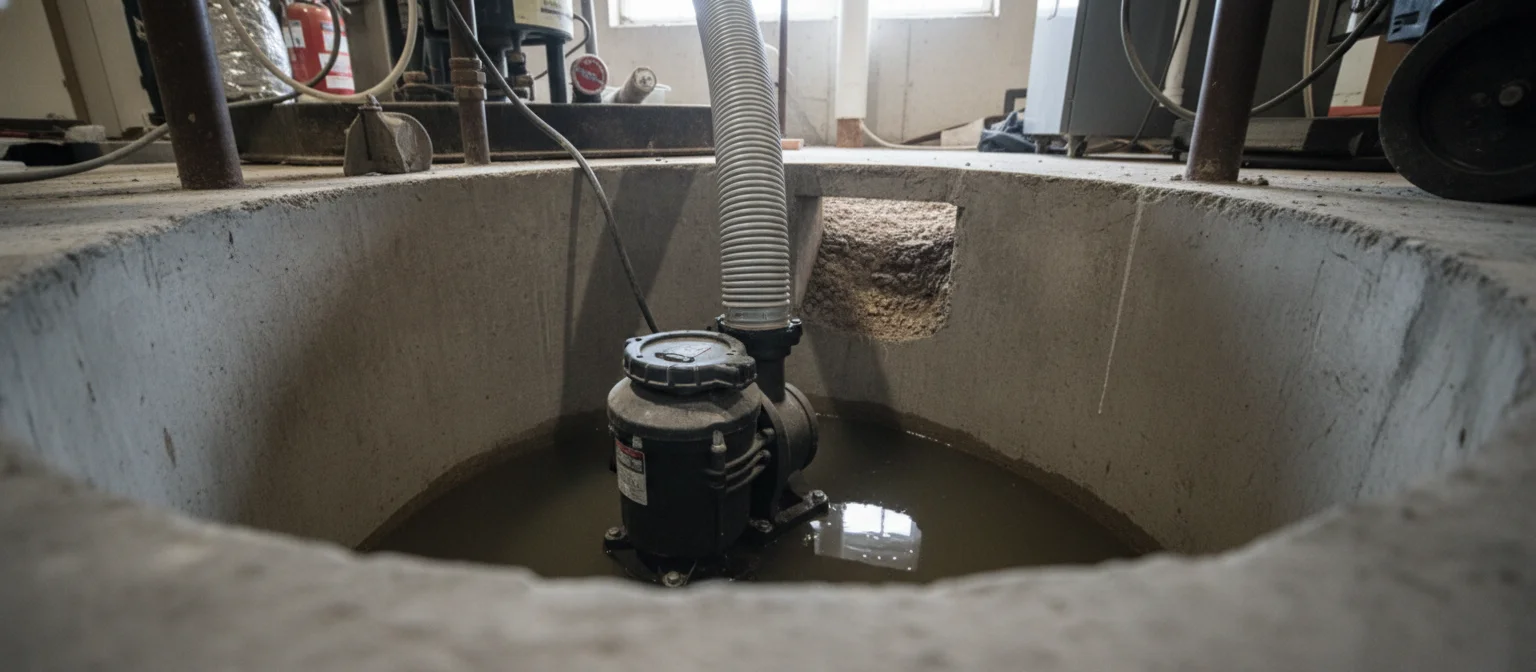
Sump Pump vs Gravity Drainage
Gravity drainage routes water downhill to an outlet without any mechanical help. A sump pump is for when gravity can’t do the job.
Gravity works when your lot has enough slope that a pipe from the interior drain or perimeter drain can reach a lower outlet — a ditch, road edge, or property boundary — at a lower elevation than the collection point.
A pump is needed when the lot is too flat for that to happen. The foundation perimeter sits lower than any available outlet. Or the water table is shallow enough that perimeter drainage alone can’t prevent saturation against the footing.
The NC builder accountability playbook: a lot with a correctly designed exterior drainage plan rarely needs a sump pump. Positive drainage away from the foundation, a properly sloped perimeter drain daylighting to a natural outlet — that system doesn’t require mechanical intervention.
If a new-build foundation needs a pump within two years of construction, that’s a signal. Exterior drainage design may have been inadequate from the start.
When to Add a Sump Pump
Add a sump pump when the outlet elevation is higher than the collection point, or the water volume exceeds what gravity discharge can handle.
Three scenarios where a pump is the right call:
-
Basement or crawl space is below grade with no daylight outlet. There is no pipe path that runs continuously downhill from the interior to daylight. Hydrostatic pressure against the footing requires mechanical removal.
-
Interior drain discharges to a sump pit because no gravity path exists. The perimeter drain collects water, but the only way out is up — or too flat to flow reliably.
-
Existing gravity system is overwhelmed by NC spring storm volumes. The gravity path exists but can’t handle peak flow during a heavy event. A supplemental pump handles the overflow.
What a sump pump does NOT fix: the source of water entry. It manages the symptom. A foundation caught in a new-construction drainage failure pattern NC — where the perimeter wasn’t properly graded, the exterior drain was undersized, or the waterproofing failed — will keep generating water. The pump keeps running. That’s the signal that the source problem hasn’t been addressed.
Sizing a Sump Pump for NC Rain Events
Size the pump for the 10-year storm event, not the average rain — an undersized pump fails exactly when you need it most.
Pump capacity is measured in . The sizing target is the peak inflow rate your drainage area generates during an intense NC rain event.
Working numbers for residential installations:
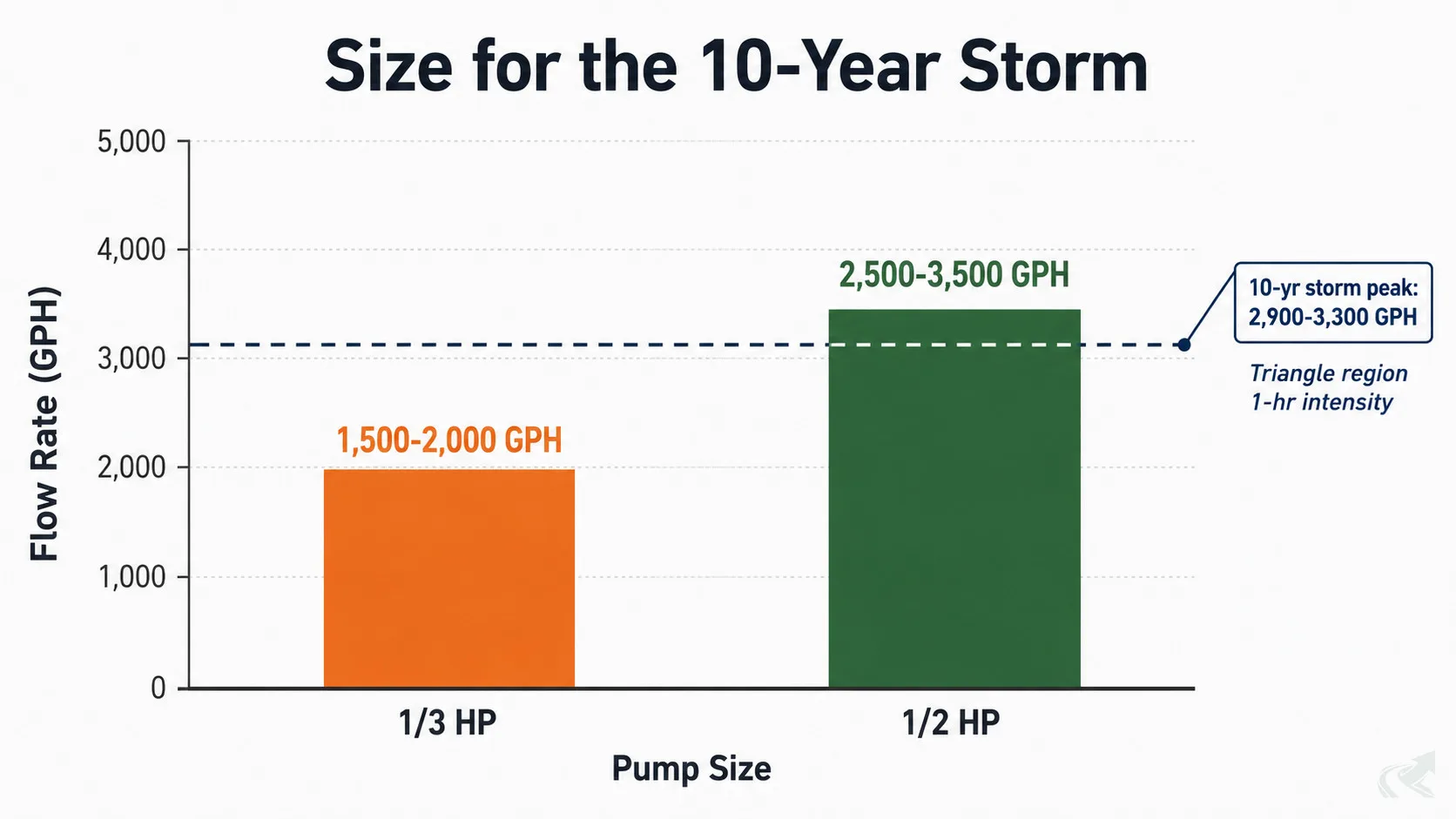
- 1/3 pump — typically rated 1,500—2,000 GPH at a 10-foot head. Adequate for most single-story crawl-space installations with limited drainage area.
- 1/2 HP pump — typically rated 2,500—3,500 GPH. Required for larger drainage areas, shallow water tables, or basements where the static head is higher.
The Triangle region’s 10-year, 1-hour storm intensity runs roughly 3.5—4 inches per hour. For a 1,000 square foot drainage area contributing to the pit, that’s around 2,900—3,300 gallons per hour at peak. A 1/3 HP pump is marginal. A 1/2 HP pump provides the margin you need when a storm stalls over your neighborhood.
Ask any contractor these questions before accepting a pump spec: “What GPH is this pump rated for? What’s the estimated peak GPH inflow from my drainage area?” If they can’t answer both, the pump was sized by habit, not by calculation.
Signs of an undersized pump: it runs constantly during heavy rain, or the pit fills faster than the pump discharges — often because yard drainage solutions NC above grade are contributing more inflow than the spec assumed. Either condition means you need more capacity before the next storm.
Battery Backup: Non-Negotiable in NC
NC ice storms and summer hurricanes both knock out power. A sump pump without battery backup will fail the night it matters most.
Sump pump through an NC storm: backed up vs unprotected
Comparison. Battery backup in place: DC backup pump kicks in the instant AC power drops; Audible alarm signals the primary failed and the battery is running; Discharge line routes to a pop-up emitter 10+ ft from the house; Keeps pumping through a multi-day hurricane or ice-storm outage. No backup: Primary pump dies the moment the power goes out; No backup unit -- the spec saved a few hundred dollars; Sump pit overflows onto the crawl-space floor; Fails during the exact storm that generates the most water.
- DC backup pump kicks in the instant AC power drops
- Audible alarm signals the primary failed and the battery is running
- Discharge line routes to a pop-up emitter 10+ ft from the house
- Keeps pumping through a multi-day hurricane or ice-storm outage
- Primary pump dies the moment the power goes out
- No backup unit -- the spec saved a few hundred dollars
- Sump pit overflows onto the crawl-space floor
- Fails during the exact storm that generates the most water
NC ice storms and summer hurricanes both cut power for days -- a sump pump without battery backup fails the night it matters most.
North Carolina has two distinct power-outage threats for foundation drainage. The hurricane season runs June through November — when tropical systems slow down and stall, a single storm can drop 10—20 inches over 48 hours while simultaneously knocking out power for days. Winter ice storms — common across the Piedmont and Triangle — can pull power for 24—72 hours while the ground is saturated from melting ice.
A pump without backup fails during the exact weather conditions that generate the most foundation water. That’s not a coincidence. It’s a physics problem.
Battery backup options:
- DC pump + lead-acid battery — the most common residential backup. A second pump mounted above the primary, powered by a 12V battery. Kicks in automatically when AC power drops or when the pit rises above the primary pump’s float. Battery life: 3—5 years typical.
- DC pump + lithium battery — longer cycle life, more consistent output as the battery depletes. Higher upfront cost.
- Water-powered backup — uses municipal water pressure to eject sump water via a venturi. Works without any battery, but requires adequate city water pressure and wastes roughly 1 gallon of supply water per gallon ejected. Not a fit for well-water properties.
- Whole-house generator circuit — if you have a standby generator, include the sump pump circuit in the load plan. Not a substitute for a battery backup (generator startup takes 10—30 seconds; a battery backup is instantaneous).
A fair spec includes: primary pump with rated GPH, battery backup unit with rated GPH and battery type, and an audible alarm that activates when the backup engages. The alarm matters — it tells you the primary failed and the battery is running down.
There is no NC Residential Building Code requirement mandating backup power for sump pumps in residential construction as of 2026. That doesn’t make it optional. It makes it a spec discipline issue.
Discharge: Where Does the Pump Send the Water?
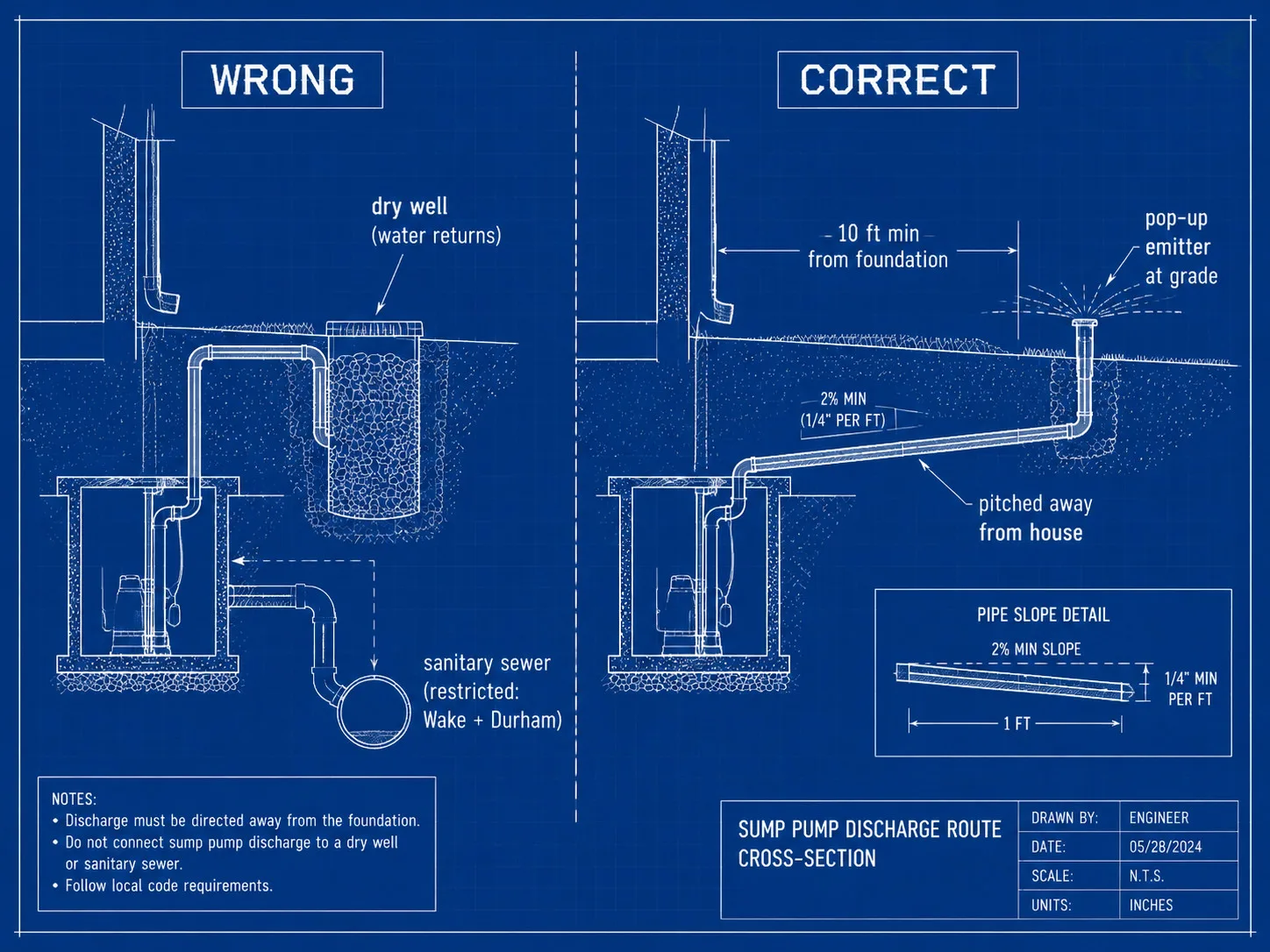
The pump discharge must route to daylight — not to a dry well, not to the sanitary sewer.
A sump pump that discharges into a dry well is cycling water back into the saturated soil around the foundation. The water returns. It’s a loop, not a solution.
Sewer tie-in is a different problem. Wake County and Durham County both restrict or prohibit sump pump discharge into the sanitary sewer system under their stormwater and sewer-use ordinances. Check your local stormwater authority before accepting any spec that routes to the sewer — the connection can be ordered cut, and the reconnection cost lands on the homeowner.
The correct discharge route:
- A dedicated 1.5—2 inch discharge line running to a pop-up emitter vs daylight for sump pump discharge
- Pop-up emitter positioned at grade, at least 10 feet from the foundation
- Sloped away from the house so the discharged water doesn’t re-enter the drainage area
The NC ice-storm discharge problem: discharge lines freeze in winter. A frozen discharge line backs up into the pit, the pump can’t move water, and the float eventually burns out the pump motor. Standard fix: use a freeze-resistant discharge elbow at the exit point, or insulate the buried section. Any quote that doesn’t address freeze protection on the discharge is missing a line item.
Maintenance and What Contractors Often Skip
A sump pump requires annual testing and battery replacement on a 3—5 year cycle — most contractor specs say nothing about either.
Maintenance checklist for any NC sump pump installation:
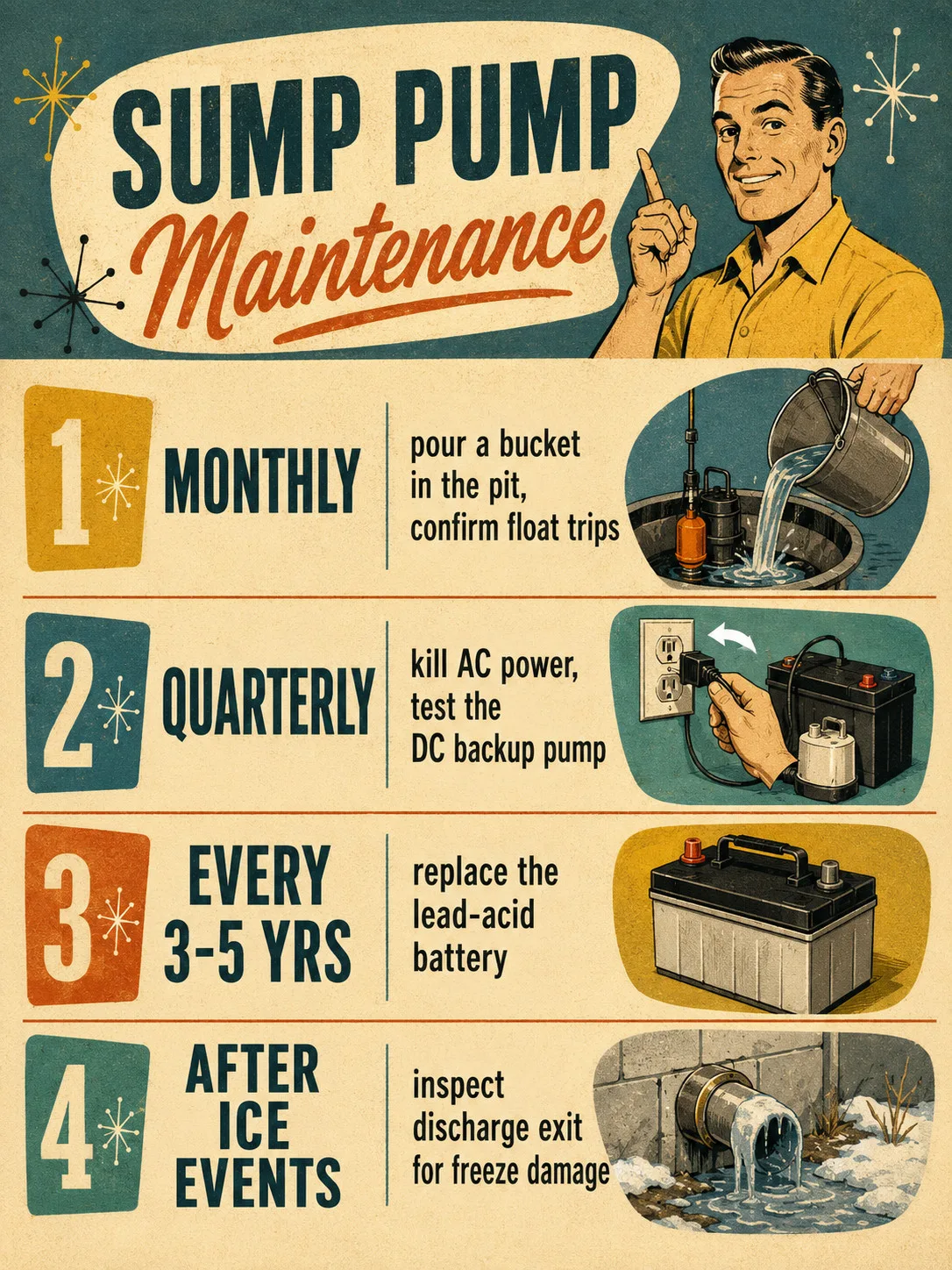
- Monthly: pour a bucket of water into the pit to confirm the float trips and the pump activates. Takes 60 seconds.
- Quarterly: test the battery backup the same way — kill the AC power at the breaker and pour water in the pit. The DC backup pump should activate.
- Every 3—5 years: replace the battery. Lead-acid batteries lose capacity gradually; by year 5, a “full charge” may only provide 20—30 minutes of runtime instead of 8+ hours.
- After each ice event: inspect the discharge pipe exit for freeze damage. A cracked fitting from last winter’s ice event fails silently until the next storm.
What contractors commonly omit from a quote:
- Battery backup unit ($300—600 in addition to the primary pump)
- Alarm that fires when backup activates
- Freeze protection on the discharge line
- Discharge route confirmation (pop-up emitter location, slope, distance from foundation)
When you get an itemized quote for a sump pump installation, it should name the pump model, the GPH rating, the HP rating, the backup unit model and battery type, the discharge route, and freeze protection. A quote that only says “sump pump installation: $2,800” tells you nothing about what you’re buying.
Get an itemized quote that includes the pump GPH rating, battery backup spec, and discharge route. Find a grading contractor in North Carolina who can walk you through the complete spec line by line.