
Two questions homeowners ask
Pop-up emitter or open daylight for my drain pipe?
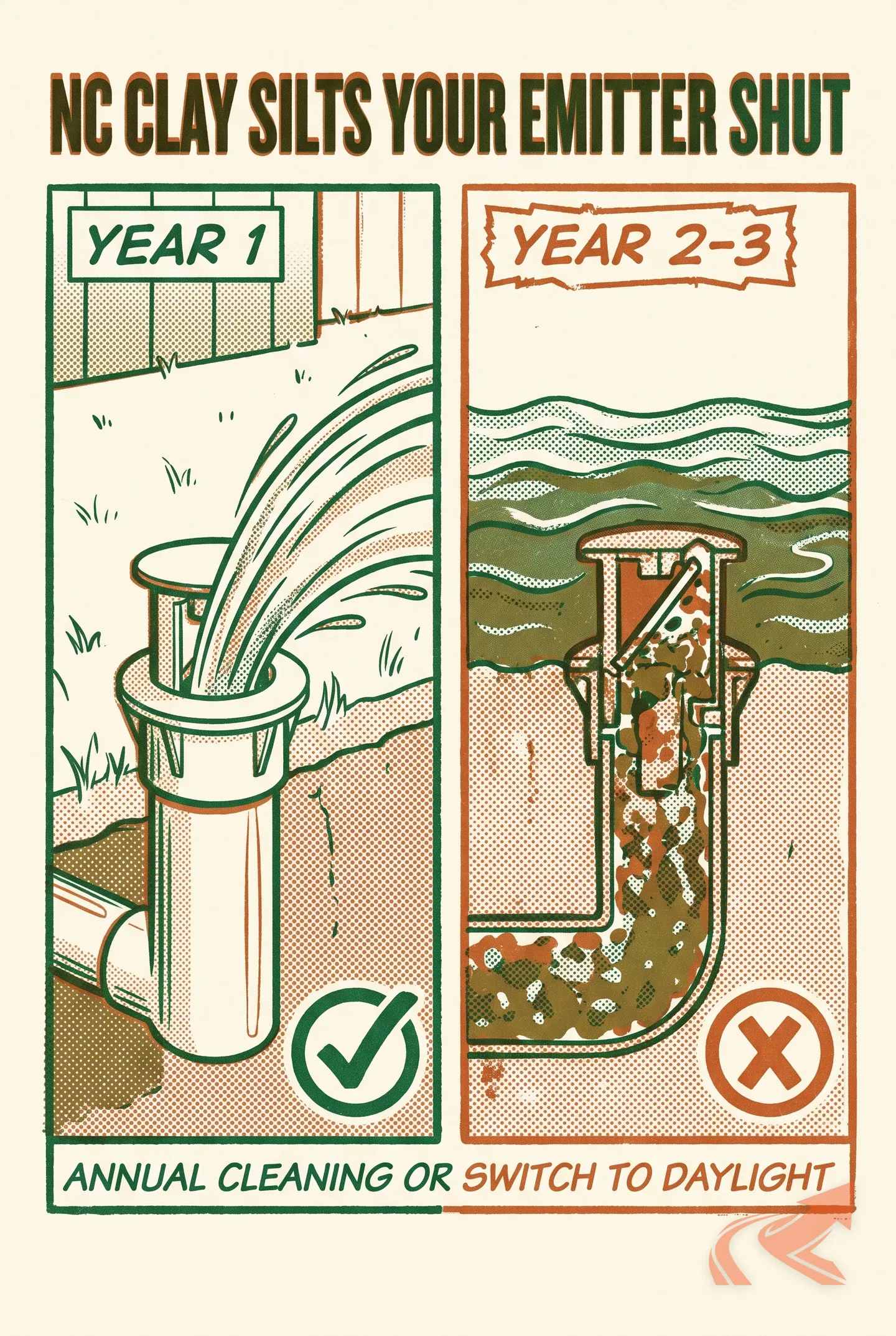
Both work. A pop-up is cleaner -- it closes when dry and keeps pests out. Open daylight is simpler but needs edge protection where mowers can clip it. In North Carolina, Piedmont red clay will silt up a pop-up emitter within 1 to 3 seasons. Plan to clean it annually or the system loses capacity.
Why does my pop-up emitter stop working after a few years?
NC Piedmont clay stays suspended in runoff water. It travels the length of the pipe and deposits on the flap mechanism at the outlet. Over time the flap sticks partially closed. Annual inspection and cleaning is the maintenance cadence for any pop-up in clay soil.
Your contractor’s quote ends the French drain run with a pop-up emitter at the yard’s edge. Sounds professional. You accept it.
Two seasons later, the system isn’t draining as well as it did at installation. Standing water takes longer to clear. The pop-up emitter has silted in with NC red clay — and nobody told you it needed cleaning.
This page covers both outlet types, their trade-offs in North Carolina conditions, and the three questions to ask before the job starts.
What a Pop-Up Emitter Is
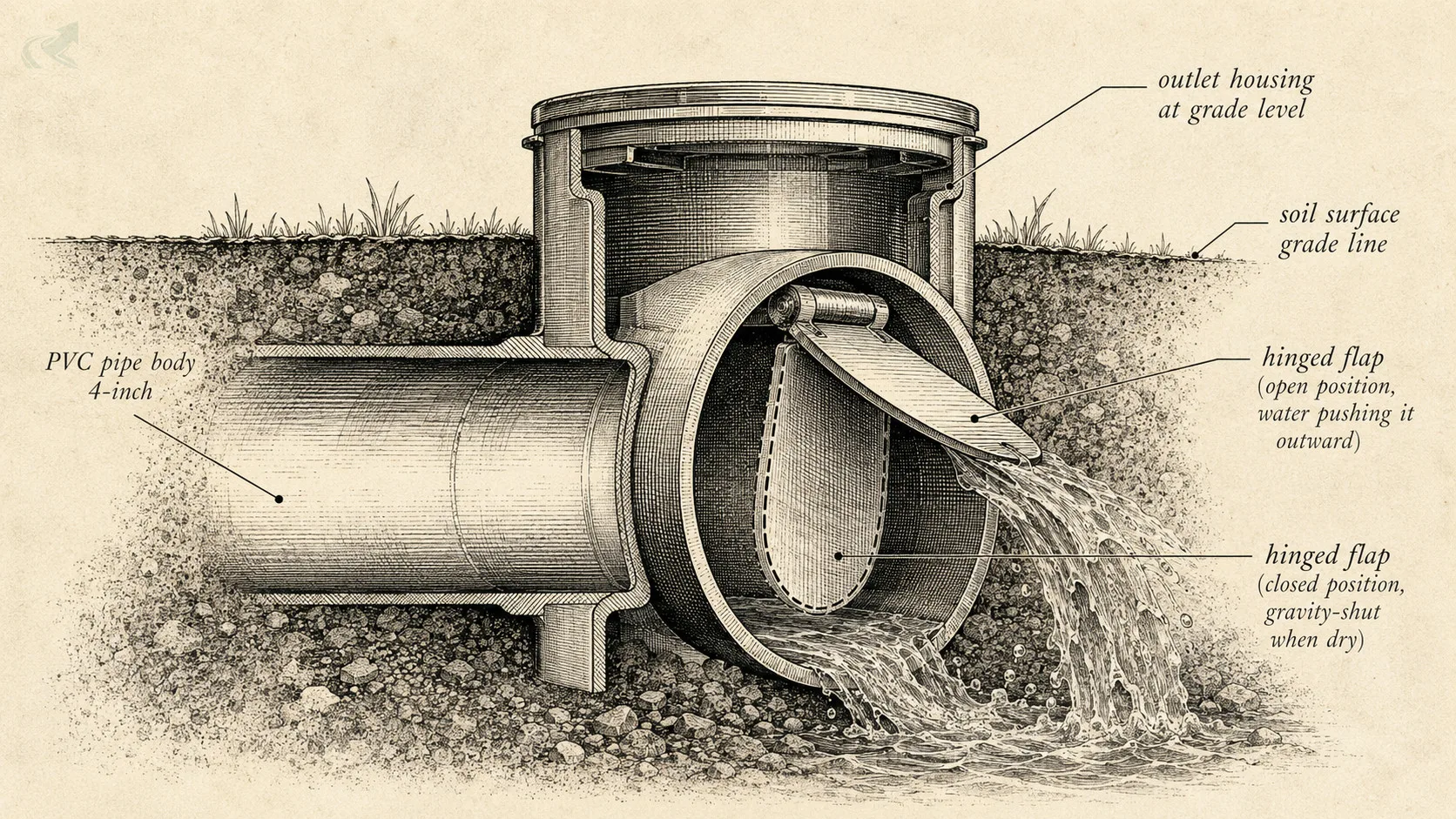
A pop-up emitter is a plastic outlet housing with a hinged flap that opens when the pipe has flow and closes when the pipe is dry.
Water pressure from the drainage pipe pushes the flap open. When flow stops, the flap drops back into the closed position under gravity. Simple one-way valve — no moving parts beyond the flap itself.
The benefits are real. A closed emitter keeps rodents, debris, and backflow out of the pipe when the system is idle. It looks cleaner than an open pipe end at grade. At ground level or slightly elevated, it doesn’t create a trip hazard the way a raw pipe end can.
Common sizes are 4-inch and 6-inch, matching the standard PVC vs corrugated pipe for French drains. Most residential drainage work in NC uses 4-inch.
What Daylighted Pipe Is
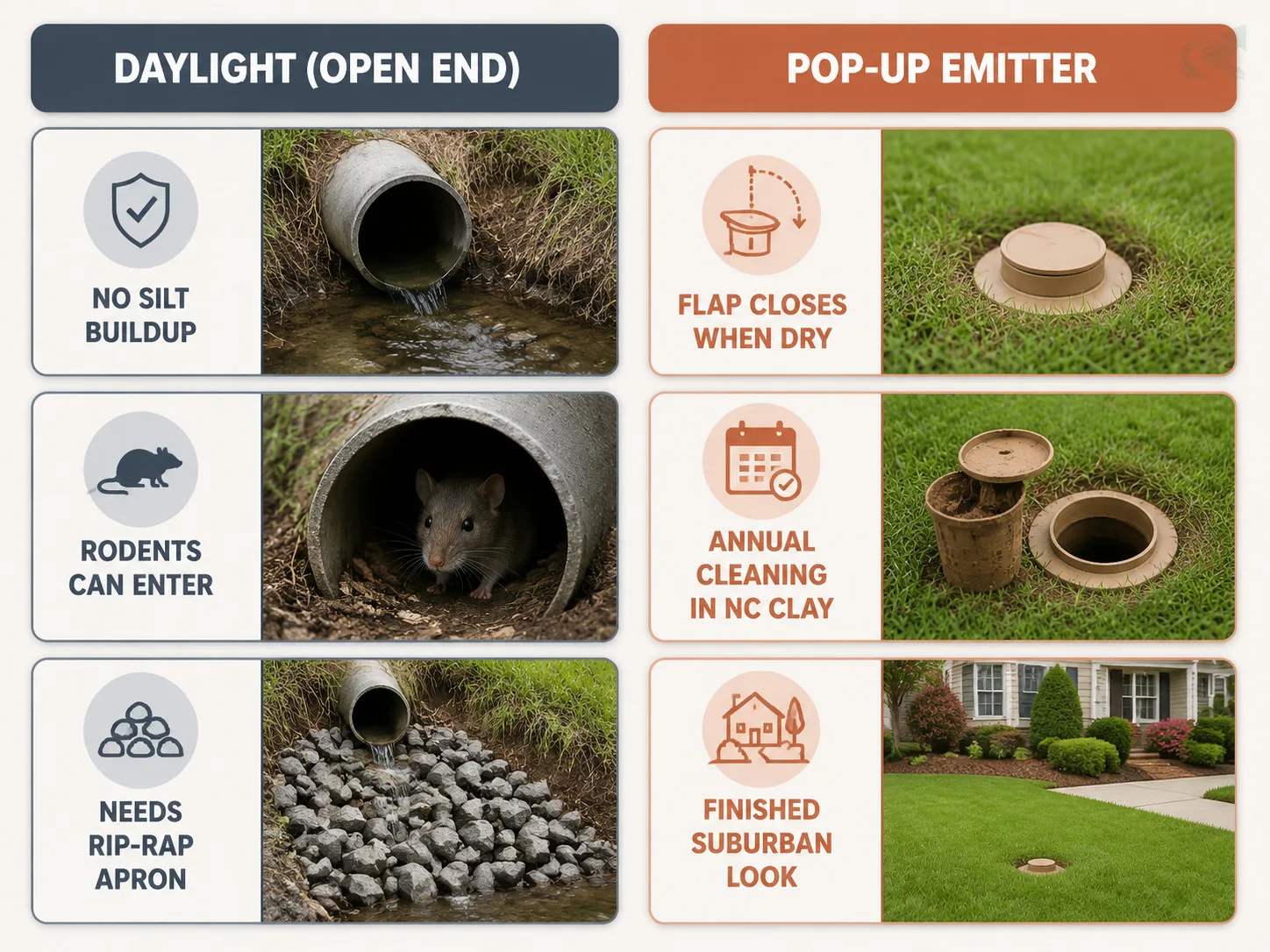
Daylighting a pipe means the pipe end exits at grade and discharges freely — no flap, no fitting.
There’s nothing to silt up. Water moves through and out; the end stays open. Lower maintenance and lower cost than a pop-up.
The trade-offs are also real. A raw pipe end needs protection from mowing damage — a lawnmower can clip an exposed end and shear the pipe. Rodents and debris can enter the pipe through the open end. The outlet point can cause erosion if the discharge velocity isn’t dissipated by rip-rap or an established slope.
Daylighting works best where the pipe exits at a natural slope or over a rip-rap apron. The outlet elevation must sit below the inlet elevation at the house side — that minimum grade for a French drain to drain is what drives flow. Without it, you don’t have drainage; you have standing water in a pipe.
The NC Clay Silting Problem with Pop-Up Emitters
NC Piedmont clay suspends easily in runoff water — it enters the pipe, travels to the outlet, and deposits at the pop-up flap. Within 1 to 3 seasons, the flap may not open fully.
Here’s the mechanism. Fine clay particles are small enough to stay suspended in moving water. As water velocity slows when it reaches the outlet flap, the clay settles on and around the flap mechanism. Over time the flap can stick closed — not enough flow pressure to push through the clay deposit — or partially open, reducing flow capacity.
This is not a defect in the product. It’s the predictable result of running drainage through NC Piedmont red clay soil without a maintenance plan.
Signs of silt buildup:
- French drain for NC red clay or downspout tie-in drains more slowly than when installed
- Standing water takes longer to clear after rain events
- Visible clay deposit around the emitter housing at grade
Maintenance cadence: inspect the pop-up emitter annually. Remove the flap housing and clean it. Check the last 3 to 5 feet of solid pipe before the outlet for clay accumulation. If that stretch has silted in, the emitter cleaning alone won’t restore capacity.
Pop-up emitter in NC clay: maintained vs silted in
Comparison. Inspected and clean: Flap opens fully under water pressure; Water flows freely out at the outlet; Flap housing cleaned on an annual cadence; Last 3-5 ft of solid pipe checked for clay buildup. Silted in with NC clay: Suspended kaolinite fines deposit at the flap; Clay buildup sticks the flap partially closed; Outflow drops; standing water clears slower; Visible clay deposit rings the housing at grade.
- Flap opens fully under water pressure
- Water flows freely out at the outlet
- Flap housing cleaned on an annual cadence
- Last 3-5 ft of solid pipe checked for clay buildup
- Suspended kaolinite fines deposit at the flap
- Clay buildup sticks the flap partially closed
- Outflow drops; standing water clears slower
- Visible clay deposit rings the housing at grade
NC Piedmont clay silts a pop-up emitter within 1 to 3 seasons -- annual inspection is the maintenance cadence, not an optional extra.
When Each Option Is Appropriate
Pop-up for clean finished yards and downspout connections; daylight for rural properties, stream-adjacent lots, and areas where maintenance access is reliable.
| Factor | Pop-Up Emitter | Daylight (Open End) |
|---|---|---|
| NC clay maintenance | Annual cleaning required | None -- open end can't silt-clog |
| Pest exclusion | Yes -- flap closes when dry | No -- pipe end is open |
| Cost | Higher (fitting + labor) | Lower (pipe cut flush) |
| Aesthetics | Finished look at grade | Functional; looks like pipe |
| Recommended site type | Suburban yard, downspout, near patio or path | Rural lot, stream bank, established slope |
NC clay maintenance
- Pop-Up Emitter
- Annual cleaning required
- Daylight (Open End)
- None -- open end can't silt-clog
Pest exclusion
- Pop-Up Emitter
- Yes -- flap closes when dry
- Daylight (Open End)
- No -- pipe end is open
Cost
- Pop-Up Emitter
- Higher (fitting + labor)
- Daylight (Open End)
- Lower (pipe cut flush)
Aesthetics
- Pop-Up Emitter
- Finished look at grade
- Daylight (Open End)
- Functional; looks like pipe
Recommended site type
- Pop-Up Emitter
- Suburban yard, downspout, near patio or path
- Daylight (Open End)
- Rural lot, stream bank, established slope
Use a pop-up emitter when: the yard is suburban with an HOA, the outlet is near a path or patio where an open pipe end is a hazard, and the owner will maintain it annually.
Daylight the pipe when: the property is rural with no HOA, the outlet sits at a stream bank or established slope, the area is not mowed close to the outlet, and the owner wants a zero-maintenance outlet.
Hybrid approach: some North Carolina contractors run a pop-up at the end of a daylighted run — the pipe is open above grade to allow easy cleaning, but the pop-up at the exit point discourages rodent entry. It’s a reasonable compromise when maintenance access matters more than appearance.
When Neither Works: The Dry Well Fallback
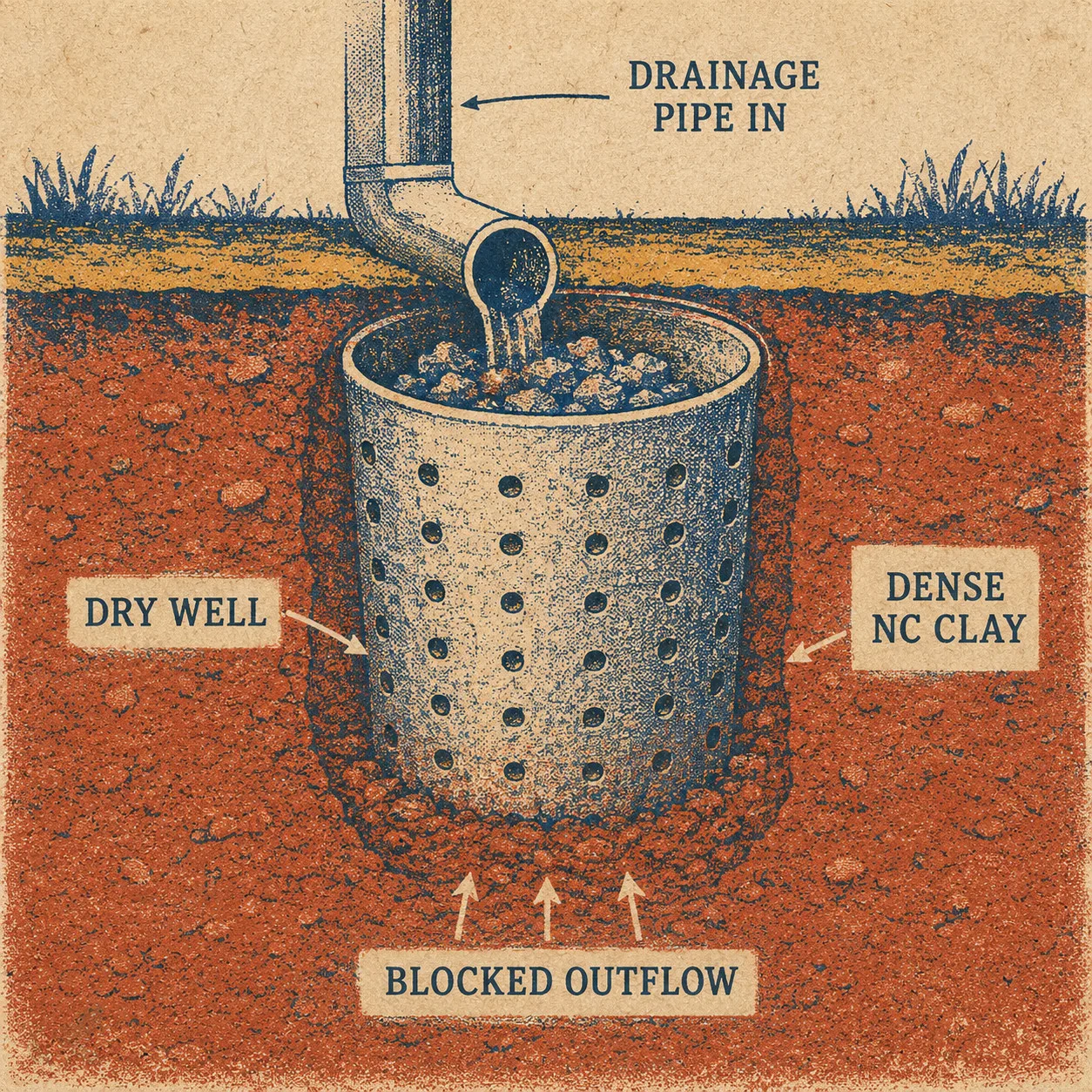
If you can’t reach daylight and a pop-up would sit above the pipe’s outlet level, a dry well — a buried perforated container — can receive the discharge.
Dry wells work poorly in NC Piedmont clay. The clay surrounding the well doesn’t absorb fast enough to handle runoff from typical NC rain events. They work better in sandier soils — Coastal Plain NC or areas with significant sand content in the profile.
If a contractor proposes a dry well in Piedmont clay, ask how they’ve sized it. NC DEQ’s Stormwater Design Manual (C-1, Infiltration System) sizes any infiltration device off a field-measured soil infiltration rate so the captured volume fully draws down within 72 hours — and it warns that construction compaction can cut soil infiltration rates by more than an order of magnitude. An undersized dry well in compacted clay won’t draw down in time and will back up the drainage system. ( is the DEQ division that administers this manual.)
What to Ask the Contractor
Before accepting a pop-up emitter in your quote, ask three questions.
These aren’t adversarial. A contractor who has installed drainage in NC clay will have answers ready. If they can’t answer, that’s information.
- “What maintenance does this emitter need annually?” — The correct answer names inspection and cleaning, not “nothing.” Any pop-up in Piedmont clay needs annual attention.
- “Is the outlet elevation lower than the pipe inlet at the house?” — If the outlet sits at the same grade as the inlet, flow depends on pressure buildup, not gravity. Gravity-fed systems drain consistently; pressure-dependent systems don’t.
- “Is there a clean-out access in the run so I can inspect the pipe near the outlet?” — A clean-out tee in the last 10 feet lets you run a snake or hose to check clay accumulation without excavating.
Get an itemized quote that names the outlet type and the maintenance requirement in writing. “Pop-up emitter, 4-inch, annual inspection required” belongs on the quote, not in a verbal add-on at the end of the walkthrough.
For context on how the outlet connects to the full system, see downspout to underground pipe — discharge decision and French drain design — discharge options.
If standing water in your yard is the underlying problem you’re solving, the outlet is one part of the system — the inlet, pipe sizing, and soil conditions matter equally.