
Before you rent the trencher
Can I install a French drain myself in NC?
For a simple yard-intercept run with a natural daylight point: yes, with the right equipment. The DIY envelope closes at 24-inch depth, proximity to a foundation, or discharge that affects a neighbor's property. Here is the honest breakdown.
What situations definitely require a professional?
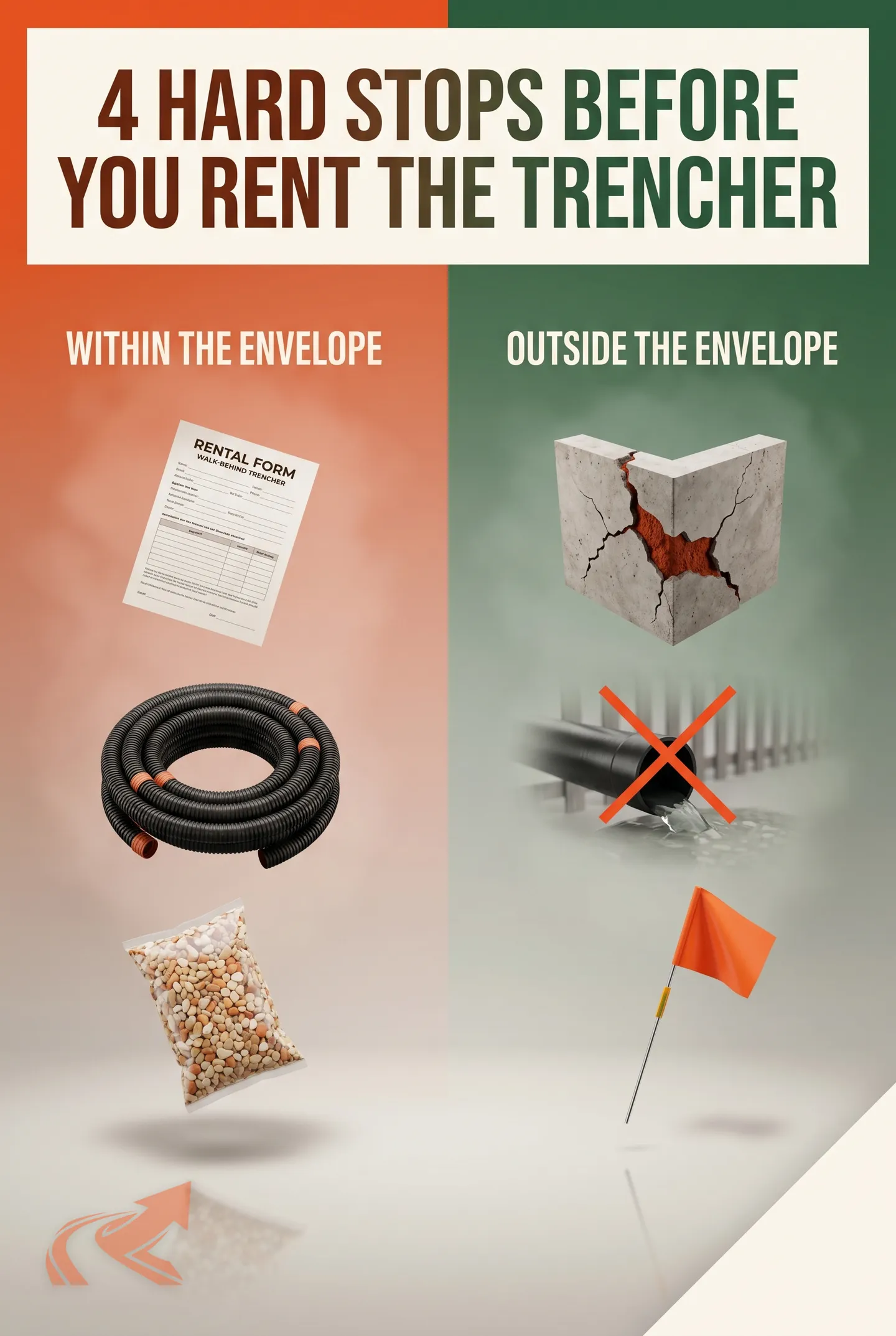
Four hard stops: depth over 24 inches, trench within 5 feet of a foundation, discharge crossing a property line, or no natural daylight point on your lot. Outside any of these, call a pro -- not because the work is too hard, but because the consequences of failure are serious.
The YouTube videos make it look simple. A guy rents a trencher, runs a line of perforated pipe, fills the trench with gravel, and the water problem is gone. Two days, done.
What those videos leave out: the stone haul, the clay disposal, the slope verification, and what happens when the discharge ends up in your neighbor’s yard. Not scare tactics — honest math.
Here is what DIY actually costs in time and money, and here is where it stops making sense in North Carolina clay.
Where DIY Is Genuinely Viable
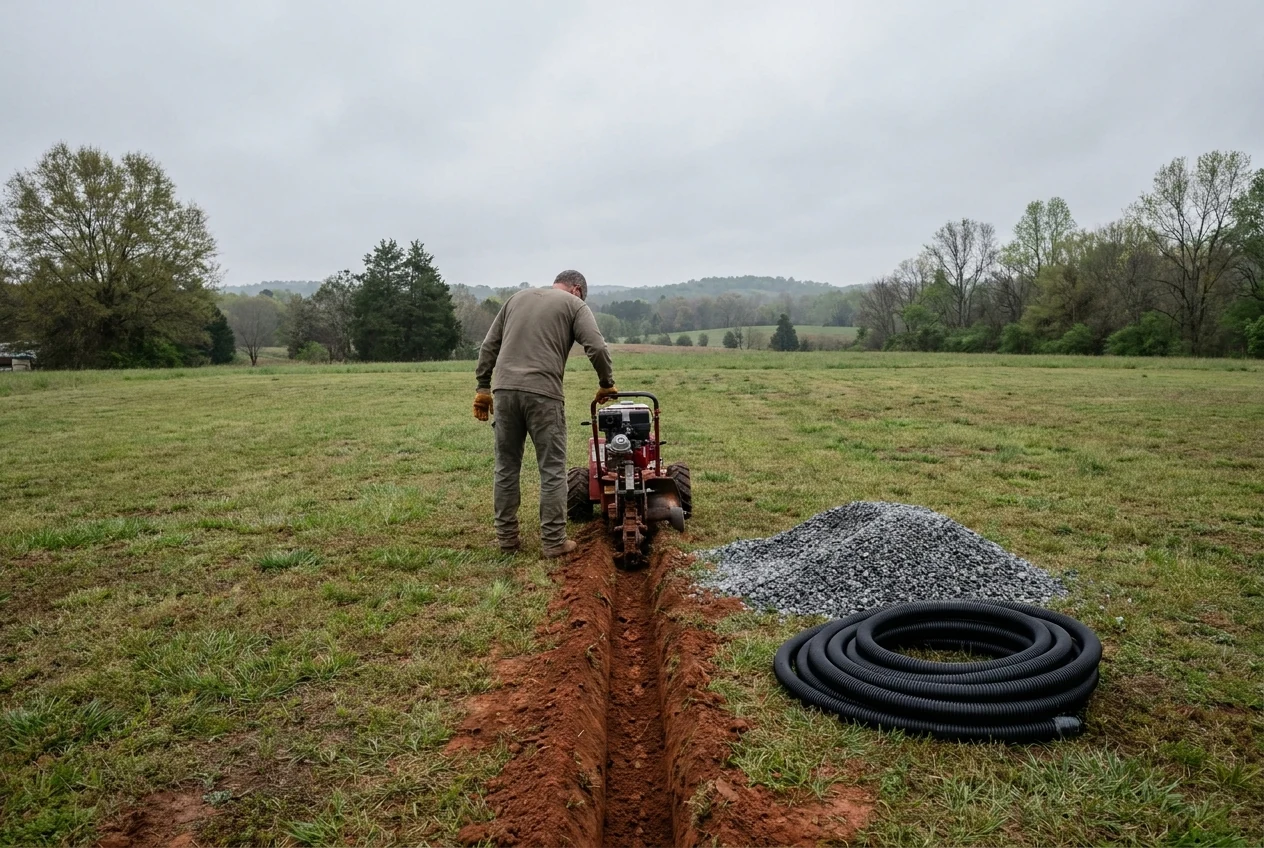
A 50 to 100 ft yard-intercept French drain with a natural daylight point, in an open-access yard with no gates or tight-clearance areas, is within a capable DIYer’s reach.
You need a trencher rental (typically $200—$350 per day in the NC Triangle area), a truck or scheduled delivery for #67 stone, and two to three days of labor for a 100 ft run.
Material costs run roughly $400—$800 for a 100 ft system: #67 washed stone (1.2—1.3 tons per cubic yard), 4-inch perforated pipe, and fabric sock if you use one. Add $200—$300 for stone delivery and you are in the $600—$1,100 range before labor.
The DIY envelope here is real. If you have open yard access, a confirmed daylight point, and yard terrain with a minimum grade for a French drain to drain, the patience to rent a trencher is all this takes.
Where the DIY Envelope Closes
Stop at 24-inch depth, stop at foundation adjacency, stop when discharge crosses a property line.
Three hard stops, each with a specific NC reason:
1. Depth beyond 24 inches. OSHA’s trench safety standard (29 CFR 1926.652) requires protective systems — shoring, sloping, or trench boxes — for any excavation deeper than 5 feet. But residential trenching in NC Piedmont clay becomes dangerous well before that. Clay walls slick and collapse without warning, especially in the shoulder seasons when moisture content shifts. A residential trencher does not carry the shoring equipment to handle depths past 24 inches safely. If the drainage problem requires going deeper — the French drain burial depth by application varies considerably by use case — that is a pro scope.
2. Foundation adjacency within 5 feet. Excavating within 5 feet of a foundation changes the soil pressure profile under the footing. In NC clay, a trench that close can introduce a void that destabilizes over time — not immediately, but across drought-then-rain cycles. Foundation waterproofing also becomes a factor at that distance. This is not a trencher job; it is a structural excavation with different equipment and liability.
3. Discharge crossing a property line. North Carolina recognizes surface water discharge onto a neighbor’s property as a nuisance under common law. Even if the water “naturally” flowed that direction before your drain existed, actively channeling it — increasing the volume and directing it — is a different legal situation. This is the most commonly overlooked DIY risk in NC drainage projects.
French drain DIY: inside the envelope vs outside it
Comparison. Within the DIY envelope: 50-100 ft yard-intercept run in an open, machine-accessible yard; Trench depth at or under 24 inches; A natural daylight point you can confirm on your own lot; Discharge stays entirely on your property. Outside the DIY envelope: Trench within 5 ft of a foundation -- undermining risk; Depth past 24 inches where clay walls slick and collapse; Discharge crosses a property line -- an NC nuisance claim; No natural daylight point -- nowhere for the water to go.
- 50-100 ft yard-intercept run in an open, machine-accessible yard
- Trench depth at or under 24 inches
- A natural daylight point you can confirm on your own lot
- Discharge stays entirely on your property
- Trench within 5 ft of a foundation -- undermining risk
- Depth past 24 inches where clay walls slick and collapse
- Discharge crosses a property line -- an NC nuisance claim
- No natural daylight point -- nowhere for the water to go
The DIY question is not 'can I do this?' -- it is 'can I afford to be wrong?' Each hard stop carries a real NC-specific consequence.
The Hidden Costs DIY Estimates Miss
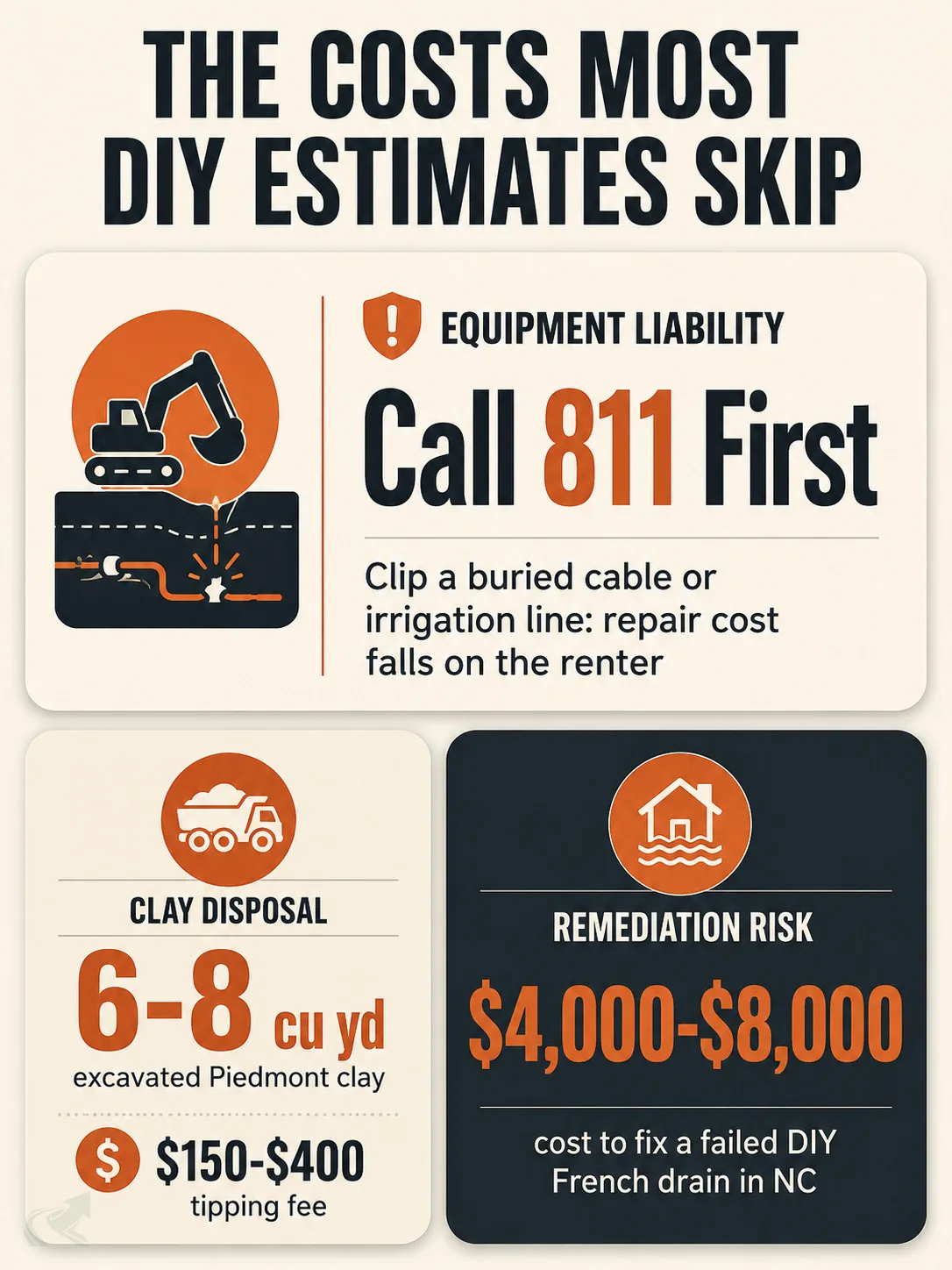
Most DIY estimates skip three costs: equipment damage liability, dump fees for excavated clay, and the cost to redo it when something goes wrong.
Equipment liability. Trencher rental insurance is real. If you clip a buried cable or irrigation line — both common in NC suburban yards — the liability falls on the renter. Call 811 before any trenching. That is not optional; it is NC law.
Clay disposal. A 100 ft French drain at 18-inch depth produces roughly 6—8 cubic yards of excavated Piedmont clay. That clay is heavy (1.4—1.6 tons per cubic yard) and is not welcome at most landfills without a tipping fee. Disposal adds $150—$400 depending on the site. Most DIY estimates treat the spoil as “free” — it is not.
Remediation cost. A failed French drain that backs up into a crawl space or re-routes water toward a foundation costs more to fix than the original job. Pro remediation of a failed DIY system runs $4,000—$8,000 in North Carolina — the same range as a full yard drainage solutions NC overhaul from scratch. That is the risk premium DIY carries.
NC-Specific DIY Risks That National Videos Miss
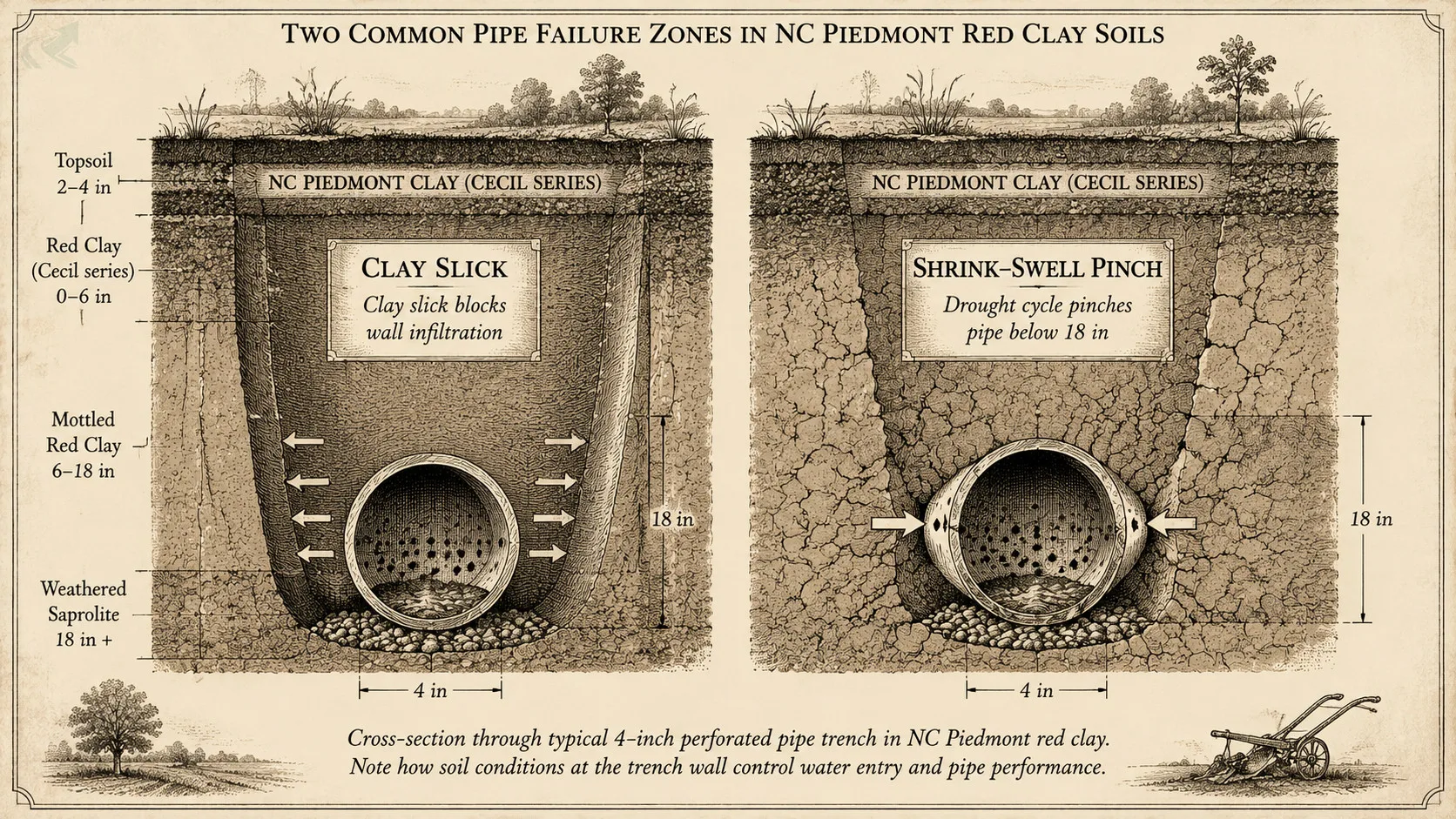
NC Piedmont clay creates two DIY risks that Florida or Michigan tutorials do not warn about: trench-wall clay slick and clay shrink-swell pipe pinch.
Clay slick (trench-wall glazing). When a trencher bucket scrapes the clay wall, it creates a smooth, compacted surface — a clay slick — that dramatically reduces water infiltration from the surrounding soil into the drain. Water enters a French drain through the trench walls, not just from above. A glazed wall cuts that infiltration path. The fix is a scratch pass — a second tool pass to roughen the wall surface before stone placement. Most national tutorials skip this step because they are not working in high-plasticity clay.
Shrink-swell pipe pinch. NC Piedmont clay expands when wet and contracts sharply during drought — a behavior that French drains in NC red clay have to account for that national tutorials skip. Perforated pipe installed at insufficient depth — less than 18 inches in most Piedmont locations — can be compressed or displaced during drought cycles as the clay contracts. The pipe that flowed freely in May may be pinched by August. Pipe bedding in compacted stone (not loose fill) reduces the risk, but depth is the primary protection.
The national YouTube instructors are not wrong — they are filming in different soil. Their methods work where they work. Apply the NC-specific steps before you copy the procedure.
The Honest Cost Comparison
Full DIY (tools plus materials plus rental) on a 100 ft run typically costs $800—$1,500. Pro install for the same scope runs $3,500—$6,000. The gap is real — and so is the difference in guarantee.
| Factor | DIY | Pro |
|---|---|---|
| Total cost (100 ft) | $800—$1,500 | $3,500—$6,000 |
| Equipment needed | Trencher rental + truck | Contractor-owned |
| Guarantee | None | Typically 1—3 years |
| NC clay expertise | Research-dependent | Built in |
| Time required | 2—3 days | 1 day |
| Failure remediation | Your cost ($4,000—$8,000) | Warranty coverage |
If the scope is within the DIY envelope — open yard, under 24 inches, clean daylight point — DIY is a legitimate financial decision. The $2,000—$4,000 gap is real money. Acknowledge it honestly before choosing either path.
For a full breakdown of what pros charge by job type in NC, see French drain cost NC — what you’d pay a pro.
DIY Scope Checklist
Even within the DIY envelope, there are situations where a pro makes sense even if the job technically qualifies.
Use this checklist before you rent a trencher:
- Depth is under 24 inches
- No foundation within 5 feet of the trench line
- Discharge stays entirely on your property
- A natural daylight point exists and you can confirm it
- The yard is machine-accessible (gate width, no underground hazards, soft-ground risk low)
If any box is unchecked, the job is outside the DIY envelope.
Even if all boxes are checked, consider a pro if:
- You cannot independently confirm where the water will daylight
- You are not confident about the soil profile at the planned depth
- The consequence of failure is crawl space flooding or foundation contact
The question is not just “can I do this?” It is “can I afford to be wrong?”
If you are outside the DIY envelope, get an itemized quote from a drainage contractor. An itemized quote will tell you more about whether the scope is being honestly represented than a single-number estimate ever will. Start with hire a yard drainage contractor NC to find verified NC contractors.
For more detail on the installation process itself, see French drain installation step-by-step NC and 9 French drain DIY mistakes NC before you start. If you are considering renting a mini skid steer instead of a walk-behind trencher, see renting a mini skid steer for French drain trenching for the tradeoffs.
Back to the full overview: French drain systems NC.