
The slope question, answered directly
What slope does a French drain need?
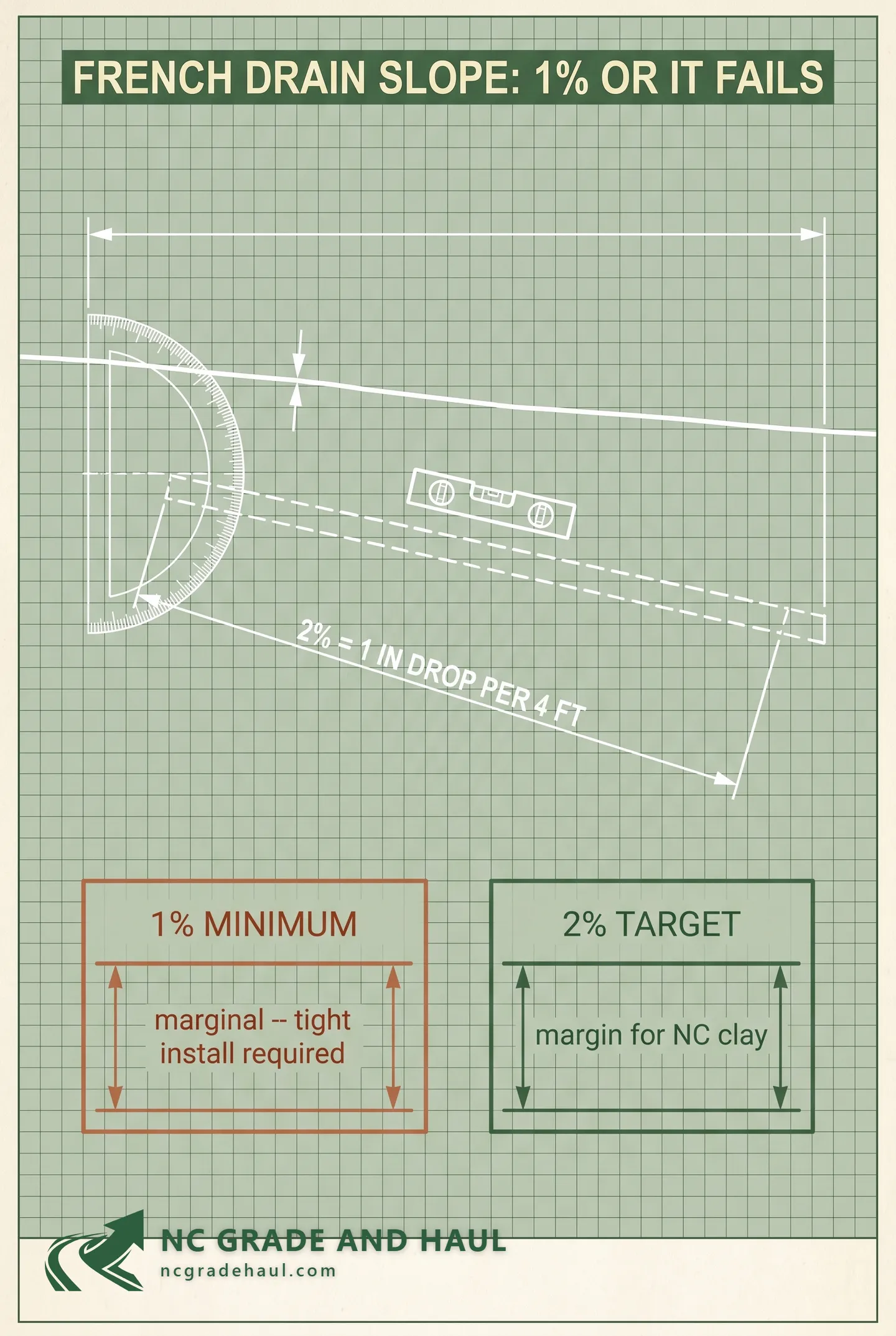
Minimum 1% -- that is 1 inch of drop for every 100 inches of run. North Carolina installers target 2% because Piedmont clay slows flow and installation variance can eat that thin margin. If your yard cannot achieve 1% to a natural daylight point, the system needs an engineered outlet.
How do I know if my yard has enough slope?
Measure the distance from trench start to discharge point. Measure the elevation change with a string-line and level or a phone level app. Divide rise by run. Multiply by 100 for the percentage. 1 inch of fall over 8 feet = 1.04% -- right at the minimum. Use the yard drainage slope calculator below for the arithmetic.
A contractor told you your yard is “too flat” for a French drain. Maybe they are right. Maybe they are upselling a sump pump you do not need. Either way, you can check the math yourself before calling them back — and knowing the number changes the conversation.
This page gives you the 1% and 2% targets in plain English, a step-by-step method for measuring your own fall, the two ways a flat French drain fails, and what to do if your yard genuinely cannot drain by gravity alone.
The Numbers: 1%, 2%, and Why the Gap Matters
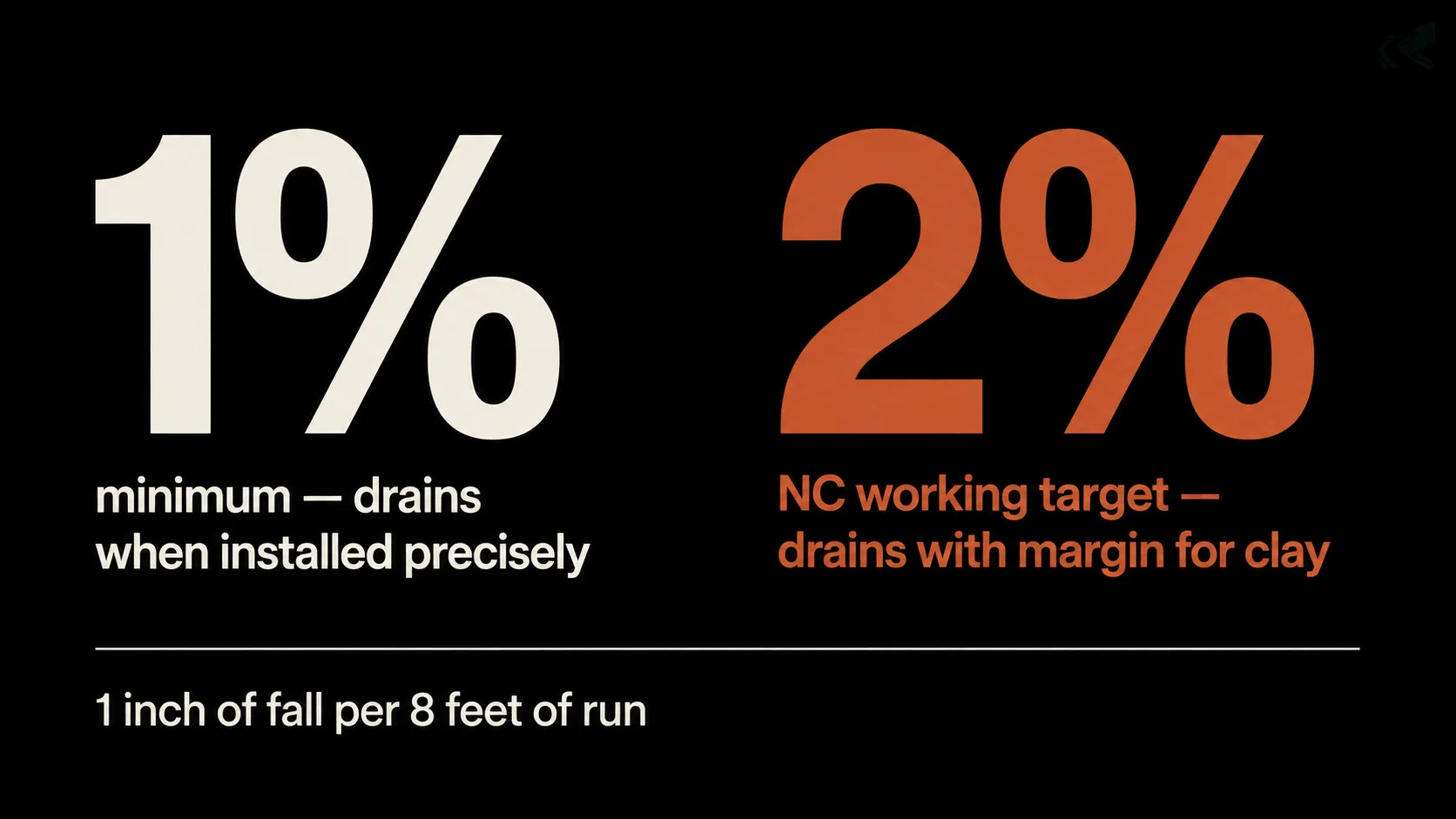
1% is the minimum — the system will drain. 2% is the North Carolina working target — the system drains with margin for clay’s reduced permeability and field installation variance.
In practical terms, 1% means 1 inch of fall for every 100 inches of run — roughly 1 inch per 8 feet, or 1 foot of drop over a 100-foot trench.
That sounds like very little. It is. On a 40-foot French drain run, 1% is only a half-inch of drop. Dig the trench a hair off-level and you have eaten the entire margin.
NC Piedmont clay is denser than sandy coastal soils. Water moves through it more slowly. A 2% grade keeps the system draining even when the #67 stone is partially silted or the trench bottom is not perfectly consistent. It also gives contractors room to work without laser-perfect precision on every foot of trench.
If your yard can achieve 2%, ask for it. If it can only manage 1%, the system can still work — but the installation needs to be tighter.
How to Calculate Your Yard’s Available Fall
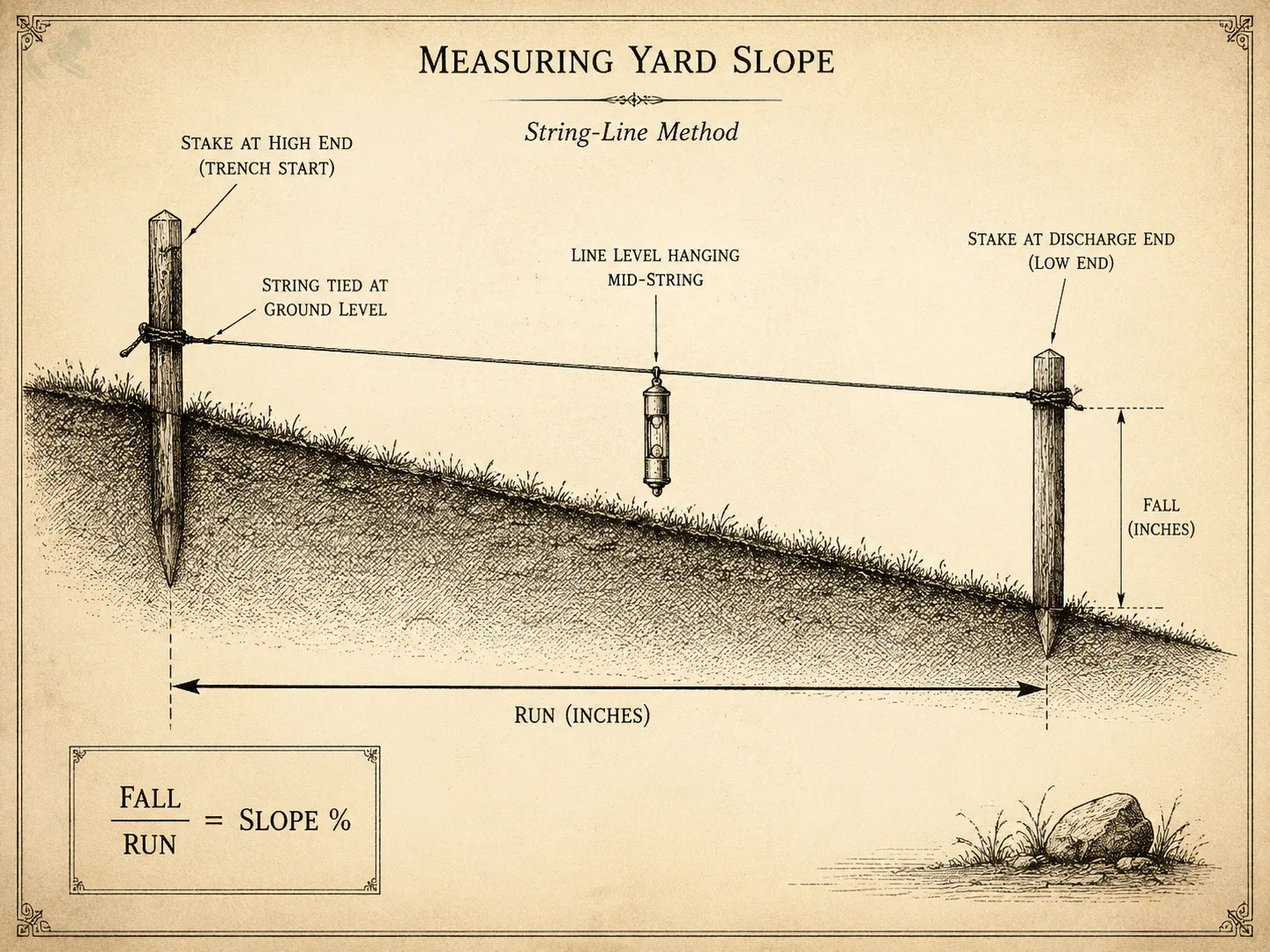
Measure the distance from where you would start the trench to where water would exit. Measure the elevation change. Divide. That is your slope percentage.
You do not need a survey crew. A 50-foot tape measure, a wood stake, a string, and a line level (or a free phone app) are enough for a planning estimate.
String-line method — four steps:
- Drive a stake at the high end (trench start). Tie a string at ground level.
- Walk the string to the discharge point. Hold it taut and level using a line level or phone level app against the string.
- Measure the vertical distance from the string down to the ground at the discharge end. That is your fall.
- Divide fall by run: if you have 3 inches of fall over 25 feet (300 inches), your slope is 3/300 = 1%.
Phone level app method: lay a long, straight board along the planned trench path. Place your phone flat on the board. The inclinometer reading gives you the grade directly. A reading of 1.0 to 1.2 degrees corresponds to roughly 1.7% to 2.1% — enough for the North Carolina target.
Run the numbers with the yard drainage slope calculator if you prefer to skip the arithmetic.
What Happens When Slope Is Too Flat
A flat French drain becomes a French bathtub — it fills with water but cannot drain it. The water either sits in the trench or finds the lowest point and emerges where you do not want it.
Two failure modes, both common in NC Piedmont infill lots:
1. Standing water in the trench. The pipe and stone fill but water has nowhere to go. The drain stops pulling moisture from the surrounding soil. The yard stays wet. Homeowners often blame the stone or the fabric — but the grade is the actual problem.
2. Back-pitch discharge. The trench is sloped in the wrong direction — toward the house instead of away. This is called back-pitch. Water follows the grade, accumulates at the foundation, and can enter a crawl space or basement. It is more common than most people realize, particularly when a DIY installation eyeballed the grade rather than measured it.
Piedmont infill lots — neighborhoods built on graded subdivision terrain — are especially prone to flat or reverse-pitch conditions because the final grade was designed for aesthetics, not drainage engineering.
French drain slope in NC: 2% fall vs a flat trench
Comparison. 2% fall to daylight: Trench pitched at the NC working target of 2%; Water moves steadily toward the daylight outlet; Margin absorbs clay's slow drainage and dig variance; The drain pulls moisture out of the surrounding soil. Flat trench becomes a bathtub: Zero fall -- collected water has nowhere to go; Back-pitch sends water toward the house instead; Pipe and stone fill and just sit; Crawl space or foundation intrusion follows.
- Trench pitched at the NC working target of 2%
- Water moves steadily toward the daylight outlet
- Margin absorbs clay's slow drainage and dig variance
- The drain pulls moisture out of the surrounding soil
- Zero fall -- collected water has nowhere to go
- Back-pitch sends water toward the house instead
- Pipe and stone fill and just sit
- Crawl space or foundation intrusion follows
On a 40-foot run, 1% is only a half-inch of drop -- dig a hair off-level and the whole margin is gone.
Slope scenario reference:
| Grade | Result | NC recommendation |
|---|---|---|
| Less than 1% | System fails — water sits or back-flows | Not acceptable |
| 1% (1 in/8 ft) | Minimum viable — drains when installed precisely | Marginal; tight installation required |
| 2%+ (1 in/4 ft) | NC working target — drains with margin for clay | Preferred in all Piedmont installs |
What to Do When Your Yard Cannot Achieve 1%
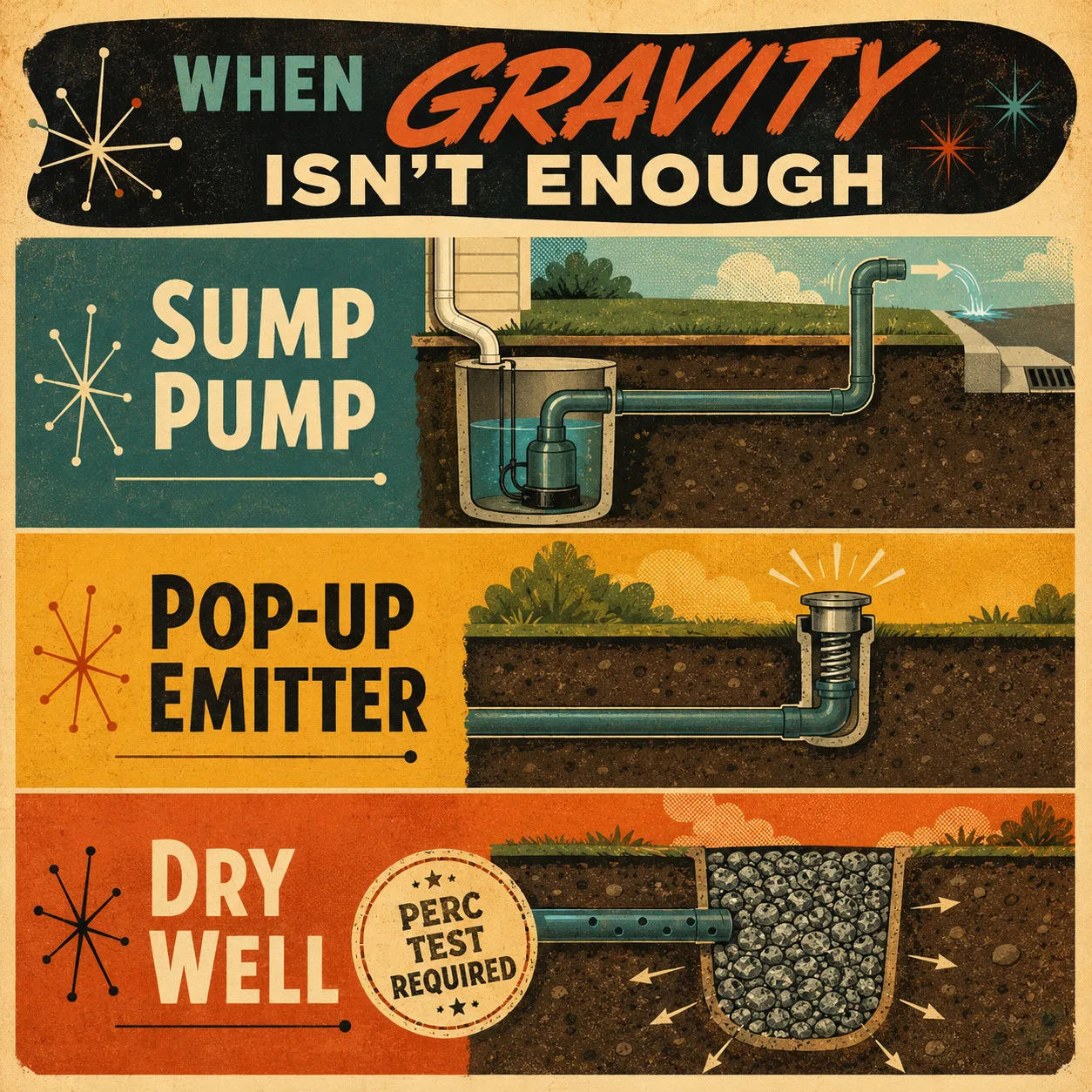
If no natural daylight point exists, you need an engineered outlet: a sump pump, a pop-up emitter at a low point, or a dry well if soil permeability allows.
“Your yard is too flat for a French drain” is sometimes true. When it is, the answer is not “no drainage” — it is a different outlet. Three options:
Sump pump with underground discharge. The French drain still collects water; a small sump basin at the low point holds it and a pump pushes it out via a buried pipe to a curb or downslope area. Reliable. Requires power and maintenance.
Pop-up emitter at the collection point. A buried pipe runs from the basin to a pop-up emitter vs daylight discharge NC — a spring-loaded cap that opens under water pressure and closes when dry. No electricity. Works for modest flow volumes if the emitter can reach a low enough point.
Dry well. A gravel-filled pit that accepts the collected water and allows it to percolate slowly into the subsoil. Works only if soil permeability is adequate — Piedmont clay rarely qualifies without a perc test to confirm. Ask your contractor whether a perc test makes sense before quoting this option.
The contractor who says “your yard is too flat — you need a sump system” may be right. Ask them to show you the grade measurement that confirms it.
How to Verify Your Contractor’s Grade Work
Ask your contractor to stake the fall before they backfill. Once the stone is in, you cannot check slope without digging it up.
This is the single most valuable question you can ask on a French drain job. Grade is set before the pipe goes in. After backfill, the only way to verify it is to pull the trench open again.
Before the crew moves to stone placement, ask them to show you the grade stakes or to run a string-line so you can confirm the fall from one end to the other. A contractor who has done this work correctly will not hesitate. A contractor who objects is worth questioning.
Get an itemized quote that lists the designed grade (e.g., “minimum 2% fall from collection point to daylight”) as a line item. That spec in writing gives you a standard to hold the installation against.
See a full list of verified NC grading contractors who work French drain systems in the Piedmont and Triangle — with license numbers you can cross-check on the NC Licensing Board.
Related reading
- French drain depth guide NC — how deep the trench needs to go and why NC clay changes the calculus
- French drain system design and layout — the full design picture: pipe placement, stone type, fabric, outlet options
- French drain for NC red clay — the hub page with cost ranges, common mistakes, and the NC clay context
- NC 6-inch foundation slope code rule — the related grade standard for soil around a foundation