The short version
Swale or French drain -- which do I need?
Swale if you see water flowing across the surface during rain. French drain if the soil stays saturated days after rain stops. Both if your lot has runoff from uphill AND wet soil near the foundation. The comparison matrix below walks through every factor.
Do national guides apply in NC Piedmont clay?
Only partially. National advice defaults toward French drains because that's what works in well-draining soils. NC Piedmont clay absorbs water slowly -- water that doesn't get underground can't be intercepted underground. A swale that routes surface water away is often more effective than a buried pipe trying to collect what never reached the soil.
Two contractors. Two diagnoses. A $4,000 spread in quotes. Neither one explained the logic.
The gap almost always traces to the same thing: one contractor identified a surface water problem, the other identified a subsurface water problem, and they recommended accordingly. Different water types require different systems. Once you know which type you have, the decision is not complicated.
The Core Difference
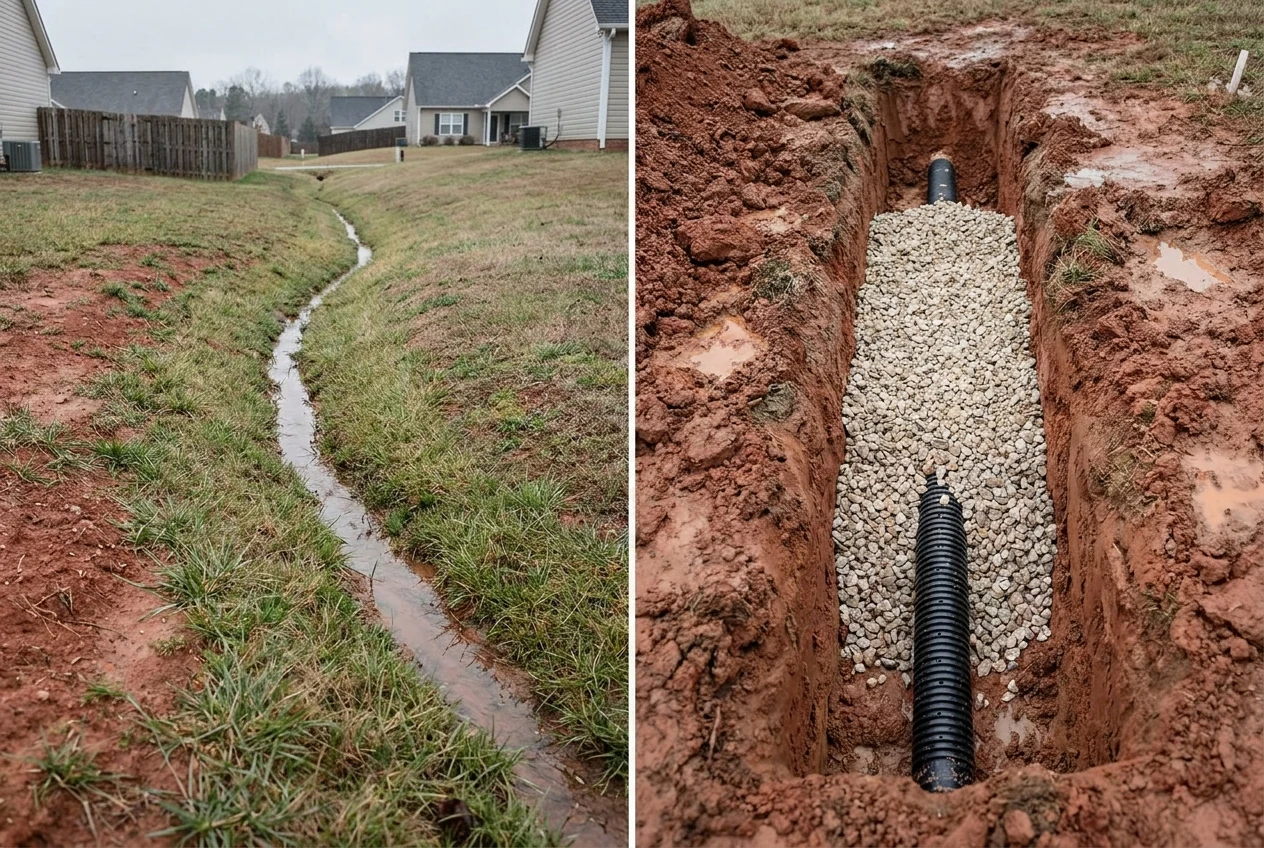
A swale manages water on top of the ground. A French drain manages water inside the ground.
Surface water is the rain you can watch — runoff that flows down a slope, collects in a low spot, and pools during a storm. It’s visible. You can trace where it came from.
Subsurface water is what you can’t see during the storm. It’s the soil that stays soggy two or three days after rain ends. It seeps up from below or moves laterally through the soil from higher ground uphill.
The diagnostic is straightforward. After a 1-inch rain, go outside and watch the yard for 30 minutes. If you see water moving across the surface — a swale is the right tool. If the soil is wet but you can’t identify where the water entered — a French drain is what you need. Both conditions at once means a hybrid system, particularly on lots where surface runoff combines with NC foundation drainage pressure near the house.
The Comparison Matrix
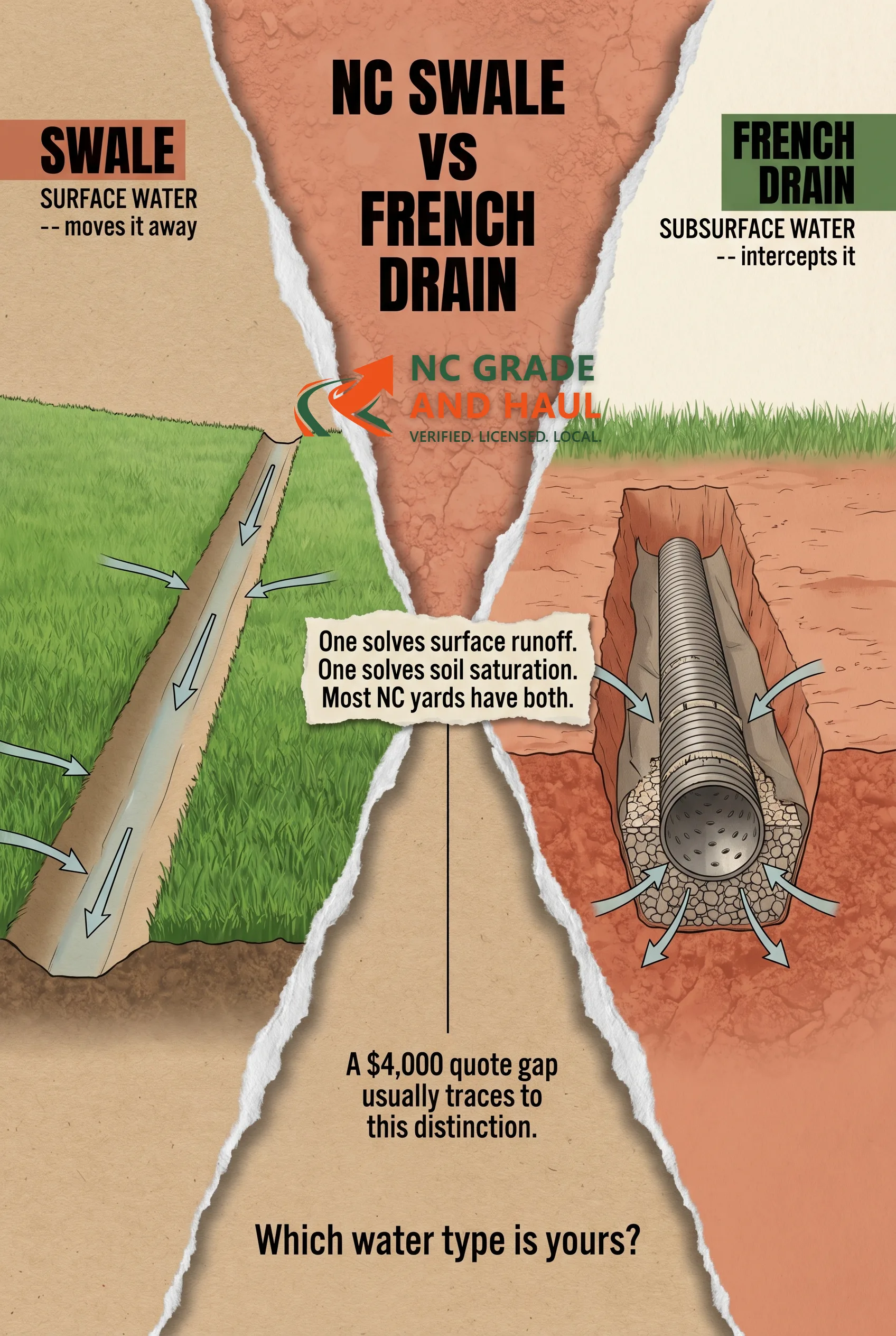
Here’s how they compare across the factors that matter for North Carolina yards.
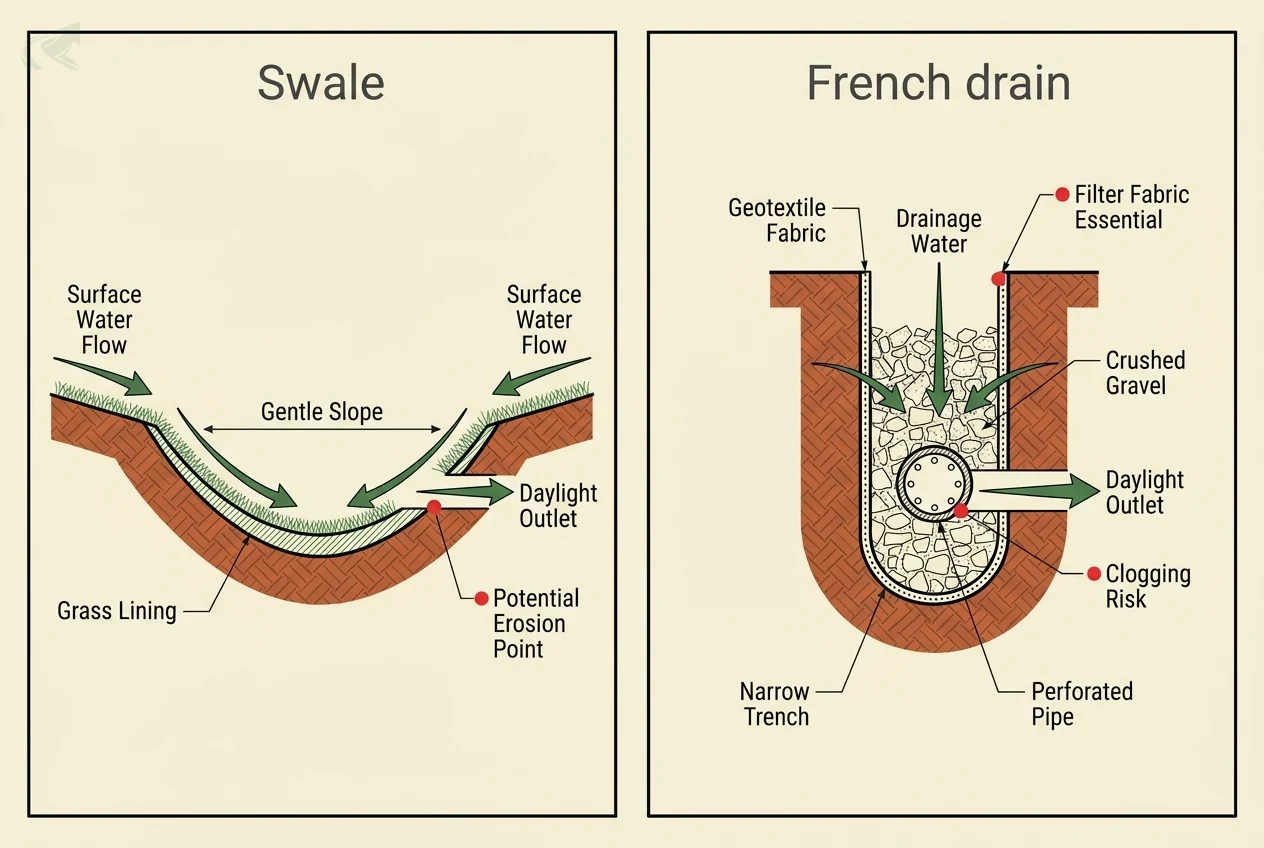
| Factor | Swale | French Drain |
|---|---|---|
| Water type managed | Surface runoff — rain you can see flowing | Subsurface saturation — soil that stays wet |
| Slope needed | Yes — minimum 1-2% to move water to daylight | Minimal — pipe slope of 0.5-1% is enough |
| Space required | Wider footprint — needs room for the channel | Narrower trench — works in tighter lots |
| NC Piedmont clay | Often the stronger choice — clay doesn’t absorb fast, so the water stays on top where a swale can catch it | Works best when there is actual subsurface flow to intercept — less effective when water never gets underground |
| Visibility / aesthetics | Visible graded channel — can be grass-lined or decorative | Buried and invisible after installation |
| HOA compatibility | May require HOA approval — some HOAs restrict grading | Generally HOA-invisible — buried below grade |
| Cost tier | Lower to mid — less material, less excavation | Mid to higher — pipe, #67 stone, fabric, deeper trench |
| Typical NC use case | Yard flooding during storms, runoff from neighboring lots, driveway washout | Foundation wet area, crawl space seepage, persistently soggy lawn after rain |
Table note: For NC Piedmont red clay drainage — the permeability of Piedmont clay makes surface solutions more effective than in sandier soils you’ll read about in national guides. Verify with your contractor which water type you have before choosing. A swale in the wrong situation wastes money just as a French drain in the wrong situation does.
Why NC Clay Changes the Calculus
National guides default to French drains. In NC clay, surface solutions often work better because the soil barely absorbs water anyway.
Most French drain advice is written for the mid-Atlantic, Pacific Northwest, or Midwest — soils with decent permeability where water actually moves through the ground. A French drain intercepts that moving groundwater and routes it to daylight. That’s the theory.
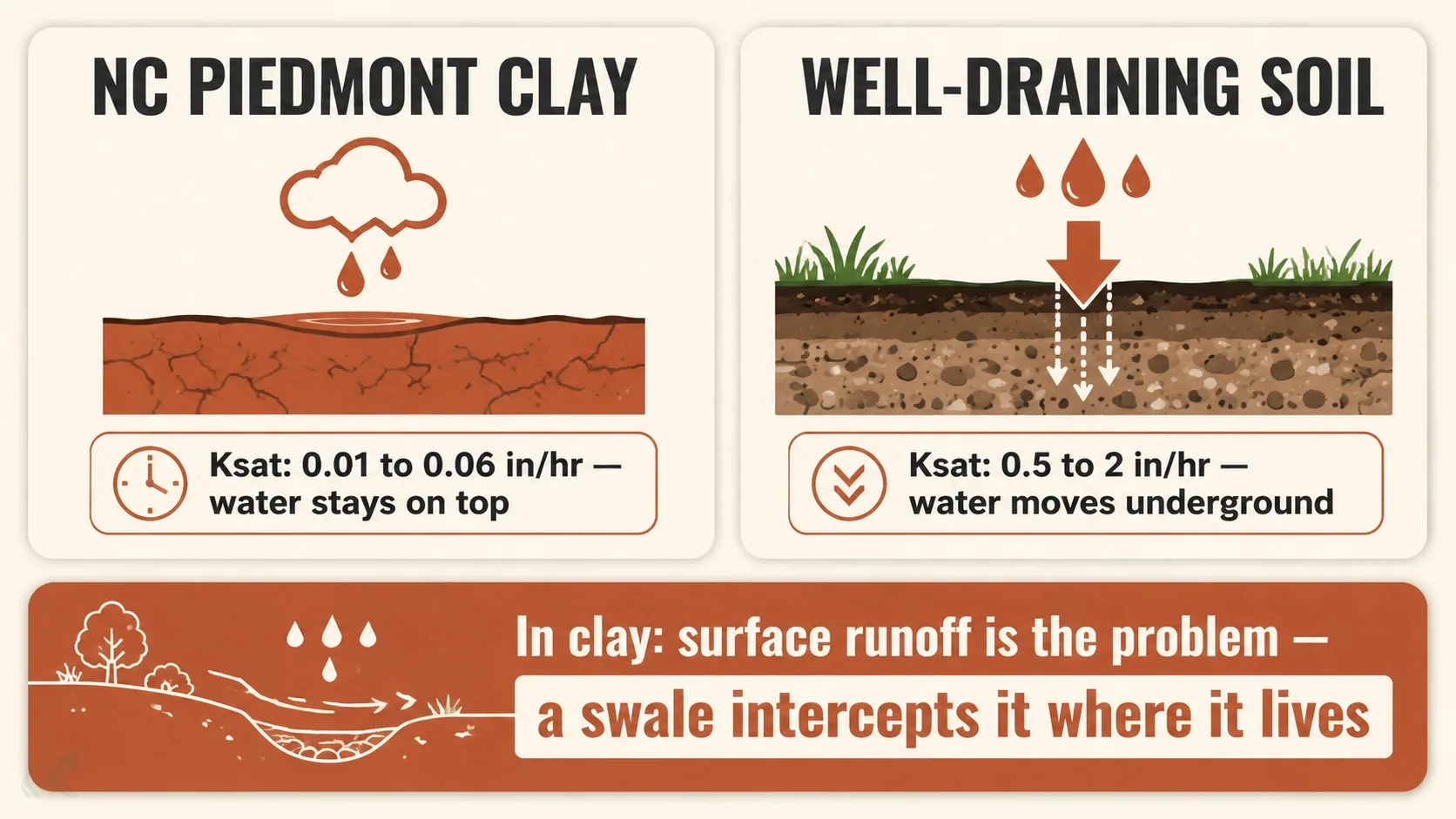
values for NC Piedmont red clay run very low — often 0.01 to 0.06 inches per hour. Water hits the clay surface and largely stays there because it can’t move downward fast enough. A French drain installed in that clay doesn’t intercept much because the water never traveled underground in the first place.
This is not a flaw in French drain design. It’s a mismatch between the tool and the water type.
A swale that intercepts surface runoff before it pools — or that channels the sheet flow off a slope — solves the problem where it actually exists. It works with the clay, not against it.
The exception: if the water table is high on your lot year-round, or if water is moving laterally through the soil from an uphill neighbor’s property, a French drain may be necessary even in clay. That lateral subsurface flow is real in some NC Piedmont lots, particularly those at the base of a slope with a perched water table.
NC Homeowner Takeaway: The French drain advice you’ve seen in YouTube videos and national home-improvement guides is not wrong — it’s just written for soils where subsurface drainage works. In North Carolina Piedmont clay, ask for the surface drainage analysis first. If your yard floods during storms (not between storms), you may have a surface water problem that a swale handles for less money. Hire a yard drainage contractor NC who diagnoses the water type before recommending a system.
When You Need Both
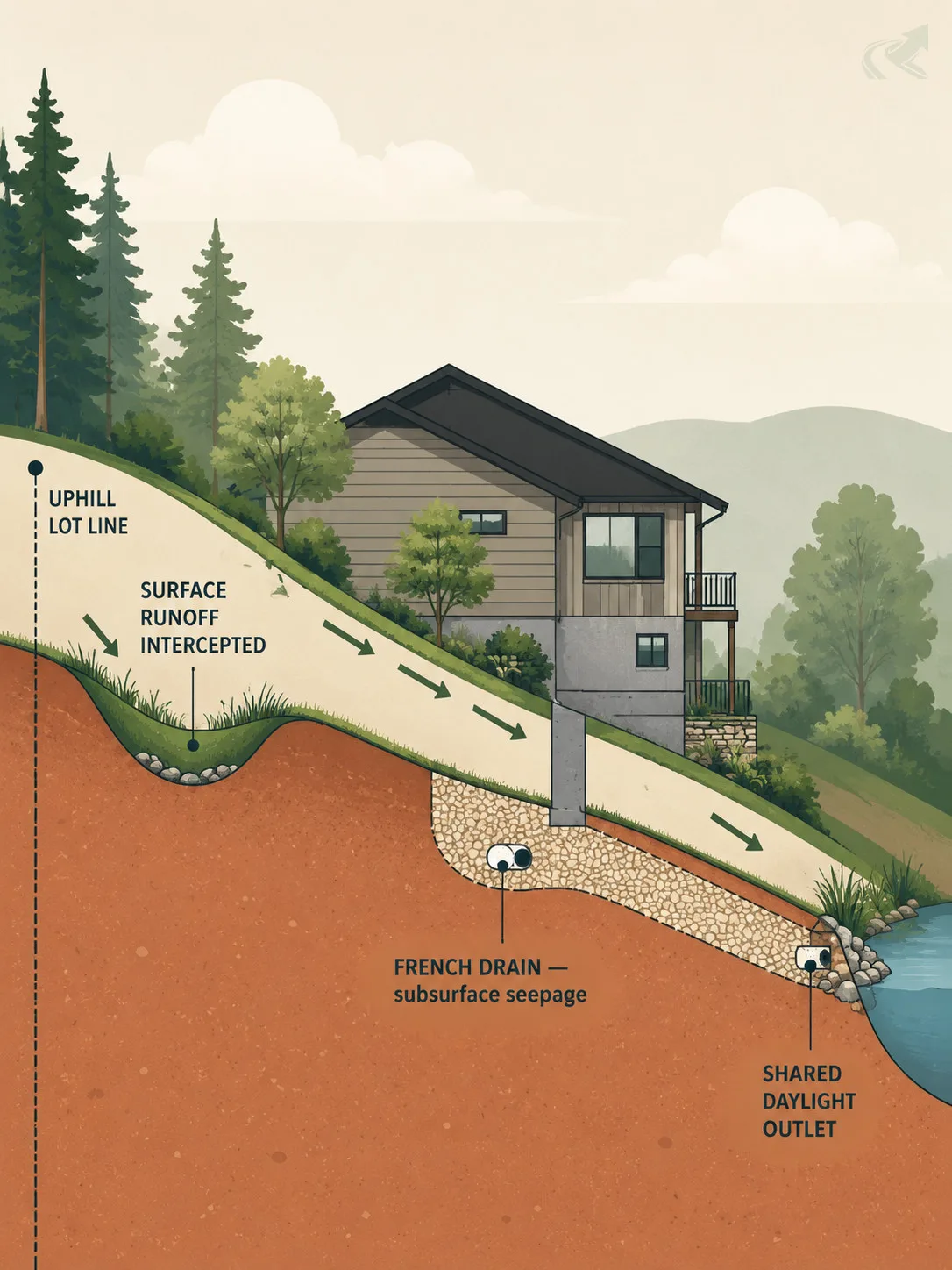
Larger lots or lots with both runoff from uphill and soil saturation near the foundation often need a hybrid system.
The hybrid setup is common on NC lots that slope toward the house. The swale goes at the uphill lot line and intercepts the surface runoff before it reaches the foundation — often as part of a broader NC yard regrading scope that reshapes the lot’s high and low points. The French drain goes near the foundation and handles any subsurface seepage that makes it through the clay.
Both systems share a single daylight outlet — the point where water exits the property into a storm drain, drainage easement, or vegetated area. Positive drainage to daylight is non-negotiable for either system.
Cost implication: hybrid systems cost more than either alone — sometimes significantly more. Get the scope itemized. If a contractor quotes one lump number for “drainage,” ask them to separate the swale cost from the French drain cost. You need to know whether you’re paying for subsurface drainage when surface drainage solves 80% of the problem.
Contractor Questions That Reveal the Diagnosis
Ask your contractor to name the water type before recommending a solution — a contractor who can’t answer this probably hasn’t looked carefully enough at your yard.
These three questions separate contractors who diagnosed the yard from contractors who brought a standard package to every call:
Question 1: “Is this a surface water problem, a subsurface saturation problem, or both?”
The answer should be specific. “You have runoff from the rear neighbor’s lot that’s sheeting across your yard during rain” is a diagnosis. “You need drainage” is not.
Question 2: “Can you show me where the outlet is for the swale or French drain?”
Positive drainage — the daylight point — is required for either system to function. If a contractor can’t point to the outlet on your lot, the design isn’t finished.
Question 3: “What happens to this system in a heavy NC spring rain?”
A well-designed system handles the design storm without backing up. The answer should include the channel width or pipe diameter sized for your drainage area — not just “it’ll handle it.”
Get an itemized quote that specifies the solution type, the water type it addresses, and the outlet location. That quote structure tells you the contractor understood the problem before pricing it.
Finding a Contractor Who Diagnoses First
North Carolina does not require a separate drainage contractor license — grading contractors handle swales and French drains as part of site grading work. What you’re screening for is diagnostic process, not a credential.
Use the questions above before accepting any quote. A contractor who leads with a solution before walking the yard in rain — or who can’t describe which water type they’re addressing — is a contractor who hasn’t diagnosed your yard.
Hire a grading operator in North Carolina who can walk you through the surface vs subsurface analysis before any quote is written.
Also see: drainage swales NC — design, cost and uses and NC French drain installation for red clay for the full detail on each system.
Related: surface vs subsurface drainage — which do you need for a deeper look at the water-type diagnostic, and standing water in yard NC solutions if you have an active pooling problem.